Hisense 55U7SE 2026
Specifications and features



Hisense 55U7SE 2026, the 55-inch MiniLED
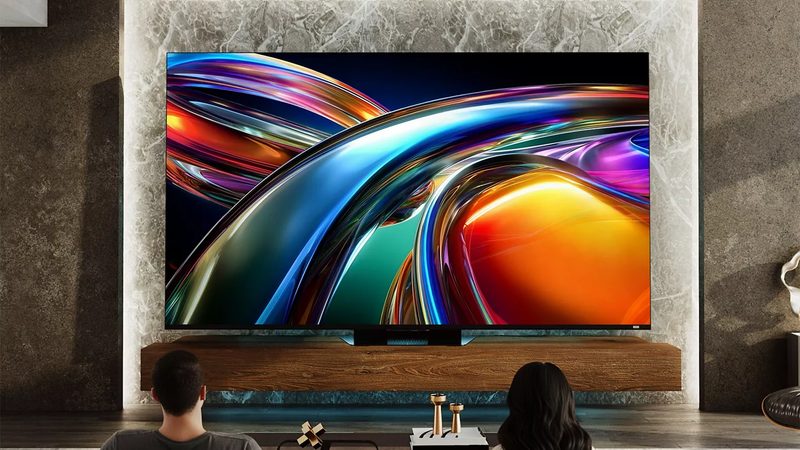
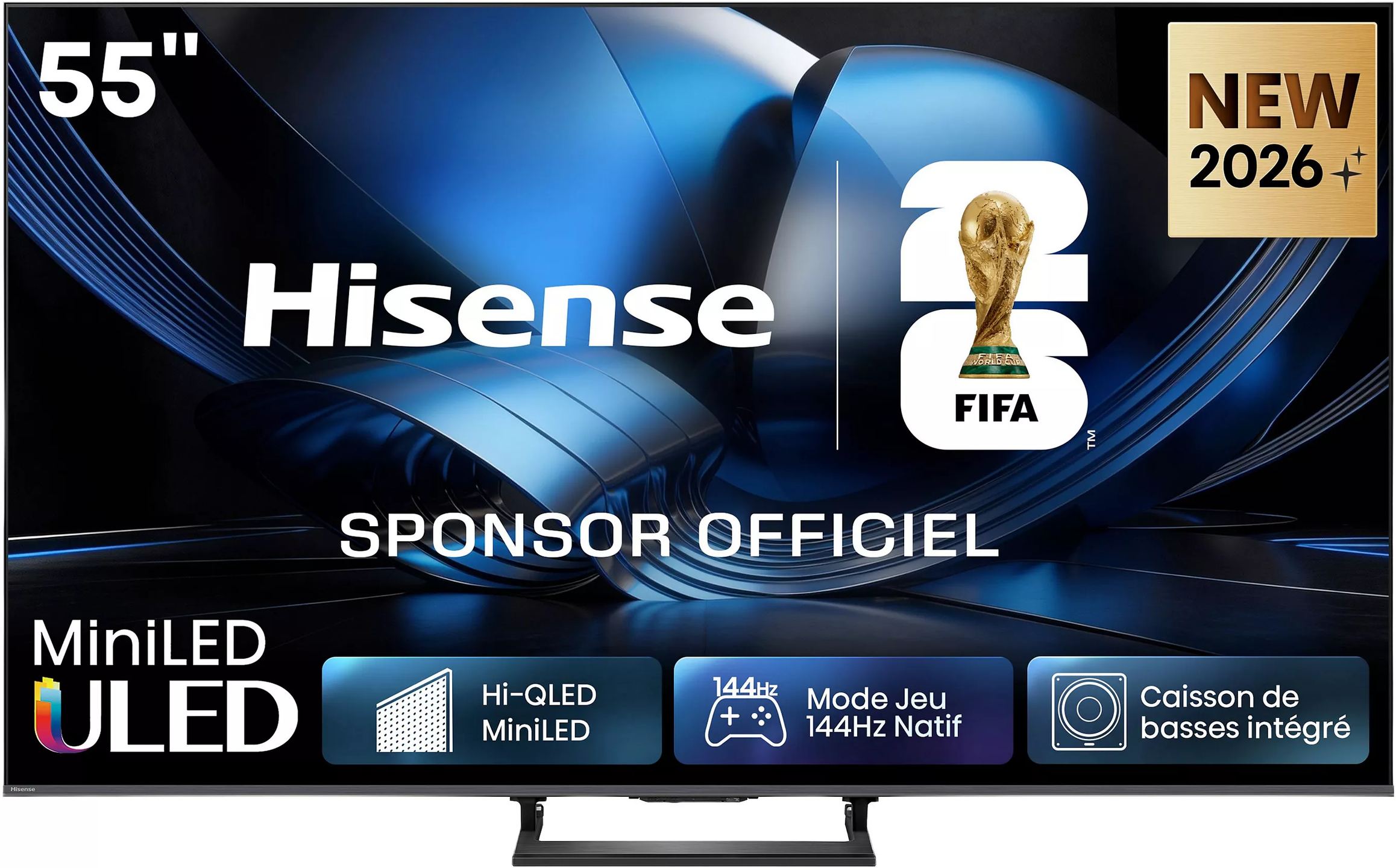
Boosting brightness without going through OLED: the U7 series has followed this path for several generations, and the 2026 model does not stray from it. On this 55-inch screen size, the MiniLED backlight works with a Quantum Dot layer to maintain contrast in a bright living room, while the fast panel and Devialet-tuned subwoofer broaden the playing field toward console gaming and sports.
A backlight split into 192 zones
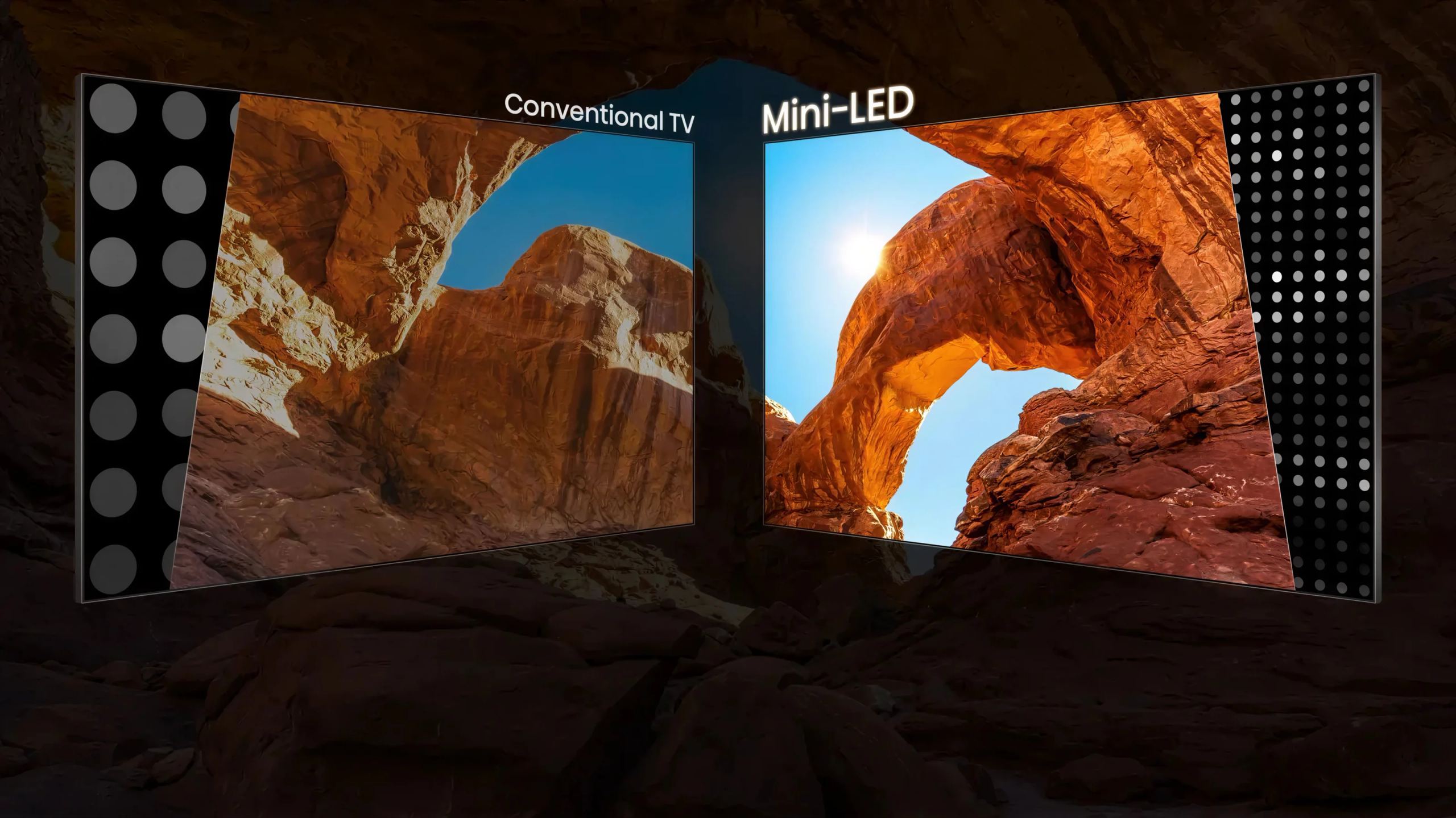
The MiniLED principle relies on the miniaturization of diodes: the more there are, the more finely the light can be controlled. On this model, they are grouped into 192 independent dimming zones. Compared with the panel’s 8.3 million pixels, each zone therefore controls around 43,000 pixels. The calculation clearly shows where the compromise lies: blacks go deep and highlights hit hard, but a very bright isolated object on a dark background, white credits, a streetlamp at night, is surrounded by a slight halo. This is the structural limit of all zone-dimming backlights, and it narrows as the number of zones increases.
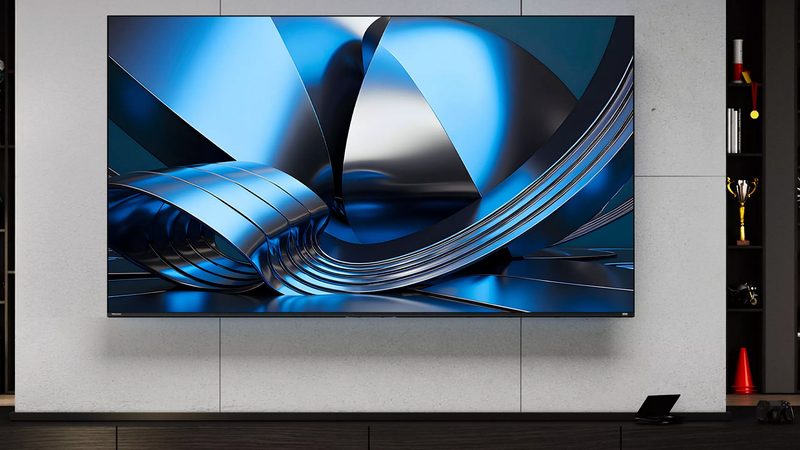
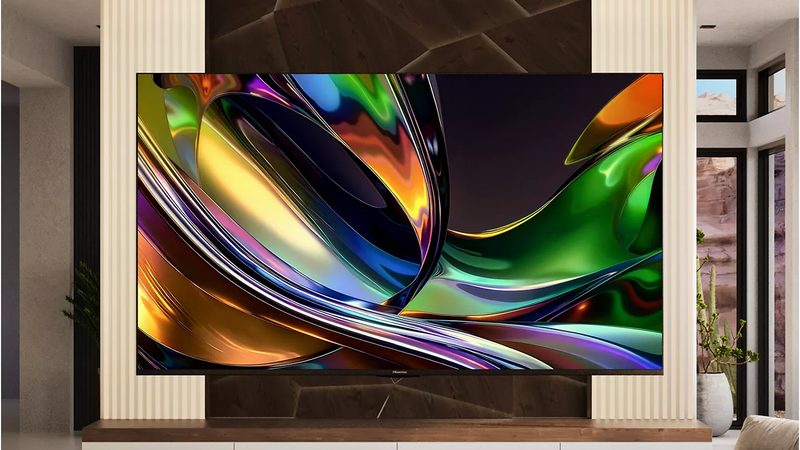
A claimed peak of 1,300 nits is measured on small highlights, not on a full-screen white image. This headroom is more than enough to make a metallic reflection or an explosion in HDR stand out, and above all to remain readable in front of a large window in broad daylight. The Quantum Dot layer expands the color spectrum to 90% of DCI-P3, the color space used for digital cinema. On saturated reds and deep greens, the difference from a conventional LED panel is immediately visible.
One point deserves attention: the panel is 8-bit supplemented by FRC, a temporal dithering process that rapidly alternates between two neighboring shades to simulate the 10 bits expected by HDR. The result holds up well on the vast majority of content. On a slow gradient, a twilight sky, smoke in a beam of light, the attentive eye may still notice slight banding.
HDR adjusts to the room’s lighting
The list of supported formats leaves nothing out: Dolby Vision and Dolby Vision IQ, HDR10, HDR10+ and HDR10+ Adaptive, HLG for broadcast television. The two adaptive variants use the built-in brightness sensor to recalculate the tone curve according to ambient lighting. A dark film watched in the late afternoon retains its shadow detail instead of sinking into a gray mush. Those who prefer to see the image as it was graded will turn off these automations and switch to Filmmaker mode, which also disables motion smoothing.
IMAX Enhanced certification governs compliance with format and colorimetry on labeled content. The list of supported audio codecs does not mention DTS: the audio side of the standard will therefore depend on the device connected via eARC. Calman Ready compatibility also opens the door to software calibration with a probe, reserved for installers and well-equipped enthusiasts.
The quad-core MT9618 processor handles upscaling of lower-resolution sources and MEMC motion compensation. The latter smooths panning shots but introduces that characteristic smoothing effect that some people hate in films. It can be disabled, and Filmmaker mode does this automatically.

144 Hz, but not on all four HDMI ports
The panel runs at 145 Hz natively, with an HSR mode advertised at 280 Hz. For gaming, the TV accepts 4K at 144 Hz with VRR, ALLM and AMD FreeSync Premium Pro, for an input lag measured at 7 ms. Current consoles top out at 120 Hz, but a PC will make full use of this headroom.
You still need to choose the right port. All four inputs carry the HDMI 2.1 label, without offering the same capabilities: HDMI 1 and 2 are limited to 4K 60 Hz with ALLM, while HDMI 3 and 4 go up to 4K 144 Hz with VRR. However, HDMI 3 is also the one that carries eARC, so it is the one where a soundbar or amplifier will be connected. A setup including an external audio system, a console and a gaming PC will occupy the only remaining 144 Hz port, HDMI 4. Something to plan for before routing the cables behind the cabinet.
The rest of the connectivity covers common uses: two USB ports including one 3.0, an optical S/PDIF output, a headphone jack, an Ethernet port and a Common Interface CI+ slot. No composite input or analog audio input, that chapter is closed.

A Devialet-tuned subwoofer
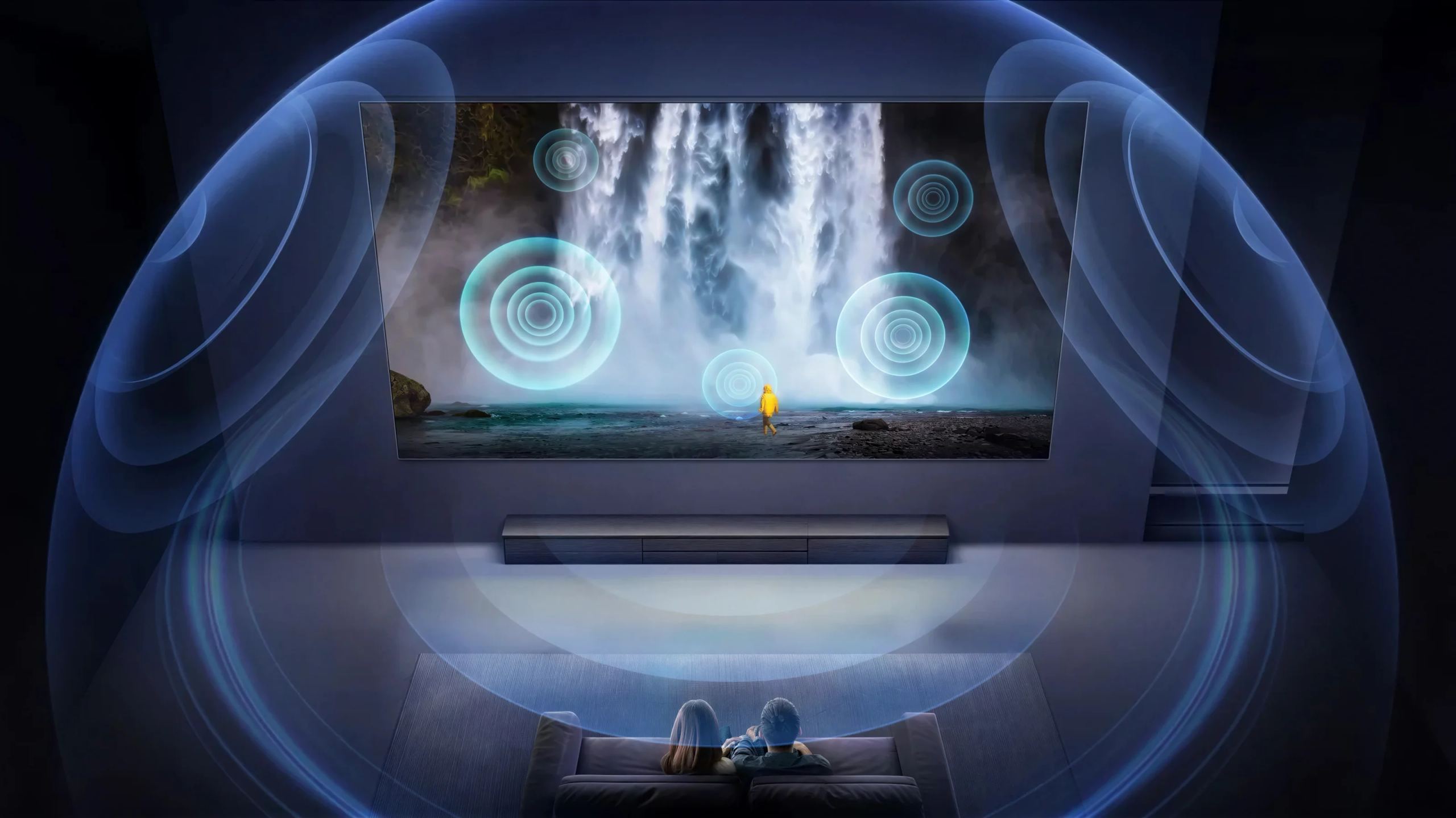
The audio system consists of two 10 W channels and an integrated 20 W subwoofer, a 2.1 configuration that is rare at this size, where the bass speaker is too often sacrificed. The tuning bears the mention Tuned by Devialet. The improvement is heard mainly in voice stability and low-end foundation, two chronic weaknesses of slim televisions.
Dolby Atmos is supported, without any upward-firing speaker in the technical description, and without any claim of virtual surround effect. Height comes from processing, with the result one can expect from a speaker array housed in a 59 mm chassis. The spatial rendering exists, but remains restrained. The Room Fitting Tuning function corrects equalization according to the room’s acoustics, and an advanced-parameter equalizer gives more curious users direct control.
Two extensions are worth knowing about. WiSA SoundSend compatibility makes it possible to connect certified wireless speakers, provided you have the corresponding transmitter. And the Hi-Concerto, TV Mode and EzPlay functions make the television work in concert with a compatible Hisense soundbar, with the screen’s speakers complementing the bar instead of falling silent.
VIDAA U9 and channel reception
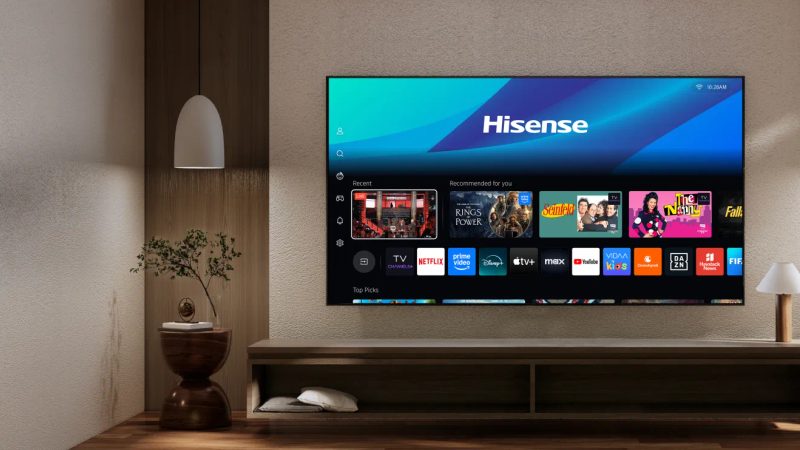
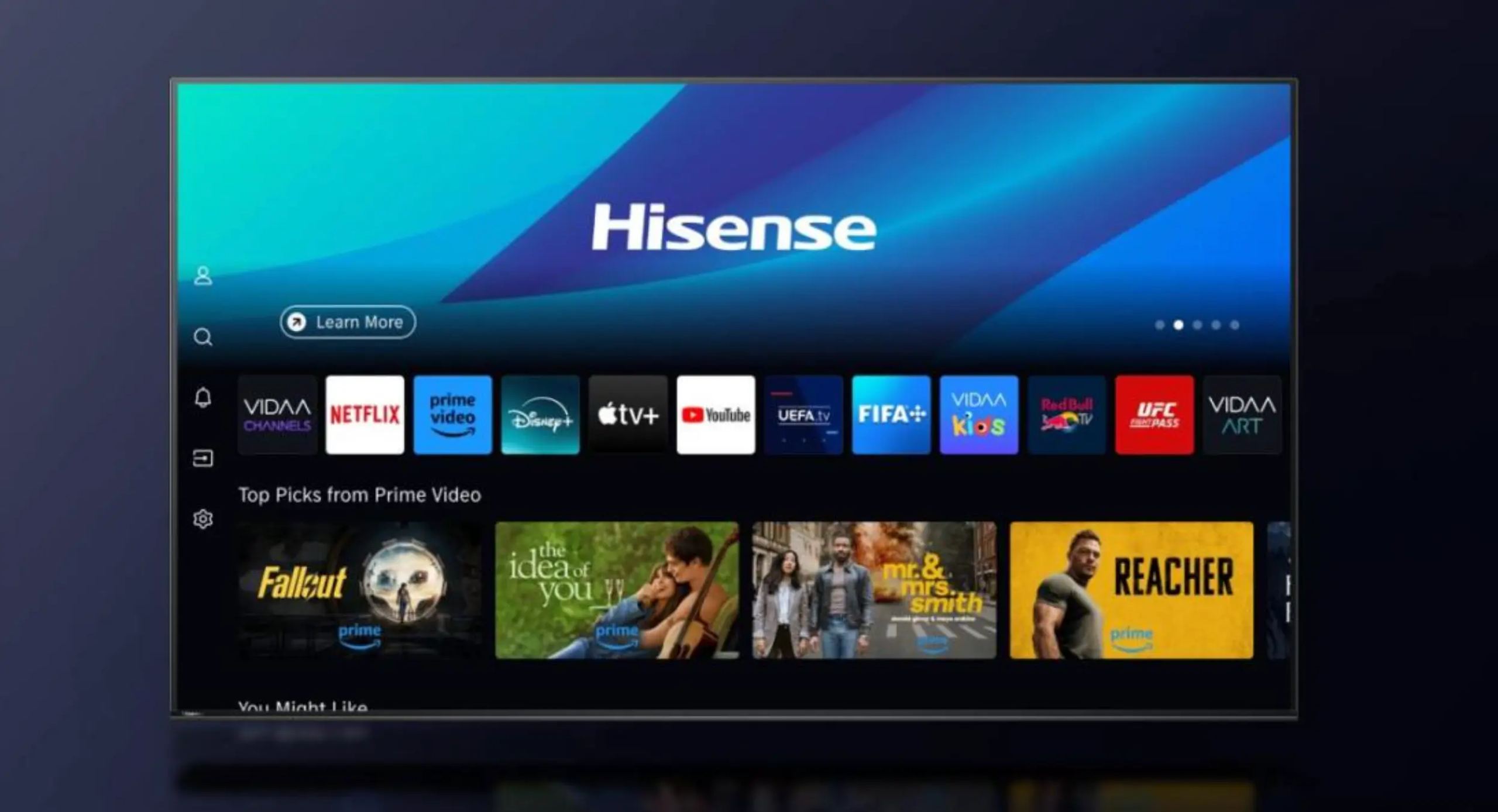
The in-house VIDAA U9 system controls everything. Its app store covers the major streaming platforms, accessible directly from the dedicated buttons on the ERF2W38H voice remote. Alexa and Vidaa Voice coexist for voice control, an internet browser and a media player complete the setup, and Vidaa ART mode turns the screen into a digital display when it is not showing anything.
Hardware decoding supports AV1 and VP9, the two codecs behind the latest streams from YouTube and streaming platforms, as well as HEVC and AVC for local files. Playback from a USB drive covers MKV, MP4 and TS containers, with FLAC and Opus on the audio side.
On the network side, Wi-Fi covers the 2.4 and 5 GHz bands under the 802.11ac standard, without moving to Wi-Fi 6. For a 4K stream the bandwidth is sufficient, but an Ethernet connection remains preferable in a home crowded with wireless signals. Bluetooth 5.4 handles headphones or a controller, AirPlay 2 accepts streaming from an iPhone or a Mac, and screen sharing works from a PC, tablet or mobile.
The reception side overlooks nothing: DVB-T2/T/C/S2/S tuner, Fransat certification for satellite, HbbTV 2.0.4 for enriched channel services, recording and Timeshift on USB storage, parental control. A hotel mode is also on the menu, intended for professional installations.
Fifty-nine millimeters and a VESA 200 x 300 mount
Without its feet, the chassis measures 59 mm thick and weighs 13.6 kg, which allows wall mounting without any special reinforcement on a sound partition. The VESA mount uses 200 x 300 mm spacing: something to check before buying a bracket, because the more common 200 x 200 square format will not fit without a suitable adapter plate. Set on its feet, the whole unit rises to 772 mm in height and requires 280 mm of cabinet depth.
Power consumption stands at 64 kWh per 1,000 hours in SDR, class E, and climbs to 130 kWh in HDR, class G. This gap reflects the energy cost of driving the backlight at a high level. Standby uses just 0.5 W, and a programmable power-off complements the automatic standby mode.
Documentation
FrenchEuropean product sheet
FrenchTechnical data sheet
FrenchUser manual
FrenchDurability index
French
Technical specifications
Display
- Diagonal: 55 inches (139 cm)
- Panel: MiniLED QLED
- Resolution: Ultra HD 3840 x 2160
- Native refresh rate: 145 Hz, 280 Hz in HSR
- Local Dimming: 192 zones
- Peak brightness: 1300 nits
- Wide color gamut: 90% DCI-P3
- Color depth: 8 bits + FRC
- Brightness sensor
HDR formats and image processing
- HDR formats: Dolby Vision, Dolby Vision IQ, HDR10, HDR10+, HDR10+ Adaptive, HLG, 4K HDR Immersive
- Certifications: IMAX Enhanced, Calman Ready
- Quad Core MT9618 processor
- 4K upscaling
- MEMC motion compensation
- Picture modes: Cinema, Filmmaker, Sport
Gaming
- 144 Hz Game Mode
- Input lag: 7 ms
- AMD FreeSync Premium Pro
- HDMI 2.1 with ALLM and VRR
Sound
- Power: 2 x 10 W + 20 W
- Built-in subwoofer
- Tuned by Devialet
- Dolby Atmos, Dolby Audio
- Equalizer with advanced settings
- Room Fitting Tuning
- WiSA SoundSend
- Audio modes: Hi-Concerto, TV Mode, EzPlay
Operating system and artificial intelligence
- VIDAA U9 system
- Built-in voice assistants: Alexa and Vidaa Voice
- Voice control via remote control
- Automatic AI picture mode
- Vidaa ART
- VIDAA App Store, apps with direct access on the remote control
- Web browser, media player
Wireless connectivity
- Wi-Fi IEEE 802.11 a / b / g / n / ac, 2.4 GHz and 5 GHz
- Bluetooth 5.4
- Content sharing and screen sharing from PC, tablet, and mobile
- AirPlay 2
Connections
- HDMI 1: HDMI 2.1, ALLM, 4K 60 Hz
- HDMI 2: HDMI 2.1, ALLM, 4K 60 Hz
- HDMI 3: HDMI 2.1, eARC, ALLM, VRR, 4K 144 Hz
- HDMI 4: HDMI 2.1, ALLM, VRR, 4K 144 Hz
- 1 USB 3.0 port
- 1 USB 2.0 port
- 1 S / PDIF audio output
- 1 headphone jack
- 2 antenna inputs
- Ethernet RJ45
- Common Interface CI+
TV reception
- DVB-T2 / T / C / S2 / S tuner
- Fransat certification
- HbbTV 2.0.4
- PVR and Timeshift
- Parental control
- Hotel mode
Supported formats and codecs
- Video formats: mp4, mov, mkv, ts, avi, wmv, webm
- Video codecs: MPEG1 / 2, MPEG4, AVC (H.264), HEVC (H.265), WMV3, VC1, VP8, VP9, AV1
- Audio formats: wav, mp3, wma, flac
- Audio codecs: LPCM, MPEG1 / 2 Layer1, MPEG1 / 2 Layer2, MPEG1 / 2 / 2.5 Layer3, WMA, AAC, MPEG-H, FLAC, Vorbis, Opus
- Photo formats: jpg, jpeg, png, bmp, gif, webp, tiff
Energy and power consumption
- Power supply: AC 100-240 V, 50 / 60 Hz
- SDR energy class: E
- HDR energy class: G
- SDR consumption: 64 kWh / 1000 h
- HDR consumption: 130 kWh / 1000 h
- Standby power consumption: 0.5 W
- Programmable shutdown and automatic standby
Dimensions and weight
- TV without stand: 1226 x 715 x 59 mm
- TV with stand: 1226 x 772 x 280 mm
- Box: 1360 x 142 x 846 mm
- Weight without stand: 13.6 kg
- Weight with stand: 14.2 kg
- Weight with box: 18.2 kg
- VESA compatibility: 200 x 300 mm
Included accessories
- ERF2W38H voice remote control
- Power cable
Frequently Asked Questions
What viewing distance should you choose for a 55-inch 4K screen?
Between approximately 1.5 and 2.3 meters. Ultra HD allows for a shorter viewing distance than Full HD without the pixel structure becoming visible. Below 1.5 meters, the eye has to scan the image to take it in, which becomes tiring during a long film. Beyond 2.5 meters, some of the benefit of 4K is lost and a larger diagonal would be more appropriate.
Do you need a specific HDMI cable to achieve 4K at 144 Hz?
Yes. A certified Ultra High Speed cable is necessary to sustain this refresh rate without chroma compression. High Speed cables from previous generations will still display an image, but the source will then reduce the refresh rate or the color subsampling, without necessarily indicating this on screen.
What do you need to record a program?
A USB storage device, not included. The PVR and Timeshift functions write the tuner stream to this device, which will be prepared by the television. Content from streaming applications is not affected by these functions.
What does Fransat certification mean on this model?
It guarantees that the integrated DVB-S2 satellite tuner can receive the Fransat package, which broadcasts DTT channels by satellite for households poorly covered by the terrestrial transmitter. A Fransat access card is still required and must be inserted into the TV’s Common Interface CI+ module. A satellite dish pointed toward the 5 degrees West position completes the installation.
What is the Calman Ready label for?
It indicates that the television supports calibration controlled by Calman software, which writes the corrections to the screen’s internal conversion tables rather than to an external box. The procedure requires a colorimetric probe and a test pattern generator. Without this equipment, the function has no effect, and Filmmaker and Cinema modes then provide the best starting point.
Can wireless speakers be connected to this television?
WiSA SoundSend compatibility makes this possible, provided you add the SoundSend transmitter, sold separately, and WiSA-certified speakers. The protocol transmits multiple uncompressed channels with low latency, which Bluetooth cannot do. The TV’s Bluetooth 5.4 remains reserved for headphones or a backup stereo speaker.
- Eco-contribution of €12.65 included in the sale price.
- Spare parts available for 7 years
- Manufacturer reference: 20018749
- GTIN / EAN: 6942351433677