

Turntable Center Spindles
A turntable adapter fits 45 rpm records onto the standard 7.2 mm spindle designed for 33 rpm LPs. This circular plastic or aluminum part, 38 mm in diameter, sits on the platter’s drive spindle to ensure optimal centering of singles. Without an adapter, the large center hole of 45s prevents them from being played on a standard turntable. Learn more
Why 45s require an adapter
Turntables have a standard central spindle 7.2 mm in diameter, sized for 33 rpm records whose center hole matches this exact diameter. This spindle precisely positions the record on the platter and holds it in place throughout playback. Without this support, the force exerted by the stylus tracing the groove would gradually shift the vinyl, causing the cartridge to derail and making playback impossible.
45 rpm records have a much wider center hole, 38 mm in diameter. This difference goes back to 1949, when RCA Records established this standard with the commercial launch of the 45 rpm format. The goal was to revive and grow the jukebox market. The small center hole on LPs did not allow automated mechanical handling of records without the risk of warping or damage. The large center hole of 45s made automatic loading in jukeboxes easier and ensured optimal centering regardless of the record’s initial position.
Although jukeboxes disappeared with the arrival of the CD, the 38 mm hole has remained the standard for 45 rpm pressings, notably singles and 12-inch 45s used by DJs. Using an adapter is therefore essential to correctly position a 45 rpm record on a home turntable.
How adapters work and their types
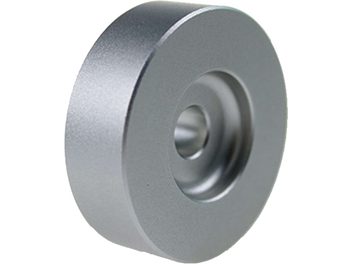
The adapter is a flat circular piece with an outer diameter of 38 mm, exactly matching the size of a 45 rpm record’s center hole. A central opening of about 8 mm runs through the adapter, allowing it to slide onto the spindle of any turntable. Once placed on the spindle, it effectively increases the usable diameter, turning the 7.2 mm spindle into a 38 mm centering surface perfectly suited to singles.
Two materials dominate the adapter market. Plastic models (polymer, polyamide) offer an economical, lightweight solution. Their main advantages are affordability and the lack of risk of damaging the record or the turntable if dropped. Simple and effective, they’re perfectly suitable for occasional home use. Some snap directly into the 45’s center hole to make handling easier.
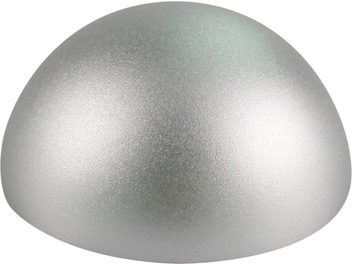
Aluminum adapters are the premium option. Heavier and more precisely machined, they provide increased stability and better weight distribution. Some models have a hemispherical shape which, beyond aesthetics, improves weight distribution and can help slightly limit vibrations or record warping. Their refined finish (brushed, anodized, metallic gray aluminum) blends seamlessly into a hi-fi turntable setup. Weight generally ranges between 30 and 50 grams for aluminum models.
Use and compatibility
Using an adapter is extremely simple. First place the adapter on the turntable’s central spindle. It slides down until it rests flat on the platter (or on the platter mat if the turntable has one). Then position the 45 rpm record by inserting the adapter into its large center hole. The record will sit stable and perfectly centered, ready for playback.
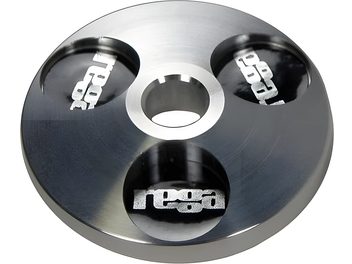
All universal adapters work with any standard turntable, whether belt-drive or direct-drive. Only the spindle height may vary slightly depending on the model, but this does not affect the adapter’s use. Some turntable manufacturers (Pro-Ject, Clearaudio, Rega, Thorens) offer their own adapters specifically designed to aesthetically match their decks, but universal models are perfectly suitable.
Note that not all manufacturers systematically include an adapter with their turntables. Buying a separate 45 rpm adapter is therefore necessary to play your singles. The adapter is not always included even with mid-range or high-end turntables, as manufacturers consider this accessory optional depending on the intended use.