

Turntable Tonearm Counterweights
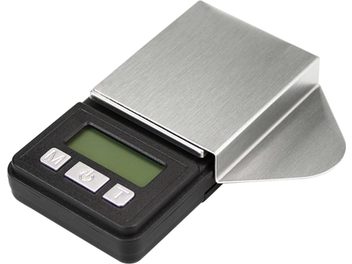
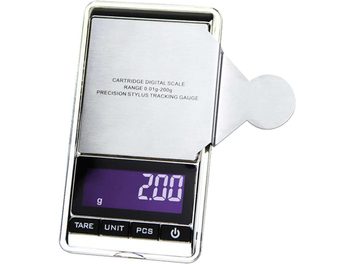
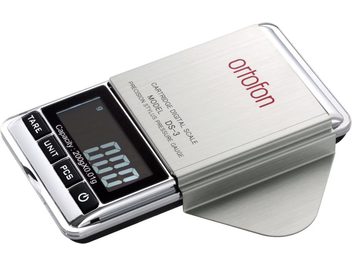
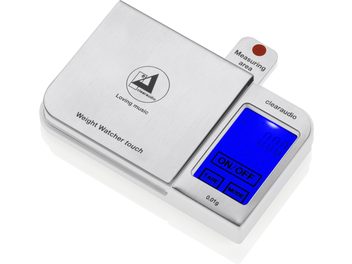
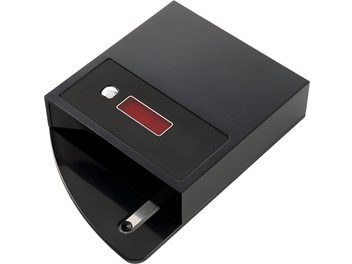
A scale for a turntable precisely measures the tracking force exerted by the cartridge on the record. Also called a stylus force gauge, it displays the weight in grams (typically from 0.01 to 5 g) to adjust the tonearm counterweight according to the manufacturer’s recommendations. Available in mechanical or electronic versions, it prevents premature wear of the stylus tip and record grooves. Learn more

The importance of setting tracking force
Tracking force corresponds to the vertical pressure the stylus tip exerts on the sides of the record groove. This parameter determines playback quality and equipment longevity. Each cartridge manufacturer specifies an optimal tracking force, generally between 1.8 and 2.5 grams for hi-fi listening, with a tolerance of only a few tenths of a gram. Insufficient force causes skipping and the stylus to mistrack, while excessive force digs into the microgrooves and accelerates wear on both the vinyl and the stylus tip.
Adjusting via the tonearm counterweight’s graduated markings remains approximate. These graduations provide guidance but do not guarantee the precision needed to meet the manufacturer’s specifications. Many users observe significant discrepancies between the value indicated on the counterweight and the actual force applied. This is where a turntable scale comes in—the only tool that objectively verifies the pressure applied to the record.
Mechanical versus electronic scales
Mechanical scales operate without batteries or electronics. Made of two plastic pieces forming a lever system, they measure tracking force by moving a slider along a graduated scale. Compact, lightweight, and virtually indestructible, these scales never break down and maintain their calibration over time. Their accuracy, typically 0.1 to 0.2 grams, is sufficient for most setups. The mechanical Ortofon model is the benchmark in this category, appreciated for its reliability and accessible price.
Electronic scales use a load cell and display the measurement on an LCD, often backlit. Their accuracy reaches 0.01 gram, enabling extremely fine adjustment for demanding audiophiles or sensitive high-fidelity cartridges. These models generally offer a tare function, auto power-off after 30 to 60 seconds of inactivity, and run on button cells (LR43) or AAA batteries. The measuring range spans 0.1 to 5 grams for standard models, up to 100 or 200 grams for certain professional references.
Usage and precautions
Using a stylus force gauge requires a few precautions. The scale must be placed on the turntable platter at the same height as a record in the playing position to obtain an accurate reading. The measurement point is usually at the center of a flat or slightly recessed surface. Before each measurement, ensure the display reads exactly 0.00 grams, and perform a tare if necessary.
Some scales feature a central recess that may cause issues with cartridges that have low clearance. The cartridge body may touch the measuring surface at the same time as the stylus tip, skewing the reading. This drawback particularly affects high-end hi-fi cartridges with short cantilevers. Check compatibility or opt for a model with a perfectly flat measuring surface.
Electronic scales require regular calibration to maintain accuracy. A 5-gram or 1-gram calibration weight is usually supplied for this operation. Some users recommend periodically checking the scale’s accuracy with a coin of known weight (a 1-cent euro coin weighs 2.30 grams).
Adjustment process using a scale
Adjusting tracking force involves several steps. Start by finding the tonearm’s balance point by adjusting the counterweight until the arm floats horizontally without touching the arm rest. Then set the counterweight’s graduated ring to zero without moving the counterweight itself. Next, screw the entire counterweight assembly to reach the value recommended by the cartridge manufacturer.
Once this setting is done using the graduations, verify the actual force with the scale. Gently place the tonearm on the measuring surface and read the displayed value. If there is a discrepancy between the target value and the measurement, adjust the counterweight in small increments until you obtain the exact weight. Several successive measurements help confirm the stability of the setting.
The scale is also useful after any turntable move, cartridge change, or simply for periodic checks. The counterweight can loosen slightly due to vibrations, hence the benefit of regularly checking tracking force to preserve your records and stylus. For DJ turntables, tracking forces can reach 3 to 6 grams depending on the intended use, which requires a scale suited to this extended measuring range.