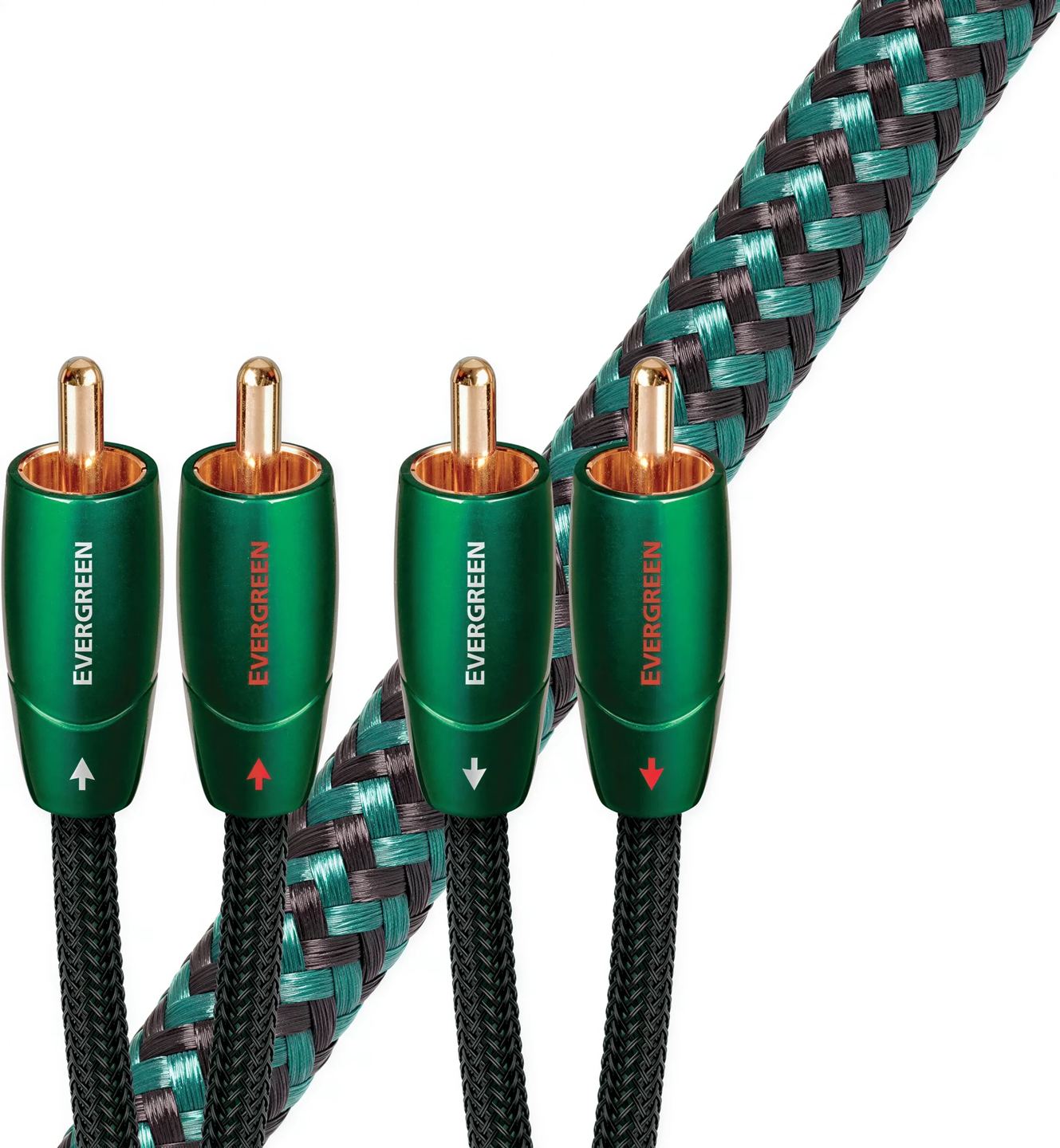
AudioQuest’s Evergreen RCA cable uses an asymmetrical double-balanced geometry and Long-Grain Copper (LGC) solid conductors. It is part of the Bridges & Falls series, named after the Evergreen Point Bridge linking Seattle to Bellevue. The cable features cold-welded connectors and a metal-layer Noise-Dissipation System. Its outer jacket is a black-and-green braid for quick visual identification.
Technical architecture and materials: where physics meets acoustics
The Evergreen cable uses Long-Grain Copper (LGC) solid conductors. Unlike multi-strand conductors, where each strand can generate electrical interactions, a solid conductor avoids this phenomenon. LGC copper has an elongated crystalline structure that reduces the number of grain boundaries—areas where conduction can be locally disrupted. By comparison, standard OFHC (Oxygen-Free High-Conductivity) copper has shorter grains, multiplying these interfaces.
The insulation is made of foamed polyethylene, a material containing a significant proportion of air microbubbles distributed throughout the polymer mass. Since air has a low dielectric constant, this structure limits losses and energy storage compared with solid polyethylene. It helps reduce phase shift effects introduced by absorption and delayed release of electromagnetic energy within the dielectric.
The cable adopts an asymmetrical double-balanced geometry. Unlike conventional unbalanced cables where ground and shield share the same conductor, the Evergreen separates the return conductor from the shield. This separation reduces the influence of the shielding on the signal path and helps limit the pickup of electromagnetic interference.
Cold-welding: an age-old technique in the service of high fidelity
Unlike traditional soldering, which uses heat and a tin-lead or silver-based alloy as filler, AudioQuest’s “cold-weld” method relies on the application of high electrical and mechanical pressure. This process creates a direct bond between the copper conductor and the gold-plated RCA plug, with no intervening solder alloy.
With conventional soldering, the joint brings two different metals into contact, introducing a transition zone with electrical properties different from those of copper. Cold-welding, on the other hand, relies on plastic deformation of the metal that promotes a continuous metallurgical contact between the conductor and the plug. The RCA connectors’ ground shells are produced by stamping, allowing the use of metals chosen for their electrical or mechanical characteristics rather than their machinability.
Noise dissipation: a shield against modern electromagnetic pollution
The Evergreen cable incorporates a metal-layer Noise-Dissipation System designed to reduce the influence of radio-frequency (RF) interference. With the growing presence of wireless devices, switching power supplies, and variable-speed drives, signal conductors can be exposed to a dense household electromagnetic spectrum. The metal layer acts by absorbing and reflecting interference before it reaches the conductors.
The shielding is designed asymmetrically and connected to ground only on the source side. This configuration creates a one-way drain path for interference, limiting ground loops between components. The cables are marked with an arrow indicating the recommended signal direction, corresponding to this shield orientation.
Practical applications and positioning in a hi-fi chain
The Evergreen cable is designed for systems where signal fidelity is paramount. It is often used to connect turntables to a phono preamplifier, where lowering the noise floor can be particularly helpful for low-level signals. It can also be used between a DAC and an amplifier, helping to preserve detail and precision in spatial layering.
The Evergreen’s RCA plugs are grouped within a single jacket, with a maximum spacing of about 7.6 cm. This configuration may require adjustment on some equipment with more widely spaced inputs. It results from bundling the two channels in a single jacket, a compromise aimed at optimizing electrical performance while keeping manufacturing costs in check.
The cable is available in several standard lengths, from 0.6 m to 20 m. Shorter lengths have lower total capacitance and series resistance. Lengths up to 3 m preserve performance suitable for most home systems. Beyond 5 m, the cable’s characteristic impedance becomes a factor to consider, especially with sources that have a high output impedance.