United States
EN
Contact
Account
Quote
Basket

Atoll Electronique DAC300 black

$2,984 €2,600
Available on order
Notify me when it's back in stock

Specifications and features

DSDUSB

Overview

The DAC300 from Atoll Electronique is the brand’s flagship model. It uses a SABRE ES9038PRO conversion chip and offers nine digital inputs to connect network players, CD transports, computers, or game consoles. The output stage is based on discrete components biased in Class A, and the unit features three independent transformers as well as twelve voltage regulators to produce an analog signal that faithfully follows the digital stream.

The heart of the device: conversion chip and signal processing

The DAC300 is built around the SABRE ES9038PRO chip from ESS Technology. This 32-bit reference processes PCM signals up to 768 kHz and offers a dynamic range of 137 dB along with a total harmonic distortion (THD+N) of -122 dB. The signal-to-noise ratio reaches 132 dB. These values demonstrate the chip’s ability to maintain an exceptionally low level of residual noise.

Atoll has equipped the DAC300 with an ultra high-precision, low-jitter clock. This clock stabilizes the digital stream before conversion, reducing timing variations that can affect signal fidelity. Digital signal processing prior to conversion is given particular attention, as is every element of the chain: from incoming stream to analog output.

The converter’s power supply is based on a SABRE ES9311EQ chip whose residual noise remains below 1 μV RMS. This dedicated supply preserves signal purity right at the conversion stage. In addition, three very low-noise linear transformers ensure the main power supply: two reserved for the analog audio stages and one for the digital circuits. This separation limits interference between the digital and analog sections. Total filtering capacity reaches 20,030 μF.

Twelve independent voltage regulators distribute current to the different sections of the circuit. Each area receives its own stabilized voltage, which reduces parasitic interactions. The coupling capacitors use metallized polypropylene (MKP) technology from the ESA series by CLARITY CAP, a manufacturer well known for audio-grade components. High-frequency capacitors employ silvered mica technology.

Discrete-component output stages

The output stages of the DAC300 stand out through their discrete-component design. Unlike integrated operational amplifiers, this approach enables finer control over circuit behavior. Atoll opted for carefully selected and matched transistors, biased in Class A. In this operating mode, the transistors remain conductive at all times, eliminating the crossover distortion found in other configurations.

The absence of global feedback is a deliberate technical choice. While feedback can reduce certain measurable distortions, it can also introduce undesirable transient effects. By removing this loop, Atoll’s engineers aim for more linear and transparent behavior when faced with rapid variations in the musical signal.

Analog outputs are available as unbalanced stereo RCA and balanced stereo XLR. Balanced outputs deliver a differential signal in which each channel uses two conductors carrying signals of opposite polarity. This configuration improves rejection of electromagnetic interference, which is particularly useful for long cable runs. The balanced power supply of the output audio stages supports this design philosophy: each channel has its own positive and negative regulation, ensuring maximum isolation between left and right channels.

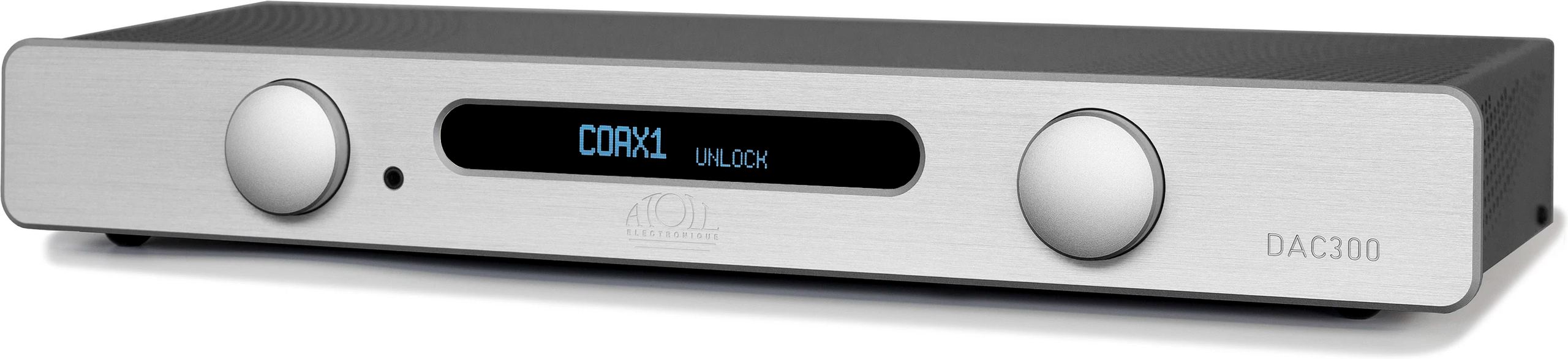
A 3.5 mm jack headphone output completes the front panel. The maximum output level reaches 2.25 V RMS on both the RCA and XLR outputs.

Connectivity: nine inputs for all sources

The rear panel of the DAC300 gathers extensive connectivity. There are three RCA coaxial inputs, three Toslink optical inputs, one AES/EBU input on XLR, one type-B USB input, and a Bluetooth receiver. This variety of inputs makes it possible to connect multiple digital sources simultaneously without having to swap cables.

The S/PDIF inputs (coaxial and optical) accept PCM streams up to 24-bit/192 kHz. The asynchronous USB-B input handles PCM up to 32-bit/768 kHz as well as DSD64, DSD128, DSD256, and DSD512 formats. Windows users must install a dedicated driver, downloadable from the Atoll website. Mac and Linux computers recognize the DAC300 natively.

The asynchronous USB input operates on the principle that the converter imposes its own clock on the source, rather than following the computer’s clock. This mode reduces the jitter inherent in USB streams and improves the timing stability of the signal. To take full advantage of this input, it is recommended to use playback software compatible with the ASIO protocol under Windows (such as Foobar2000) or Audirvana under macOS.

Bluetooth expands listening possibilities by allowing connection of smartphones and tablets, although the quality cannot compete with high-resolution wired inputs.

Two digital outputs, one coaxial and one optical, allow you to daisy-chain the DAC300 with other devices or send the signal to a recording system.

Integrated volume control

The DAC300 features onboard volume control by the converter, which can be disabled via the BY-PASS option. In active mode, volume is adjusted digitally upstream of the analog conversion, allowing a direct connection to a power amplifier without going through a preamplifier. This configuration simplifies the audio chain and reduces the number of links in the signal path.

In BY-PASS mode, the DAC300 delivers its maximum output level. The user then returns to a conventional setup with volume control managed by a downstream preamplifier.

Differences compared with the DAC200 Signature

Atoll also offers the DAC200 Signature, equipped with the SABRE ES9028 chip (the next model down from the ES9038PRO). Connectivity remains identical: nine digital inputs and both unbalanced and balanced outputs. The two converters share the same ability to process PCM streams up to 768 kHz.

The DAC300 stands out through its ES9038PRO chip with higher measured performance, as well as more advanced implementation of the power supply and output stages. User feedback reports a stronger sense of presence, along with greater finesse and detail in the sound. The bass section has been given particular attention, with a balance between warmth and precision. The DAC300 naturally pairs with the IN300 EVO and IN400 EVO integrated amplifiers, while the DAC200 Signature is a natural partner for the IN200 Signature.

Use and integration into an audio system

The DAC300 can be easily integrated into various setups. It can receive the signal from a dedicated CD transport such as Atoll’s DR200 EVO, from a network player such as the ST200 or ST300 Signature, from a computer via USB, or from any other digital source (TV, game console, Blu-ray player). The versatility of the inputs allows multiple devices to be connected simultaneously.

On the output side, balanced XLR connections are particularly suitable for linking to preamps or power amplifiers equipped with this type of input. Unbalanced RCA outputs are intended for more conventional devices. In a setup where the integrated amplifier does not have XLR inputs, the RCA outputs provide the connection.

The volume control function opens the possibility of using the DAC300 as a digital preamp. This option appeals to those wishing to reduce the number of components and favor the most direct signal path possible between the digital source and the power amplifier.

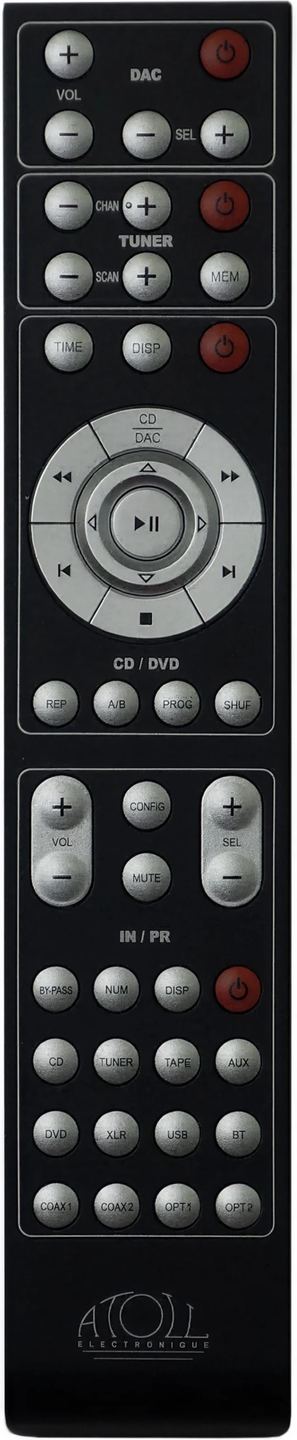
Atoll’s universal remote control makes it easy to control not only the DAC300 remotely, but also other components from the brand in the system. Input selection, volume adjustment, and converter filter choice can all be carried out from the sofa.

Sound signature of the DAC300

Atoll has designed the DAC300 to deliver a musical presentation focused on density, harmonic richness, and dynamics rather than clinical analysis. The stated goal is to shape the sound with a certain substance, detailed reproduction without harshness, fluidity in transitions, and the ability to maintain engagement at all listening levels.

The soundstage is intended to be stable and open, with precise localization of instruments. Instrumental and vocal textures benefit from a grain and smoothness that avoid the dryness sometimes attributed to certain delta-sigma converters. Instruments retain their individuality, clearly outlined in the sound field, while listening remains comfortable even during extended sessions.

This sound orientation is the result of the technical choices made: Class A output stages without feedback, MKP coupling capacitors, carefully designed power supply, and strict separation of digital and analog supplies. These elements converge toward a coherent result where measurements and listening impressions are brought into balance.

Documentation

User manual
French

Technical Specifications

Audio

  • SABRE ES9038PRO Converter (32-bit / 768 kHz)
    • Dynamic range: 137 dB
    • THD+N: -122 dB
  • Ultra-high precision low-jitter clock
  • Balanced voltage outputs
  • SABRE ES9311EQ ultra-low noise power supply (< 1 µV RMS)
  • Symmetrical power supply for audio output stages
  • 12 independent voltage regulators
  • Discrete component output stages
    • No feedback
    • Class A biased
  • Metallized polypropylene (MKP) coupling capacitors
  • Silver mica high-frequency capacitors

Interface

  • Universal remote control included
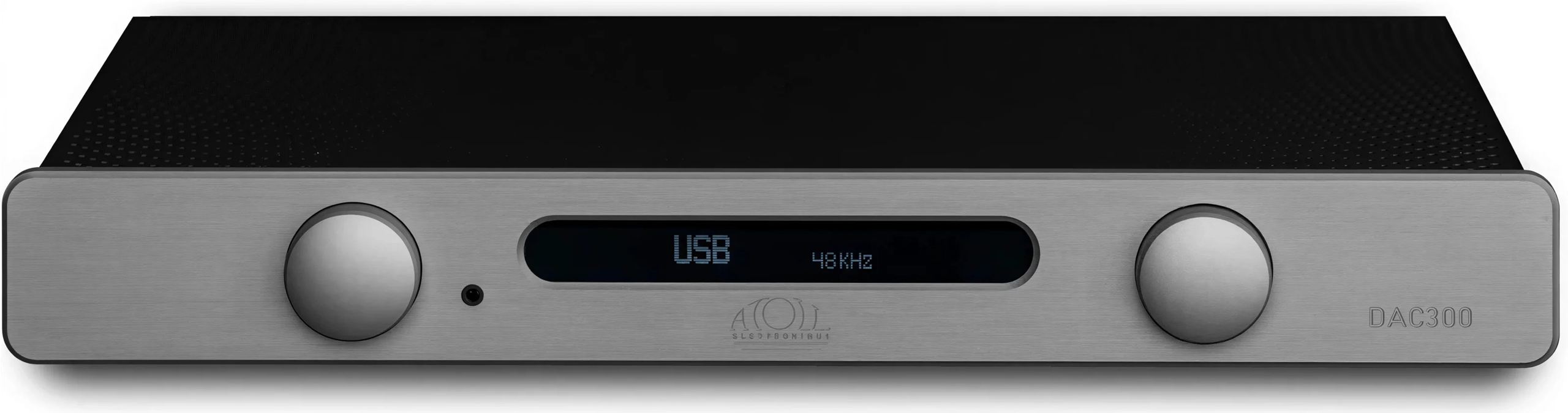
  • Low-power organic light-emitting diode (OLED) display

Connectivity

Digital Inputs

  • 3 coaxial
  • 3 optical
  • Bluetooth
  • AES/EBU
  • USB type B (USB-B)

Digital Outputs

  • 1 coaxial
  • 1 optical

Analog Outputs

  • 1 unbalanced stereo RCA
  • 1 balanced stereo XLR
  • 1 3.5 mm headphone output

Physical Characteristics

  • Dimensions (W × H × D): 440 × 280 × 60 mm
  • Weight: 4 kg

Frequently Asked Questions

What is the main difference between the S/PDIF and USB inputs on the DAC300?

The S/PDIF inputs (coaxial and optical) accept PCM streams up to 24-bit/192 kHz. The asynchronous USB-B input supports PCM up to 32-bit/768 kHz as well as DSD formats up to DSD512. USB therefore offers broader compatibility with high-resolution files and allows you to fully exploit the capabilities of the ES9038PRO chip.

Is it necessary to install a driver to use the DAC300 with a computer?

Under Windows, installing a specific driver is required; it can be downloaded from the Atoll Electronique website. macOS and Linux systems recognize the DAC300 without any additional driver. Using playback software compatible with ASIO (Foobar2000 under Windows) or Audirvana (under macOS) optimizes the use of the USB input.

Can the DAC300 be used directly with a power amplifier?

Yes. The DAC300 includes a switchable digital volume control. In active mode, volume is adjusted via the front-panel encoder or the remote control, making it possible to connect directly to a power amplifier. In BY-PASS mode, the converter delivers its maximum output level and requires a downstream preamplifier.

What is the difference between the DAC300’s RCA and XLR outputs?

The XLR outputs deliver a balanced signal in which each channel uses two conductors of opposite polarity, which improves rejection of electromagnetic interference. The RCA outputs provide a conventional unbalanced signal. The maximum output level is identical for both connection types (2.25 V RMS). The choice depends on the downstream equipment and the length of the cable runs.

Is the DAC300’s Bluetooth function suitable for critical listening?

The DAC300’s Bluetooth receiver makes it easy to play music occasionally from a smartphone or tablet. However, the compression inherent to this wireless protocol limits quality compared to wired inputs. For critical listening that fully exploits the converter’s capabilities, it is recommended to use the S/PDIF or USB inputs with high-resolution sources.

What filters are available on the DAC300 and how are they selected?

The DAC300 offers several reconstruction filters accessible via the front encoder dedicated to volume and filter management, or via the remote control. These filters modify the converter’s response in the time and frequency domains. The user can thus fine-tune the sound according to personal preference and the type of music being played. The user manual details the characteristics of each filter.

User reviews

Arnold

remarkable tonal balance, unbeatable value for money

Comment from February 19, 2026 — Experience from May 25, 2024

Automatically translated — Show original (French)
equilibre tonal remarquable ,rapport qualite:prix imbattable
Laurent

Excellent DAC combining fine details and a vast soundstage including depth, respecting timbres in a very pleasant analog rendering for listening to Hi-Res audio without compromise. You can feel the concert stage where each performer is in their place. Needs a few dozen hours of listening to reveal itself.

Comment from February 05, 2024 — Experience from January 25, 2024

Automatically translated — Show original (French)
Excellent Dac combinant de fins détails et une vaste scène sonore y compris en profondeur, respect des timbres dans un rendu analogique très agréable pour écouter du HiRes sans compromis. On ressent la scène du concert où chaque interprète est à sa place. À besoin de quelques dizaines d'heures d'écoute pour se révéler.

Carim

Here is my review after several months of use:
On the positive side, the sound experience. Soundstage, dynamics, definition, bass control, sonic texture - it's all improved. This is in comparison to a Naim Uniti Nova and a Bluesound Node X. I absolutely do not regret my purchase!
On the negative side, the device emits nasty crackles when powering on or off. Another issue is a background hum in the speakers when combined with my tube amp. This does not occur with the Naim Uniti Nova used as an amp. Finally, although not very serious, the cold start is a bit long and it takes a good 20 minutes of use before hearing the true potential of this DAC (as indicated in the manual).
Last point, the device is equipped with different phase settings but without any information. This makes choosing the setup quite difficult, but it's a marginal adjustment.
In the end, a very high-end device reserved for purists who don't care about frills.

Comment from January 08, 2024 — Experience from September 30, 2023

Automatically translated — Show original (French)
Voici mon avis après plusieurs mois d'utilisation :
Côté positif, l'expérience sonore. Scène, dynamique, définition, maîtrise des basses, texture sonore, tout y est en mieux. Ceci en comparaison d'un Naim Uniti Nova et d'un Bluesound Node X. Je ne regrette absolument pas mon achat !
Côté négatif, l'appareil émet de vilains craquements en sortie ou en mise en veille. Autre nuisance, un bourdonnement de fond dans les enceintes en combinaison de mon ampli à lampe. Ceci ne se produit pas avec le Naim Uniti Nova utilisé comme ampli. Enfin, même si ce n'est pas très grave, le démarrage à froid est un peu long et il faut 20 bonnes minutes d'utilisation avant d'entendre le vrai potentiel de ce DAC (comme indiqué dans la notice).
Dernier point, l'appareil est équipé de différents réglages de phase mais sans aucune information. Ce qui rend le choix du setup assez difficile, mais c'est un réglage marginal.
Au final, un appareil très haut de gamme réservé aux puristes qui n'ont que faire des fioritures.
  • Eco-contribution of €0.90 included in the sale price.
  • GTIN / EAN: 4260099316789
HomeCineSolutions
Loading