
Bruno
Does the job, it's a great replacement for the original cable.
Comment from December 27, 2021 — Experience from December 16, 2021
Automatically translated — Show original (French)
Fait le job, il remplace avantageusement le câble d’origine.
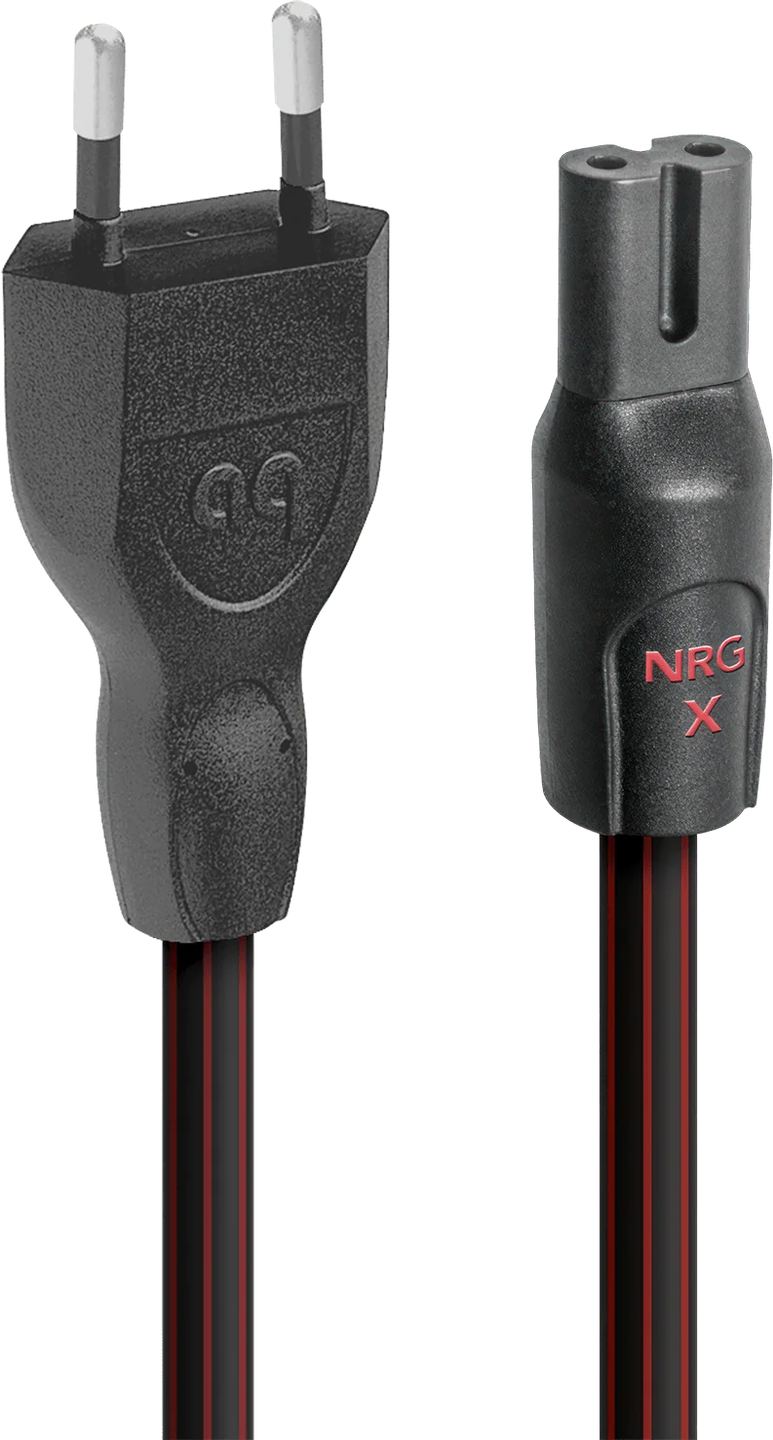
The power cable AudioQuest NRG-X2 C7 uses semi-solid concentric technology and directional long-grain copper conductors. Designed to optimize power quality, this cable aims to reduce interference and improve signal stability in an audio system. It is positioned as an entry-level option within the AudioQuest range.
The NRG-X2 stands out first and foremost for its particularly meticulous physical construction. Its ultra-slim, non-polarized 2-pole C7 connector fits perfectly with modern equipment where space is at a premium. This slim connector does not compromise on robustness: AudioQuest has designed this cable for intensive daily use, with materials capable of handling 2.5 amps at 120 VAC.
The internal architecture reveals all of AudioQuest’s expertise in signal transmission. The conductors use a semi-solid concentric topology where only 7 copper strands form a single uniform layer around a central strand. This configuration is a dramatic improvement over the previous generation, which had 37 strands spread over three layers. Fewer strands mean fewer parasitic interactions between them, resulting in a purer transmission of electrical current.
Long-grain copper (LGC) is at the heart of this technology. Unlike standard OFHC copper, which has about 1,500 grains per 30 centimeters, AudioQuest’s LGC has only 300. Since each grain boundary is a potential source of distortion, this drastic reduction results in more linear conductivity and less alteration of the electrical signal.
AudioQuest has developed a multidimensional approach to combat electromagnetic interference. The noise dissipation technology is based on several complementary principles that work together.
The controlled directionality of the conductors is the most counterintuitive innovation. Every drawn metal conductor has an asymmetrical grain structure that creates variable impedance depending on the direction of current flow. AudioQuest systematically tests each batch of conductors through comparative listening to determine the optimal orientation. Arrows on the connectors indicate the correct installation direction—a detail that may seem esoteric but makes all the difference in listening.
This directional approach channels radio frequency noise to ground rather than allowing it to contaminate the audio signal. The result? Quieter backgrounds, a better-defined soundstage, and preserved dynamics. Parasitic noise that masked micro-details disappears, revealing nuances previously imperceptible in your favorite recordings.
The NRG-X2’s C7 connector naturally makes it suitable for the compact devices in your system. Digital-to-analog converters (DACs), which are particularly sensitive to power quality, greatly benefit from the noise reduction provided by this cable. Powered desktop speakers enjoy a cleaner background, allowing for extended listening without auditory fatigue.
Network players and audio streamers are an ideal application. These devices, essentially computers dedicated to music, generate high-frequency interference that the NRG-X2 efficiently dissipates. Sonos speaker owners will especially appreciate the ultra-slim C7 connector, which fits discreetly into tight spaces.
Even gaming consoles benefit from this improvement. Gamers report smoother menu navigation and reduced operating temperatures. While the impact on gaming performance is anecdotal, the improvement in game audio quality is real, with more precise spatialization of sound effects.
Within the AudioQuest range, the NRG-X2 occupies a strategic entry-level position. Compared to the NRG-Z2, a higher-end model equipped with Perfect-Surface Copper (PSC+) conductors and ZERO-Tech technology, the X2 forgoes some refinements but retains the essentials: semi-solid concentric topology and controlled directionality.
The Z2 offers zero characteristic impedance for even faster transients, as well as silver-plated drain conductors for optimal RF noise evacuation. These improvements result in an even wider soundstage and better-controlled bass. However, for many systems, the NRG-X2 already delivers 80% of the benefits at a fraction of the price.
Compared to the Y2 model, which adds grounding via a third prong, the X2 remains relevant for all two-pole devices. This simplicity also allows for greater flexibility and avoids ground loop issues in certain setups.
Yes, listening tests conducted by AudioQuest consistently demonstrate an audible difference. The correct orientation, indicated by the arrows on the connectors, optimizes RF noise dissipation. Installing the cable the wrong way won’t damage it, but you’ll miss out on some of its acoustic benefits.
Any equipment using a C7 (figure-8) power connector can benefit from the NRG-X2. This includes many DACs, portable CD players, recent gaming consoles, powered speakers, Sonos equipment, Apple TV, and some televisions. Just make sure your device uses this type of two-prong connector.
No, these two approaches are complementary. The NRG-X2 improves current transmission and dissipates RF noise, while a conditioner addresses upstream issues. Used together, they offer a particularly effective synergy for cleaning your system’s power supply.
Cables supplied with devices generally use low-quality multi-strand conductors, with no attention paid to geometry or directionality. The NRG-X2 offers optimized construction that drastically reduces parasitic interactions between strands and the buildup of electromagnetic noise.
Absolutely. Although the specifications mention 120V/60Hz, the NRG-X2 is designed to work perfectly on European grids. AudioQuest also offers versions with Schuko connectors for direct compatibility with European outlets.
Bruno
Does the job, it's a great replacement for the original cable.
Comment from December 27, 2021 — Experience from December 16, 2021
