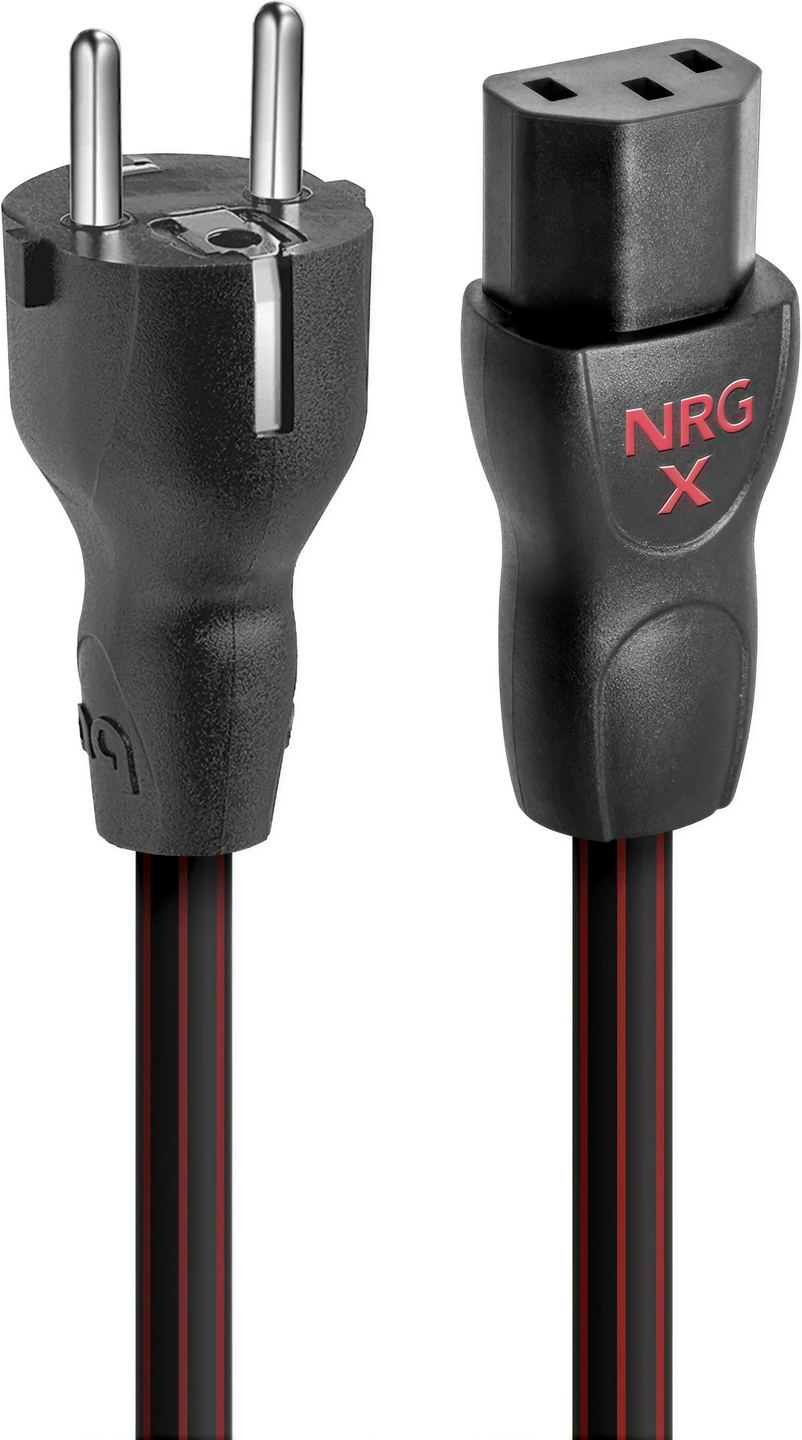
The AudioQuest NRG-X3 C13 power cable is designed with an optimized conductor architecture to preserve the integrity of the electrical signal. This model draws on over forty years of cable design experience to improve the transmission of mains power to audio-video equipment.
Semi-Solid Concentric Construction to Minimize Parasitic Interactions
The NRG-X3’s architecture is based on a semi-solid concentric conductor topology, marking a departure from conventional multi-strand cables. Instead of the previous generation’s 37 strands arranged in three layers, AudioQuest has chosen just seven larger-gauge strands, laid out in a single uniform layer around a central conductor. This seemingly simple configuration conceals remarkable sophistication: the strands are tightly compacted and maintain a fixed position along the entire length of the cable.
This structural rigidity eliminates a pernicious phenomenon found in traditional cables: dynamic strand interaction. In a classic multi-strand cable, every relative movement of the conductors generates electromagnetic micro-distortions that accumulate and gradually degrade the signal. The NRG-X3’s semi-solid structure suppresses this source of distortion by locking the internal geometry in place, thus ensuring a more faithful transmission of alternating current.
The 16 AWG gauge (3 x 15 AWG for the three conductors) offers a carefully calculated balance between current capacity and flexibility. This cross-section comfortably supports 15 amps at 120V AC, more than covering the needs of modern audio-video components while remaining more flexible than generic, thicker-gauge power cables.
Long-Grain Copper: Metallurgy in Service of Electrical Purity
At the heart of the NRG-X3, Long-Grain Copper (LGC) is much more than just a material choice. This copper undergoes a specific manufacturing process that significantly lengthens the metal’s crystalline structure. The boundaries between crystalline grains are zones of electrical turbulence where electron flow experiences microscopic disruptions. By drastically reducing the number of these interfaces, LGC minimizes this insidious form of distortion.
The difference with standard OFHC (Oxygen-Free High-Conductivity) copper is not just a matter of purity. While OFHC specification focuses solely on electrical conductivity, AudioQuest’s LGC also addresses signal distortion. Fewer oxides, fewer impurities, but above all, fewer structural discontinuities: every aspect helps preserve the integrity of the electrical waveform.
Directional Control: Managing the Inherent Asymmetry of Drawn Metal
A counterintuitive yet fundamental aspect of the NRG-X3 lies in its directional control of the conductors. All drawn metal exhibits an asymmetric grain structure, creating a natural directionality in the propagation of interference. AudioQuest leverages this characteristic by systematically orienting the conductors so that induced radio-frequency noise is drained in a direction where it will cause the least harm to the system.
This directionality is not theoretical: each batch of conductors is tested by ear to determine the optimal orientation. Clearly visible arrows on the connectors indicate the correct direction for connection, ensuring that RF noise drainage is consistent throughout the audio system. This meticulous attention to detail illustrates AudioQuest’s empirical approach, where theory is always validated by practical testing.
Cold-Welded Connections: Preserving Molecular Integrity
The NRG-X3’s terminations use Cold-Weld technology, a connection method that avoids the inherent problems of traditional hot soldering. Instead of melting metals to create a bond, the Cold-Weld system uses extreme pressure combined with a copper- or silver-impregnated conductive paste. This approach preserves the crystalline structure of the conductor right up to the contact point, eliminating metallurgical transition zones that can introduce parasitic resistance and nonlinear diode effects.
The female C13 connector and the three-prong male power plug both benefit from this technology, creating electrically transparent junctions that maintain the consistency of the conductive path from end to end.
Helical Geometry to Optimize Electrical Properties
The helical arrangement of the conductors in the NRG-X3 is not an aesthetic choice but a deliberate technical decision. This circular spiral geometry directly influences the cable’s fundamental electrical characteristics, notably its capacitance and inductance. Unlike parallel or multiple twisted-pair configurations, the helical arrangement delivers significantly greater dynamic contrast and clarity.
This improvement is due to the reduction of parasitic capacitive coupling between conductors and a more even distribution of the magnetic field around the cable. The result is better separation of fast transients and enhanced preservation of the electrical signal’s dynamics.