Amedee
Very good equipment thank you
Comment from June 18, 2026 — Experience from June 07, 2026
Automatically translated — Show original (French)
Très bon matériel merci
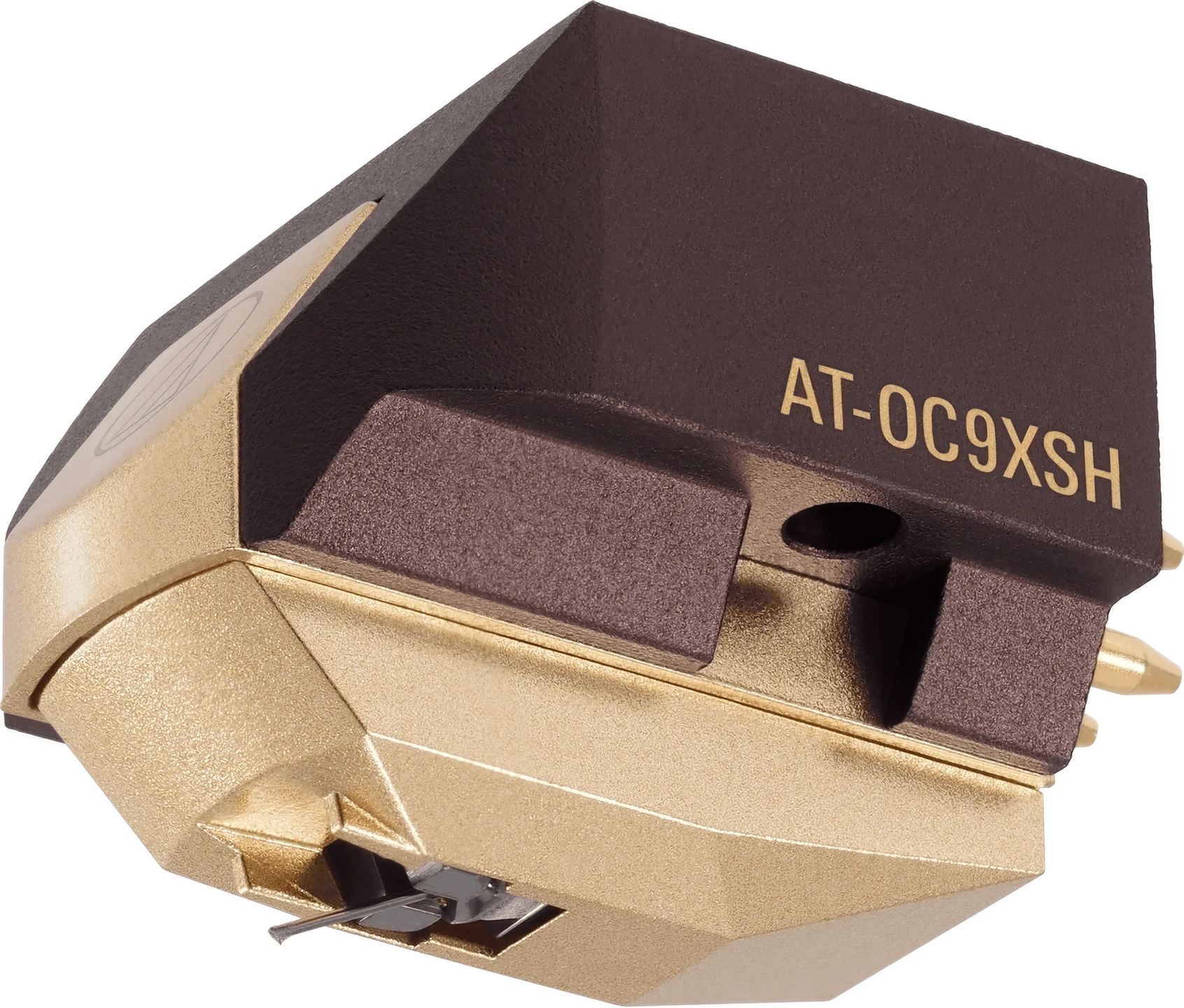
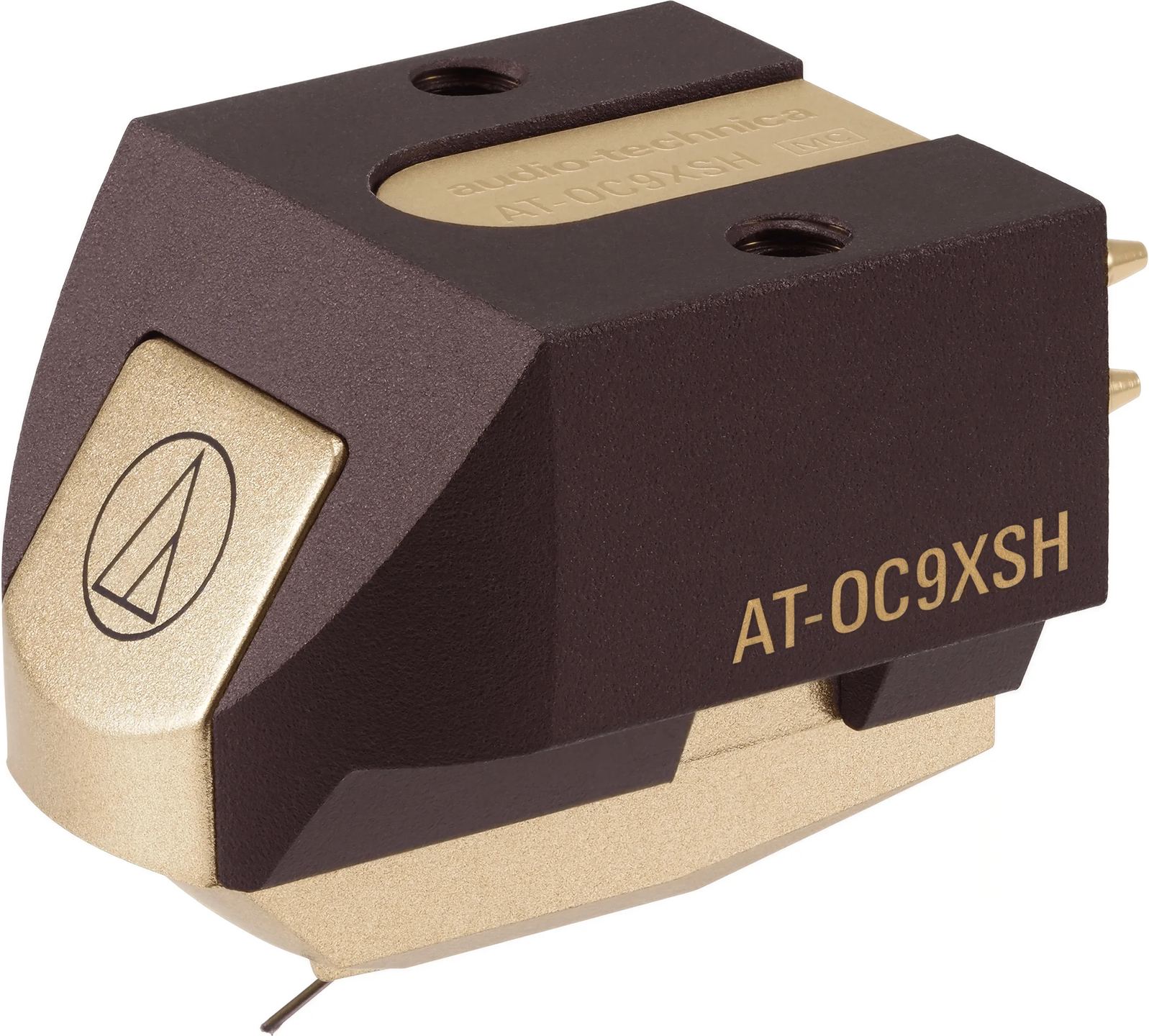
Thirty-seven years after the introduction of the first OC9, Audio-Technica continues a lineage that has shaped the expectations of analog playback enthusiasts. The OC9X series, the fourth evolution of this family, comes in five models with distinct characteristics. The AT-OC9XSH occupies the second-to-last position in the range and combines a Shibata stylus with a boron cantilever, a pairing that blends reading accuracy with fast transient response.
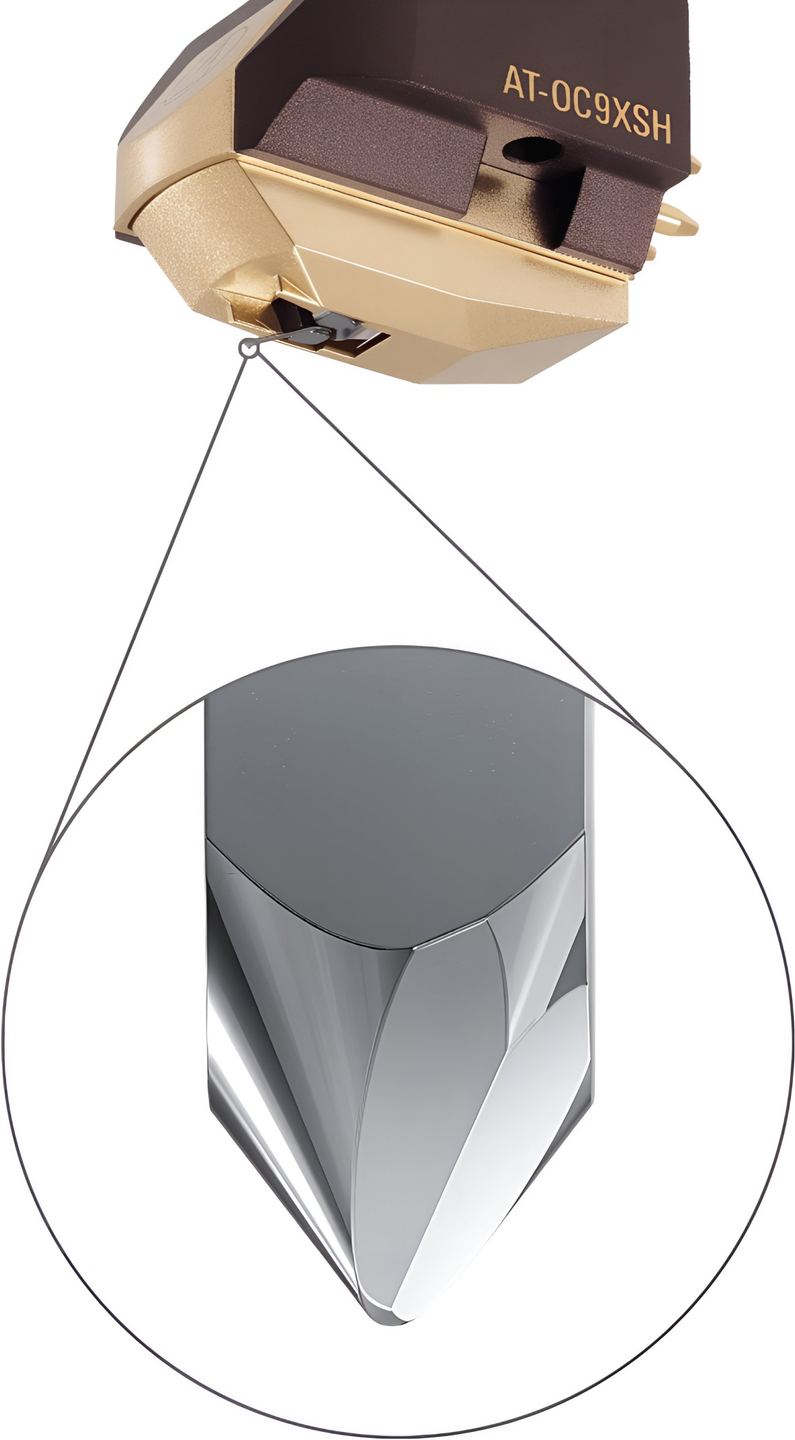
The Shibata stylus takes its name from engineer Norio Shibata, who developed it at JVC in the early 1970s to meet the demands of the CD-4 quadraphonic format. This system encoded the information of four channels at frequencies reaching 45 kHz, well beyond the capabilities of the conical or elliptical styli of the time. The Shibata profile, with its 2.7 × 0.26 μm dimensions, hugs the groove walls with an extended line contact in depth but narrow in the direction of travel. This geometry makes it possible to reproduce high frequencies while spreading the pressure over a larger surface than a standard elliptical stylus.
On the AT-OC9XSH, the stylus is nude-mounted on a boron cantilever with a diameter of 0.28 mm. Boron offers a particularly favorable stiffness-to-mass ratio: it transmits the vibrations captured by the diamond with minimal deformation and parasitic damping. This cantilever-stylus combination gives the cartridge a specified frequency response up to 47 kHz and channel separation of 27 dB at 1 kHz.
The three top models in the OC9X series, XML, XSH and XSL, share a magnetic circuit enhanced with a permendur yoke. This iron-cobalt alloy, developed in 1929, offers the highest magnetic saturation among commercially available metals (around 2.4 teslas). Its higher permeability compared with iron allows a more intense magnetic field to be concentrated in the gap where the coils move. Combined with a neodymium magnet, this circuit generates a dense magnetic flux that improves the mechano-electrical conversion of the signal.
The coils, arranged in an inverted V according to an architecture introduced with the first OC9 in 1987, are wound with PCOCC copper (Pure Copper by Ohno Continuous Casting). This continuous casting process, developed in Japan by Professor Ohno of the Chiba Institute of Technology, produces a copper wire whose crystalline structure forms an almost continuous chain over several hundred meters. The absence of grain boundaries reduces imperfections that could degrade signal transmission. The output voltage reaches 0.4 mV, a value slightly higher than that of models equipped with a standard iron yoke (0.32–0.35 mV).
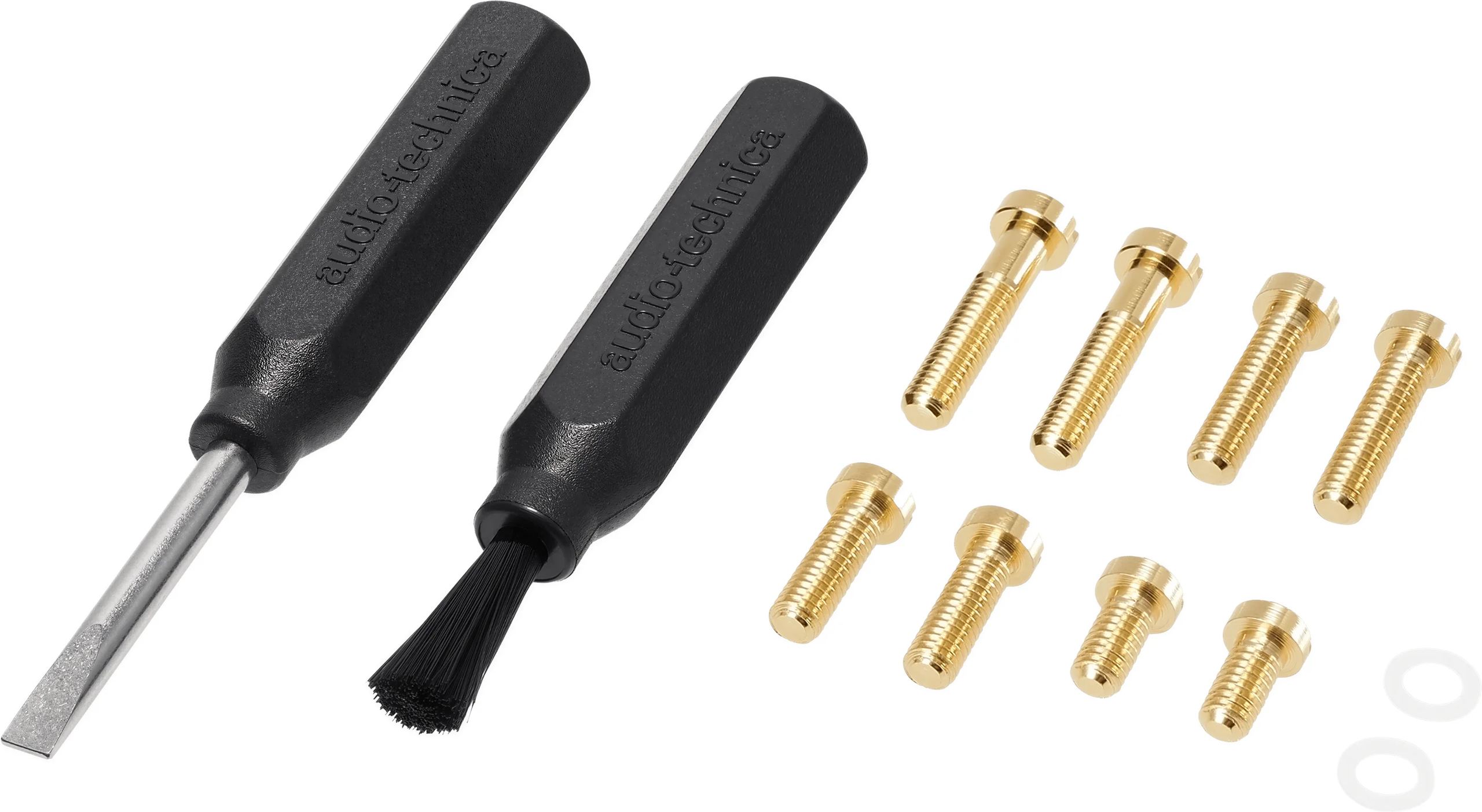
The body of the AT-OC9XSH, machined from hardened aluminum, limits parasitic vibrations that could color the sound. Its metallic brown finish visually sets this model apart within the range. Audio-Technica has integrated threaded inserts that simplify mounting: two screws are enough to secure the cartridge to the headshell or integrated tonearm, without the nuts that are usually required. This design makes alignment easier and ensures stable mechanical coupling.
The weight of 7.6 g and the dynamic compliance of 16 × 10⁻⁶ cm/dyne make the AT-OC9XSH suitable for low- to medium-mass tonearms. The recommended tracking force is 2 g, with an adjustment range between 1.8 and 2.2 g depending on usage conditions. The minimum load impedance of 100 ohms and the low output level require an MC phono preamplifier capable of providing at least 60–62 dB of gain.
The OC9X series offers five versions that differ mainly in their stylus and cantilever. The XEB and XEN models, featuring an aluminum cantilever and iron yoke, form the entry point to the range. The XML, XSH and XSL step up the specification with a boron cantilever and permendur yoke. The AT-OC9XSH, with its Shibata stylus, sits between the Microlinear profile of the XML and the Special Line Contact of the XSL.
The Shibata profile offers an interesting compromise: its contact surface, slightly smaller than that of the Microlinear, can be a bit more forgiving of minor groove imperfections while preserving high definition in the upper frequencies. This makes it a relevant option for varied vinyl collections, including pressings from different eras and of varying quality.
Longevity depends on record quality, diamond cleanliness, and tracking force adjustment. Under normal use with regular maintenance, a Shibata stylus can operate between 800 and 1,000 hours before wear significantly affects playback quality. Periodic microscopic inspection allows you to monitor the condition of the diamond.
The dynamic compliance of 16 × 10⁻⁶ cm/dyne and the weight of 7.6 g point towards low- to medium-effective-mass tonearms, typically between 8 and 18 g. Independent measurements suggest actual compliance slightly higher than the specifications, which extends compatibility towards lower-medium-mass arms. Heavy arms (over 25 g) should be avoided.
No, the AT-OC9XSH generates 0.4 mV, a level sufficient for most modern MC phono preamplifiers offering 60 dB or more of gain. A step-up transformer remains an option for preamps with limited gain or to slightly alter the sonic signature, but it is not essential.
The threaded body incorporates tapped holes that directly accept the mounting screws. This design eliminates the nuts under the headshell, simplifies alignment, and avoids the risk of loosening. However, it is not compatible with bottom-mount headshells used on some vintage turntables.
The supplied brush can be used to remove dust after each side. The movement should always go from the rear to the front of the cantilever, never sideways. For more thorough cleaning, a dedicated stylus cleaning fluid applied sparingly will dissolve greasy residues. Abrasive methods or ultrasonic cleaning should be avoided.
The Shibata profile traces the groove in areas sometimes spared by the conical or elliptical styli previously used. On well-preserved records, this can reveal previously masked details. On records heavily worn by repeated play with spherical styli, the Shibata can, on the contrary, make certain groove degradations more audible.
Amedee
Very good equipment thank you
Comment from June 18, 2026 — Experience from June 07, 2026
Nelson
Top-notch cartridge, no regrets about replacing my AT33 with the AT-OC9.
Comment from November 06, 2025 — Experience from December 12, 2024
Jean Pierre
The AT-OC9XSH cartridge sounds like Mr. "Stradivarius'" violin—yay!
Comment from December 05, 2024 — Experience from November 22, 2024