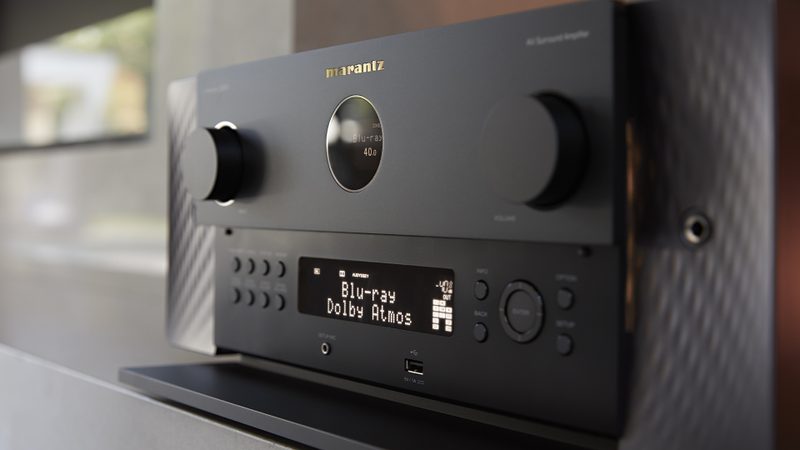
The Marantz Cinema 50 is a 9-channel audio/video amplifier delivering 110 watts per channel. It supports immersive audio formats and 8K video, and offers acoustic calibration features as well as extensive connectivity. Thanks to its multiroom integration, it can be used both in a dedicated home theater and in a versatile living space.
A deliberate aesthetic break for contemporary integration
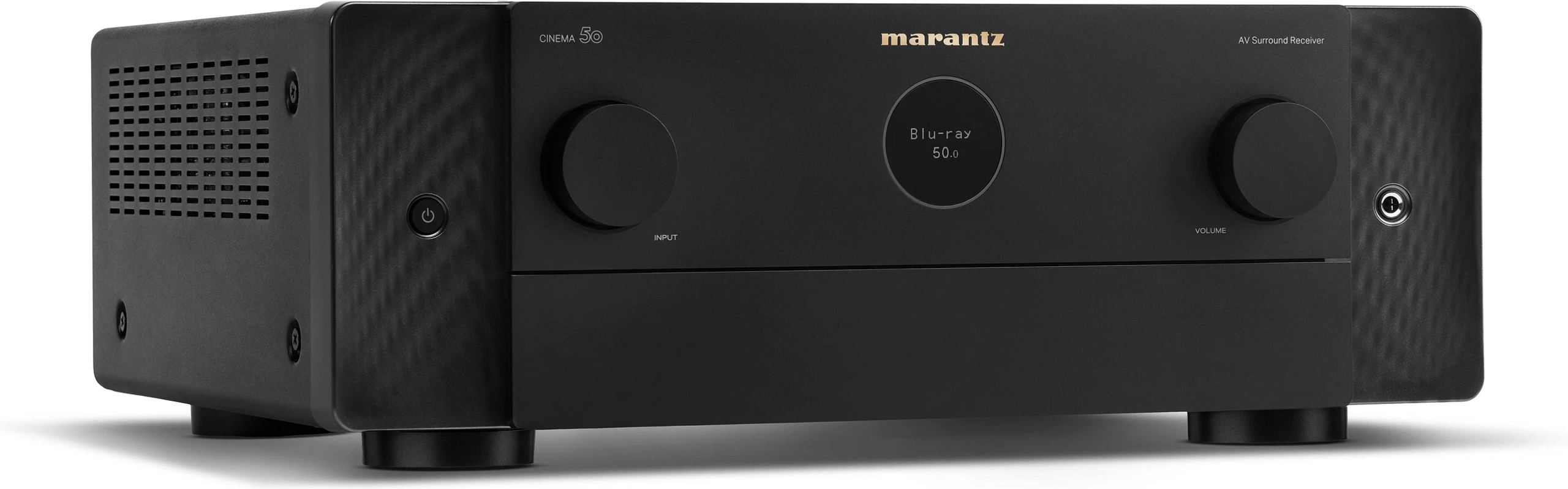
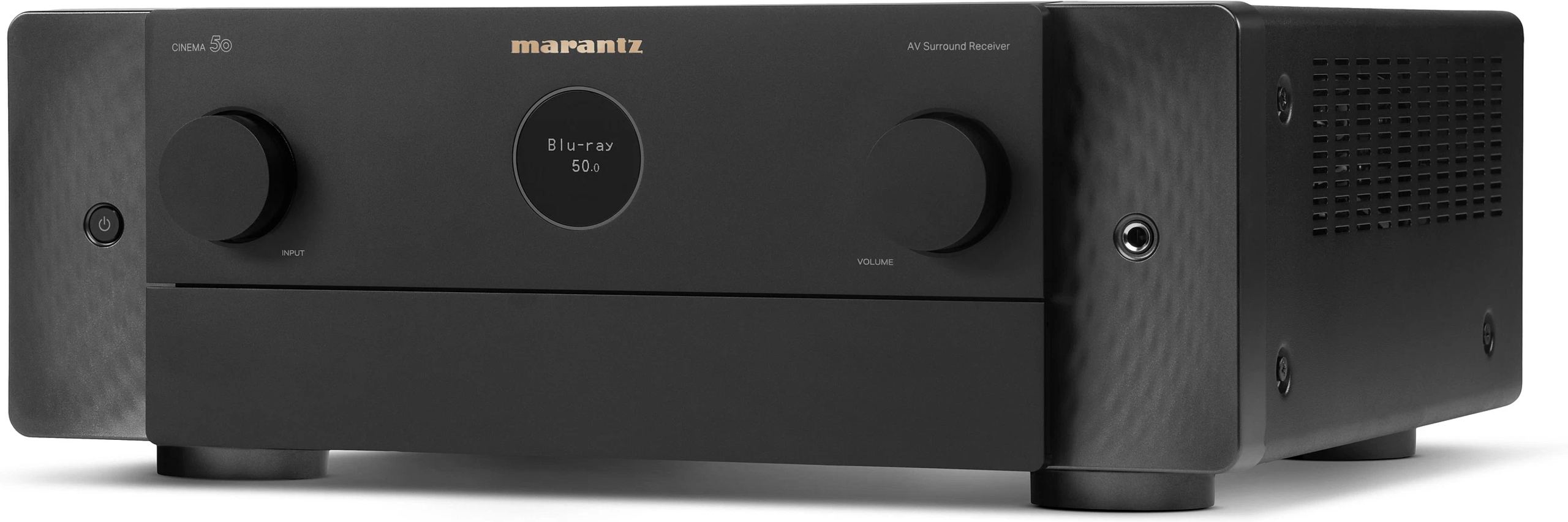
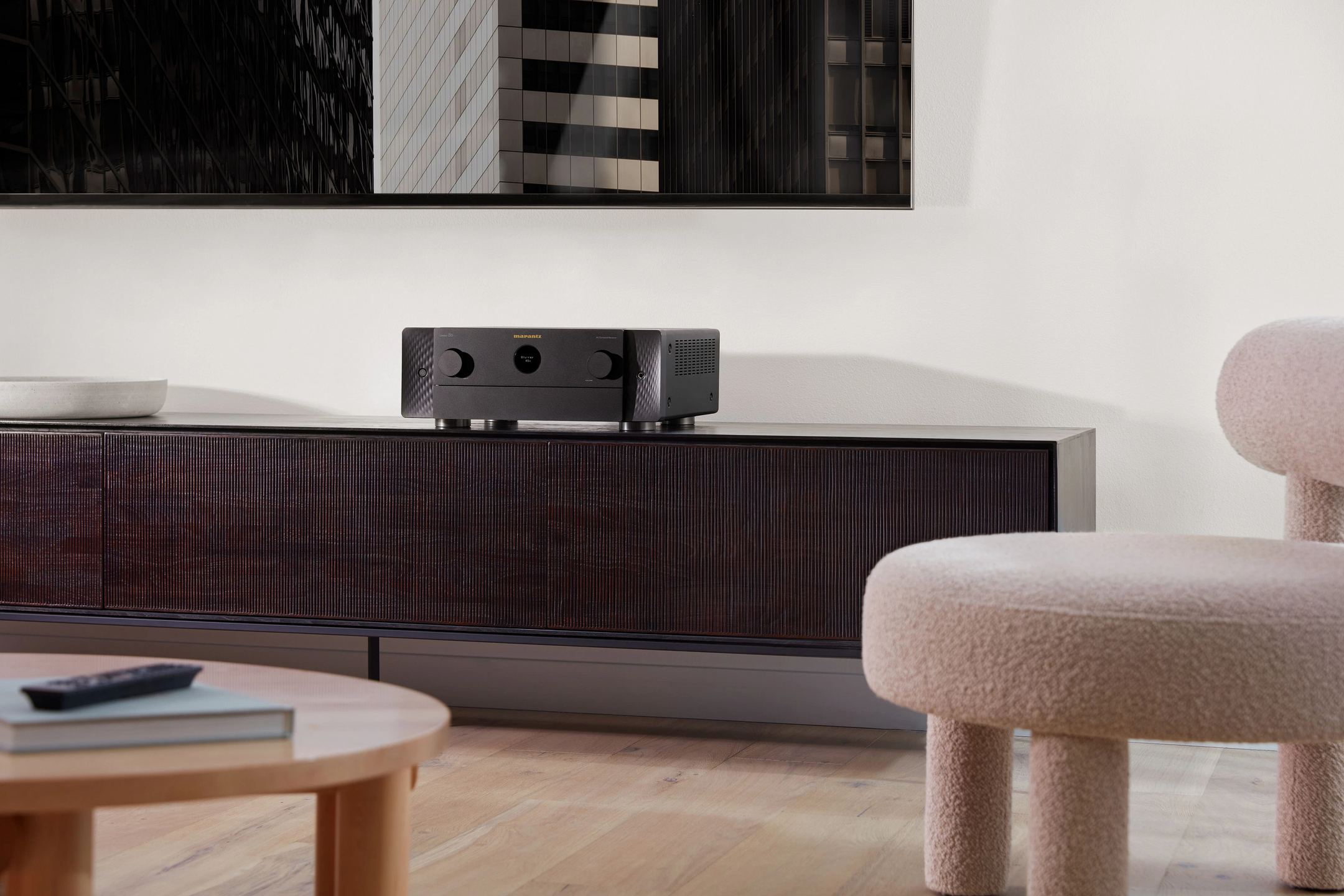
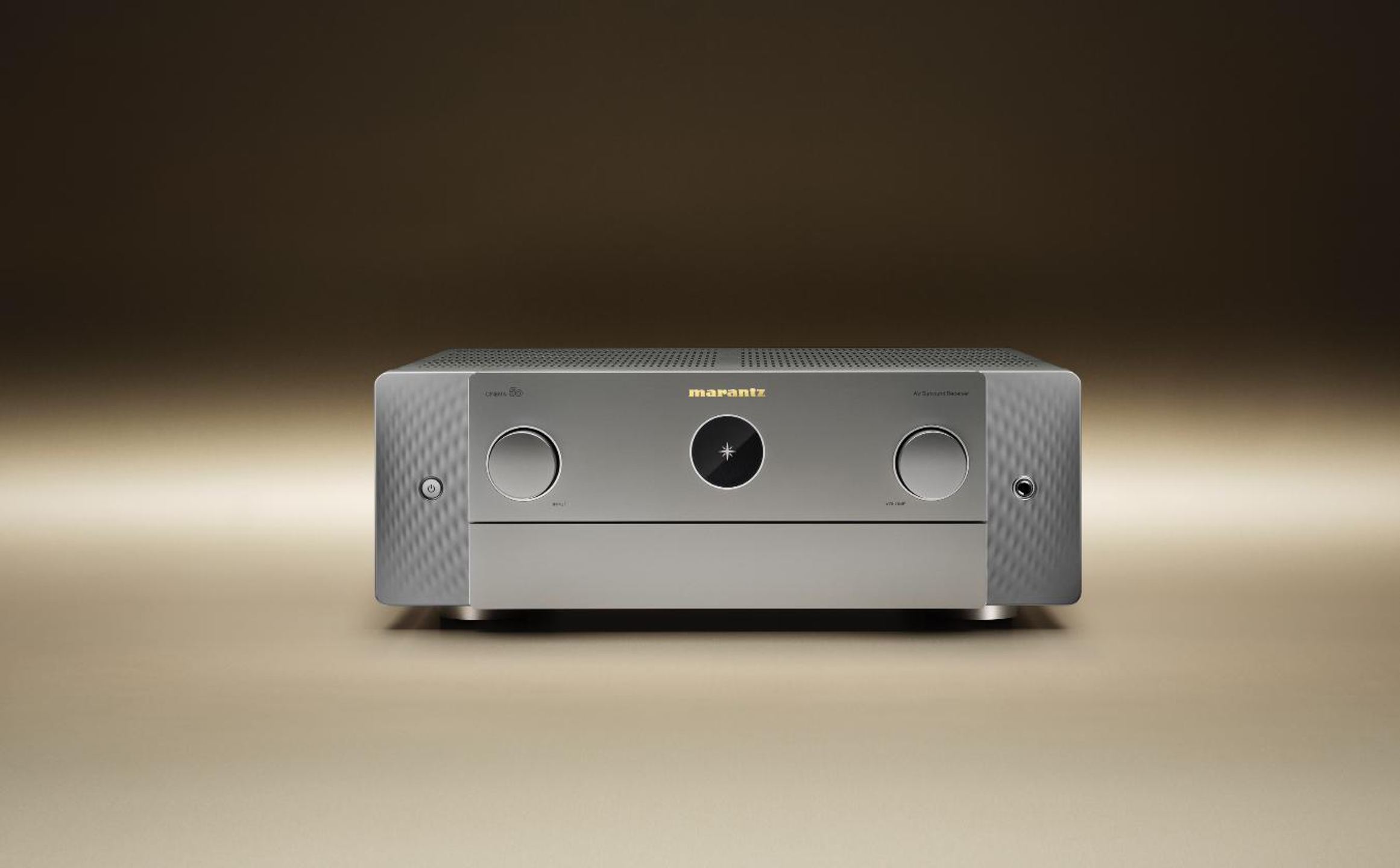
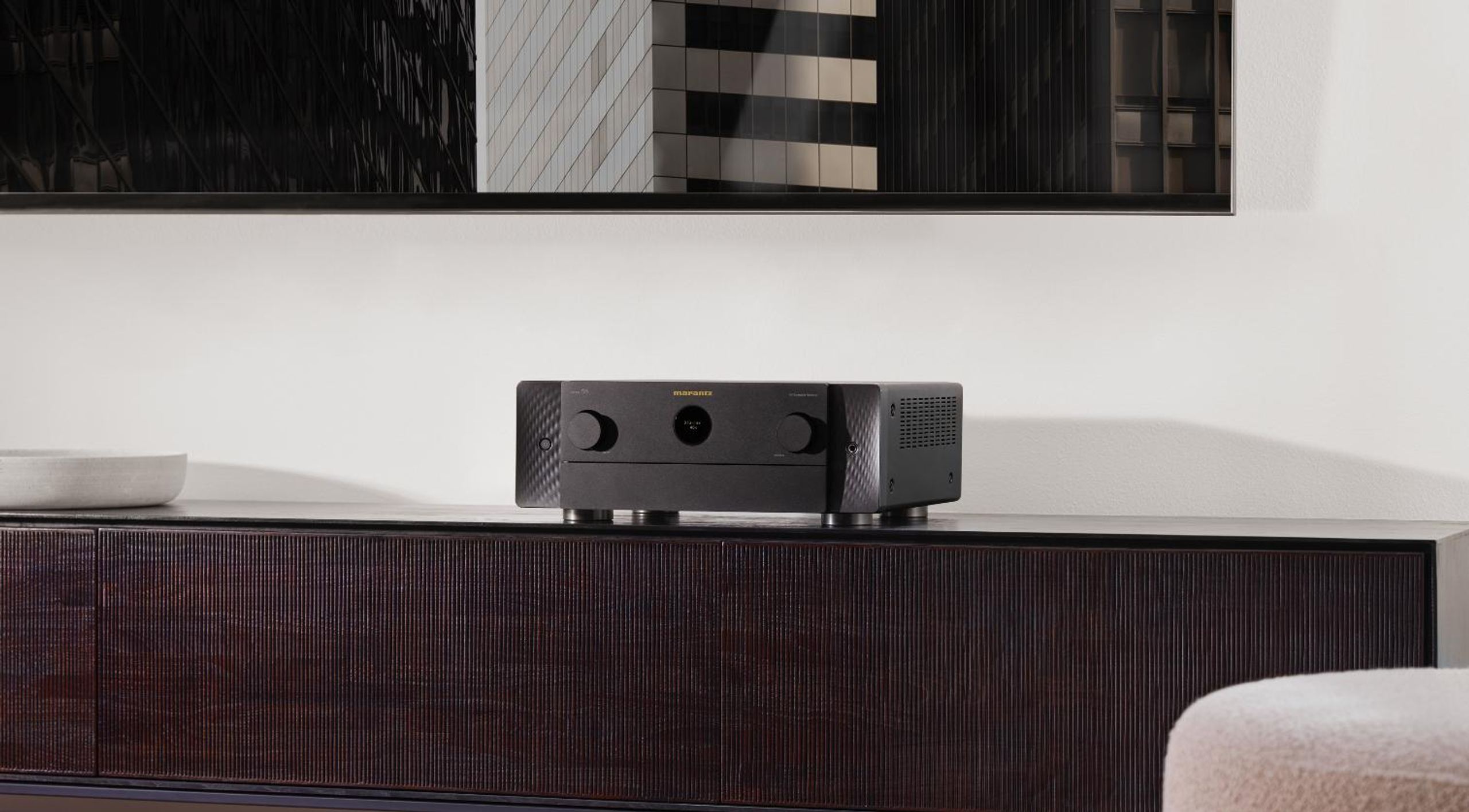
The Cinema series marks a radical shift in Marantz’s design philosophy. Abandoning the traditional curves that have long characterized the brand, the Cinema 50 adopts a decidedly contemporary aesthetic inspired by the high-fidelity stereo amplifiers Model 30 and Model 40n. This transformation is not merely a stylistic whim: it signals a desire to reposition Marantz in the premium home cinema segment while making it easier to integrate the unit into modern interiors.
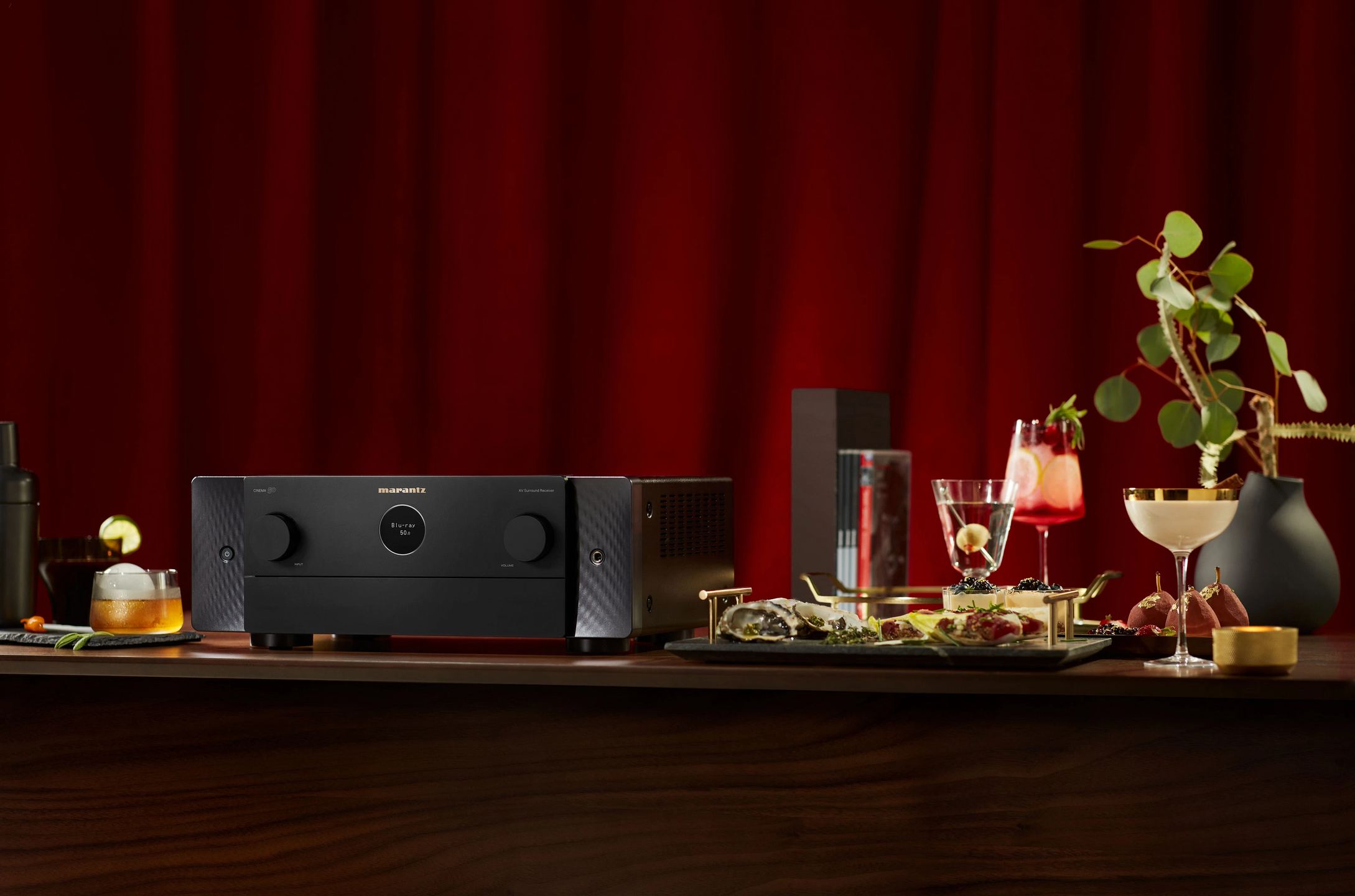
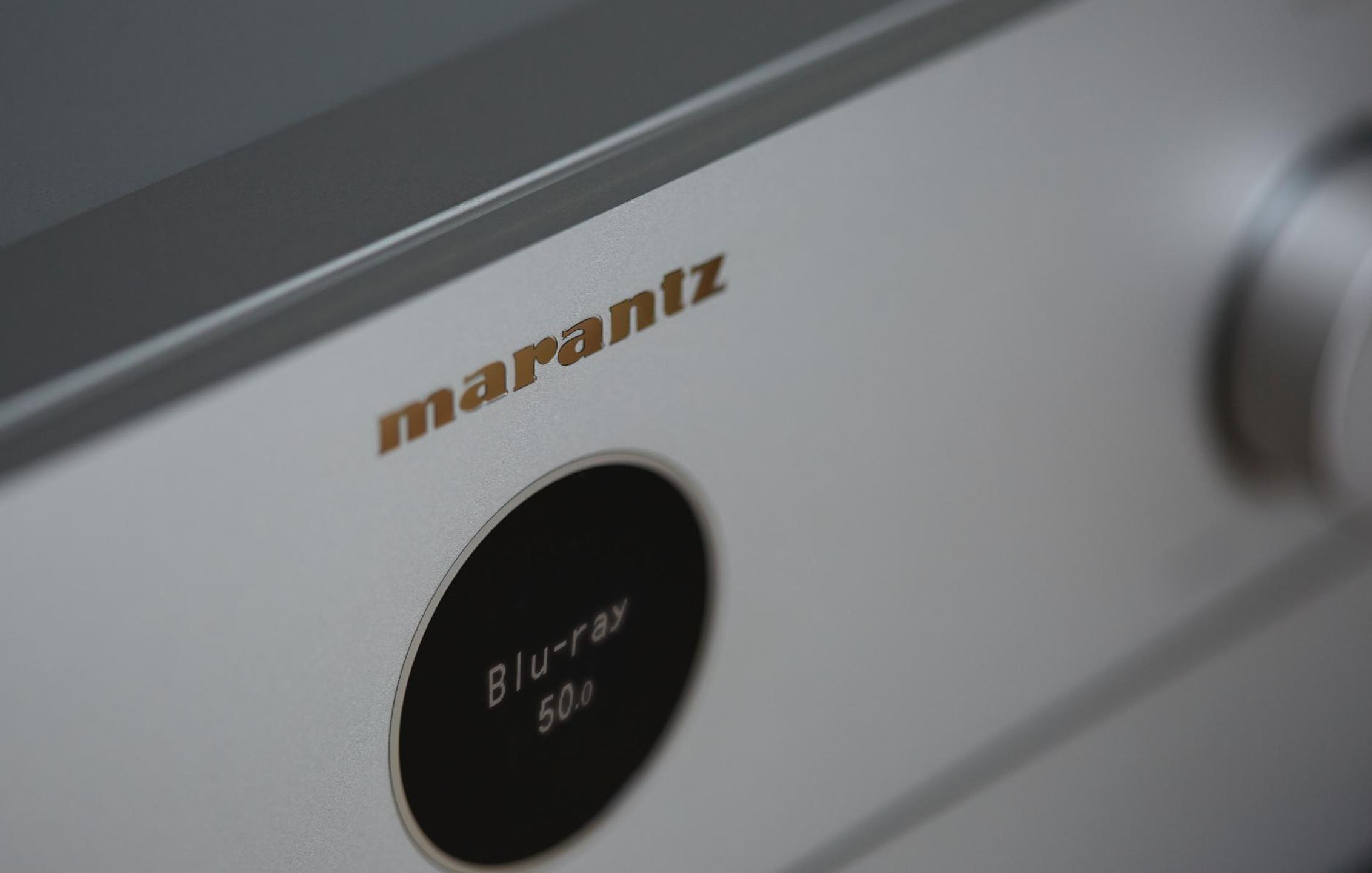
The front panel presents perfect symmetry, with two imposing rotary knobs framing the famous central porthole, Marantz’s visual signature for decades. This circular window, although modest in size, displays essential information selected source and volume level with welcome discretion in a dark environment. The granular texture of the front panel, available in black or silver-gold finish, gives the whole unit a distinctive tactile presence that contrasts with the smooth uniformity of competing amplifiers.
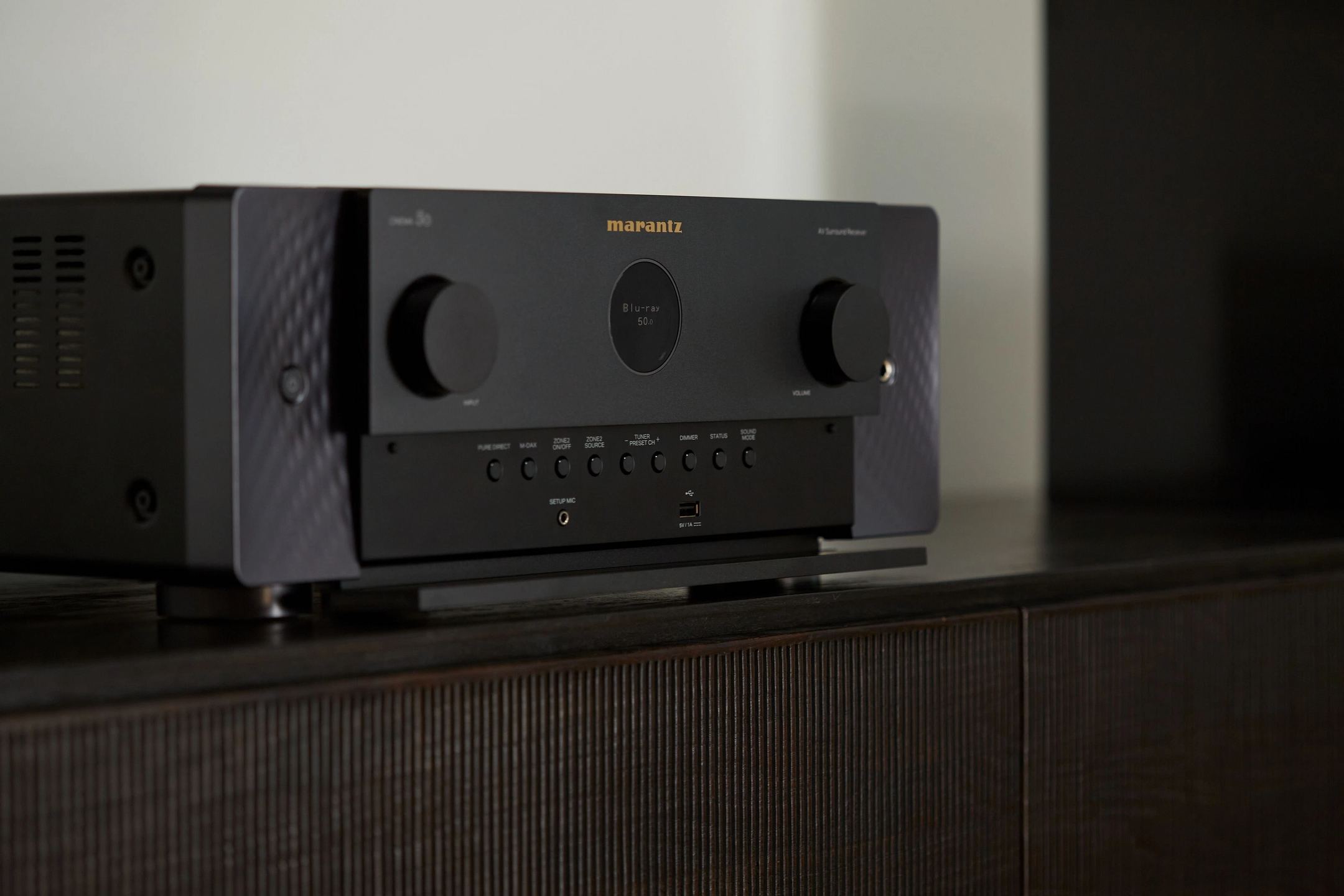
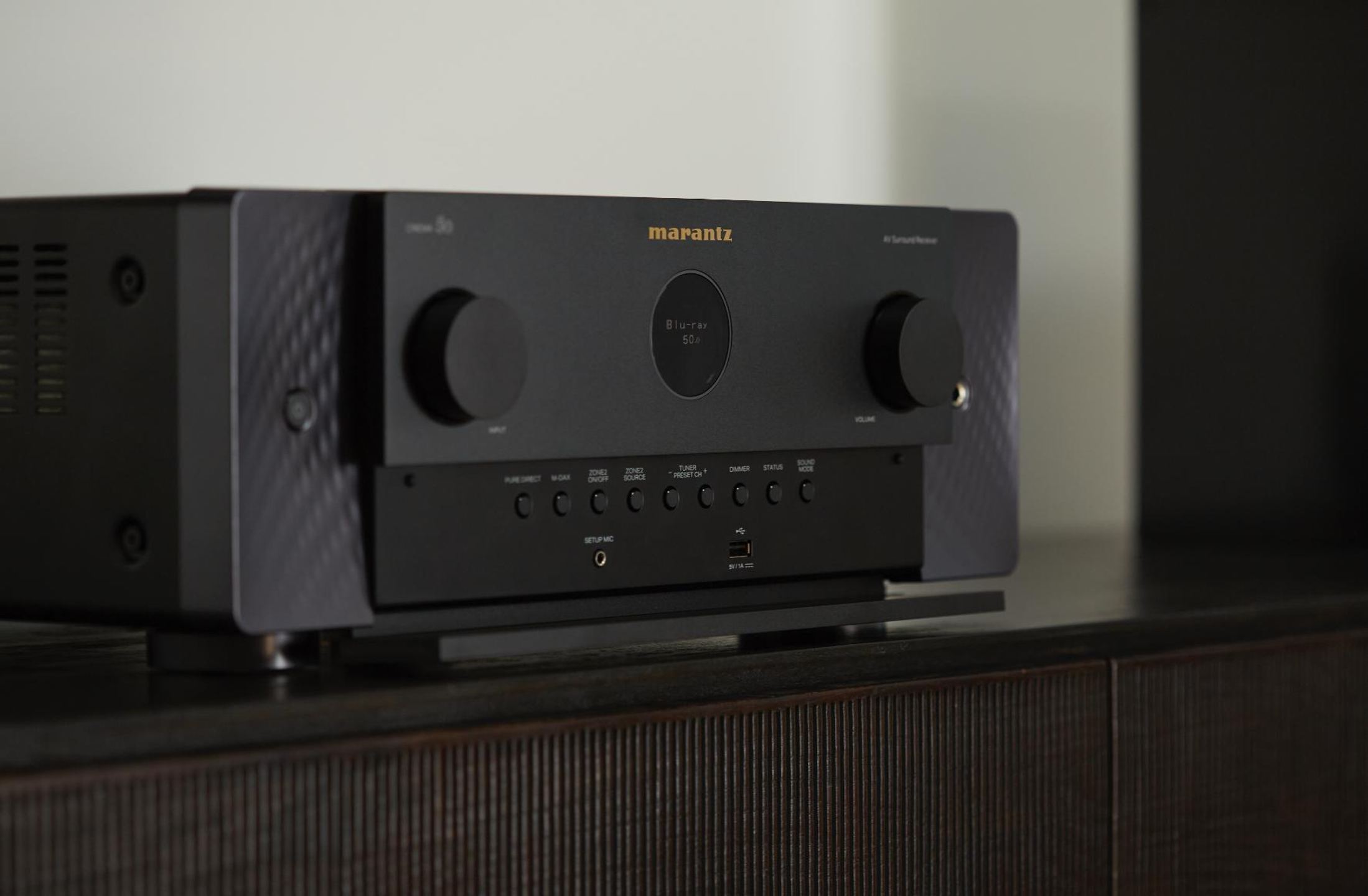
A flap concealed in the lower section reveals, once lowered, a set of additional controls including buttons for managing Zone 2, audio mode selectors, and HDMI output selection. There is also a USB-A port for direct playback of audio files from external storage, as well as a jack for the calibration microphone. The absence of a front HDMI input may disappoint some users accustomed to temporarily connecting portable devices, but this omission aligns with the minimalist approach that defines this new design.
HDAM modules: perpetuating the Marantz sound signature
At the heart of the Cinema 50’s sonic philosophy are the HDAM (Hyper Dynamic Amplifier Module) stages, a proprietary technology developed by Marantz since the early 1990s. These discrete amplification circuits, built from individually selected components rather than standardized integrated chips, constitute the soul of the Marantz sound. Unlike conventional operational amplifiers that can introduce limitations in slew rate and noise floor, HDAM modules offer superior transient response and significantly reduced noise levels.
In practical terms, this technology yields a sound signature recognizable among a thousand: generous spatialization, rich and natural timbres, and preserved dynamics even at low volume. The midrange benefits from particularly refined texture, rendering cinematic dialogue with remarkable clarity and presence. The highs retain their definition without tipping into harshness, while the low end exhibits articulation and control that avoid the formless mass effect often criticized in entry-level home cinema amplifiers.
Implementing HDAM in a multichannel context is a considerable technical challenge that Marantz meets with aplomb. Each channel receives the same meticulous attention to amplification, ensuring perfect tonal coherence between speakers. This uniformity is crucial to the credibility of the three-dimensional soundstage, particularly in Atmos configurations where sound objects move fluidly from one channel to another.
Multichannel architecture and configuration flexibility
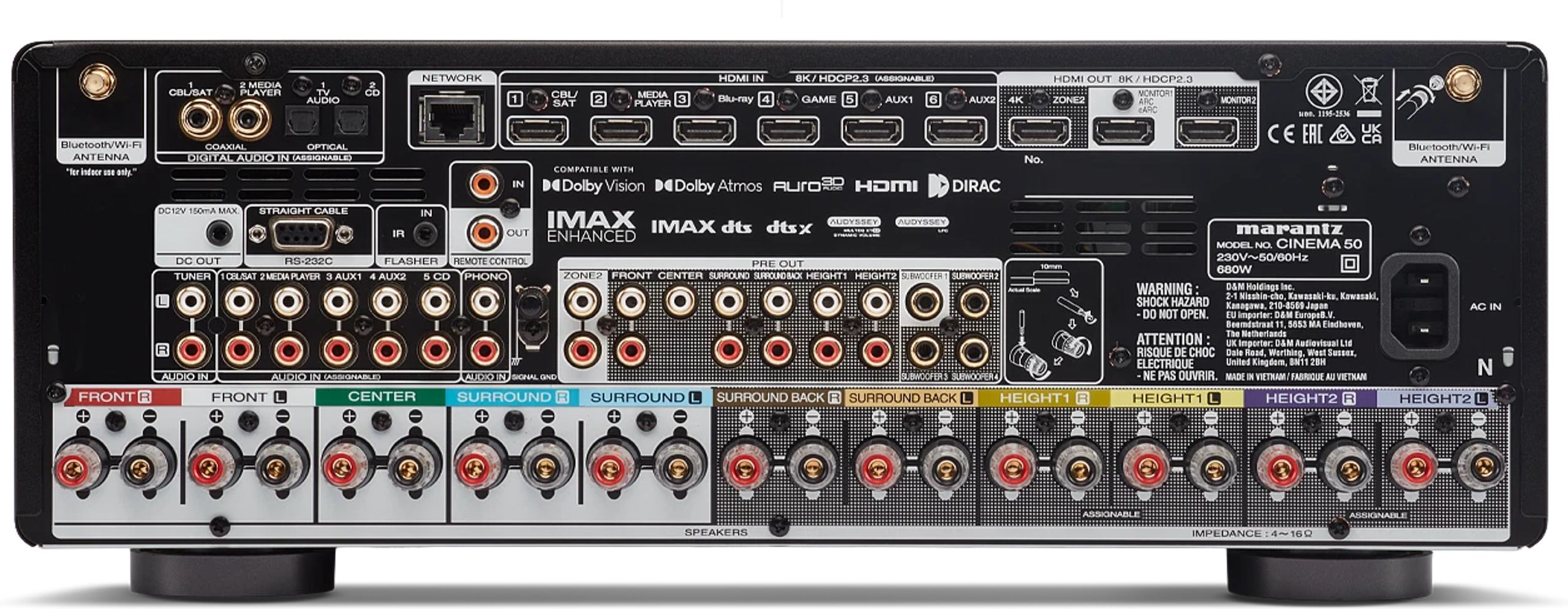
The Cinema 50 offers 9 built-in amplification channels, but its processing architecture allows for up to 11.4 channels via the available preamp outputs. This flexibility enables multiple configurations according to needs and system evolution. A classic 5.1.4 setup (five main speakers, one subwoofer, four height speakers) fully exploits the unit’s internal capabilities. For more ambitious layouts, adding external power amplifiers allows for a 7.2.4 or even 9.2.2 configuration.
Subwoofer management deserves particular attention. The Cinema 50 includes four independent subwoofer outputs, a rare feature at this price point. This multiplicity is not a marketing gimmick: it enables sophisticated low-frequency management with the ability to set distinct parameters (level, phase, delay, crossover) for each sub. Audyssey Sub EQ HT technology automatically optimizes the integration of multiple subs by measuring and compensating for their mutual interactions, a complex process that previously required specialized measurement equipment and advanced acoustic expertise.
The preamplifier mode is a particularly interesting feature for users wishing to fully externalize amplification. In this configuration, the Cinema 50 transforms into an 11.4-channel processor, retaining all its decoding and processing capabilities while delegating amplification to dedicated power blocks. This option will appeal to purists seeking physical separation between processing and amplification stages to minimize electromagnetic interference.
Acoustic calibration: the precision of Audyssey MultEQ XT32
The integration of the Audyssey MultEQ XT32 system puts the Cinema 50 on par with professional processors in terms of acoustic correction. This automatic calibration technology represents the pinnacle of Audyssey expertise, using thousands of measurement points and high-resolution FIR (Finite Impulse Response) filters to compensate for the acoustic flaws inherent to any listening room.
The calibration process begins with a series of measurements using the supplied microphone, positioned successively at eight different locations around the main listening area. At each position, the system emits test signals covering the entire audible spectrum and analyzes the response of each speaker. The algorithm then identifies acoustic issues modal resonances, early reflections, phase cancellations and generates correction filters specific to each channel.
MultEQ XT32’s superiority over earlier versions lies in its processing resolution. With 512 points of resolution for each main channel and the subwoofer (versus 16 for the standard XT version), the system can correct frequency response anomalies with surgical precision. The generated filters preserve the integrity of the direct signal while effectively attenuating colorations induced by the room’s acoustics.
The optional Audyssey MultEQ Editor app gives advanced users the ability to manually fine-tune correction curves. This interface allows visualization of raw measurements, adjustment of target curves according to personal preferences, and even disabling correction over certain frequency ranges. The feature limiting correction to low frequencies only will appeal to audiophiles who prefer to preserve the intrinsic character of their speakers in the mids and highs.
Dirac Live compatibility: the Nordic alternative
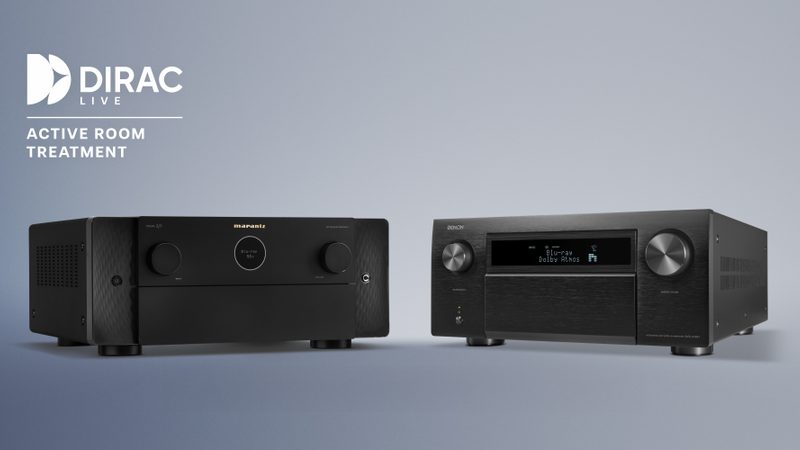
Remarkably for this price range, the Cinema 50 offers compatibility with the Dirac Live calibration system, a direct competitor to Audyssey developed by Swedish company Dirac Research. This option, available via a firmware update and the purchase of a separate license, provides a different approach to acoustic correction.
Dirac Live uses a mixed phase/amplitude correction methodology aimed not only at linearizing frequency response but also optimizing the system’s impulse response. This approach theoretically enables better stereo imaging precision and enhanced transient definition. Dirac’s user interface, more graphical and intuitive than Audyssey’s, makes it easier to understand and adjust correction parameters.
The coexistence of these two calibration systems on the same device is a first at this price point. Users can choose the solution that best matches their sonic preferences or even keep multiple calibration profiles for different types of content. This flexibility reflects Marantz’s desire not to impose a single approach but to let the end user choose their acoustic optimization.
HDMI 2.1 connectivity: at the heart of the modern video ecosystem
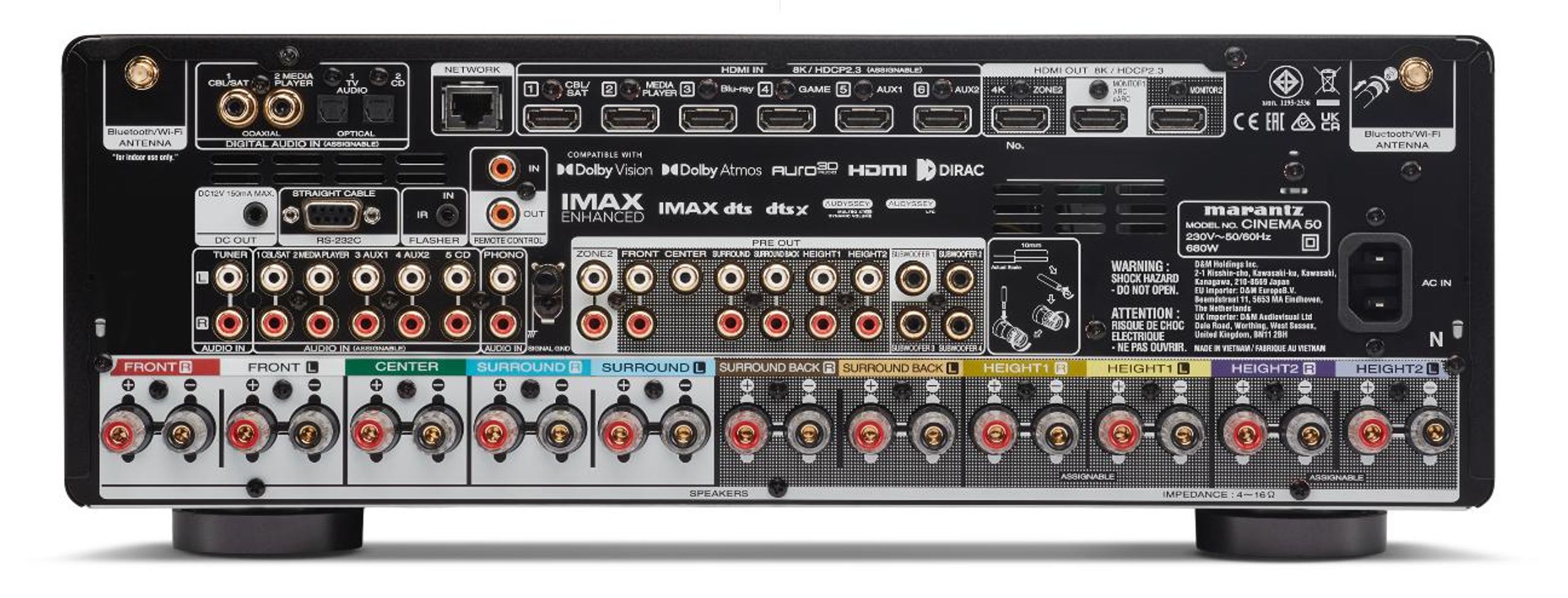
All six HDMI inputs on the Cinema 50 support HDMI 2.1 specifications, including transmission of 8K at 60 Hz and 4K at 120 Hz. This colossal bandwidth (48 Gbps) ensures compatibility with the most demanding video sources, whether next-generation game consoles or high-end media players. The three HDMI outputs allow remarkable configuration flexibility: the main output with eARC for the primary TV or projector, a secondary monitor output, and a dedicated Zone 2 output to distribute content to an adjacent room.
Full support for HDR formats including Dolby Vision, HDR10, HDR10+ and HLG ensures seamless transmission of dynamic metadata between source and display. The integrated video processor even offers an upscaling function capable of converting 1080p and 4K signals to 8K resolution, optimizing display on emerging 8K TVs and projectors.
For gaming enthusiasts, the implementation of ALLM (Auto Low Latency Mode), VRR (Variable Refresh Rate) and QFT (Quick Frame Transport) turns the Cinema 50 into a high-performance gaming hub. These features, previously reserved for direct console-to-TV connections, now allow for an optimal gaming experience while benefiting from a home cinema audio system.
Streaming and multiroom: HEOS integration
The built-in HEOS platform transforms the Cinema 50 into a true connected media center. Compatible with major streaming services Spotify Connect, Amazon Music HD, TIDAL, Deezer, Napster, SoundCloud the amplifier accesses music catalogs directly without requiring an external source. Support for high-resolution formats up to 192 kHz/24-bit and DSD ensures optimal listening quality for services offering lossless streams.
The HEOS ecosystem enables the creation of a sophisticated multiroom system by pairing the Cinema 50 with other compatible products from the Denon/Marantz lineup. Perfect synchronization between zones, the ability to group or ungroup rooms on the fly, and centralized control via the mobile app deliver a smooth and intuitive user experience.
AirPlay 2 compatibility facilitates integration into the Apple ecosystem, allowing direct streaming from iOS and macOS devices while supporting voice commands via Siri. Bidirectional Bluetooth not only enables receiving audio streams from mobile devices but also transmitting to Bluetooth headphones or speakers, a handy feature for nighttime listening.
Measured performance and usage nuances
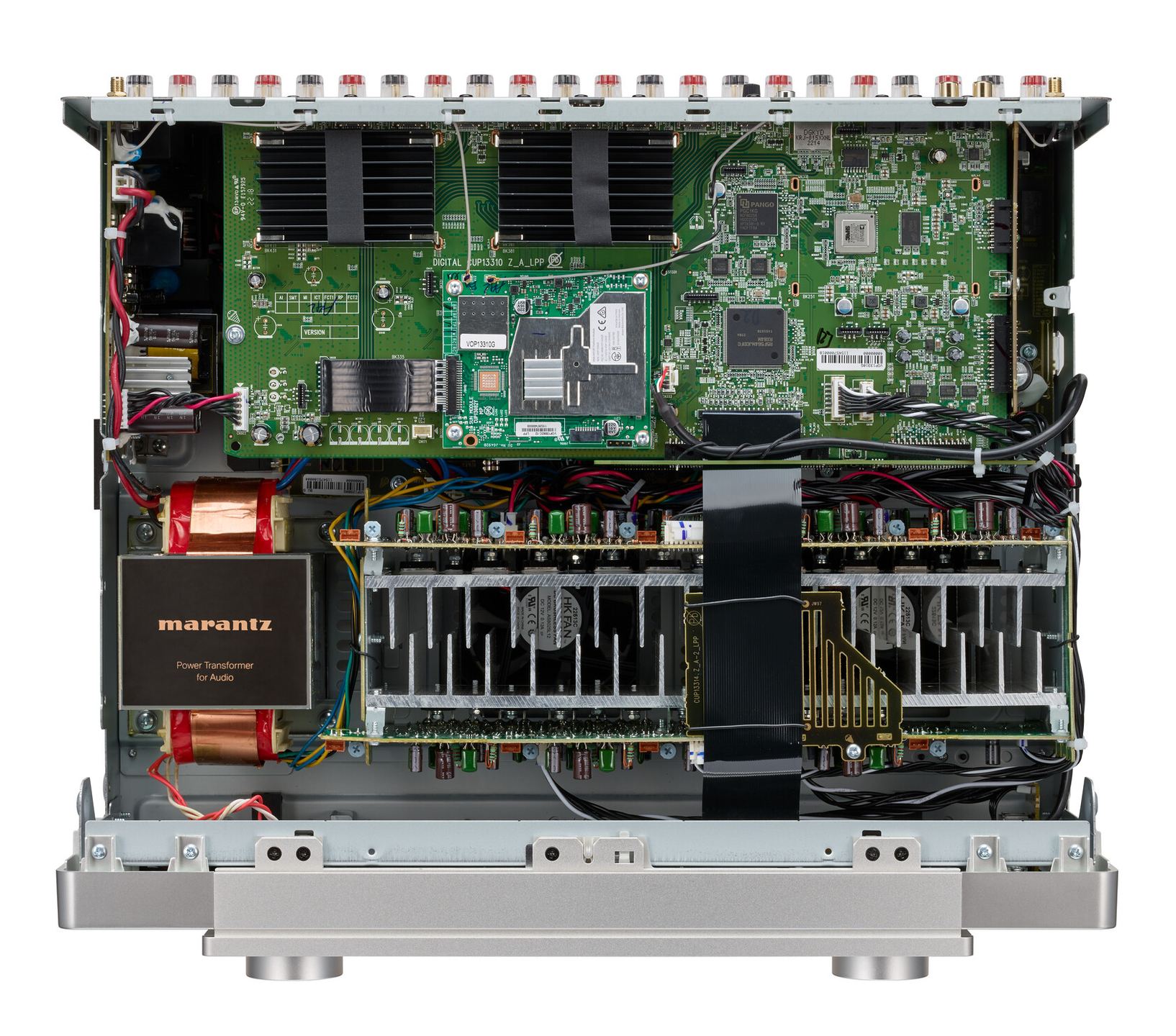
With 110 watts per channel into 8 ohms, the Cinema 50 provides ample power reserves for most home setups. The Class AB amplification topology, Marantz’s traditional choice, prioritizes sound quality over energy efficiency. This architecture, combined with oversized power transformers and high-capacity filter capacitors, ensures exemplary stability even with difficult loads.
Objective measurements reveal total harmonic distortion below 0.08% across most of the bandwidth, a remarkable figure for a multichannel amplifier. Interchannel crosstalk, measured at less than -70 dB, guarantees optimal stereo separation. The signal-to-noise ratio, exceeding 100 dB in Pure Direct mode, puts the Cinema 50 on par with dedicated stereo amplifiers.
Subjective listening confirms these excellent technical performances. On orchestral soundtracks, the amplifier unfolds a wide, layered soundstage where each section occupies its natural place. Crescendos retain their emotional impact without perceptible dynamic compression. Surround effects in modern blockbusters benefit from precise localization and smooth movement that enhance immersion.
No sound: 60 W (ECO mode on), 100 W (ECO mode off)
Normal/Eco standby: 0.2 W
CEC standby: 0.5 W
Network standby: < 2.0 W
Box Contents
Main unit
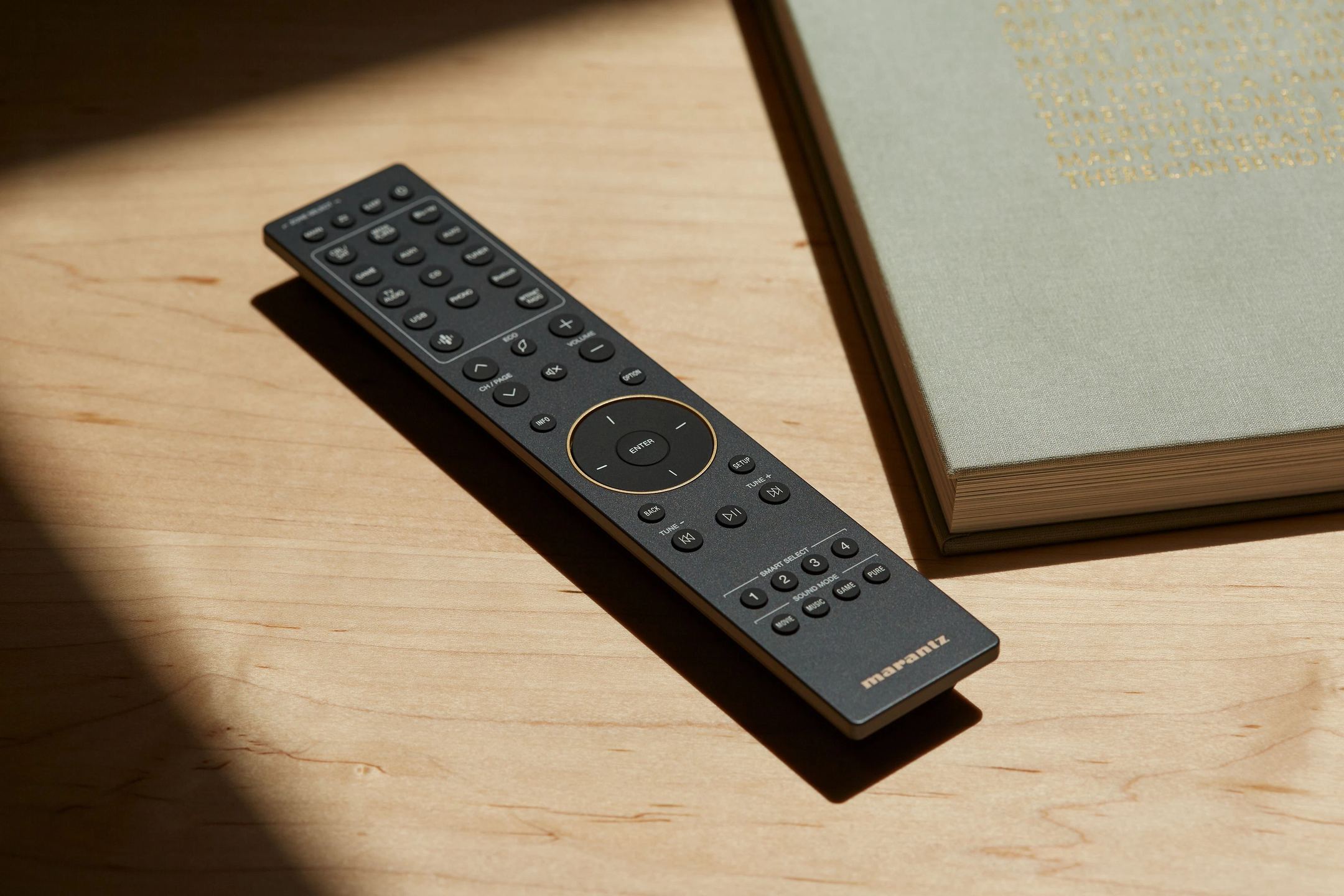
Remote control RC-049SR
Batteries
Quick start guide
Audyssey microphone with stand
2 removable external antennas
Power cord
Frequently Asked Questions
What is the main difference between the Cinema 50 and the Cinema 60?
+
The Cinema 50 offers 9 channels of amplification compared to 7 for the Cinema 60, with slightly higher power (110W vs 100W). More importantly, the Cinema 50 includes the XT32 version of Audyssey MultEQ, significantly more precise than the XT version on the Cinema 60. The Cinema 50 also features Dirac Live compatibility, Auro-3D support, and IMAX Enhanced certification, which the 60 lacks. The Cinema 50’s more generous power supply also translates to superior dynamics and better power handling.
Can the Cinema 50 truly rival stereo amplifiers for music listening?
+
Thanks to HDAM modules and Pure Direct mode, which disables all digital processing circuits, the Cinema 50 indeed offers remarkable musical performance in stereo. While a dedicated stereo amplifier at the same price could offer higher power and a few extra refinements, the Cinema 50 will satisfy the vast majority of music lovers, especially those seeking a versatile device that excels in both music and home cinema.
Is the Audyssey MultEQ Editor app essential?
+
While not essential, this paid app significantly enhances the calibration experience. It allows you to view measured response curves, fine-tune correction parameters, and most importantly save multiple calibration profiles. For users satisfied with the standard automatic calibration, the app does not add major value. However, acoustics enthusiasts will find it a valuable tool for optimizing their system.
How to choose between Audyssey and Dirac Live?
+
Both systems deliver excellent results but with different philosophies. Audyssey tends to provide a more “neutral” correction aiming for a linear response curve, while Dirac more readily allows you to adjust the target curve to your preferences. Dirac excels at phase correction, potentially improving stereo imaging and spatial precision. Audyssey remains simpler for newcomers. Ideally, test both systems in your listening environment.
What speaker configuration should be favored with the Cinema 50?
+
A 5.1.4 configuration (5 main speakers, 1 sub, 4 Atmos speakers) ideally leverages the 9 built-in channels while offering convincing vertical spatialization. For large rooms, a 7.1.2 setup with rear surround speakers may be more suitable. The presence of four subwoofer outputs encourages the use of multiple subs for homogeneous low-frequency coverage, particularly beneficial in large or acoustically complex rooms.
Does 8K upscaling provide a visible benefit?
+
Upscaling to 8K uses sophisticated algorithms to interpolate missing pixels but cannot create detail absent from the source signal. On a large 8K TV (75 inches and above), upscaling can slightly improve perceived sharpness of 4K content, especially on wide shots and fine textures. For 1080p content, the gain remains marginal. This feature is most useful for harmonizing display when using an 8K screen, thus avoiding scaling artifacts introduced by the TV.
User reviews
Michel
Beautiful receiver! Very happy with it. Not only the appearance, but the sound character is magical.
Comment from June 11, 2026 — Experience from May 30, 2026
Automatically translated — Show original (Dutch)
Prachtige receiver! Zeer content mee. Niet alleen uiterlijk, maar klinkkleur is magisch.
Fabio
Marantz a guarantee. Suitable for those seeking versatility and quality for both home theater and HiFi music. Homecinesolution impeccable service, expertise, availability, and efficiency.
Comment from May 01, 2026 — Experience from April 20, 2026
Automatically translated — Show original (Italian)
Marantz una garanzia. Adatto per chi cerca versatilità e qualità sia per per home theatre che per musica HiFi. Homecinesolution impeccabile servizio, competenza, disponibilità ed efficienza.
Gabriele
I just installed it and I'm impressed. The "Cinema" design is superb, but it's the sound that really stands out: warm, detailed, and highly immersive. It handles my setup perfectly. The interface is intuitive and the Audyssey calibration does a remarkable job. A big thank you to HomeCinéSolutions for the price and the delivery.
Comment from April 21, 2026 — Experience from April 10, 2026
Automatically translated — Show original (French)
Je viens de l'installer et je suis conquis. Le design "Cinema" est superbe, mais c'est le son qui impressionne : chaud, détaillé et très immersif. Il gère parfaitement mon installation. L'interface est intuitive et la calibration Audyssey fait un travail remarquable. Un grand merci à HomeCinéSolutions pour le prix et la livraison.
To better understand our visitors, measure marketing effectiveness and personalise ads, we and our partners use cookies and mobile advertising identifiers on your device. This data makes it possible to display personalised and non-personalised ads and measure their performance. Some cookies, which are technically necessary, are exempt from consent. You can accept those that require your consent, refuse them by clicking "Refuse", or customise your choices via the settings screen.
To find out how Google uses the data collected once you have given your consent, see Google’s Business Data Responsibility site.
You can change or withdraw your consent at any time via the "Consent and cookies" link. Your choices will apply on our site for 12 months.