

Home Theater Amplifiers
The home theater receiver centralizes your audio-video setup by decoding and amplifying multichannel audio tracks to your speakers. Capable of handling configurations from 5.1 to 11.2 channels, it supports Dolby Atmos, DTS:X, Dolby TrueHD and DTS HD Master Audio formats to reproduce movie and TV sound with precision. 4K/8K HDMI connectivity ensures transmission of sources to your TV or projector. Read more


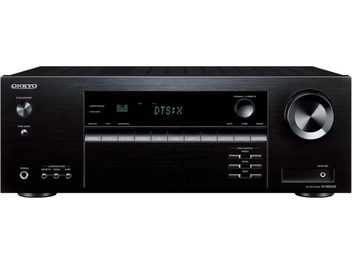


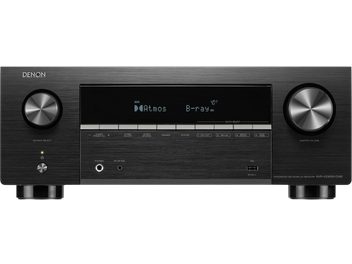


Operation and role
The audio-video receiver is the nerve center of a home theater system. It receives audio signals from connected sources (Blu-ray player, game console, set-top box), decodes them according to the format used, then amplifies and distributes them to each speaker. Unlike a stereo amplifier limited to two channels, a home theater receiver simultaneously manages multiple outputs to create an immersive, spatial sound environment.
A standard 5.1 setup includes two front speakers, a center channel for dialogue, two surround speakers, and a subwoofer. 7.1 models add two rear speakers, while Dolby Atmos configurations (5.1.2, 7.1.4, etc.) incorporate height speakers for vertical sound spatialization.
Audio formats and decoding
Modern receivers decode lossless high-definition audio formats found on Blu-ray discs: Dolby TrueHD and DTS HD Master Audio in 24-bit/96 kHz over 8 channels. Models compatible with Dolby Atmos and DTS:X add a vertical dimension to the mix, placing sound effects in a three-dimensional space. Some high-end receivers also support Auro-3D and IMAX Enhanced.
Classic DVD formats (Dolby Digital 5.1 and DTS) remain supported. Most devices include upmixing modes (audio upscaling) that adapt stereo content to multichannel to make use of all speakers.
Power and number of channels
Power is expressed in RMS watts per channel at a given impedance (typically 8 ohms). A minimum of 50 to 80 watts per channel is suitable for a medium-sized living room with speakers of standard sensitivity. Large rooms or low-sensitivity speakers require more powerful models exceeding 100 watts per channel.
The number of amplified channels determines the possible configuration. A 5.1 receiver powers five speakers (plus the subwoofer, amplified separately), a 7.1 handles seven, and so on. 9.2 or 11.2 models allow complex Dolby Atmos setups with multiple height speakers and two subwoofers.
Connectivity and video
HDMI inputs (typically 4 to 7) centralize video and audio sources. HDMI 2.1 compatibility enables passthrough of 4K at 120 Hz or 8K at 60 Hz signals, with support for HDR10+, Dolby Vision, and HLG. The eARC (Enhanced Audio Return Channel) function transmits high-definition audio tracks from a compatible TV to the receiver.
Optical, coaxial, and analog RCA audio inputs round out connectivity for older devices. Some models include a phono preamp to connect a turntable. Pre-outs allow you to add external power amplifiers to boost performance.
Network and multiroom features
Wi-Fi and Bluetooth turn the home theater receiver into a network audio player. Multiroom protocols (HEOS for Denon/Marantz, MusicCast for Yamaha, DTS Play-Fi for Onkyo/Pioneer) let you stream music to multiple rooms simultaneously from streaming services (Spotify, Deezer, Tidal, Qobuz) or from a NAS.
Integration with AirPlay 2, Chromecast, or Roon ensures compatibility with different ecosystems. Voice assistants (Amazon Alexa, Google Assistant) make voice control easy. Dedicated mobile apps simplify setup and day-to-day operation.
Automatic acoustic calibration
Automatic calibration systems analyze the room’s acoustics using a measurement microphone. They then adjust distances, levels, crossover frequencies, and EQ to optimize sound at the listening position. The main technologies are Audyssey MultEQ (Denon, Marantz), YPAO (Yamaha), AccuEQ (Onkyo, Pioneer), and Dirac Live (NAD, Arcam).
These calibrations partially compensate for room acoustic flaws (resonances, reverberation) and balance differences between speakers. Advanced versions (Audyssey MultEQ XT32, Dirac Live) offer more precise and customizable correction.
Video processing
Built-in video processors convert and scale signals to match the TV or projector’s native resolution. 4K upscaling improves the definition of HD sources, while 8K upscaling transforms 4K content. Some receivers apply additional processing to enhance contrast, sharpness, or reduce video noise.
Choosing based on use
For a living space with a TV and a compact 5.1 system, an entry-level 5- or 7-channel model is sufficient. A dedicated room with a projector and floorstanding speakers calls for a more powerful receiver, ideally Dolby Atmos compatible. Music enthusiasts will favor models with a refined preamp section and audiophile-grade components.
Denon, Marantz, Yamaha, Onkyo, and Pioneer dominate the market with comprehensive lineups from mainstream to high-end. Anthem, Arcam, NAD, and Primare target premium installations with superior audio performance.