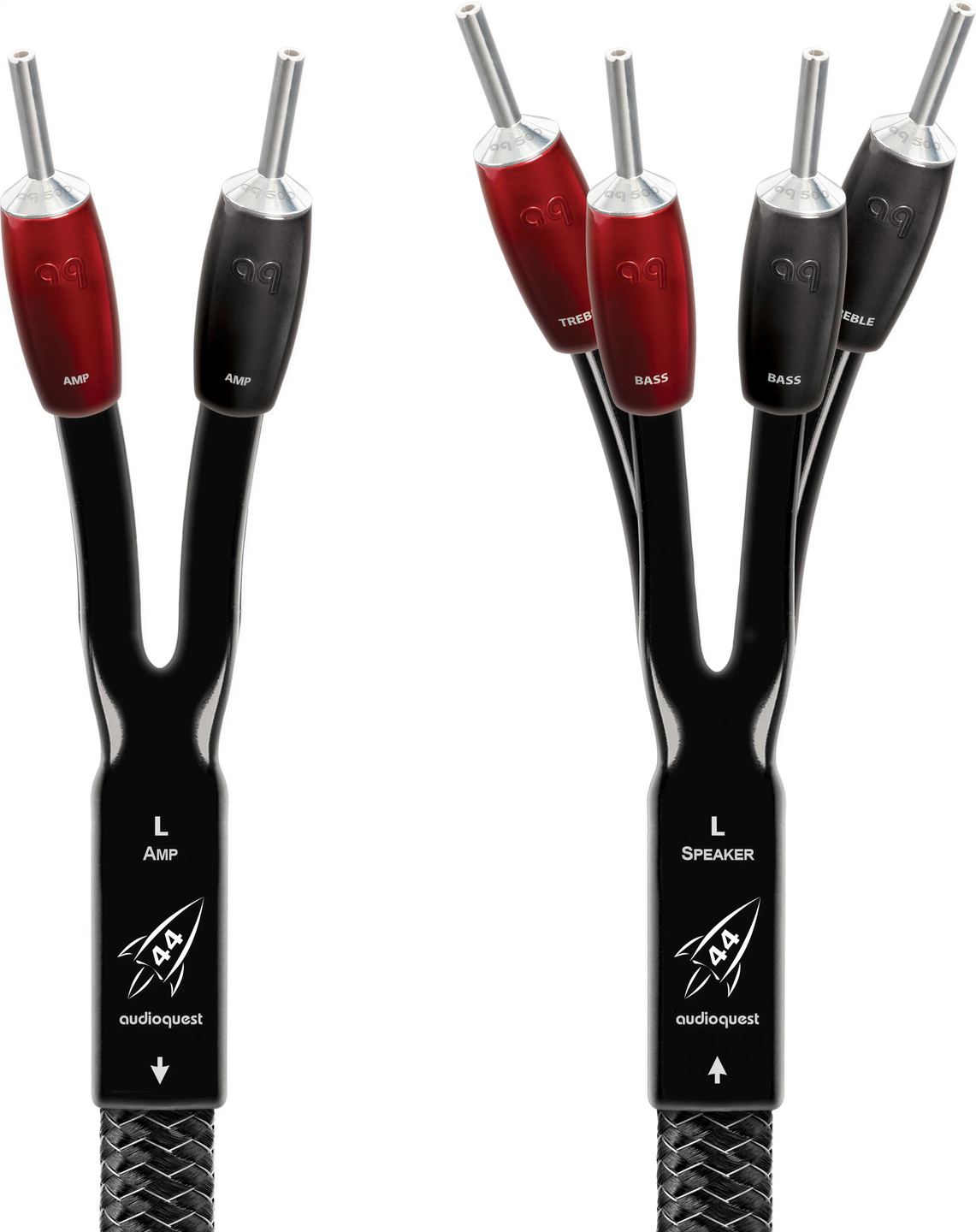
The Rocket 44 SBW from Audioquest is a speaker cable using PSC and PSC+ copper conductors and a Double Star-Quad geometry to ensure balanced signal transmission.
A refined metallurgical construction to minimize distortion
The Rocket 44 SBW is based on a carefully balanced combination of two types of solid copper conductors. The PSC (Perfect-Surface Copper) conductors form the foundation of this construction, offering an exceptionally smooth surface thanks to a proprietary manufacturing process that protects the wire at every stage of drawing. This technology significantly reduces surface discontinuities where high-frequency currents usually concentrate, according to the well-known principle of the skin effect.
The PSC+ (Perfect-Surface Copper+) conductors, with even higher purity, complement this configuration. They feature fewer grain boundaries—the microscopic borders between metallic crystals—which constitute obstacles to the flow of electrical signal. Reducing these internal barriers directly lowers sonic roughness, enabling a more natural rendering of instrumental timbres.
The total cross-section of 3.31 mm² ensures current-handling capacity suitable for medium- and high-power amplifiers, while the exclusive use of solid conductors eliminates interactions between multiple strands, a major source of dynamic distortion in conventional cables. This approach contrasts with traditional multi-strand cables where the magnetic fields generated by each individual strand mutually interfere, creating a form of internal electromagnetic smearing that is particularly detrimental to the clarity of the musical message.
Double Star-Quad geometry: mastering fundamental electrical parameters
The Double Star-Quad configuration represents the culmination of decades of Audioquest research into conductor geometry optimization. This specific layout organizes the conductors into two independent quadruple groups, each forming a star. This complex geometry allows precise control of the cable’s capacitance and inductance values, two fundamental electrical parameters that largely determine the cable’s behavior across the audio spectrum.
Unlike cables where conductors are simply arranged in parallel or twisted in pairs, Star-Quad geometry offers several decisive advantages. It significantly reduces the “time-smearing” phenomenon, a form of temporal distortion that blurs the rhythmic coherence of music. Transients—the rapid attacks characteristic of percussive instruments or plucked strings—retain their sharpness and natural impact.
This architecture also enables better magnetic separation between positive and negative conductors. In a bi-wiring configuration, where the cable splits to separately feed the bass and treble sections of compatible speakers, each Star-Quad group operates autonomously. The powerful magnetic fields generated by low-frequency signals thus remain isolated from the path taken by high frequencies, preserving their delicacy and finesse.
A multilayer radio-frequency noise reduction system
Today’s electromagnetic environment constantly exposes audio cables to pervasive RF interference. The Rocket 44 SBW incorporates a sophisticated noise dissipation system based on carbon-loaded polyethylene to isolate the negative conductors. This partially conductive material acts as a drain for RF noise, channeling it away before it reaches the amplifier’s ground plane.
The operating principle is akin to a semi-permeable shield: stray charges are captured and dissipated within the carbon structure rather than propagating into the audio circuit. This technology produces an immediately audible effect in the form of a reduction in the sonic “veil,” the diffuse background noise that masks micro-details and flattens soundstage depth. Music emerges from a deeper silence, with a notable improvement in dimensionality and instrument separation in space.
The carbon treatment serves a dual purpose by also damping electromagnetic interactions between adjacent positive and negative conductors. This mutual isolation helps preserve the signal’s temporal integrity, which is particularly critical for faithful reproduction of harmonics and the natural reverberation of recording spaces.
Foamed polyethylene dielectric insulation: preserving signal energy
The choice of dielectric—the insulating material surrounding the conductors—directly affects signal transmission quality. The Rocket 44 SBW uses foamed polyethylene for all positive conductors, a material characterized by its high air content. This cellular structure has remarkable dielectric properties: it absorbs a minimal amount of energy from the electromagnetic field generated by the signal.
In a conventional dense dielectric, part of the signal’s energy is temporarily stored in the insulating material and then released with a time delay, creating a form of electrical echo that blurs musical clarity. Foamed polyethylene, with its numerous microscopic air pockets, minimizes this store-and-release phenomenon. Since air is a near-ideal dielectric, the signal travels through the cable with fewer losses and less temporal distortion, preserving the original dynamics and clarity of the recording.
Series 500 connectors built to last
The Series 500 banana connectors fitted to the Rocket 44 SBW are far more than simple mechanical terminations. Available in gold or silver finish, these connectors are plated directly onto the base metal without an intermediate nickel layer, unlike many connectors on the market. This approach eliminates a potential source of distortion caused by nickel’s magnetic properties and differing conduction characteristics.
The connection between conductors and connectors uses Audioquest’s Cold-Weld system, a cold-pressure assembly technique. This method preserves the conductor’s structural integrity by avoiding crystalline changes induced by traditional solder heat. A copper-based conductive paste ensures an optimal electrical interface while protecting against long-term oxidation.
Banana connectors offer several practical advantages, notably their compatibility with binding posts that comply with European insulation standards, where optimal fork tightening can be difficult or even impossible. The SBW model’s 2-to-4 banana plug configuration simplifies bi-wiring for compatible speakers, allowing full exploitation of the Double Star-Quad geometry’s potential.
The importance of signal directionality
Although counterintuitive for an AC signal, audio cable directionality is a measurable phenomenon related to the orientation of the metal’s crystalline structures during the drawing process. Audioquest carefully controls this characteristic for all Rocket 44 SBW conductors. The jackets are clearly marked “Speaker End” and “Amp End” to ensure optimal installation.
This directionality mainly influences the cable’s behavior in the presence of RF interference. When the cable is oriented correctly, RF noise is drained more efficiently to ground, reducing its impact on sound quality. The effect manifests as a more stable soundstage, better image focus, and less congestion during complex musical passages.