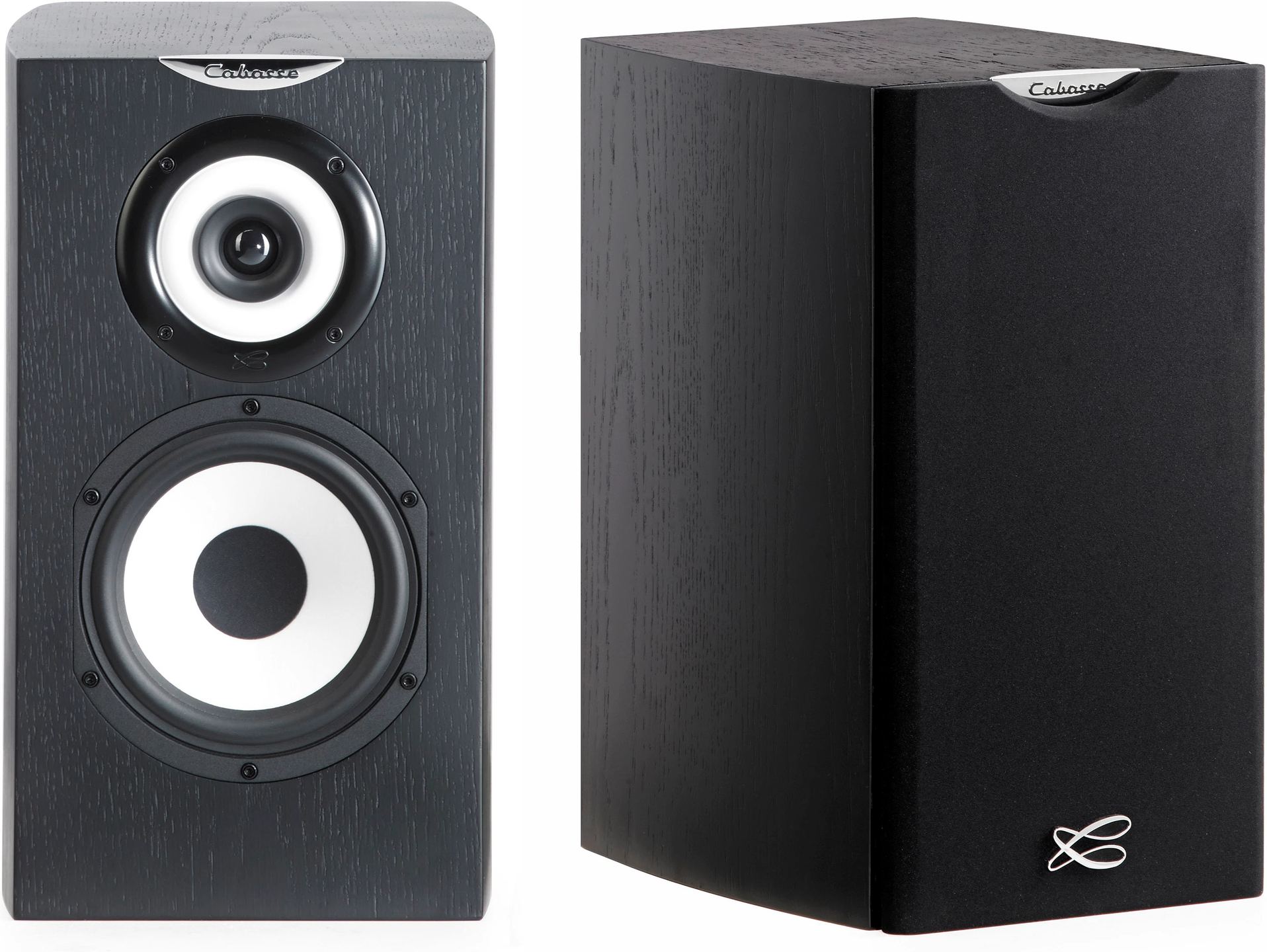
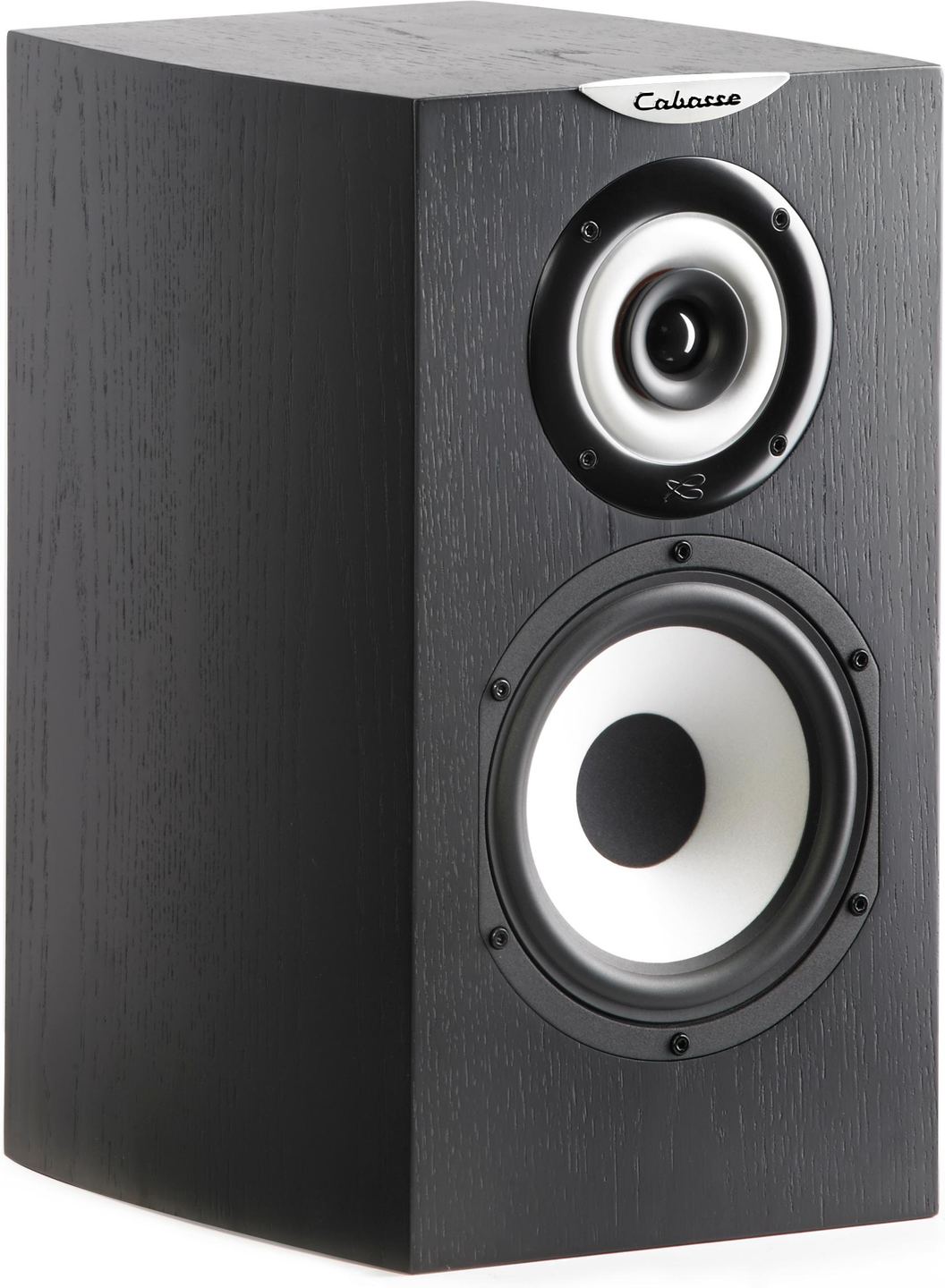
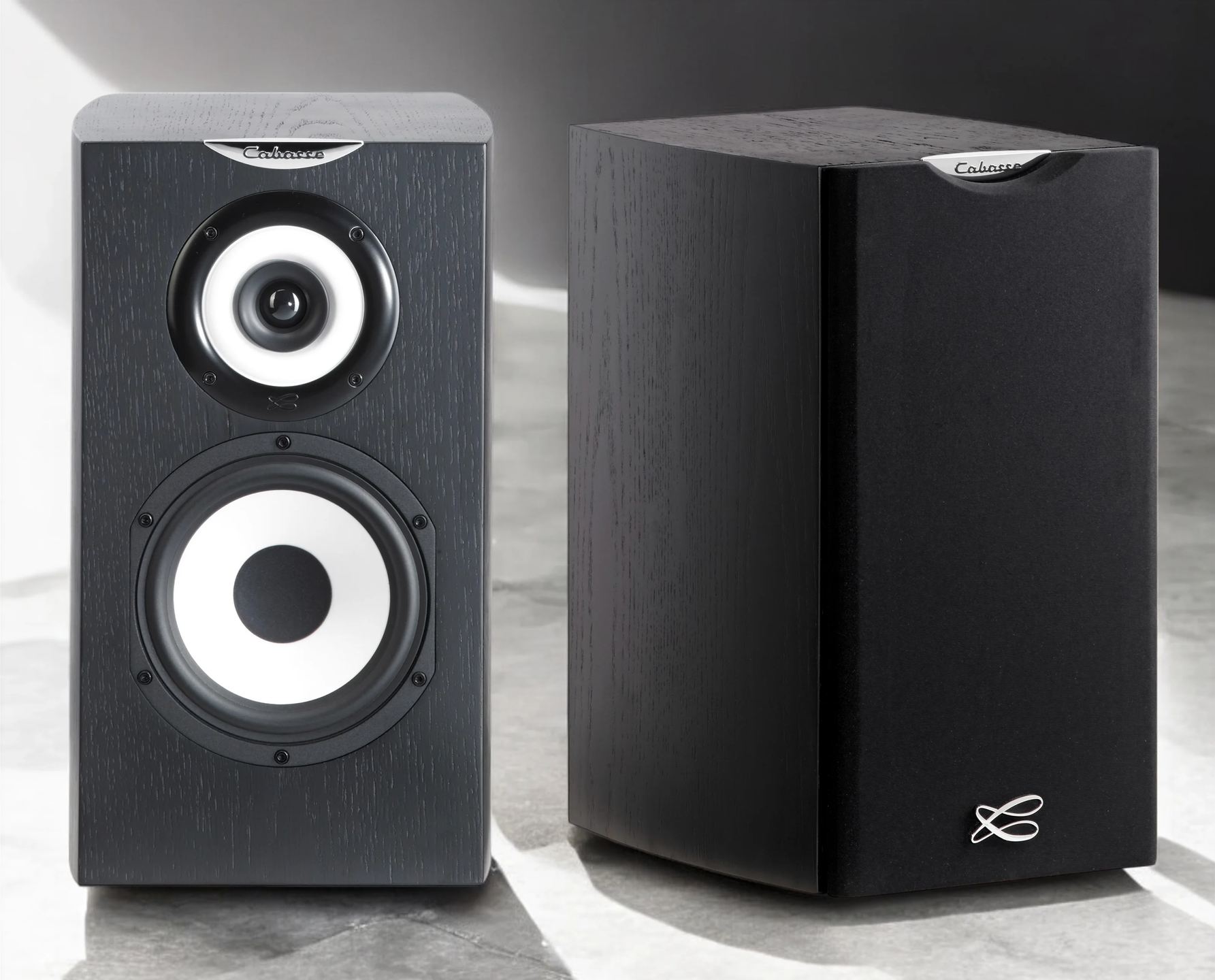
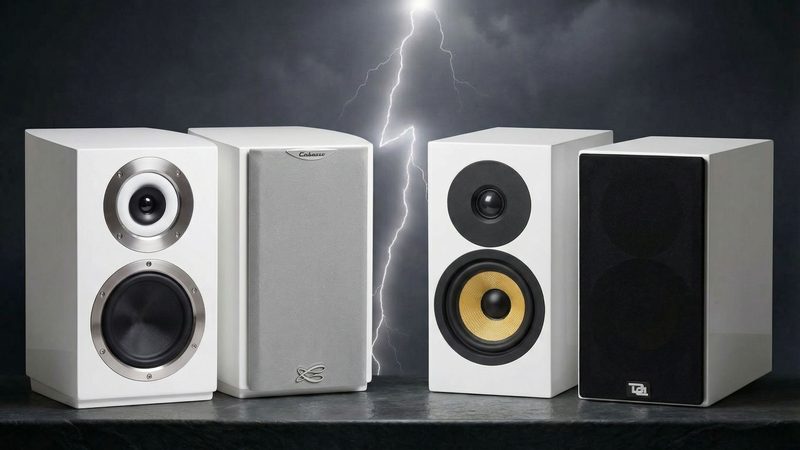
The Minorca MC40 by Cabasse are compact 3-way bookshelf speakers. They feature the BC10 coaxial driver, derived from high-end models, paired with two Duocell-coned woofers. This design ensures remarkable spatial coherence and sound precision, qualities often reserved for larger speakers.
Acoustic Architecture and Design: Meticulous Construction in Every Detail
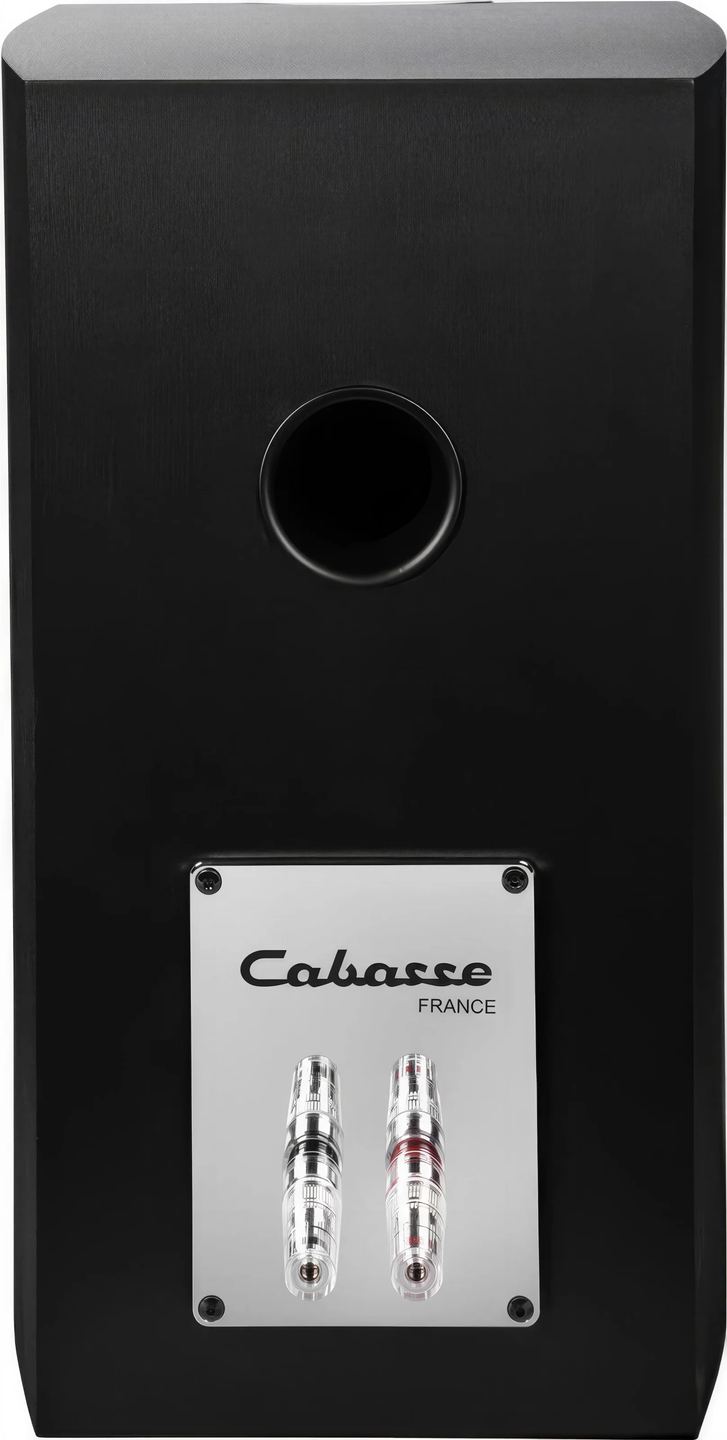
The Minorca MC40 adopts a cabinet with controlled dimensions (40 × 23 × 28 cm, weighing 8.5 kg), whose slightly curved side panels avoid strict parallelism. This particular geometry limits internal standing waves and reduces unwanted coloration. The bass-reflex system is built around a circular port on the rear panel, whose placement and size have been calculated to optimize airflow while minimizing turbulence.
The front panel houses the BC10 coaxial driver at the top, while the two 17 cm woofers occupy the middle and lower sections. This asymmetrical arrangement helps reduce diffraction effects at the cabinet edges. The protective grilles, attached by magnets, preserve the clean aesthetic while allowing easy removal for critical listening sessions.
The rear terminal accepts banana plugs, spades, and thick cables, reflecting a design focused on installation flexibility. Available in several finishes (white oak, ebony, brushed black, lacquered black), the Minorca MC40 naturally fits into various listening environments.
BC10 Coaxial Technology: Spatial Coherence in Service of Musicality
At the heart of the Minorca MC40 is the BC10 driver, the result of decades of Cabasse research into coaxial sources. This two-way speaker integrates a 27 mm dome tweeter housed at the center of a 12 cm annular midrange. This architecture, called SCS (Spatially Coherent Source), offers the fundamental advantage of emitting all frequencies from a single point in space.
This configuration solves several issues inherent to traditional multi-way systems. Time alignment becomes natural since the high and midrange wavefronts originate from the same acoustic center. Directivity remains consistent across the driver’s entire bandwidth, preserving tonal balance even off-axis. Measurements taken in an anechoic chamber over 360° confirm this uniform dispersion, an essential characteristic for achieving a coherent sound field in the listening room.
The tweeter benefits from technical solutions inherited from the reference system La Sphère, notably in the choice of materials and dome geometry. The annular midrange, thanks to its specific profile, ensures a seamless transition to the low frequencies while maintaining precision in the vocal range.
Duocell Cone: Breton Innovation Serving the Bass
The two 17MD18LB1 woofers in the Minorca MC40 use Duocell technology, developed and manufactured exclusively in Cabasse’s Plouzané workshops. This cone results from a thermal transformation process of Rohacell, a high-performance foam used in aerospace.
Cabasse robots shape this foam using a patented process that alters its internal structure. The result resembles bone structure: an internal honeycomb network providing lightness, covered by a rigid, perfectly airtight outer surface. This biomimetic architecture gives the cone an exceptional stiffness-to-mass ratio, allowing for rapid transient response while maintaining excellent internal damping.
Each cone takes about 20 minutes to manufacture, compared to just a few seconds for a conventional polypropylene cone. This slow production process ensures uniform mechanical characteristics, a sine qua non for achieving perfect stereo balance between the two speakers in a pair.
The exponential profile and variable thickness of these cones optimize performance at high excursion. The high-force motors can thus fully exploit their linear travel without generating mechanical distortion, preserving the clarity of the sound even at high volumes.
Crossover and Tuning: Cabasse Expertise in Action
The Minorca MC40’s crossover exemplifies Cabasse’s holistic approach. The crossover frequencies, set at 900 Hz and 3200 Hz, result from an iterative process combining objective measurements and listening sessions. The slopes, ranging from 6 to 24 dB per octave depending on the driver, take into account the cabinet geometry and the specific characteristics of each transducer.
This complex tuning aims for a simple goal: to preserve the naturalness of the musical message. The nominal impedance of 8 ohms (minimum 3.3 ohms) makes it easy to pair with a wide range of amplifiers, from tube models to modern solid-state electronics. The sensitivity of 89 dB for 1 watt at 1 meter allows for comfortable listening with moderate power, while accepting up to 75 watts RMS (550 watts peak) for the most demanding dynamics.