

Taga Harmony PC-7000 (2025) black


Complementary product
Overview
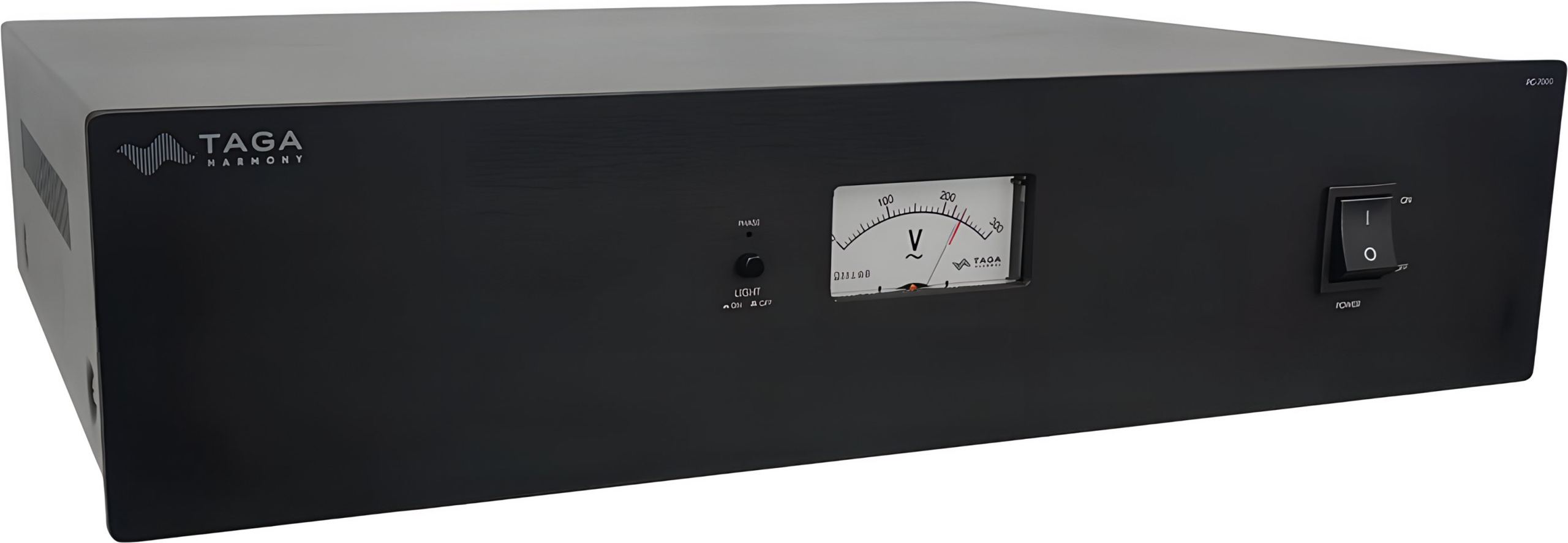
The PC-7000 from Taga Harmony is a power conditioner designed for audio and video installations. This 8.4 kg unit features a 200 W toroidal transformer and individualized filtering for eight Schuko outlets arranged in four groups, tailored to different types of equipment. It also includes an analog voltmeter, a phase detector, and surge protection up to 4500 A.
Design and construction of the PC-7000
The PC-7000 uses a black metal chassis measuring 11 cm high, 43 cm wide, and 33 cm deep with the feet installed. At 8.4 kg, it has a reassuring density. The front panel hosts a backlit analog voltmeter, a phase detection indicator that lights up red in case of reversal, and a main power switch that controls only the four switched outlets.
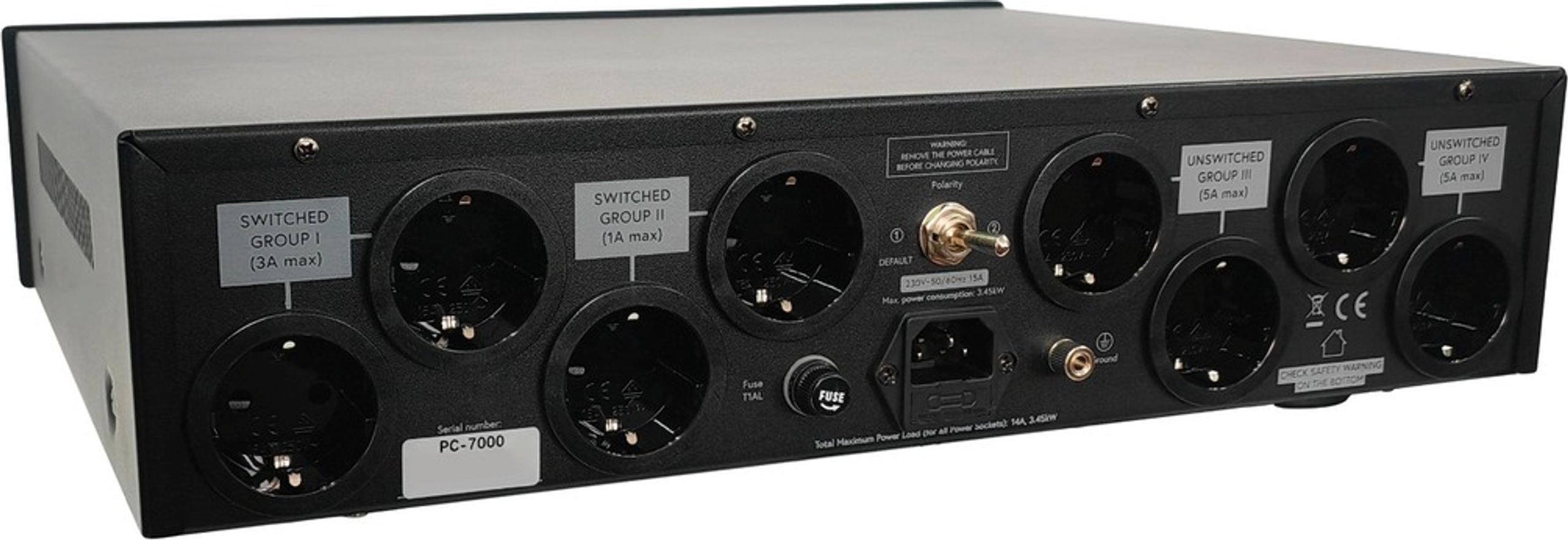
On the back, eight Schuko outlets are divided into four groups of two. This layout is no accident: each pair receives specific filtering adapted to the type of equipment it is intended to power. The input cable uses an IEC C14 connector, allowing you to replace it with a specialized power cord if desired.
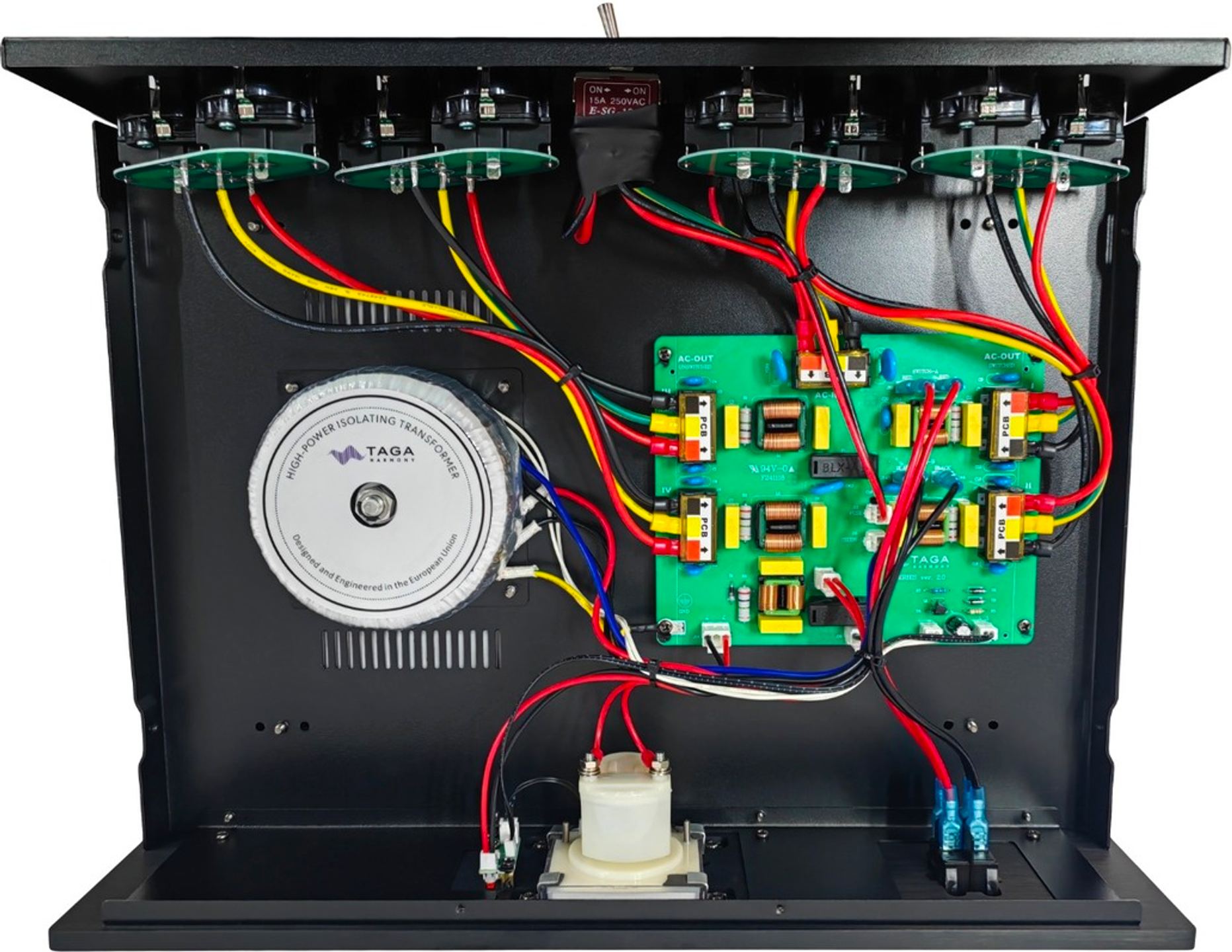
At the heart of the unit is a 200 W toroidal transformer designed to isolate audio sources from line noise. This transformer is covered by a shielded aluminum cap to protect it from external electromagnetic interference. The internal wiring uses oxygen-free copper (OFC), a material that minimizes electrical resistance and optimizes conductivity. Each group of outlets has its own oxygen-free copper inductors, while class X capacitors provide filtering.
The total maximum load is 14 A, or 3450 W, with noise reduction ranging from -10 dB to 55 dB depending on the frequency range (2 to 100 MHz). Surge protection accepts a peak current of up to 4500 A for a very brief duration (8/20 µs), with a maximum clamping voltage of 775 V and an energy absorption capacity of 140 joules.
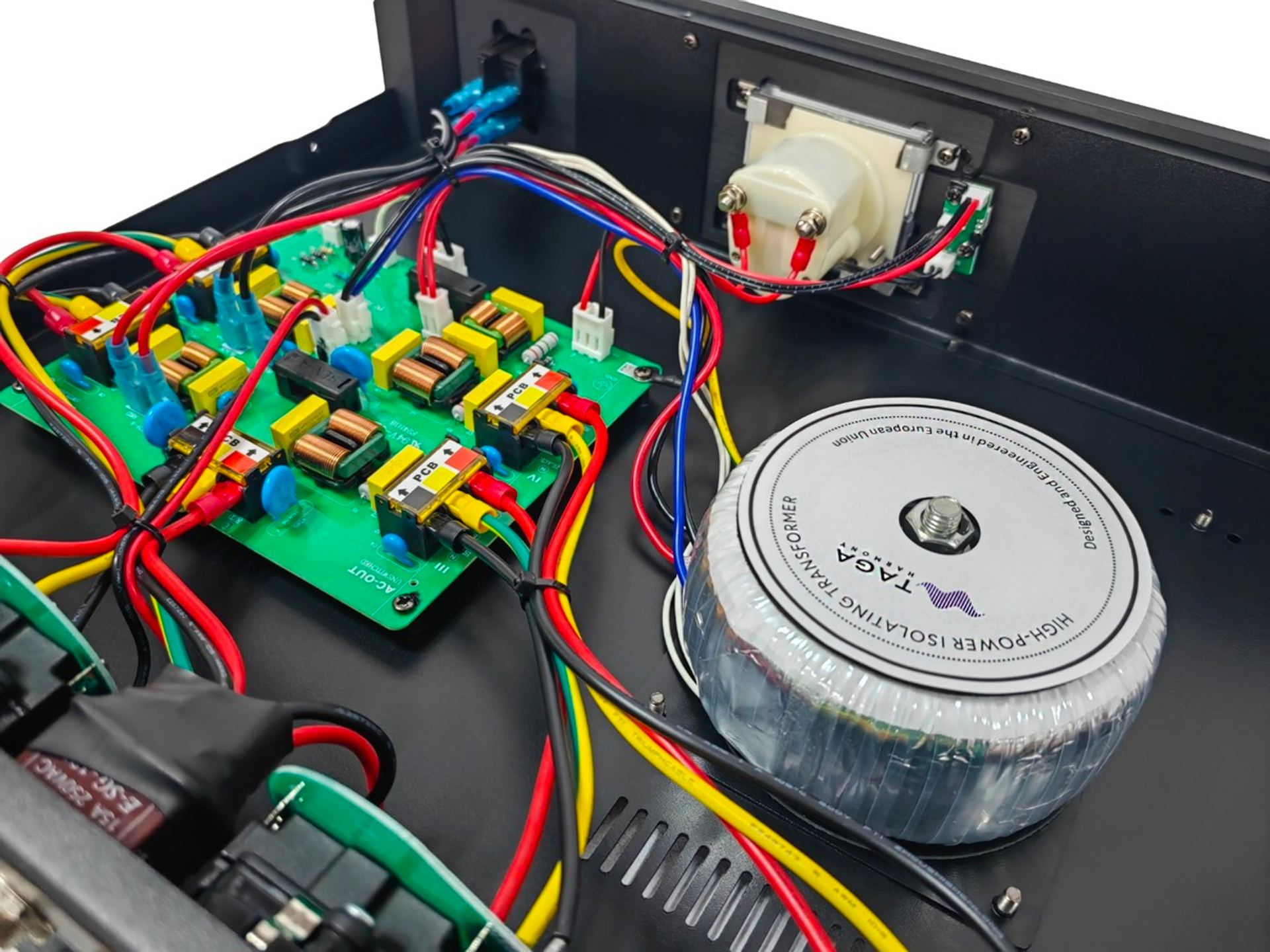
A filtering system tailored to each type of device
Dividing the eight outlets into four distinct groups is one of the PC-7000’s main strengths. This segmentation reflects a precise understanding of the differing needs of hi-fi and home theater equipment.
Group I (Switched - 3 A max): These two switched outlets are intended for digital accessories. They benefit from filtering suitable for devices that generate electromagnetic interference while being sensitive to clean current.
Group II (Switched - 1 A max): This second pair of switched outlets specifically targets audio sources (CD players, network players, DACs). The 1 A limit matches the typical consumption of these devices, while the filtering prioritizes signal purity.
Group III (Unswitched - 5 A max): These unswitched outlets, which remain powered even when the front switch is off, are suitable for preamplifiers and accessories that need to stay on. The filters in this group are sized to handle higher currents.
Group IV (Unswitched - 5 A max): The last pair, also unswitched and accepting up to 5 A, is intended for power amplifiers. The filtering is tuned not to compress dynamics while cleaning the current.
This organization into independent groups aims to prevent a particularly electrically noisy device from contaminating other equipment connected to the same conditioner. A Class D amplifier, for example, can generate high-frequency interference that, without separate filtering, would propagate to more sensitive audio sources.
Protection and monitoring of the electrical network
Beyond filtering, the PC-7000 incorporates several protection and monitoring features. The front analog voltmeter lets you check, in real time, the stability of the mains voltage. This visual indication is useful for detecting abnormal variations that could affect performance or equipment longevity.
The phase detector, indicated by a light, identifies a possible reversal of phase and neutral in the electrical installation. When the indicator lights red, a simple polarity switch on the back corrects this issue without having to modify the home’s fixed wiring. This function may seem anecdotal, but reversed phase can sometimes create ground loops or background noise in audio systems.
Surge and spike protection activates automatically. The system can absorb spikes up to 3000 V (at 10 mA) and limit the voltage delivered to connected devices to a maximum of 775 V during a fast transient. The maximum dissipable energy is 140 joules, which corresponds to standard protection against thunderstorms or occasional grid faults, though it does not match the capacity of dedicated, high-capacity surge arresters.
The conditioner’s own consumption remains negligible: less than 0.1 W at idle, plus 0.2 W when the voltmeter backlight is on. This energy frugality allows you to leave the PC-7000 powered at all times without significantly impacting your electricity bill.
Documentation
Technical Specifications
Electrical Specifications
- Device type: Power line conditioner
- Outlets: 8 Schuko sockets (4 switched + 4 unswitched)
- Configuration: 4 groups of 2 sockets each
- Group I (switched): 3 A max – digital accessories
- Group II (switched): 1 A max – audio sources
- Group III (unswitched): 5 A max – preamplifiers and accessories
- Group IV (unswitched): 5 A max – amplifiers
- Total maximum load: 14 A, 3450 W
- Power supply: 230 V 50 / 60 Hz
- Power consumption
- Without connected device: < 0.1 W
- With backlight enabled: + 0.2 W
Filtering and Protection
- Noise filtering: -10 dB to 55 dB (2 – 100 MHz)
- Individualized filtering for each outlet group according to equipment type
- Surge and spike protection
- Maximum surge current: 4500 A [8 / 20 µs, single]
- Maximum peak voltage: 3000 V [10 mA]
- Maximum clamping voltage: 775 V [8 / 20 µs]
- Maximum rated energy: 140 J [10 / 1000 µs]
- Full protection against electrical overloads
Components and Construction
- 200 W toroidal transformer to isolate audio sources from line noise
- Shielded aluminum cover to protect the transformer from electromagnetic interference
- Oxygen-free copper inductors for each outlet group
- High-quality class X capacitors for optimal filtering
- Internal oxygen-free copper wiring for maximum conductivity
Connectivity
- Output sockets: Schuko type
- Power input: IEC C14
- Power cord: Removable Schuko–IEC C13, compatible with premium audiophile cables
Interface and Control
- Analog voltage meter with backlight to monitor grid stability
- Phase detector to identify wiring errors
- Polarity switch to easily correct phase errors
Dimensions and Weight
- Dimensions: 11 H x 43 W x 33 D cm (with feet)
- Weight: 8.4 kg
Frequently Asked Questions
Should you plug all your devices into the PC-7000 or only certain components?
Logic suggests prioritizing sensitive audio sources (DACs, CD players, preamplifiers) and noisy digital devices that benefit most from filtering. Power amplifiers can also gain from more stable current, but some very high-end systems prefer a direct wall connection to preserve maximum dynamics. Ideally, test different configurations to find what best suits your setup.
Can the toroidal transformer limit the available power for a demanding amplifier?
The PC-7000’s 200 W transformer serves for isolation rather than raw power delivery. The outlet groups accept up to 5 A (i.e., 1150 W at 230 V) for amplifiers. This is sufficient for most living-room amplifiers, but a very power-hungry monoblock or a high-power Class AB amp could, in theory, run into this limit during large musical peaks. In practice, it is rare in domestic situations for this constraint to become audible.
Are the voltmeter and phase detector actually useful day-to-day?
The voltmeter provides reassuring visual feedback on mains stability. It helps spot abnormal variations that would otherwise go unnoticed. The phase detector is mainly useful during initial setup: once the correct polarity is set via the dedicated switch, the indicator remains off and you can forget about it. These features aren’t essential to the conditioner’s operation, but they help with troubleshooting if issues arise.
Can the supplied power cable be replaced with a specialized model?
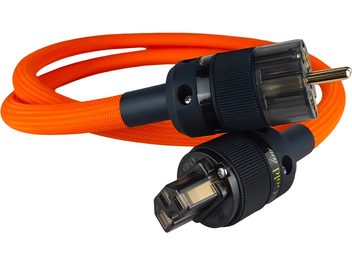
Yes, the IEC C14 input on the back of the PC-7000 accepts any compatible power cable. Taga Harmony also offers its own range of power cords (TPC and STPC series) designed to pair with its conditioners. Some users report subtle improvements when replacing the stock cable, while others hear no difference. As often in audio, the result depends on the system and the listener’s sensitivity.
The front switch only controls four outlets: is that a limitation?
It may be surprising, but this design isn’t a flaw. The four unswitched outlets (Groups III and IV) are intended for equipment that benefits from staying powered: preamplifiers, amps that need warm-up time, audio servers. The four switched outlets (Groups I and II) let you cut sources and digital accessories with a single action. This logic fits real-world use, even if a global switch would have offered more flexibility.
What’s the real difference between the PC-7000 and the more expensive PC-5000?
Both models share a similar philosophy with four independent outlet groups, a toroidal transformer, and phase detection features. The PC-5000 uses slightly different internal components and shows similar specifications. The PC-7000 is a slightly reworked 2025 version, but the performance differences remain subtle. The choice often comes down to availability and pricing rather than a dramatic sonic gap.
Does the PC-7000 effectively protect against lightning and power outages?
The PC-7000’s surge protection absorbs spikes up to a certain threshold (140 joules, 4500 A one-time peak). This covers common grid surges and minor disturbances, but it doesn’t replace a modular surge arrester installed at the breaker panel in areas prone to severe thunderstorms. Likewise, the conditioner does not protect against power outages: for that, you would need an uninterruptible power supply (UPS) with a backup battery.
- Eco-contribution of €1.46 included in the sale price.