

Bowers & Wilkins ISW-8

Overview
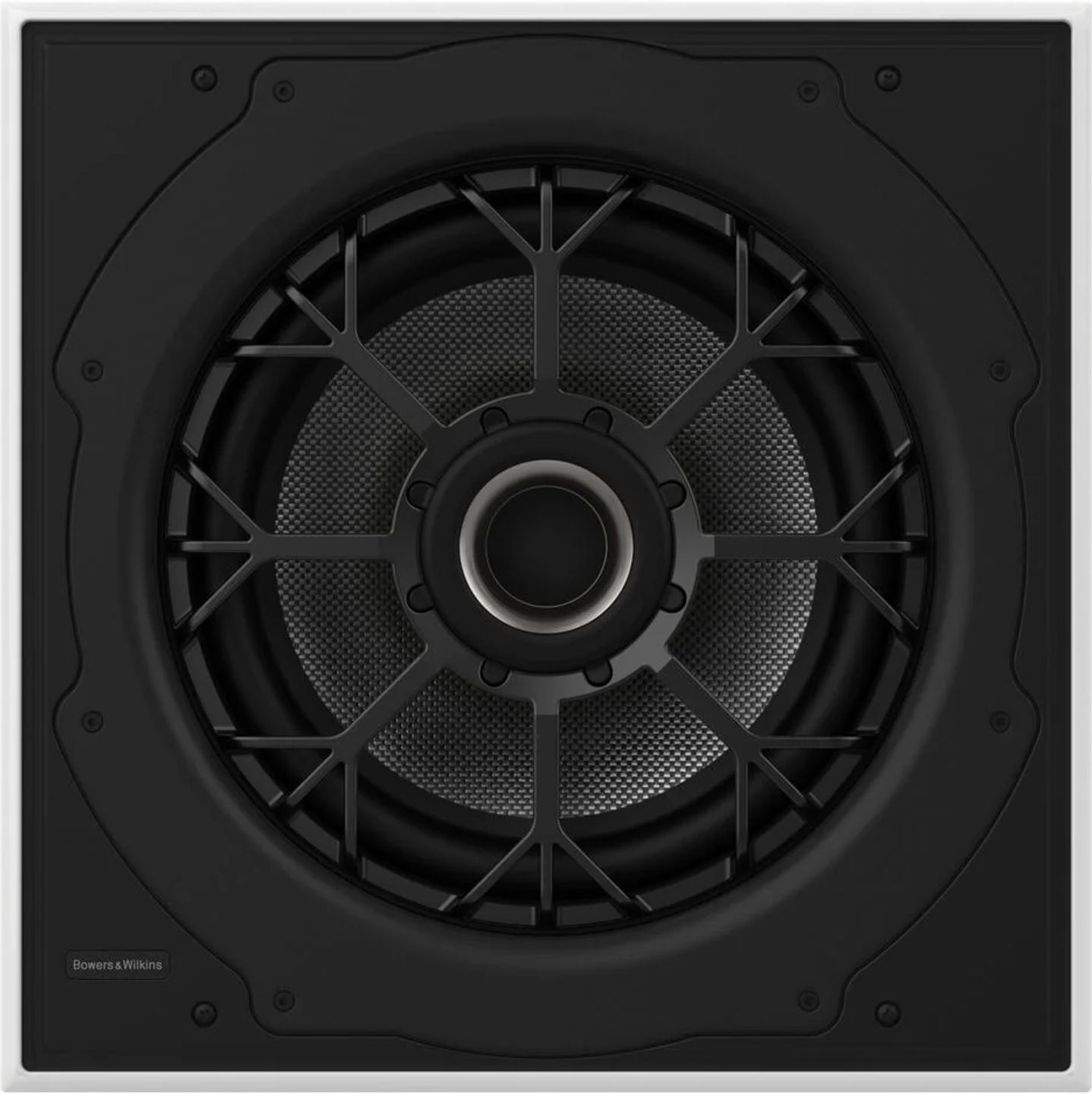
The ISW-8 from Bowers & Wilkins is an in-wall subwoofer designed for custom installations. It features a 30 cm Aerofoil cone driver and an anti-vibration isolation system. This passive subwoofer can be integrated into a standard 2×4 wall with a depth of 84 mm. It is designed to be used with CI700 and CI800 in-wall speakers, delivering bass suitable for both home theater and hi-fi installations.
A subwoofer designed for uncompromised in-wall integration
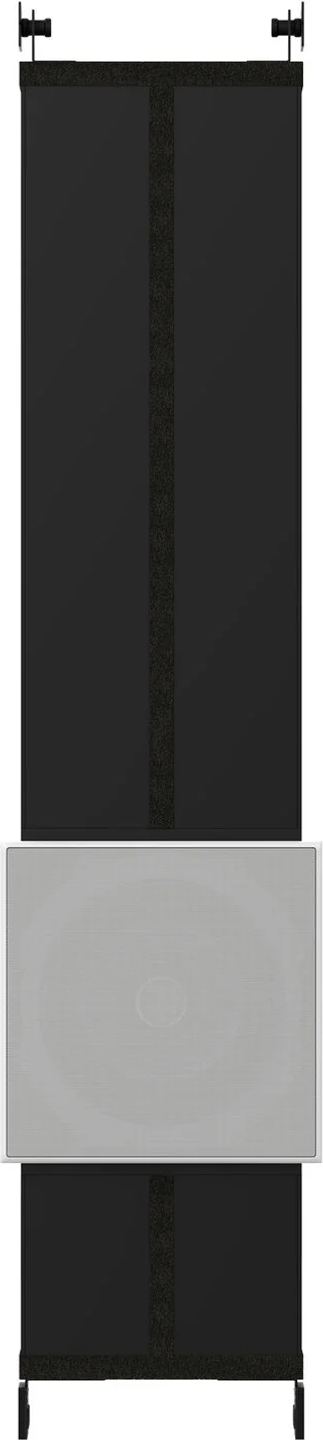
The ISW-8 embodies Bowers & Wilkins’ response to a very specific challenge: how to achieve reference-grade bass in a custom installation where visual discretion is paramount? The technical challenge was to design a subwoofer capable of moving enough air to generate deep bass while adhering to the dimensional constraints of a standard wall. The result takes shape in a sealed (closed-box) MDF cabinet with internal bracing, measuring 1,640 mm in height, 350 mm in width, and only 84 mm in depth, allowing integration into a 2×4 stud bay typical of North American construction or equivalent European partition walls.
The subwoofer’s internal volume of 30 liters, though limited by the shallow depth, is optimized through meticulous acoustic design. The sealed enclosure, rather than a bass-reflex (ported) system, was chosen for several technical reasons: it offers faster transient response, better cone control at low frequencies, and avoids air turbulence that could be problematic in the confined space between wall studs. Internal bracing reduces cabinet self-resonances, ensuring that only the driver produces sound.
The subwoofer’s visible baffle measures 400 × 400 mm with a depth of 8.5 mm, ensuring discreet in-wall integration. This square surface provides installation flexibility and visual balance. The baffle can be painted to match decor, offering complete invisibility once the installation is complete.
The Aerofoil cone: the result of advanced computer modeling
At the heart of the ISW-8 is a 30 cm (12-inch) driver featuring an Aerofoil cone, a technology derived from research developed for the 800 Diamond series. This composite cone has a variable thickness calculated through advanced computer modeling: thicker where rigidity is crucial, thinner elsewhere to keep overall mass low. This approach achieves optimal pistonic behavior, where the cone moves like a rigid piston without deformation or parasitic breakup modes within the usable bandwidth.
The Aerofoil cone’s sandwich structure combines a carbon fiber skin with a syntactic foam core, a composite material formed from preformed hollow microspheres. This construction offers an exceptional stiffness-to-mass ratio: the cone remains light enough to react instantly to fast transients, yet rigid enough to move the air needed for reproducing the lowest frequencies. Neodymium magnets, more powerful than ferrite magnets of the same volume, enable precise magnetic control of the voice coil while reducing the overall motor size.
The cone excursion sets a record for Bowers & Wilkins in the field of in-wall subwoofers. This long-throw design allows the large displacements required to generate high sound pressure levels despite the cabinet’s limited volume. Frequency response extends from 16 Hz to 200 Hz (-3 dB), with a usable range of 12 Hz to 260 Hz (-6 dB), providing comprehensive low-frequency coverage. The nominal impedance of 8 ohms makes it easy to drive with external amplifiers, and the 1000-watt power handling allows the transducer’s dynamic potential to be fully exploited.
An integrated anti-vibration system to preserve structural integrity
One of the most remarkable aspects of the ISW-8 is its integrated anti-vibration mounting system. Unlike traditional floor-standing subwoofers, an in-wall subwoofer presents a major risk: the direct transmission of low-frequency vibrations into the building’s structure. These vibrations can not only disturb occupants in adjacent rooms but also degrade perceived sound quality by creating parasitic resonances in the surrounding partitions.
Bowers & Wilkins has designed the ISW-8’s backbox with vibration isolation mounts specifically developed for this application. These mounts suspend the subwoofer in the wall while mechanically decoupling it from the rest of the structure. The principle relies on elastomeric materials that absorb vibrational energy rather than transmitting it. This active decoupling delivers two distinct benefits: it improves acoustic performance by eliminating colorations induced by wall resonances, and it preserves the building’s structural integrity by limiting mechanical fatigue of the materials.
This approach contrasts with aftermarket isolation solutions, such as platforms or decoupling stands, often required for traditional subwoofers. Here, isolation is an integral part of the design, ensuring maximum effectiveness without additional interventions. For installers, this also simplifies implementation: once the subwoofer is properly positioned and secured according to the instructions, the anti-vibration system operates optimally with no further adjustments.
Documentation
Technical Specifications
Speaker
- Type: in-wall subwoofer
- Driver size: 30 cm
- Cone: Aerofoil bass profile
- Nominal impedance: 8 Ω
- Power handling: 1000 W
Frequency response
- Frequency response at –3 dB: 16–200 Hz
- Frequency range at –6 dB: 12–260 Hz
Enclosure
- Type: sealed enclosure
- Dimensions
- Height: 1640 mm
- Width: 350 mm
- Depth: 84 mm
- Material: MDF with internal bracing
- Internal volume: 30 L
Front panel
- Dimensions
- Height: 400 mm
- Width: 400 mm
- Depth: 8.5 mm
BB ISW-8 (back box) is mandatory for the Bowers & Wilkins ISW-8 built-in subwoofer
Frequently Asked Questions
Which amplifier should be used to drive the ISW-8?
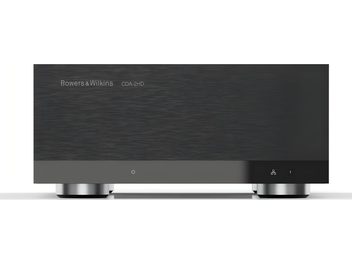
As the ISW-8 is a passive subwoofer, it requires a dedicated external amplifier. Bowers & Wilkins recommends its own CDA-2HD, a Class D power amplifier specifically developed for custom installations. This two-channel amplifier delivers 2 × 250 watts into 8 ohms, or can be bridged to provide 1000 watts on a single channel, exactly matching the ISW-8’s power handling. The CDA-2HD includes a digital preamplifier with DSP, allowing fine adjustments of level, phase, and crossover frequency. Other amplifiers of equivalent quality can be used, provided the 8-ohm impedance is respected and continuous power does not exceed 1000 watts.
Can the ISW-8 be installed in all wall types?
The 84 mm mounting depth allows installation in standard 2×4 stud walls (actual 89 mm), common in North America, as well as equivalent European partitions from 70 to 100 mm. However, installation in a load-bearing concrete or masonry wall requires a specially prepared niche. The subwoofer’s considerable height (1,640 mm) also requires checking the spacing of horizontal noggings. For renovations, a prior assessment of the wall structure is essential. Installation in non-load-bearing lightweight partitions remains the simplest solution, provided the structure can support the system’s weight and the dynamic forces generated during operation.
Is the backbox really mandatory?
Yes, the backbox is an integral part of the ISW-8 system and its use is not optional. Without this backbox, the subwoofer would not function correctly. The backbox serves three essential functions: it defines the rear acoustic volume required for proper cone behavior, prevents the rear sound waves from dissipating into the wall cavity (which would create destructive interference), and incorporates the anti-vibration mounts that protect the building’s structure. The backbox must be ordered separately when purchasing, as it is not included with the subwoofer itself. This separation allows installers to choose the optimal timing for backbox installation during construction or renovation.
Can the ISW-8 be used in a stereo setup rather than home theater?
Absolutely. While home theater is the primary application for many subwoofers, the ISW-8 also excels in high-performance stereo configurations. For fans of classical, jazz, or electronic music, adding one or two ISW-8 units to a stereo system based on CI700 or CI800 in-wall speakers extends low-frequency response down to 16 Hz (-3 dB), a region unreachable for most speakers. This extension provides foundation and depth that are especially rewarding with orchestral recordings, church organs, or synthesizers. Using two ISW-8s in stereo, each assigned to one channel, preserves spatial information contained in low frequencies and creates an even more natural, three-dimensional soundstage.
What is the difference between the ISW-8 and the ISW-6?
The ISW-6 is the mid-range model in Bowers & Wilkins’ in-wall subwoofer lineup, while the ISW-8 sits at the top. The main difference lies in driver size: 20 cm (8 inches) for the ISW-6 versus 30 cm (12 inches) for the ISW-8. This difference in diameter translates into the ISW-8’s increased ability to move air and therefore generate higher sound pressure levels, particularly in the deep bass. The ISW-8 also extends lower in frequency (16 Hz versus around 25 Hz for the ISW-6) and can handle more power (1000 watts versus 500 watts). The ISW-6 is nonetheless more compact in height, making it easier to integrate in certain configurations. The choice between the two models depends on room volume, associated speakers, and the desired performance level.
How do you set the level and crossover frequency of the ISW-8?
These settings are made on the external amplifier driving the ISW-8, typically the Bowers & Wilkins CDA-2HD or an equivalent amplifier. The crossover frequency, generally between 50 and 120 Hz depending on the main speakers used, determines the point where the subwoofer takes over from the speakers. With CI700 or CI800 speakers, a crossover around 80 Hz is often a good starting point. The subwoofer level should be adjusted to blend naturally with the main speakers, without excessive or insufficient bass. Acoustic measurement tools, such as an SPL meter with spectral analysis or a calibration microphone, allow these settings to be refined objectively. Phase may also require adjustment to compensate for delay introduced by the distance between the subwoofer and the listening position.
- Eco-contribution included in the sale price.
- Manufacturer reference: FP42900
- GTIN / EAN: 714346337569