

Bowers & Wilkins CDA-2HD

Overview
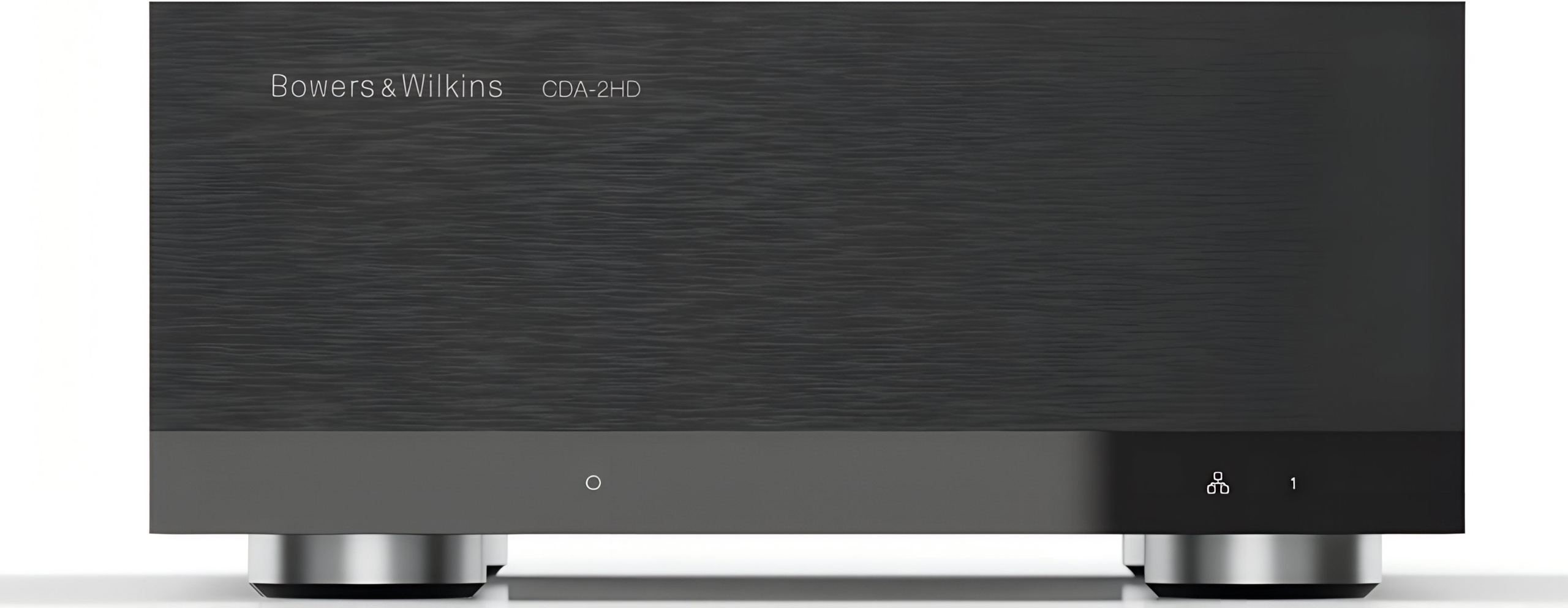
The CDA-2HD is a two-channel amplifier designed for Bowers & Wilkins installation speakers. It delivers 500 watts per channel in Class D and integrates digital signal processing (DSP). Its half-width 2U rack-standard format allows for compact installation. The unit can operate in bridged mode to deliver 1,000 watts and includes dynamic equalization tailored to the brand’s subwoofers. It also offers configuration and control via the AVB network protocol.
Power and flexibility in an optimized form factor
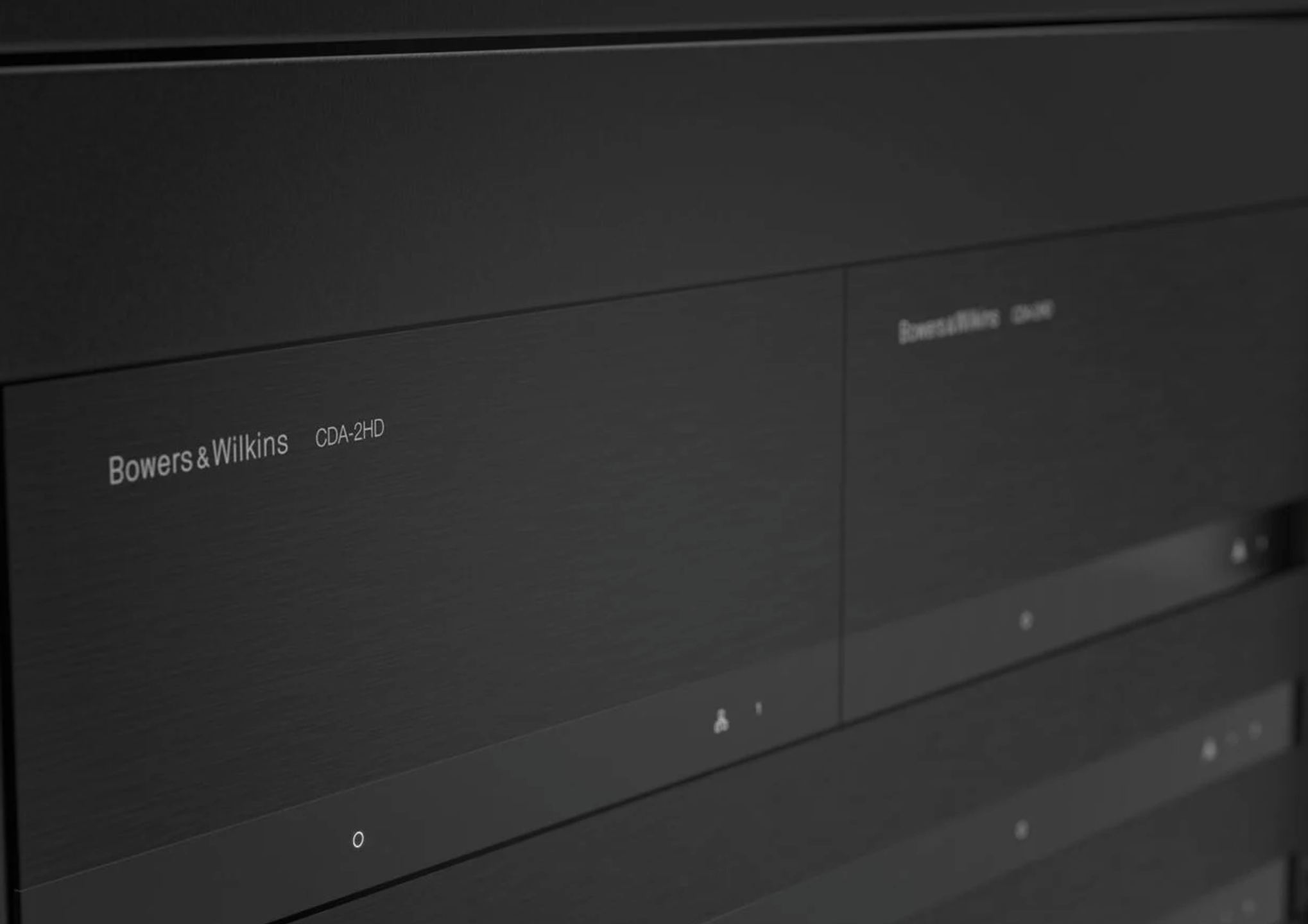
The CDA-2HD delivers 500 watts per channel into 4 ohms thanks to its Class D amplification. This technology provides high power density while maintaining notable thermal efficiency—an appreciable advantage in installations where rack space is limited. Its half-width format occupies only 218 mm in width and 85 mm in height (1U in standard configuration, 2U with the supplied feet), allowing two units to be installed side by side in a standard 19-inch rack.
Bridged mode converts the two stereo channels into a single 1,000-watt mono output at 8 ohms, a relevant option for powering a demanding subwoofer or a speaker requiring greater headroom. The amplifier supports load impedances above 3 ohms per channel, or above 6 ohms in bridged mode, thus offering compatibility with most professional installation speakers.
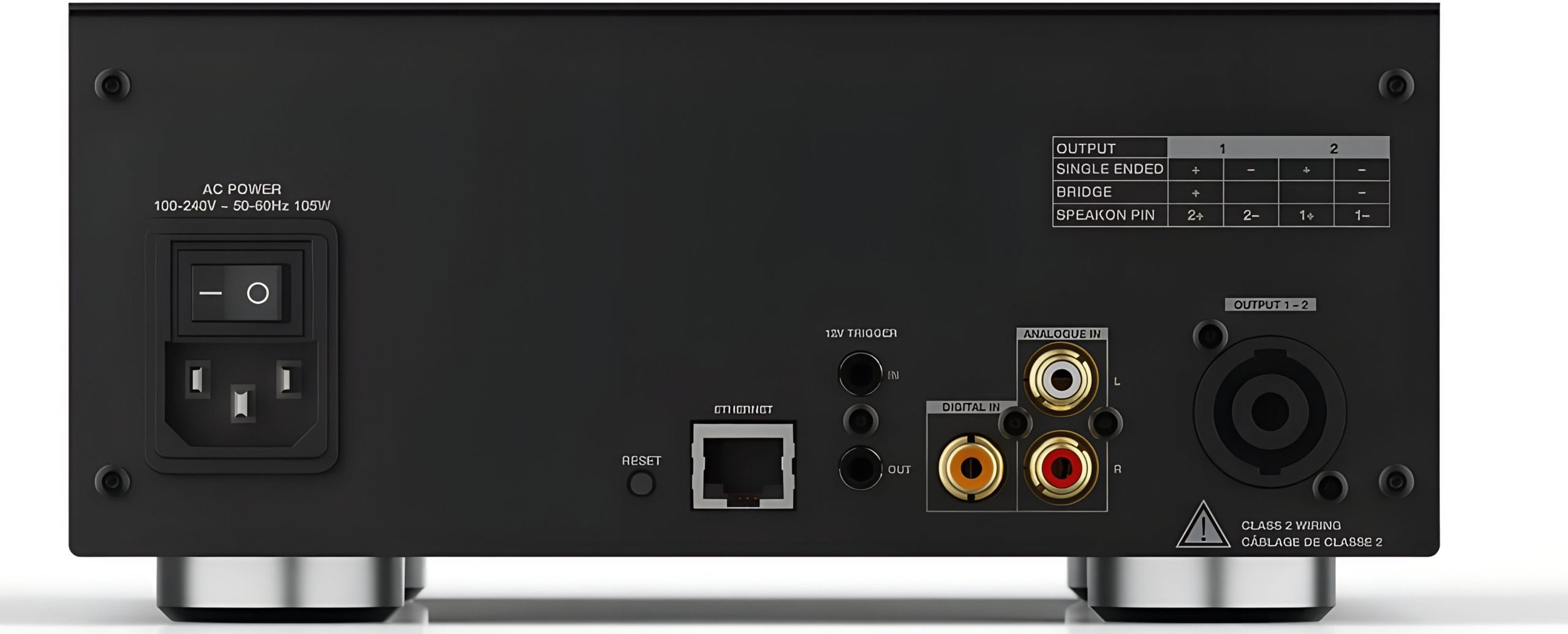
SpeakON connectors ensure speaker hookup—a coherent choice for permanent installations where connection reliability is paramount. The universal 100–240 V power supply with IEC C14 connector and integrated switch facilitates integration across different geographic regions.
Digital signal processing and tailored equalization
The onboard DSP processor is the core of the CDA-2HD’s flexibility. It allows fine-tuning of acoustic parameters according to the driven speaker and the room’s acoustics. The 8-band parametric equalizer offers precise control over frequency response, with configurable crossover-type filters (High Shelf, Low Shelf, or disabled).
The dynamic equalization developed specifically for Bowers & Wilkins subwoofers automatically adapts the signal based on listening level and program content. This function preserves low-frequency accuracy without excessive compression or distortion, even at sustained listening levels.
Delay settings allow temporal alignment of the different speakers in a system—a necessity in installations where distances between transducers and listeners vary. Delay is expressed in milliseconds, feet, or meters, with conversions between these units calculated automatically in the configuration interface.
The 180° phase inversion function facilitates correction of potential phase issues between speakers, while the adjustable gain from 21 dB to 45 dB adapts input sensitivity to different audio sources, whether analog via RCA connectors or digital via coaxial input.
Network management and AVB protocol
The Ethernet interface allows not only amplifier configuration via a web browser, but also integration within an AVB (Audio Video Bridging) network. This IEEE-standardized technology ensures synchronized, low-latency audio transmission over standard Ethernet.
When multiple CDA amplifiers (CDA-2HD or CDA-4D) are connected to the same network via an AVB-compatible switch, they can share their analog or digital audio sources. This network architecture simplifies wiring in complex multizone installations and enables centralized audio routing without multiplying dedicated cables.
Configuration is performed entirely via a web interface accessible from any device connected to the network, whether a computer, tablet, or smartphone. This approach avoids installing proprietary software and facilitates remote adjustments once the installation is complete.
The CDA-2HD offers three power-on modes: manual activation, automatic audio signal detection (2.5 mV threshold), or triggering via a 12 V signal. This last mode allows power-on to be synchronized with other system equipment. Auto-standby occurs 15 minutes after the last detected signal, reducing power consumption to less than 0.5 watts in standby.
Documentation
Technical specifications
General features
- Number of channels: 2 channels
- Output power
- 250 W into 8 Ω
- 500 W into 4 Ω
- 1000 W into 8 Ω in bridged mode
- Number of zones: 1 zone
- Digital signal processor: Built-in DSP
Audio performance
- Load impedance range: greater than 3 Ω per channel, greater than 6 Ω in bridged mode
- DC offset voltage: less than 50 mV
- Frequency response at -3 dB: below 10 Hz to above 30 kHz, any load impedance
- Frequency response accuracy 20 Hz - 20 kHz: +/- 1 dB
- Dynamic range: greater than 85 dB A-weighted
- Total harmonic distortion + noise at 1 kHz, 500 W, 4 Ω: less than 1%
- Voltage gain: 21 dB to 45 dB, adjustable
- Input impedance: 10 kΩ
- Maximum input voltage: 4 Vrms
- Signal detection threshold: 2.5 mV, independent of gain setting
- Wake-up time: less than 0.2 s if other zones active, less than 2 s from all zones inactive
- Power-down time: 15 minutes after last signal detection
- 12 V trigger threshold: typically 3 V, recommended input 5 - 15 V
Connectivity
- Inputs
- 1 stereo RCA jack: analog line input
- 1 RCA jack: digital line input
- 1 Ethernet port
- Output
- 1 SpeakON connector
- 12 V trigger control
- 1 x 3.5 mm jack: 12 V trigger input
- 1 x 3.5 mm jack: 12 V trigger output, maximum 100 mA pass-through
Power and thermal
- Power consumption
- Less than 0.5 W in standby, network wake-up disabled
- Less than 0.5 W in standby, network wake-up enabled
- Mains power: 100 - 240 V, 50 / 60 Hz
- Mains inlet: IEC C14, with switch
- Heat dissipation
- 1.7 BTU / h in standby
- 150 BTU / h at idle
- 650 BTU / h at maximum operation
Controls and indicators
- Front panel
- 1 power indicator: white when the unit is active, red in case of fault
- 1 network status indicator: white when the network is present, red in case of fault
- 1 zone status indicator: white when a signal is present, red in case of fault
- Rear panel
- 1 reset panel
Dimensions and finish
- Height: 85 mm, 1U, 100 mm with feet
- Width: 218 mm
- Depth: 323 mm
- Net weight: 3.4 kg
- Finish: black
Frequently Asked Questions
Can the CDA-2HD be used with speakers from other brands?
The amplifier supports any passive speaker with an impedance above 3 ohms per channel. However, the DSP presets and dynamic EQ have been optimized specifically for Bowers & Wilkins speakers and subwoofers. With other brands, you will need to manually configure the EQ and crossover parameters to achieve optimal results.
What is the difference between the CDA-2HD and the CDA-4D?
The CDA-2HD delivers 500 watts across two channels in a 2U half-rack format, prioritizing raw power. The CDA-4D offers four 125-watt channels in a full-width 1U format, geared toward multizone installations or bi-amping. Both share the same DSP features and AVB compatibility, so the choice mainly depends on power needs and the number of zones.
Does the AVB protocol require specific network equipment?
An AVB-compatible Ethernet switch is required to fully benefit from source-sharing features among multiple amplifiers. These managed switches reserve dedicated bandwidth for audio streams and ensure precise synchronization. For simple configuration via the web interface of a single amplifier, any standard switch or router is sufficient.
How to handle installations requiring more than two zones?
Several solutions exist: use a CDA-4D for four distinct zones, install multiple CDA-2HD units daisy-chained via AVB, or combine both models depending on each zone’s power requirements. The AVB network allows free routing of audio sources among all connected amplifiers, offering maximum flexibility.
Does the amplifier generate a lot of heat?
Class D amplification offers high energy efficiency, limiting thermal dissipation. Passive cooling is sufficient in most setups, provided minimum clearances around the unit are respected. The unit dissipates about 150 BTU/h when idle and up to 650 BTU/h at maximum power—moderate values for an amplifier in this category.
Is special cabling required to connect the speakers?
SpeakON connectors accept standard speaker cable of appropriate gauge. For long distances or high power, favor conductors of at least 2.5 mm² to limit line losses. No shielding is required, unlike line-level connections, which benefit from shielding to reduce interference risk.
What is the audio latency introduced by the DSP?
Wake time from standby is under 0.2 seconds if other zones are active, or under 2 seconds from a full shutdown. Once active, the DSP processing introduces negligible latency for residential or commercial installation applications. In an AVB context with multiple synchronized amplifiers, overall latency remains controlled thanks to the protocol’s integrated time precision.
- Eco-contribution included in the sale price.
- Manufacturer reference: FP43613
- GTIN / EAN: 714346339976