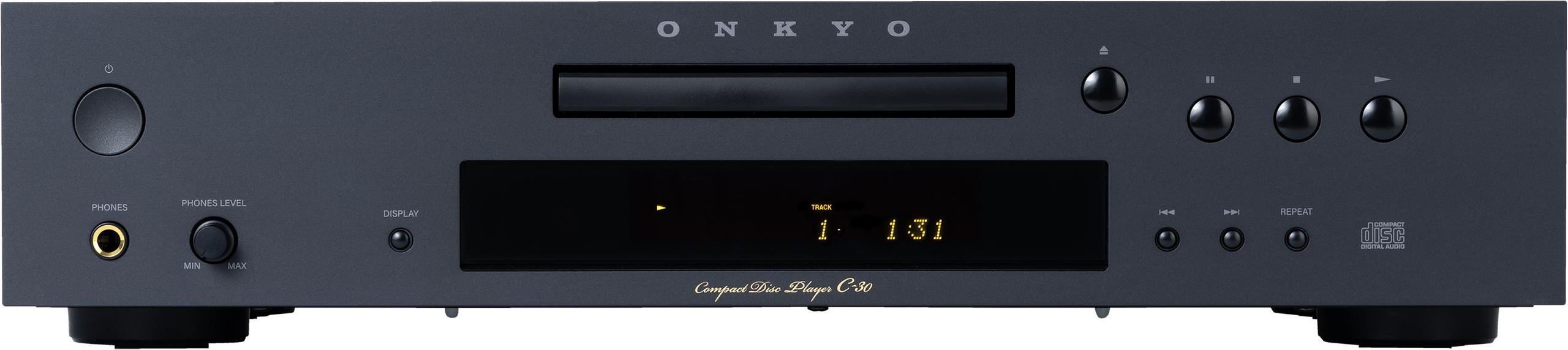
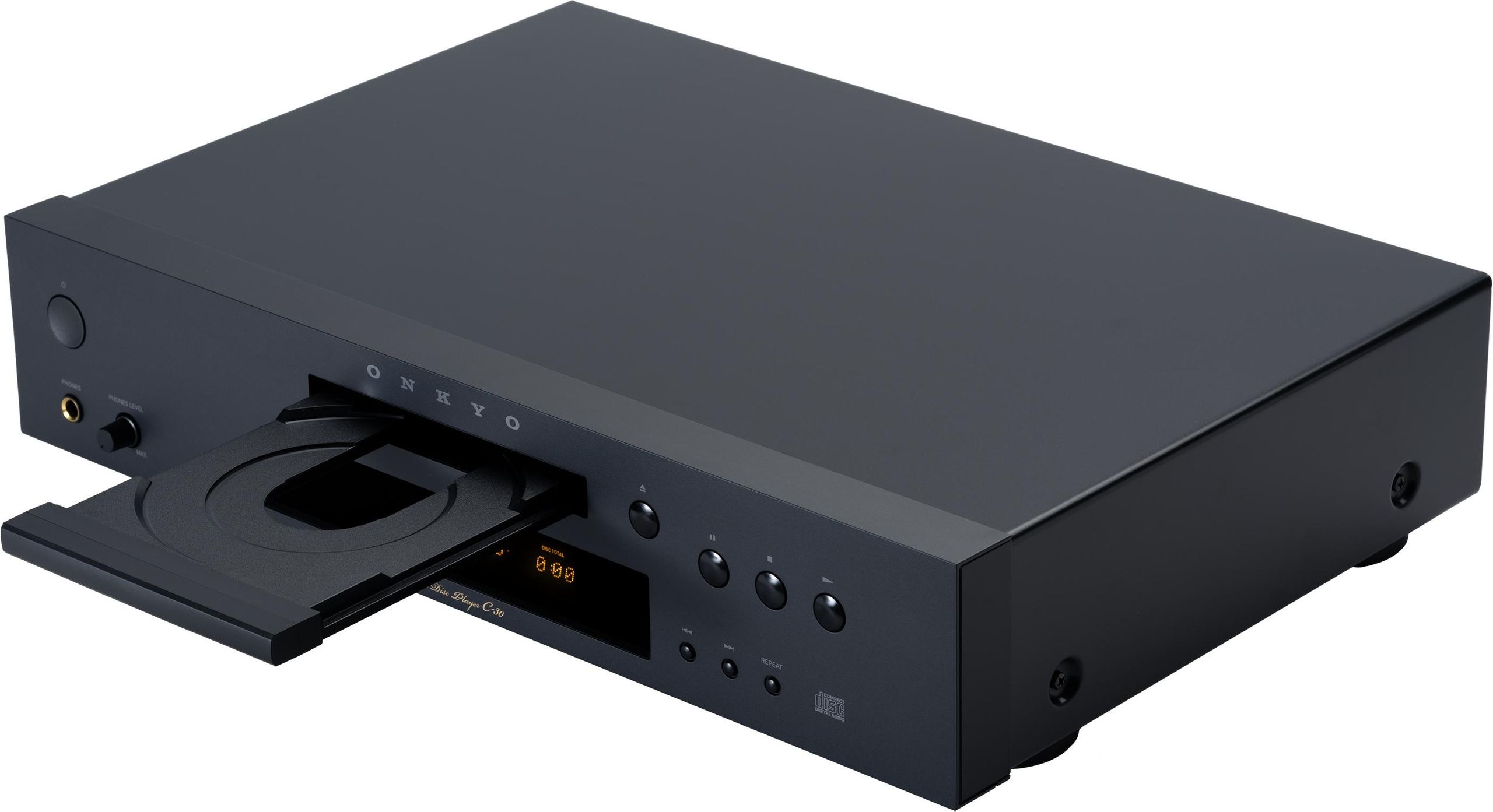
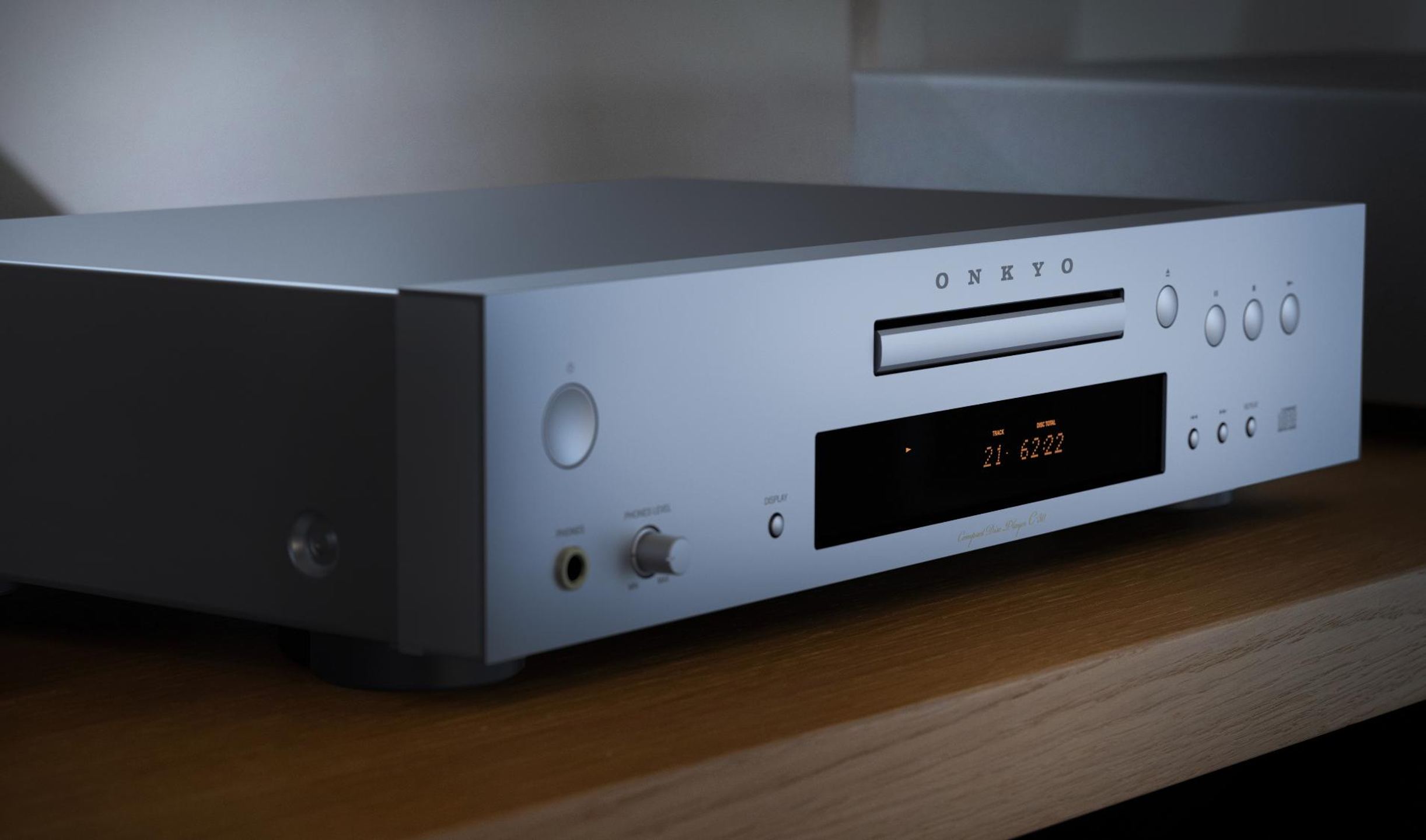
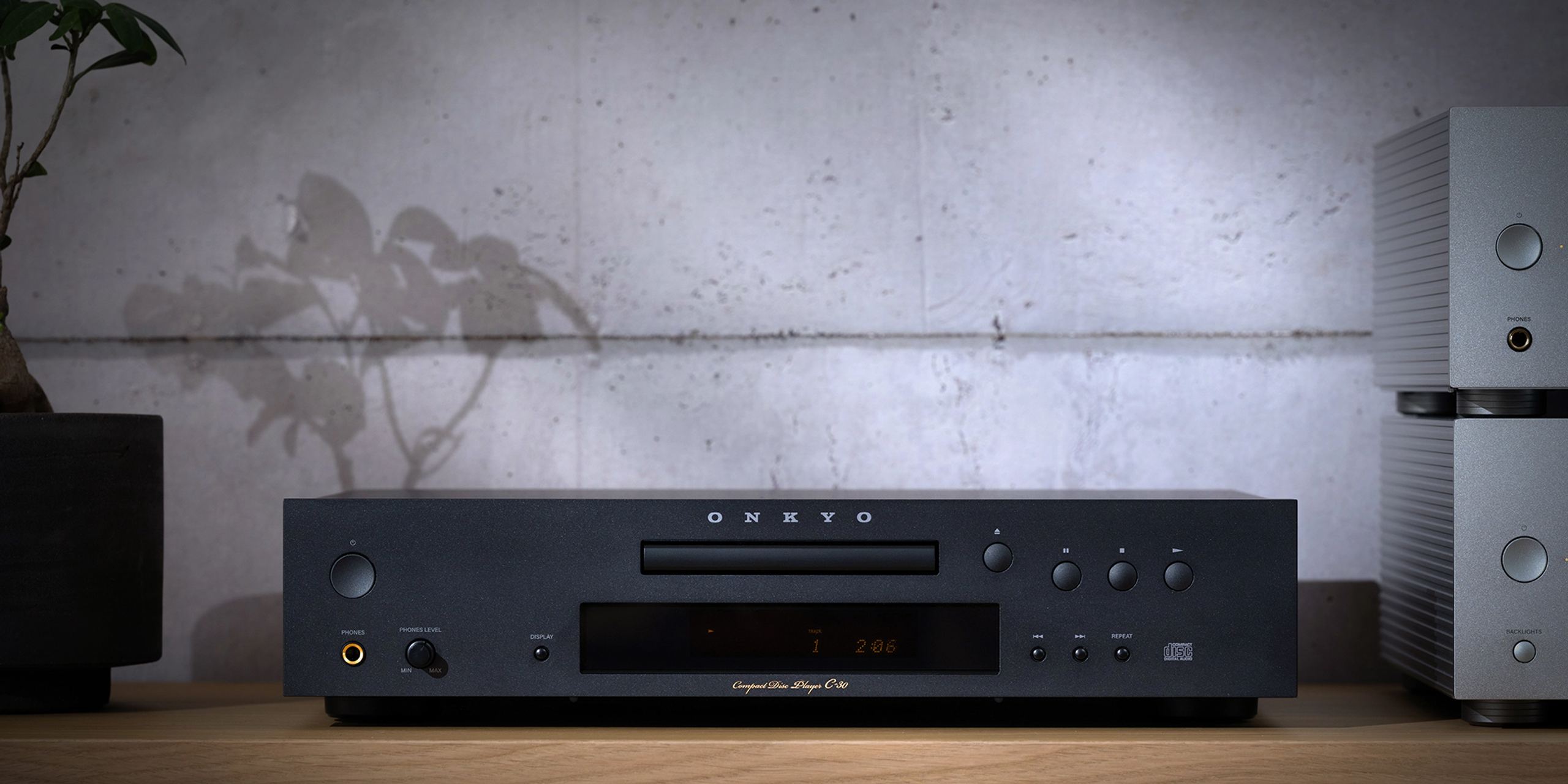
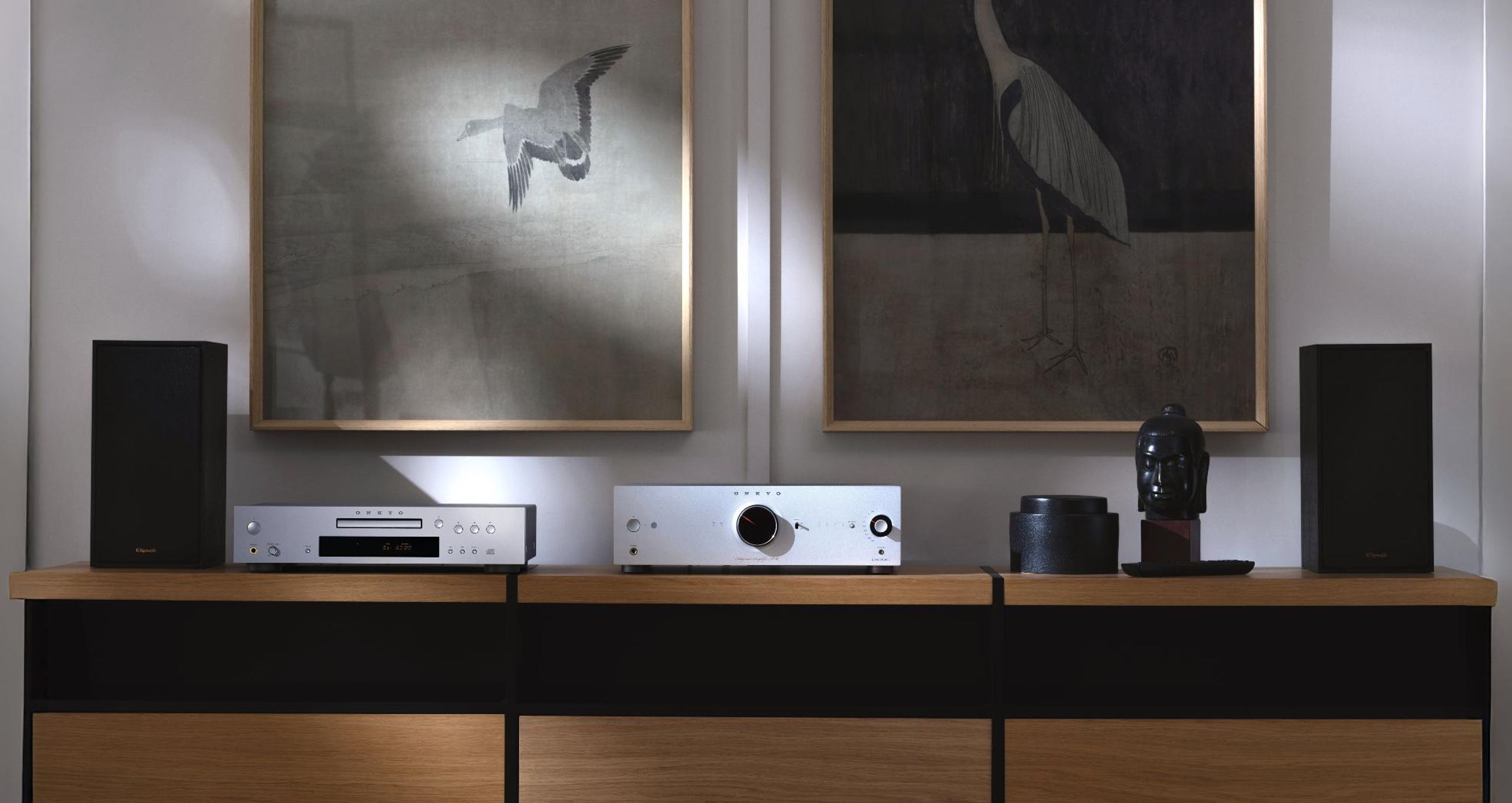
The Onkyo Icon C-30 is a CD player that is part of the Icon series of separate components. The C-30 features Onkyo’s VLSC technology, a 32-bit/768 kHz stereo digital-to-analog converter, and a high-precision clock. Its low-profile, anti-vibration chassis and bead-blasted aluminum front panel are designed to minimize mechanical interference. As the entry-level model in the Icon series, it provides CD playback for users with a disc collection
A chassis designed for mechanical stability
The C-30’s construction is based on a simple principle: eliminate any unwanted vibration that could disrupt disc playback. The low-profile chassis is 1.6 millimeters thick according to data from the previous C-7030 model, and this design is likely carried over to the C-30. This structural rigidity protects the transport mechanism from vibrations transmitted by the equipment rack. The bead-blasted aluminum front panel retains the texture of the metal while reducing reflections. This surface treatment is not just cosmetic: it also helps limit mechanical resonances that can degrade signal quality.
The absence of a fan also contributes to this pursuit of silence. Active cooling systems generate noise and vibration. The C-30 instead uses an extruded aluminum heatsink that dissipates heat through natural convection. This passive solution ensures completely silent operation, allowing the player to integrate into demanding hi-fi systems where any background noise is unacceptable.
VLSC: a proprietary approach to digital-to-analog conversion
VLSC (Vector Linear Shaping Circuit) is at the heart of the C-30. Developed by Onkyo over several decades and present on the C-7030, this proprietary circuitry tackles a recurring problem in digital-to-analog conversion: impulse noise. In conventional methods, the converter transforms digital data into an analog signal in discrete steps. These abrupt transitions generate high-frequency artifacts which, even when filtered, can impair transparency.
The VLSC circuit works differently. Instead of filtering the noise after the fact, it intervenes during the conversion itself. The data are continuously sampled between two discrete points via a signal comparison generator, and the difference is assembled with analog vectors in real time to produce a smooth waveform. The result is an analog signal virtually free of impulse noise, revealing acoustic nuances and subtle details that traditional digital filters can obscure.
The C-30 incorporates a stereo digital-to-analog converter with specifications listing 32-bit resolution and a 768 kHz sampling rate. These figures far exceed the CD format’s 16-bit/44.1 kHz. This upsampling capability allows the DAC to reconstruct waveforms with greater precision, reducing quantization distortion and improving linearity across the entire audible spectrum.
A master clock that synchronizes playback
The C-30 features a high-precision clock with ±10 PPM (parts per million) stability. In a CD player, the clock controls the pace at which data are read from the disc and sent to the digital-to-analog converter. An unstable clock causes jitter, i.e., timing variations in the data stream. Jitter results in a blurry stereo image, weakened rhythmic coherence, and a loss of detail in fast transients.
±10 PPM precision means the clock deviates by at most 10 microseconds per second. This stability, significantly better than the standard clocks found in entry-level players, ensures stable stereo imaging and faithful musical timing. Instruments maintain their placement in the soundstage, note attacks remain crisp, and the soundstage gains depth.
Connectivity: analog, digital, and headphone
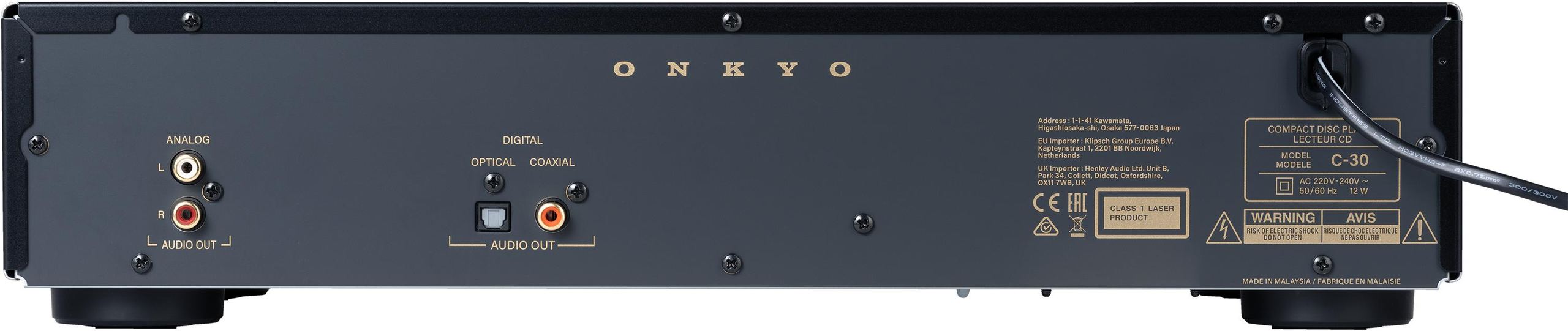
The C-30’s rear panel offers three types of outputs. Gold-plated stereo RCA outputs deliver the analog signal from the internal converter. These connectors benefit from gold plating to prevent oxidation and maintain transmission quality over time. Next to them are two digital outputs—one Toslink optical and one S/PDIF coaxial—which let you bypass the internal DAC. This option is ideal for those who own a higher-quality external converter or want to integrate the C-30 into a digital chain. The C-30 then functions as a transport only: it reads the disc and sends raw data without conversion.
The front panel includes a headphone jack with independent volume control. Some sources mention a 6.35 mm jack, others a 3.5 mm jack. The official C-30 spec sheet lists a 3.5 mm output. This output enables direct headphone listening without an external amplifier. A differential amplification circuit drives this output, ensuring sufficient power for headphones of medium sensitivity.
Supported formats and playback modes
The C-30 plays standard Red Book audio CDs (16-bit/44.1 kHz), as well as burned CD-R and CD-RW discs. It also accepts MP3 and WMA files recorded on these media. This versatility lets you enjoy older personal compilations while maintaining optimal playback of commercially pressed discs.
Playback modes include random play, repeat (single track or entire disc), and program play allowing up to 25 tracks in a custom order. These modes can be combined—for example, random with repeat. While commonplace today, these functions remain useful for looping albums or creating specific sequences without leaving your seat.
What the press says
The C-30 doesn't have a personality, and I mean that as a compliment. [...] The noise floor is impressively low. Background silence in quiet passages is genuinely quiet—no hiss, no hum, nothing creeping up between notes. [...] There's a calmness to it that reminds me of older dedicated CD transport designs—gear built before everything became about the feature count. [...] No SACD support — if you have a high-res disc collection, this won't play it. No USB input — you can't plug in a drive full of FLACs. The controls are functional, not premium. [...] It's just a well-built, well-measured CD player that handles its one job with a composure that a lot of more ambitious gear can't match.
Generation of a pure, distortion-free analog signal
High-precision clock
Stability: ±10 PPM
Stable stereo imaging
Focused, precise soundstage
Playback Formats and Modes
Supported formats: CD, CD-R, CD-RW, MP3, WMA
Available playback modes
Random playback
Repeat playback
Programmed playback
Possible mode combinations
Connectivity
Analog audio outputs
Gold-plated stereo RCA outputs (rear panel)
3.5 mm headphone jack (front panel)
Digital audio outputs
Optical output
Coaxial output
Build and Design
Rigid aluminum front panel with bead-blasted finish
Low-profile chassis optimized for vibration suppression
Fanless design for silent operation
High-quality components ensuring reliability and longevity
Resistance to internal and external vibrations
Frequently Asked Questions
Can the C-30 be used as a dedicated digital transport connected to an external DAC?
+
Yes. The optical and coaxial digital outputs transmit the audio stream without analog conversion. You can thus use a higher-quality external converter while benefiting from the C-30’s transport mechanism and precise clock. This setup appeals to those who have invested in a high-end DAC and are looking for an affordable, reliable CD transport.
What is the main difference between the C-30 and the C-7030?
+
The C-30 joins the Icon series with a new design and updated logo. The converter theoretically moves from 24-bit/192 kHz to 32-bit/768 kHz, improving resolution and dynamics. The styling aligns with other Icon components, allowing you to build a cohesive system. The C-7030 remains available in some channels as an older alternative, but the C-30 represents the natural evolution with Onkyo’s current technologies.
Does the VLSC circuit provide an audible improvement over a standard DAC?
+
VLSC reduces impulse noise at the source instead of filtering it afterward. This approach preserves more detail and avoids artifacts introduced by aggressive digital filters. Feedback from C-7030 users, which already featured VLSC, mentions clear, detailed reproduction with good instrument separation. The circuit’s effectiveness also depends on the quality of the rest of the system: a revealing setup will make these differences more apparent than entry-level gear.
Does the C-30 play SACDs or high-resolution files from a USB drive?
+
No. The C-30 is limited to audio CDs, CD-Rs, CD-RWs, and MP3/WMA files burned to these discs. There is no SACD playback, no USB port for file playback, and no network connectivity. This deliberate specialization avoids complexity and focuses on optimal playback of the standard CD format. If you’re looking for high-resolution file playback, the Icon series P-80 preamplifier includes a 32-bit/768 kHz DAC and network functions.
What is the headphone output power, and is it suitable for demanding headphones?
+
Onkyo mentions a differential amplification circuit for the headphone output, a sign of better sound quality and sufficient power. Precise technical specifications for this output are not publicly detailed. The C-7030’s headphone output, equipped with a similar system, could drive medium-sensitivity headphones without difficulty. For low-efficiency planar headphones or very high-impedance models, a dedicated headphone amplifier is still recommended.
Does the CD format offer better sound quality than streaming services?
+
CD delivers an uncompressed 16-bit/44.1 kHz stream, equivalent to FLAC or ALAC in streaming. Services offering lossless streaming (Tidal HiFi, Qobuz, Apple Music Lossless) theoretically provide the same quality. The difference lies elsewhere: stream stability, absence of network-related variations, and above all permanent ownership without a subscription. For those who have built a CD collection over the years, a dedicated player like the C-30 makes the most of that investment and ensures lasting access to their music.
User reviews
Leszek
So far, no complaints. Big plus for the quiet drive and retro display.
Comment from February 08, 2026 — Experience from January 26, 2026
Automatically translated — Show original (Polish)
Na razie bez zastrzeżeń. Duży plus za cichy napęd i retro wyświetlacz.
Aneta
Great player, replacing my worn-out Denon that has trouble reading discs. I think it sounds better, in real life it looks very good, now I’m waiting for a price drop on the remaining ICON series components so I can complete the whole set ;-)
Comment from February 06, 2026 — Experience from January 26, 2026
Automatically translated — Show original (Polish)
Świetny odtwarzacz, zastępuje wysłużonego denona w którym mam problem z czytaniem płyt.
Uważam że gra lepiej, na żywo wygląda bardzo dobrze, czekam na obniżenie cen pozostałych elementów z seri ICON żeby skompletować całość ;-)
Eco-contribution included in the sale price.
Manufacturer reference: C30BMMP
GTIN / EAN: 4573211155921
Thank you for choosing us
To better understand our visitors, measure marketing effectiveness and personalise ads, we and our partners use cookies and mobile advertising identifiers on your device. This data makes it possible to display personalised and non-personalised ads and measure their performance. Some cookies, which are technically necessary, are exempt from consent. You can accept those that require your consent, refuse them by clicking "Refuse", or customise your choices via the settings screen.
To find out how Google uses the data collected once you have given your consent, see Google’s Business Data Responsibility site.
You can change or withdraw your consent at any time via the "Consent and cookies" link. Your choices will apply on our site for 12 months.