Gold Note PA-10 EVO black


Complementary product
Overview
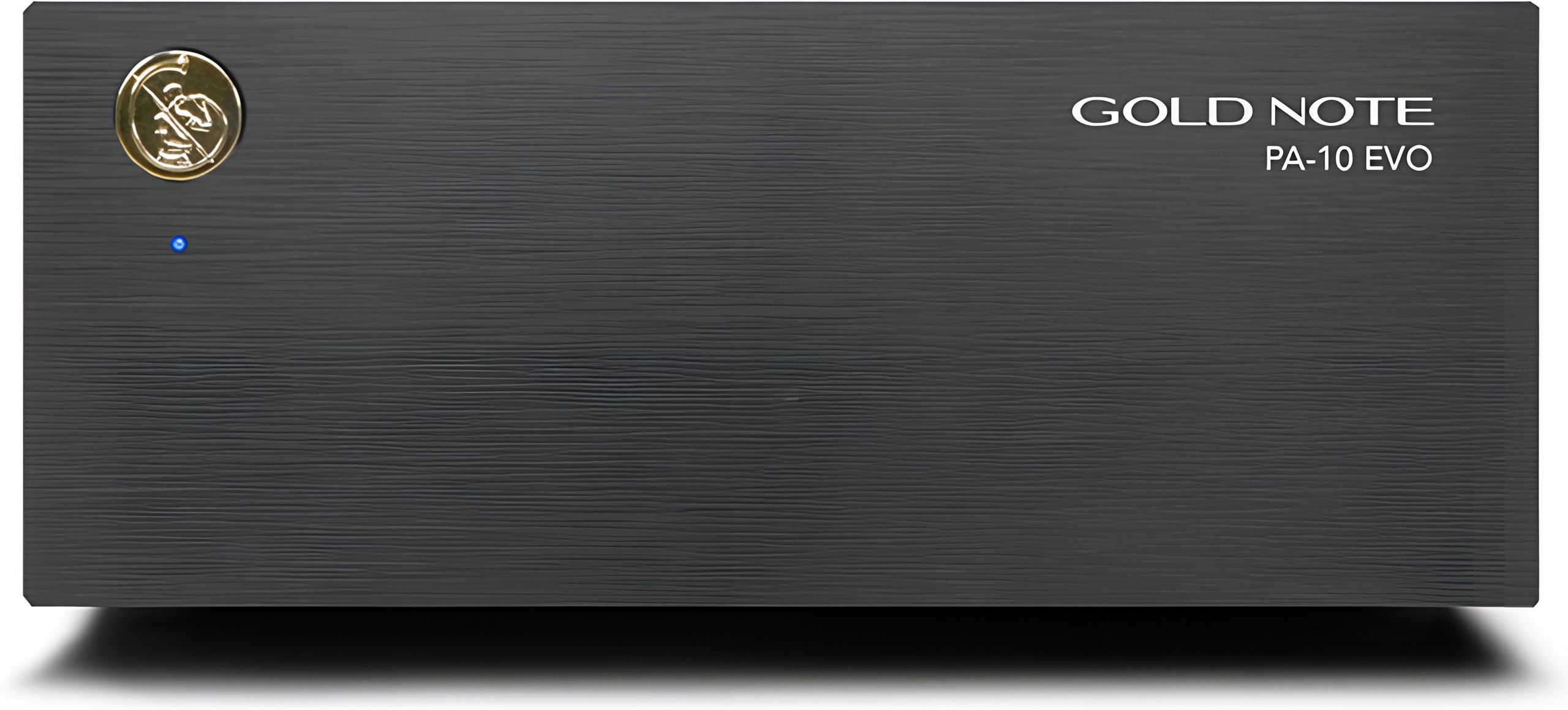
The Gold Note PA-10 EVO takes a miniaturization-focused approach by integrating amplification technology into a chassis that is 200 millimeters wide. This power amplifier, which can be used in stereo or mono mode, delivers 140 watts per channel into 8 or 4 ohms and up to 280 watts in monoblock configuration. It features a specified total harmonic distortion of 0.01%. Its adjustable damping factor and hybrid class AD architecture are designed to ensure compatibility with various types of loudspeakers.
Hybrid Class AD: combining efficiency and musicality
The key innovation of the PA-10 EVO lies in its hybrid class AD amplification, a topology that combines a class A preamplification stage with a class D power stage. Class A operates by biasing the transistors so that they remain constantly active, even in the absence of a signal. This configuration guarantees high linearity and low distortion, at the cost of modest efficiency and significant heat dissipation. Class D, on the other hand, relies on fast switching transistors that operate in an on/off mode, which maximizes energy efficiency (often above 90%) and reduces heat production.
By combining the two approaches, class AD seeks to take advantage of the strengths of each technology. The class A input stage preserves the harmonic richness and accuracy of the signal, while the class D output stage provides the required power with minimal losses. This hybridization enables the PA-10 EVO to deliver 140 watts per channel in stereo into 8 or 4 ohms, and up to 280 watts in mono under the same load. The high efficiency limits heat buildup and allows for a compact power supply, consistent with the reduced dimensions of the chassis.
For the output stage, Gold Note uses latest-generation MOSFET transistors, some of which incorporate gallium nitride (GaN). This wide bandgap semiconductor material stands out for its very high switching speed (on the order of 1 MHz), reduced conduction and switching losses, and ability to operate at high temperatures and voltages. In the context of audio amplification, GaN transistors make it possible to push switching noise out of the audible band, improve the linearity of the power stage, and reduce thermal stress. The PA-10 EVO thus benefits from an architecture capable of doubling its power when the load impedance drops, behavior similar to that of a pure class A amplifier but with far better efficiency.
Fully balanced design and monoblock mode
The PA-10 EVO is based on a fully balanced design, meaning that the audio signal path is symmetrical from end to end. This approach aims to cancel out noise and interference that may occur along the signal chain. In a balanced circuit, the signal is transmitted over two lines of opposite polarity; any external interference affects both lines identically and can be eliminated by subtraction. The result: increased immunity to electromagnetic noise and better channel separation.
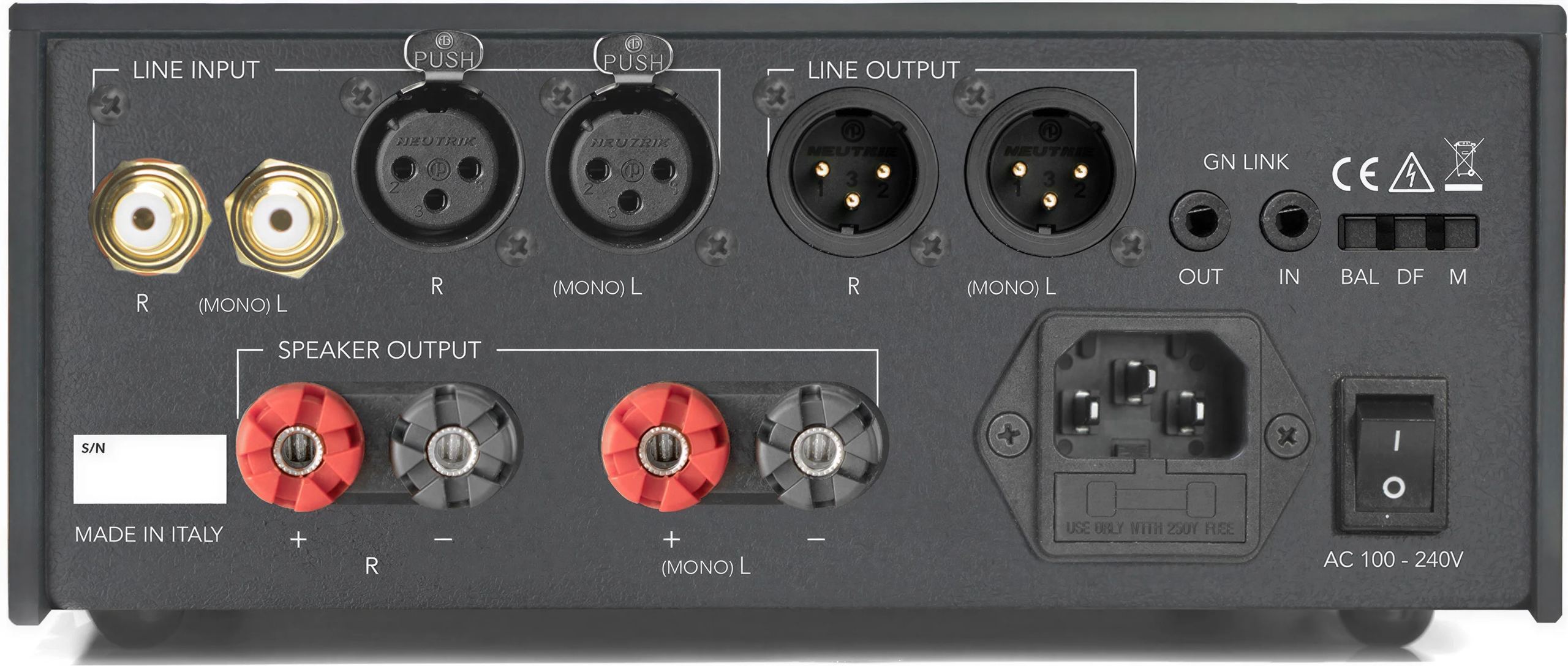
The amplifier offers two distinct operating modes: stereo and mono. In standard stereo mode, each channel of the PA-10 EVO delivers 140 watts into 8 or 4 ohms. In mono mode, Bridge-Tied Load (BTL) technology comes into play: the two output stages are configured in bridge mode to drive a single speaker with double the power, i.e., 280 watts into 8 or 4 ohms. This switching is done via a DIP micro-switch located on the back of the chassis, with no need for internal modification.
Using the PA-10 EVO as monoblocks naturally requires two units for stereo playback. This configuration offers several advantages: it eliminates any residual crosstalk between channels, improves instantaneous dynamics thanks to two independent power supplies, and makes it easier to drive demanding or low-sensitivity speakers. For bi-amped systems, where the bass and mid/high sections of the same speaker are powered separately, monoblock mode provides welcome flexibility.
Adjustable damping factor: adapting to each speaker
The damping factor measures an amplifier’s ability to control the movement of a loudspeaker’s diaphragm, particularly in the bass region. It is calculated as the ratio between the speaker’s nominal impedance and the amplifier’s output impedance. A high damping factor (greater than 200) means the amplifier introduces very little resistance into the circuit and can quickly stop the diaphragm after a loud transient. This results in tight, precise bass with minimal overhang. A lower damping factor (around 25) allows more inertia in the diaphragm, which may suit very sensitive speakers or listening preferences that favor a warmer presentation.
The PA-10 EVO features an adjustable damping factor, switchable between two values: 250 (High position) and 25 (Low position). This setting is also made via a DIP micro-switch on the rear panel. The High position is recommended for three-way floorstanding speakers or models that are hard to drive, which benefit from tight control of the load. The Low position is better suited to high-sensitivity mini-monitor speakers or setups where slightly softening the bass is desirable.
This versatility allows the PA-10 EVO to be adapted to different loudspeaker topologies without having to change amplifiers. It reflects Gold Note’s philosophy, which favors integration flexibility rather than imposing a fixed sonic signature. The damping factor also affects the frequency response of the speaker-amplifier system: tight control flattens the speaker’s resonance peaks, while looser control can accentuate certain frequencies. The choice between High and Low thus becomes a tuning tool to harmonize the amplifier with the listening room’s acoustics.
Connectivity and system integration
On the rear of the PA-10 EVO, all connections are arranged in a single row to maintain overall compactness. There is a pair of unbalanced stereo RCA inputs (3600-ohm input impedance) and a pair of balanced XLR inputs (7200-ohm input impedance). The input sensitivity is identical for both connection types: 2.5 Vrms. These two options allow the amplifier to be connected to a preamplifier, a home-cinema processor, or a source with an integrated volume control such as Gold Note’s network player DS-10 EVO.
The speaker outputs use binding-post terminals, compatible with banana plugs, spades, or bare wire. This choice ensures good contact surface and secure cable fastening. In stereo mode, both pairs of terminals are active; in mono mode, only the main pair is used. Three DIP micro-switches allow switching between stereo and mono modes, selecting the unbalanced or balanced input, and choosing the damping factor. These settings are indicated by blue LEDs that show the status of each function.
The PA-10 EVO also incorporates GN Link technology, a proprietary Gold Note system that enables automatic power-on of multiple compatible devices. When a source equipped with GN Link (such as the DS-10 EVO) is switched on, it sends a trigger signal to the connected amplifiers, which then power up. Conversely, switching off the source puts the entire system into standby. This feature simplifies daily use by eliminating the need to operate multiple power switches, especially since the PA-10 EVO’s power button is located on the back of the chassis.
Recommended pairings and compatibility
Gold Note suggests pairing the PA-10 EVO with the DS-10 EVO network player to create a compact and coherent system. The DS-10 EVO incorporates an AKM AK4493 DAC, a line preamplifier, and a headphone amplifier, and offers network streaming functions via Wi-Fi, Ethernet, and Bluetooth. It supports high-resolution PCM up to 32-bit/768 kHz and DSD512, as well as Roon Ready services, AirPlay, MQA, Qobuz, Deezer, Spotify Connect, Tidal, and vTuner. This combination of two Series 10 units forms a complete stereo system, ideal for a contemporary setup where size and aesthetics are as important as performance.
For speakers, Gold Note recommends the A3 EVO II or A6 EVO II models, also from the brand’s range. The A3 EVO II are compact bookshelf speakers, while the A6 EVO II are three-way floorstanding models. However, the PA-10 EVO is versatile enough to work with a wide variety of passive speakers, whether compact or large, high or low sensitivity. The adjustable damping factor further broadens this compatibility by allowing the amplifier’s behavior to be tailored to the connected load.
It is crucial to note that the PA-10 EVO cannot be paired with the older PA-10 model, which was marketed prior to the EVO version. The two amplifiers differ in architecture (the older PA-10 used a traditional class AB design) and connectivity, which prevents them from being combined in a mixed system. The PA-10 EVO is, however, fully compatible with all Gold Note preamplifiers, processors, and tube output stages, making it possible to create varied configurations according to individual sonic preferences.
For those wishing to push optimization further, Gold Note offers the external power supply PSU-10 EVO, designed to power Series 10 devices such as the DS-10 EVO, CD-10, or HP-10. This linear power supply, with four transformers and a dual-isolation circuit (Dual Choke Hybrid architecture), stabilizes the current and drastically reduces electrical noise. Although it is mainly intended for sources and preamplifiers, it illustrates the attention Gold Note pays to the entire power chain in order to maximize sonic performance.
Documentation
Technical specifications
Amplification and power
- Amplifier class: Hybrid Class AD
- Operating mode: Stereo / Mono (Monoblock)
- Can be used on its own in stereo or as a pair in mono for enhanced performance
- Design: fully balanced
- Contributes to optimal sound quality and reduced noise
- Output power in stereo mode: 2 × 140 W at 8 Ω or 4 Ω
- Adequate power in a compact format
- Output power in mono mode: 1 × 280 W at 8 Ω or 4 Ω
- Power is doubled in monoblock mode
Audio performance
- Damping factor: adjustable
- High = 250 or Low = 25
- Allows precise adjustment to different types of speakers (floorstanders or mini-monitors)
- Total harmonic distortion (THD): 0.01% (1 kHz @ 1 W)
- Low distortion level for clear sound reproduction
- Frequency response: 5 Hz - 50 kHz (@ -3 dB)
- The bandwidth covers audible frequencies and beyond
Connectivity
- Audio inputs
- 1 × stereo RCA (unbalanced)
- 1 × stereo XLR (balanced)
- Input sensitivity: 2.5 Vrms (RCA / XLR)
- RCA input impedance: 3600 Ω
- XLR input impedance: 7200 Ω
- Audio outputs
- Speaker terminals: binding post type
- GN Link technology
- Allows switching the amplifier on / off from the source in master-slave mode
Power supply
- Standby consumption: < 1 W
- Idle consumption: < 6 W
- Mains power: 100-240 V, 50 / 60 Hz
- Fuse: 5 A T5
Design and construction
- Chassis: Solid Series 10 aluminum
- Style: Inspired by Italian design and our modular philosophy
- Assembly: Hand-assembled and tested with selected components
Dimensions and weight
- Dimensions (W × H × D): 200 mm × 80 mm × 260 mm
- Net weight: 3 kg
- Packaged weight: 4 kg
General information
The PA-10 EVO is a power amplifier equipped with flexible inputs and outputs for optimal integration into your audio system. It is compatible with our other electronics, preamplifiers, and tube (valve) output stages.
Compatibility note: The PA-10 EVO cannot be paired with the previous PA-10 model.
Recommended pairing: For a compact and high-performance system, we suggest combining it with the DS-10 EVO network player and A3 EVO II or A6 EVO II speakers.
Frequently Asked Questions
Can the PA-10 EVO be used on its own, without a preamplifier?
No, the PA-10 EVO is a pure power amplifier, with no volume control or input selection. It must be used with a preamplifier, a home-cinema processor, or a source with an integrated volume control (such as the DS-10 EVO or certain network players).
What is the difference between stereo mode and mono mode?
In stereo mode, the PA-10 EVO operates as a standard two-channel power amplifier, delivering 140 watts per channel. In mono mode, Bridge-Tied Load technology configures the two output stages in bridge mode to drive a single speaker with 280 watts. Therefore, two PA-10 EVO units are required for stereo reproduction in mono mode.
How do I choose between a High (250) and Low (25) damping factor?
The High setting is suitable for demanding floorstanding speakers or models that are difficult to drive, as it ensures tight control in the bass. The Low setting is recommended for high-sensitivity mini-monitors or when a warmer, less analytical sound is desired. The best choice depends on the speakers used and listening preferences.
Does GN Link technology work with other brands?
No, GN Link is a proprietary protocol developed by Gold Note. Only devices from the brand equipped with this feature can communicate with each other for automatic power on/off. However, the PA-10 EVO can be used with any source or preamplifier via its RCA or XLR inputs.
Which speakers are compatible with the PA-10 EVO?
The PA-10 EVO is designed to drive a wide range of passive speakers, from compact mini-monitors to large three-way floorstanders. Its power output of 140 watts per channel in stereo (280 watts in mono) allows it to efficiently power models with a nominal impedance of 8 or 4 ohms. The adjustable damping factor further extends this versatility by allowing the amplifier’s behavior to be adapted to different topologies.
Can two sources be connected to the PA-10 EVO at the same time?
The PA-10 EVO has one RCA input and one XLR input, but no input selector. A DIP micro-switch on the back allows you to choose between the unbalanced and balanced input. To switch between two sources, you must therefore either change this setting manually (not recommended for daily use) or use a preamplifier or source selector upstream.
- Eco-contribution included in the sale price.
- Manufacturer reference: PF-DIECI-PAE-001-B