Ferrum Audio HYPSOS Dual Output
Overview
The HYPSOS Dual Output is an advanced version of Ferrum Audio’s flagship power supply. This hybrid power block can simultaneously deliver current to two devices using the same voltage. It offers a continuous voltage range from 5 to 30 V and a maximum current of 6 A (80 W), allowing it to adapt to various audio devices, whether from Ferrum or other manufacturers. It is intended for desktop hi-fi systems or compact setups.
Design and construction
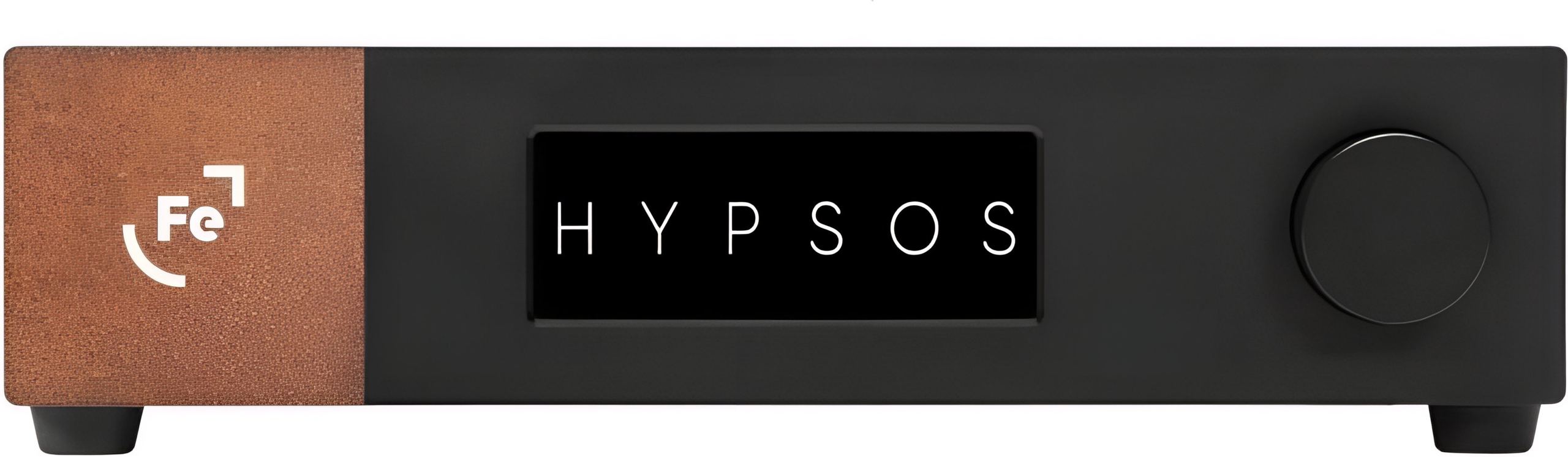
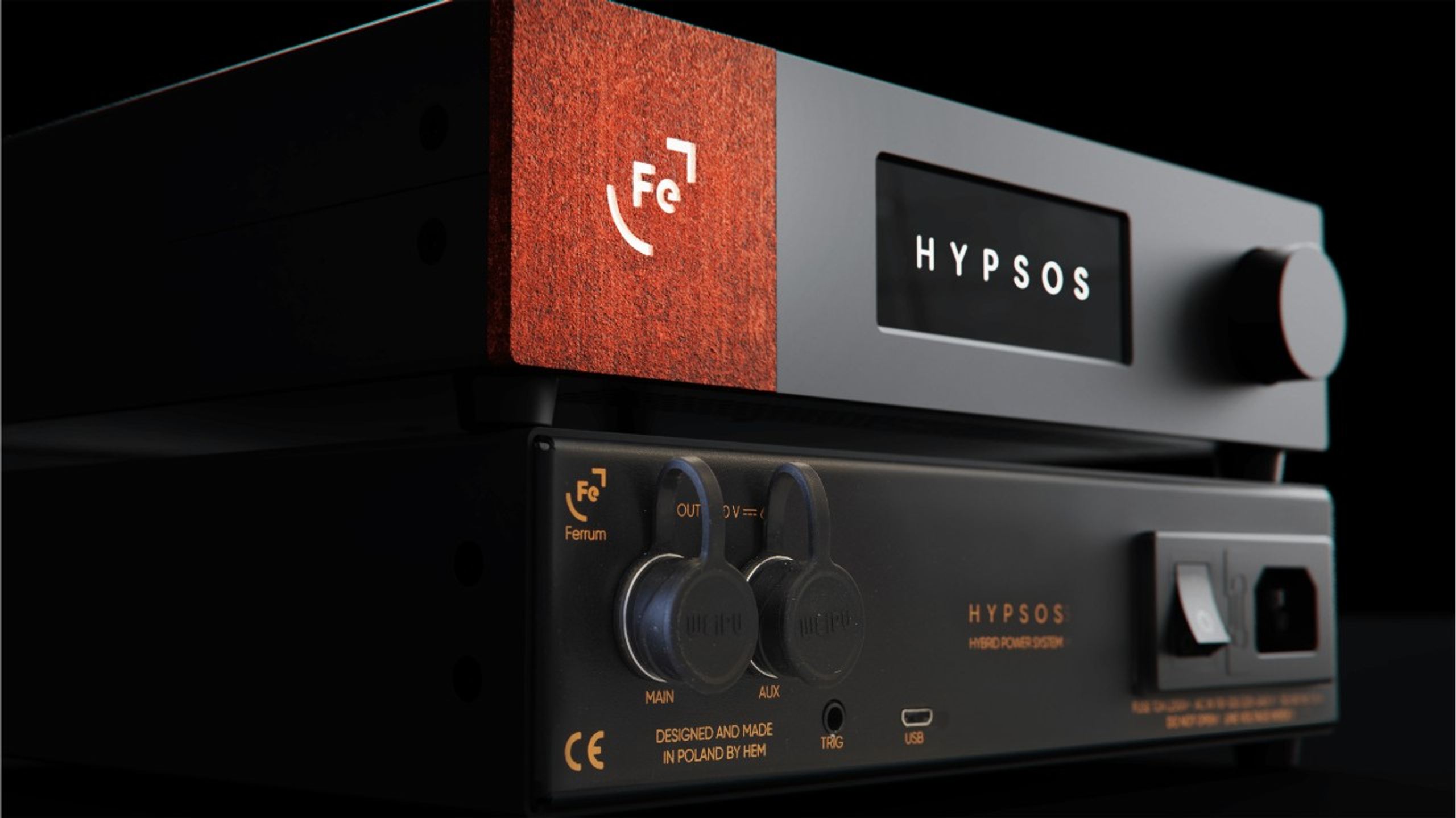
The HYPSOS Dual Output enclosure follows the visual design language of the Ferrum range. The compact chassis (21.7 × 20.6 × 5 cm, 3.05 kg) is made of thick black-painted metal sheets. The distinctive element on the front panel is a square of Corten steel, also known as weathering steel, which naturally develops a characteristic brown-rust patina over time. This material, usually reserved for architecture or sculpture, gives Ferrum products a visual identity that is instantly recognizable.
The black anodized aluminum front panel features a high-resolution color screen and a single rotary encoder that serves as the power on/off switch, menu selector, and navigation control. The user interface is intuitive: a few turns are all it takes to configure the unit or adjust settings.
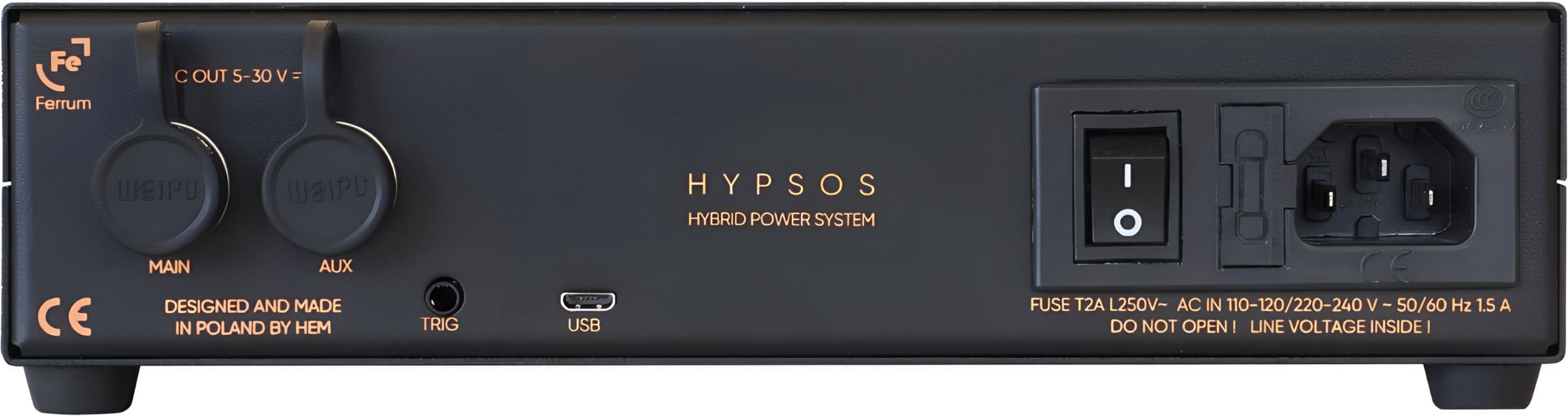
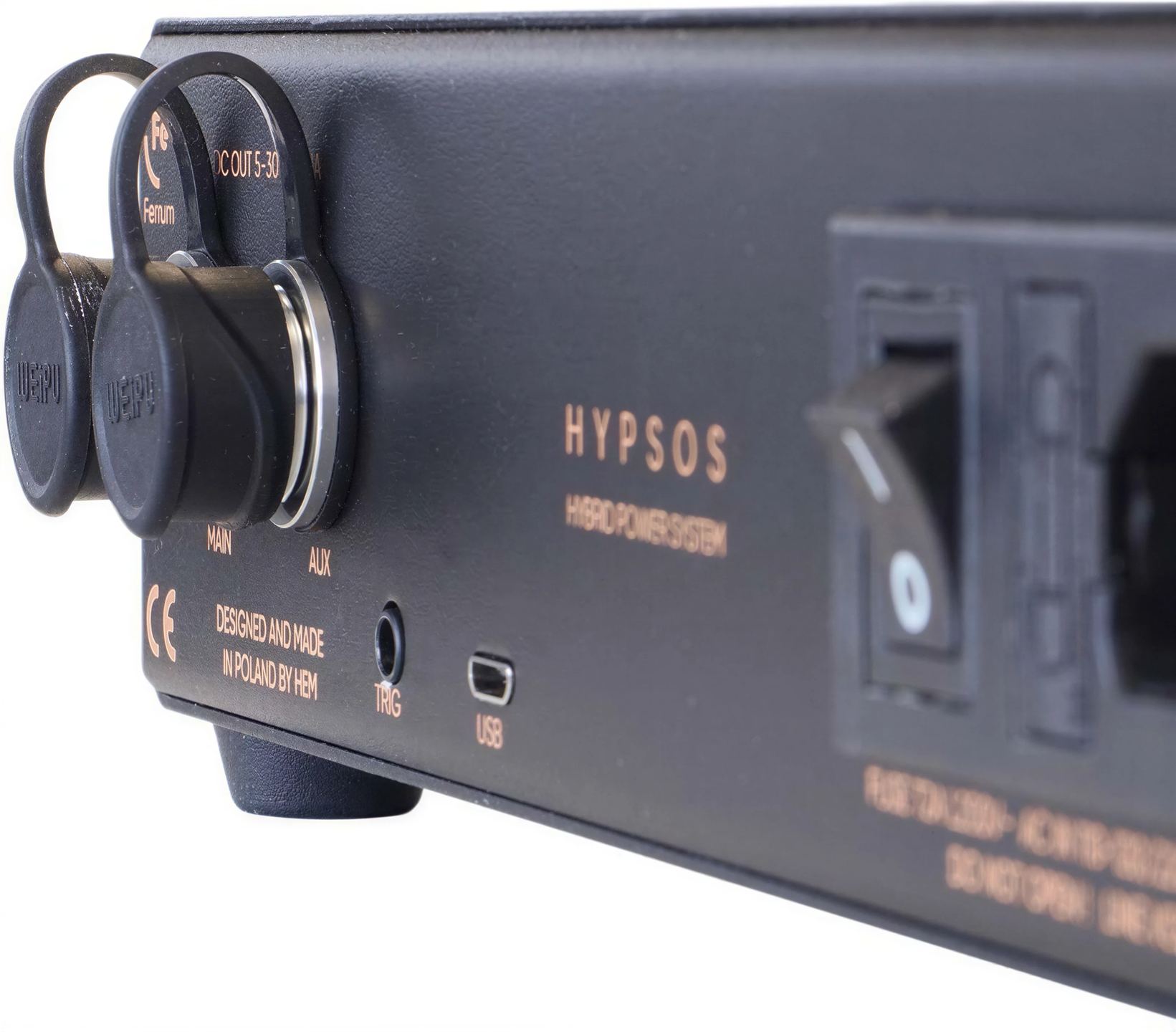
On the rear, you’ll find the IEC C14 mains input with accessible fuse, the main power switch, two DC outputs (MAIN and AUX) with four-pin Weipu connectors, a trigger input/output, and a mini USB port for firmware updates.
Hybrid design: the best of both worlds
The technical philosophy behind the HYPSOS is based on a hybrid system combining a linear power supply and a switch-mode power supply. This approach leverages the strengths of each technology while compensating for their respective weaknesses.
The switching stage operates at around 1 MHz and generates a stable intermediate voltage, regardless of the desired output level. This high frequency makes it easier to filter residual noise. To further reduce electromagnetic interference (EMI), Ferrum has implemented a Spread Spectrum Mode (SSM) that modulates the switching frequency by about 20%. This technique “spreads” the noise spectrum over a wider range, thereby reducing the amplitude of unwanted peaks.
Downstream, a discrete NMOS-transistor LDO (Low Drop-Out) linear regulator provides final filtering and precise regulation of the output voltage. This regulator requires only a small difference between its input and output voltages to operate correctly, which limits thermal losses. The result is an extremely low noise floor, minimal residual ripple, and particularly fast transient response.
Dual output: powering two devices simultaneously
The main innovation of this version lies in its ability to power two components at the same time. As the HYPSOS’s power reserves are generously dimensioned, Ferrum chose to take advantage of this headroom by adding a second DC output.
This configuration allows you, for example, to connect an OOR headphone amplifier and a WANDLA converter at the same time, or any other combination of two devices requiring the same supply voltage. There is no longer any need for an external splitter or multiple separate power supplies.
The voltage, current, and power specifications apply to both outputs combined. The two outputs must share the same voltage and polarity: it is not possible to power one device at 12 V and another at 24 V from the same HYPSOS. When using a single device, Ferrum systematically recommends using the MAIN output to benefit from all available features.
4-Terminal Sensing Design: precision right to the end of the cable
Most external power supplies measure their output voltage directly at their terminals, ignoring the voltage drop caused by the resistance of the cable connecting the power supply to the powered device. When current increases, this drop can become significant and affect performance.
The 4TSD (4-Terminal Sensing Design) system adopts a different approach. The proprietary Ferrum Power Link (FPL) power cable includes four conductors: two for carrying current and two for voltage sensing. As the sensing wires carry virtually no current, they experience no voltage drop. HYPSOS can therefore regulate its output based on the voltage actually present at the DC input of the powered device, rather than at its own output.
This setup eliminates the influence of cable resistance on the final voltage, improves transient response, and stabilizes the power supply even during abrupt changes in power consumption. The 4TSD function is active exclusively on the MAIN output; the AUX output uses conventional regulation and is therefore more suitable for devices with stable power consumption.
SST function: fine voltage adjustment
The SST (Sweet Spot Tuning) function allows you to adjust the output voltage in 0.1 V increments, typically within a range of 95% to 105% of the nominal voltage of the selected profile. Adjustments are made in real time, without interrupting operation of the powered device.
The benefits go beyond simple compliance with manufacturer specifications. Some audio devices react differently depending on the exact level of their supply voltage: a slight increase can enhance dynamics, while a slight decrease can soften the presentation. SST lets you explore these variations safely, as the HYPSOS will not exceed the limits defined for each profile.
Configuration and device profiles
The HYPSOS stores in memory a database of profiles corresponding to more than a hundred devices from many brands: Arcam, Auralic, Bel Canto, Cambridge Audio, Chord, Creek, Denon, exaSound, FiiO, Gold Note, iFi Audio, Innuos, McIntosh, Melco, Musical Fidelity, Mytek, Naim Audio, Nuprime, Pro-Ject, Roon, SOtM, Stax, and many others. This list is regularly expanded via firmware updates.
To configure the power supply, simply select the corresponding profile from the list. HYPSOS will then display a summary of the parameters (voltage, polarity) and ask for confirmation. A ten-second countdown gives you time to check the settings before they are applied.
If your device does not appear in the list, you can create a custom profile by manually entering the voltage (between 5 and 30 V) and the polarity. This universality makes HYPSOS a versatile tool, compatible with the vast majority of audio devices powered by DC.
Safety and protection
Ferrum has integrated several protection features designed to safeguard both the power supply and the connected devices:
- ATVA (Automatic Transformer Voltage Adjust): automatic adaptation to the local power grid (110-240 V AC, 50-60 Hz)
- Overvoltage protection: automatic shutdown if voltage exceeds safe limits
- Current limiting: output current cannot exceed 6 A
- Short-circuit protection: instantaneous shutdown in the event of a fault
- Electronic polarity switching: allows configuration of DC connector polarity via software, with no need for hardware intervention
Before each output is powered on, HYPSOS asks for parameter confirmation. This precaution prevents handling errors that could damage a misconfigured device.
Cables and connectors
The HYPSOS Dual Output comes with a high-quality DC cable, equipped with a four-pin Weipu connector on the power-supply side and a 5.5 × 2.5 mm or 5.5 × 2.1 mm DC jack on the device side (choice made when ordering). These two formats cover the majority of DC inputs found on audio equipment.
To connect Ferrum products (OOR, ERCO, WANDLA), the proprietary Ferrum Power Link (FPL) cable is recommended. This cable uses Weipu connectors at both ends and fully exploits the 4TSD function, allowing HYPSOS to measure voltage directly on the powered device’s motherboard.
Custom cables with other types of connectors can be ordered from Ferrum, subject to the availability of sufficiently high-quality components.
Technical specifications
Electrical specifications
- Input voltage: 110 – 240 V AC, 50 – 60 Hz
- Output voltage: 5 – 30 V DC
- Maximum output current: 6 A
- Maximum power: 80 W
- Hybrid power system: linear and switching combination for low noise, high efficiency, and fast transient response
Physical specifications
- Dimensions: 21.7 × 20.6 × 5 cm
- Net weight: 3.05 kg
Core technologies
- Sweet Spot Tuning (SST): on-the-fly voltage adjustment to achieve the best sound quality, safely
- 4-Terminal Sensing Design (4TSD): guarantees exact voltage at the DC input point, neutralizing cable resistance and improving transient response
- 4TSD active on the main output
Connectivity and outputs
- Dual DC output: allows you to connect two Ferrum devices simultaneously with the same voltage requirements, for example OOR and WANDLA
- Each output is verified before power-up to ensure safety
- Supplied cables: high quality, with 5.5 × 2.5 mm or 5.5 × 2.1 mm DC connector
- Other formats available on request
Control and automation
- Compatible with Apple TV remote control
- Trigger in / out
- Standby mode with automatic start-up
- Automatic mains voltage adjustment
Protections and safety
- Overvoltage protection
- Overcurrent protection
- Reverse polarity protection
- Short-circuit protection
Sound benefits
HYPSOS enhances your current setup by delivering a more detailed and precise sound, while remaining natural and non-fatiguing to listen to. It allows you to unlock the full potential of your digital-to-analog converters (DACs) and Ferrum amplifiers.
General information
HYPSOS is a high-performance power supply designed to optimize the performance of Ferrum audio devices. Thanks to its advanced technologies and multiple protections, it guarantees stable, high-quality power to reveal every nuance of your audio system.
Frequently Asked Questions
Can the two outputs power devices with different voltages?
No. The MAIN and AUX outputs must share the same voltage and polarity. They are designed to power two devices with exactly the same electrical requirements. To connect equipment with different requirements, you would need two separate HYPSOS power supplies.
Does HYPSOS work with brands other than Ferrum?
Yes. The internal database includes profiles for dozens of brands: Chord, iFi Audio, Arcam, Mytek, Cambridge Audio, Naim, and many more. If your device is not listed, you can create a custom profile by manually entering the voltage and polarity indicated on its original power supply. The 5 to 30 V range covers almost all devices powered by DC.
What is the difference between the MAIN and AUX outputs?
The MAIN output benefits from the 4TSD function, which measures and regulates the voltage at the end of the power cable rather than at the HYPSOS output. This improves stability and transient response, particularly useful for amplifiers or servers whose power consumption fluctuates. The AUX output, which lacks 4TSD, is better suited to devices with stable consumption such as DACs or network players.
How is the firmware updated?
The Ferrum Control application (free, available for Windows and macOS) automatically downloads and installs new firmware versions. Simply connect HYPSOS to a computer using the supplied mini USB cable, launch the application, and follow the instructions. USB drivers must be installed beforehand on Windows.
- Eco-contribution included in the sale price.
- GTIN / EAN: 5903900676137