Van den Hul The First RCA 1m
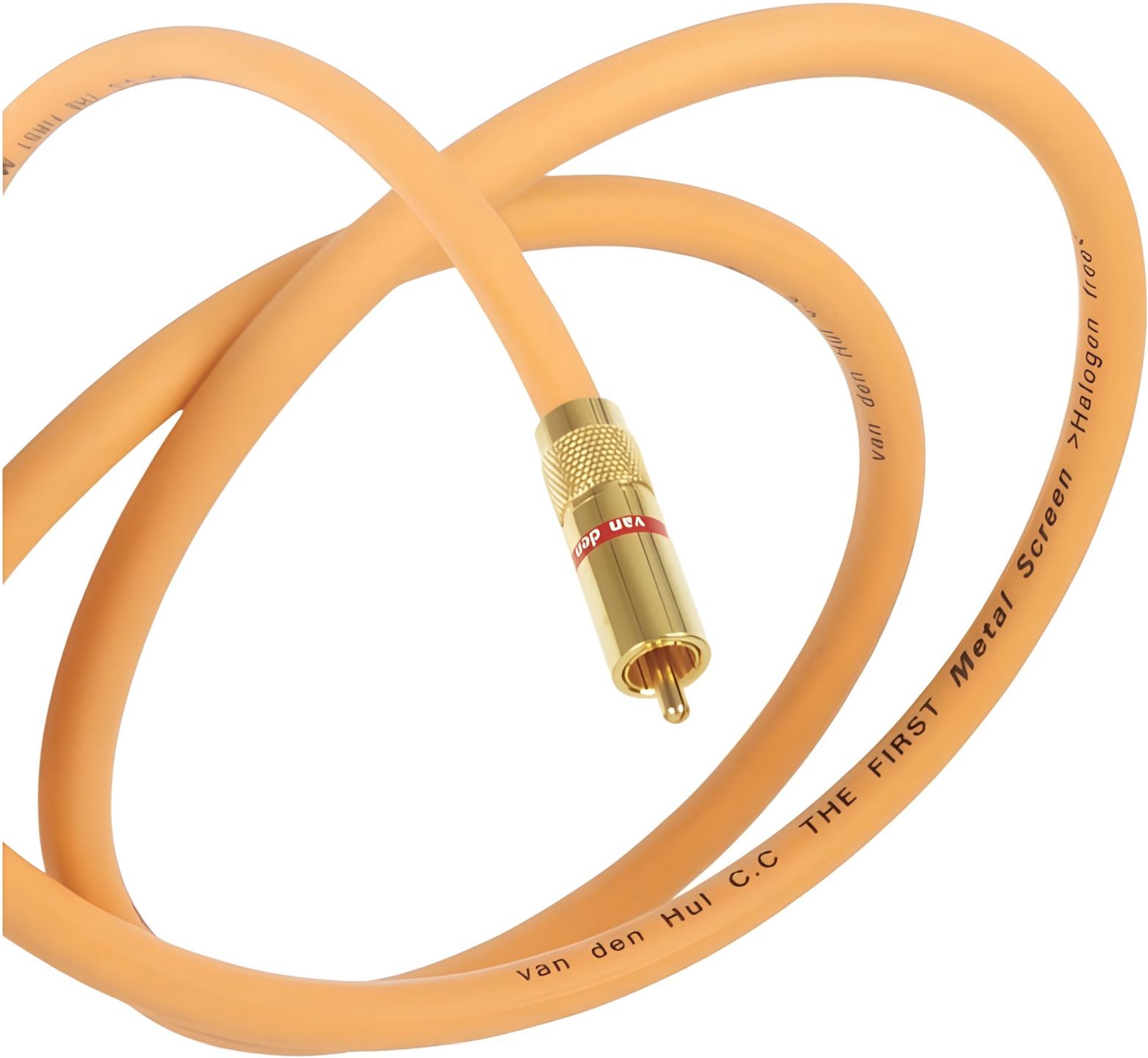
Overview
In 1993, A.J. van den Hul introduced the first audio interconnect cable without a metal conductor. More than thirty years later, the The First range has been expanded with several variants. The Metal Screen version retains the original architecture based on Linear Structured Carbon (LSC) and adds a dense metal shield to meet the most demanding installation scenarios, where ground currents and electromagnetic interference cause recurring issues.
A linear structured carbon conductor
The heart of the cable is based on the patented Linear Structured Carbon technology. The central conductor consists of 12,000 carbon strands, each 7 microns in diameter and individually insulated. This fiber-by-fiber insulation prevents electrons from flowing laterally from one strand to another: the signal travels in a strictly unidirectional manner, reducing distortion phenomena related to interactions between conductors.
Carbon offers thermal, chemical, and mechanical stability that metals cannot match. While copper or silver gradually oxidize and degrade over time, structured carbon retains its electrical and acoustic properties year after year. Van den Hul also points out that The First can be recycled at the end of its life: the material is remelted and reused as an extrusion layer on other cables from the brand.
Double shielding and minimal ground resistance
The Metal Screen version differs from The First and The First Ultimate models through the addition of an external silver-plated OFC Matched Crystal® copper braid surrounding the existing LSC shielding layer. This dual screen—saturated carbon on one side, high-purity metal on the other—lowers the shielding resistance to 0.0049 Ω/m, a value significantly lower than that of The First Ultimate (around 4.8 Ω/m) and the original The First (around 14 Ω/m).
This extremely low resistance comes into its own with tube amplifiers, which are often prone to stray ground currents manifesting as hiss or hum. It is also valuable in electrically noisy environments, close to transformers, switching power supplies, or computer equipment.
Low-level signals and long runs
The Dutch manufacturer particularly recommends The First Metal Screen for carrying low-amplitude signals. The connection between a phono cartridge and a preamplifier, or the linking of a microphone or an electric musical instrument, all benefit from the interference immunity provided by this cable. The measured capacitance (61 pF/m) remains moderate, which limits high-frequency attenuation even over significant lengths.
Unlike the fully carbon versions, The First Metal Screen can be ordered in lengths greater than 1.5 metres. This option opens up installation configurations that are difficult to achieve with cables that are more sensitive to interference over long distances.
Construction and finish
The outer diameter is 7.5 mm, with a 1.0 mm² central conductor. The peach-coloured Hulliflex jacket provides durable mechanical protection and good resistance to surrounding chemical agents. This halogen-free material, adopted by Van den Hul as early as 1990, prevents the release of harmful substances in the event of combustion or disposal.
C-8.0 type RCA connectors are factory-fitted. Van den Hul does not offer this cable on a reel for DIY assembly: connecting the carbon fibres to the metal pins requires specific expertise to avoid internal reflection issues at the terminations.
Technical specifications
Construction and technology
- Asymmetrical coaxial design based on Linear Structured Carbon® (LSC) technology
- Conductor: 12,000 individual carbon strands, each insulated
- Diameter of each strand: 7 µm
- Additional metal shielding: high-density braid in oxygen-free copper (OFC) with matched-crystal silver plating
- Double shielding
- 1 saturated LSC layer
- 1 high-purity metal layer
Electrical performance
- Shield resistance: 0.0049 Ω/m
- Minimizes ground loop issues
- Conductor resistance: 36 Ω/m
- Capacitance: 61 pF/m
Physical characteristics
- Conductor diameter: 1.0 mm
- Cable diameter: 7.5 mm
- Jacket: peach-orange Hulliflex, durable and hard-wearing
Recommended applications
- Complex or heavily polluted electrical environments
- Interconnection between tube-based equipment sensitive to ground currents
- Low-level signal transmission
- Phono cartridges
- Microphones
- Musical instruments
Key benefits
- Optimal protection against electromagnetic interference
- Coaxial alternative to the balanced version The Second
- Sound performance close to The First Ultimate
- Unique carbon construction delivering refined sound reproduction
- High-purity metal shielding ensuring noise-free operation
- Perfectly suited to sensitive systems: tube gear, phono, microphones
Frequently Asked Questions
Does the audio signal travel through the metal shielding?
No. The central conductor is exclusively carbon; the signal never passes through metal. The silver-plated braid is used solely for shielding and ground return, protecting the signal from external interference without taking part in its transmission.
Is this cable suitable for turntables fitted with low-output MC cartridges?
Van den Hul recommends it rather for MM cartridges and high-output MC cartridges. Very low-output MC cartridges generally require a dedicated phono cable with impedance and capacitance optimised for this type of source.
Can The First Metal Screen be used as an SPDIF digital cable?
Yes. The 75 Ω characteristic impedance and the low capacitance of the cable make it suitable for carrying coaxial digital signals between a CD player, a DAC or a streamer.
What is the difference compared with The First Ultimate?
The First Ultimate uses an all-carbon shield (six LSC layers, i.e. 114,000 strands), with no metal. Its higher shielding resistance may result in slight hiss with certain tube amplifiers. The First Metal Screen solves this problem thanks to its metal braid, at the cost of a hybrid construction.
- Eco-contribution included in the sale price.