Audioquest Rocket 11 SBA (2 x 3m)
Overview
In AudioQuest’s Rocket range, the 11 is the entry-level model. This positioning doesn’t take anything away from its technical sophistication: you still get the semi-solid concentric conductors and long-grain copper found in the higher-end models. The SBA (Single Bi-Amp) version is distinguished by its four connectors on each side, designed for systems where the bass and treble amplifiers are separate.
Concentric conductors: fewer interactions, more precision
In a conventional multistrand cable, the individual wires change position along the run. This movement creates electrical and magnetic interactions between strands, a source of distortion. AudioQuest addresses this problem with a semi-solid concentric structure: the strands, fewer in number but larger in diameter, stay in place over the entire length of the cable.
The term “True-Concentric” refers to a technique in which each layer of strands is wound in the opposite direction to the previous one. This layout eliminates continuous lines of contact between layers and increases the pressure at the remaining contact points. The process requires more machine time (and is more expensive to produce), but it measurably reduces distortion.
LGC copper: fewer impurities in the signal path
The Rocket 11 uses LGC (Long-Grain Copper), a material whose crystalline grains are longer than in standard OFHC copper. Why does this matter? Each boundary between two grains forms a micro-discontinuity in the conductor. Fewer boundaries mean fewer obstacles to current flow and less internal oxidation. LGC copper also contains fewer impurities than conventional OFHC copper.
Double spiral twisted geometry
A speaker cable with parallel conductors has a relatively high inductance. Inductance “spreads out” energy over time, which results in a less defined sound. In the Rocket 11, each pair of conductors (positive and negative) is twisted around the other in an opposing spiral pattern. This geometry lowers inductance and promotes extended frequency response, from bass through treble.
SBA configuration for bi-amplification
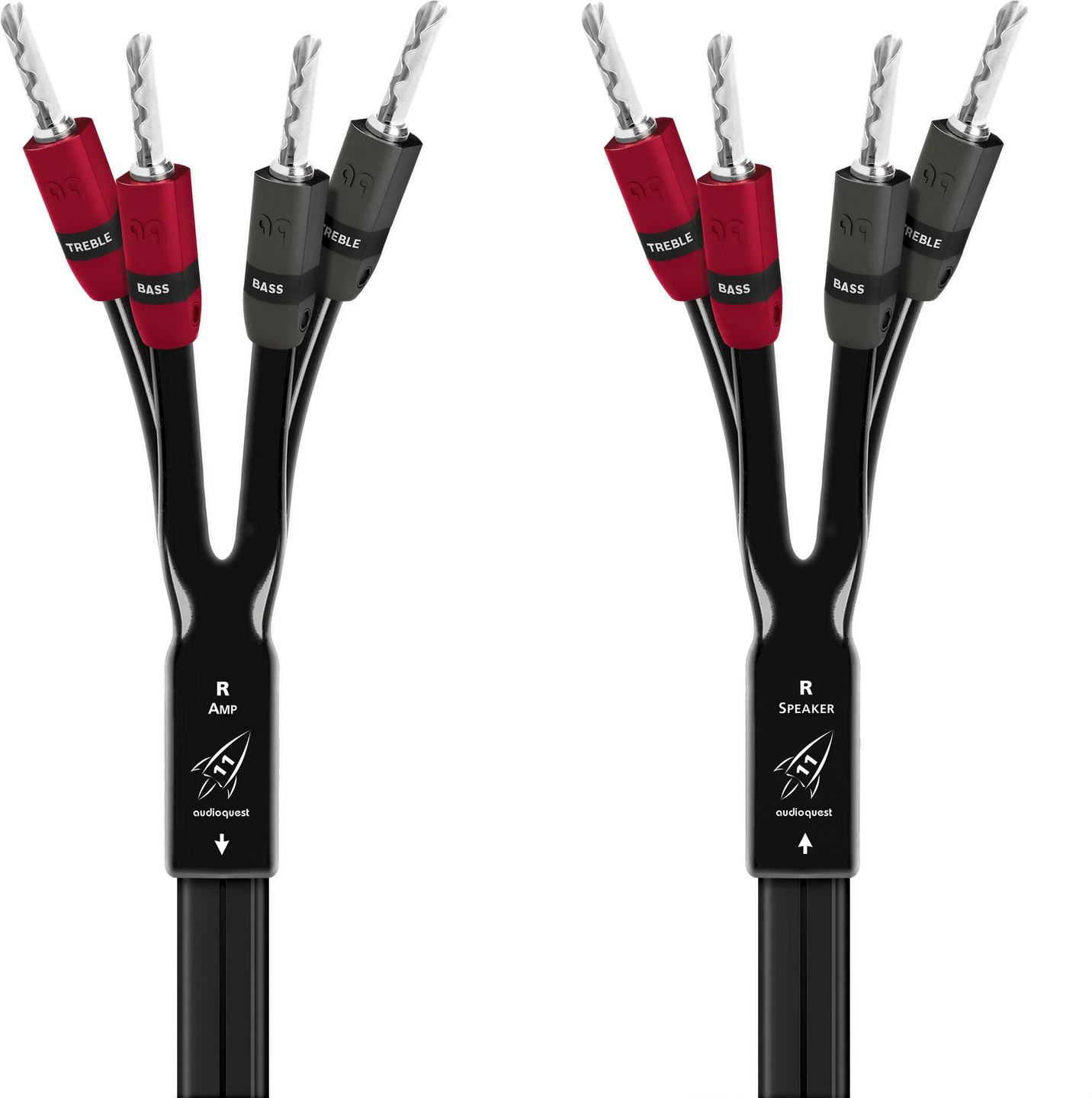
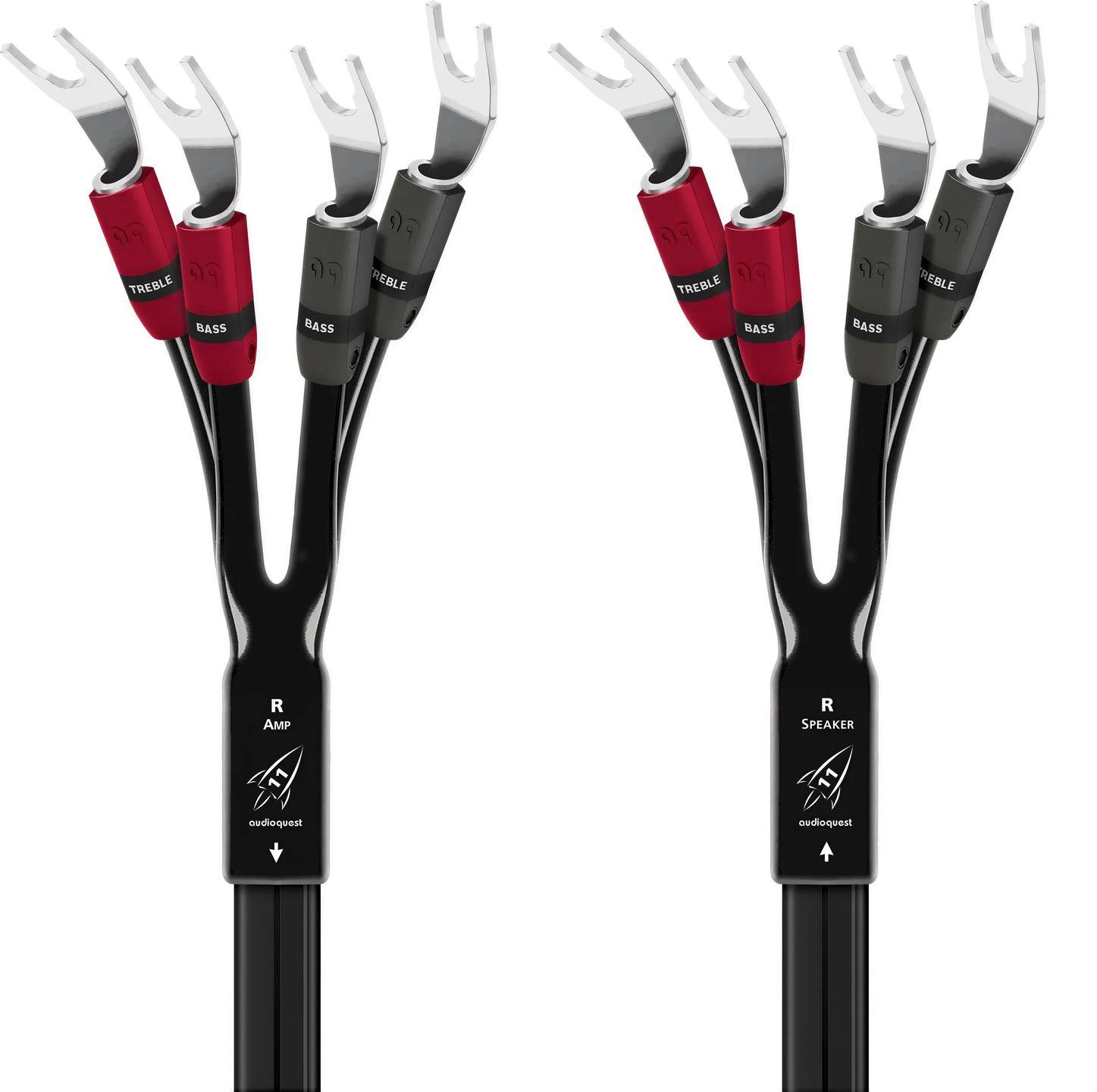
The SBA version of the Rocket 11 is terminated with four connectors at each end. On the amplifier side, two pairs connect to the bass amp and treble amp outputs. On the speaker side, the four plugs connect to the corresponding binding posts. This configuration preserves magnetic separation between the bass and treble sections of the cable: the high-amplitude current feeding the woofer does not interfere with the more delicate signal going to the tweeter.
AudioQuest compares this phenomenon to swimming: removing the waves (the bass) from the water makes it easier for the swimmer (the treble) to move forward.
SureGrip 300 connectors
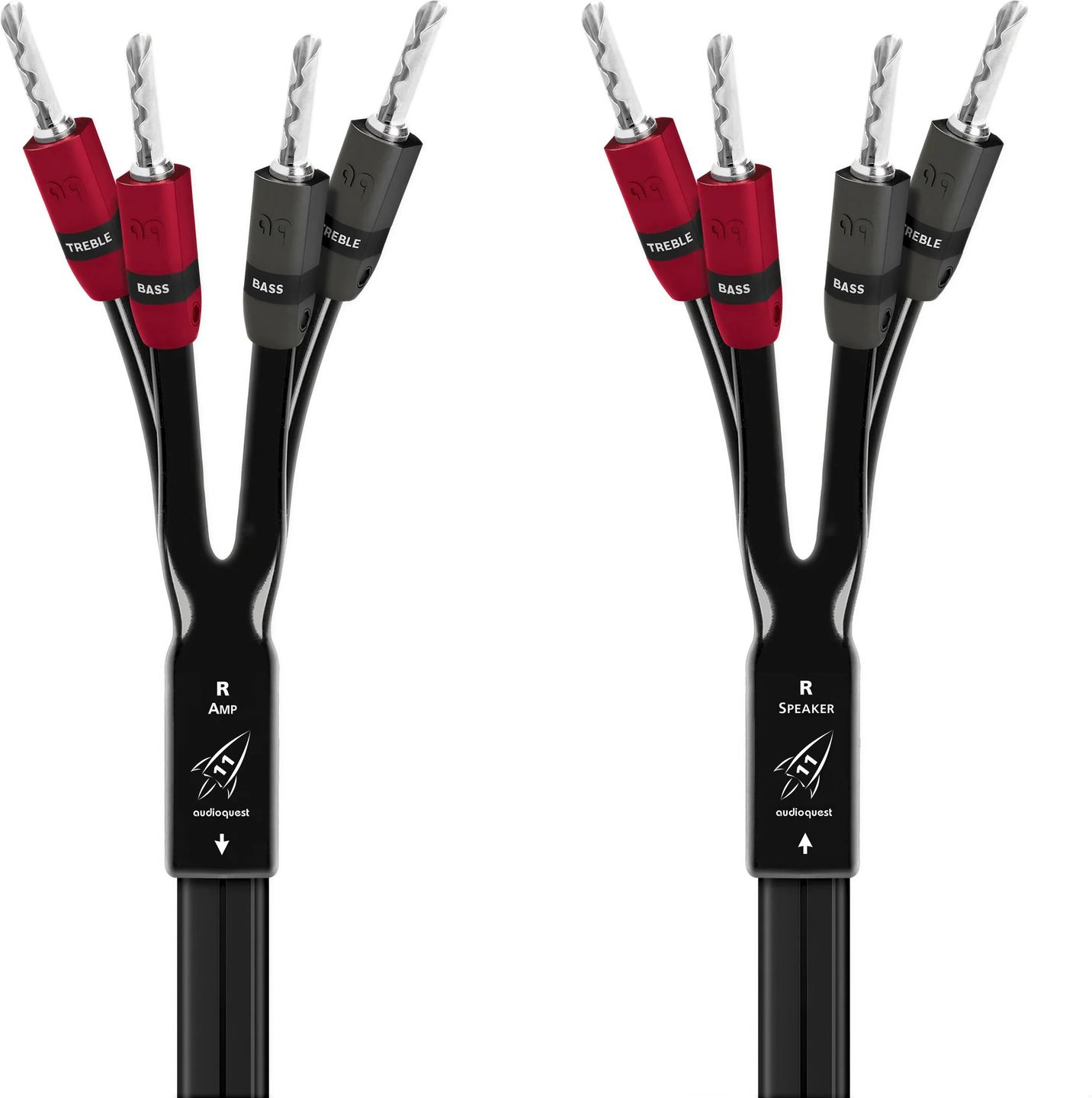
SureGrip 300 plugs use direct silver plating over copper, with no intermediate nickel layer. Nickel, often found in common audio connectors, adds resistance to signal flow. SureGrip 300 plugs are available as bananas or spades, depending on your equipment’s binding posts.
A practical detail: each cable carries markings indicating the correct connection direction (amplifier side, speaker side) and left/right identification. Directional control of the conductors is not a marketing gimmick: it routes radio-frequency noise drainage toward the amplifier’s ground rather than toward the speaker.
Installation and certification
The Rocket 11 carries CL3/FT4 certification, which authorizes in-wall use under North American standards. Its PVC jacket remains flexible and is easy to handle in tight corners. The PVC insulation was chosen to minimize energy absorption: an insulator that is too “soft” can damp the conductor’s micro-vibrations and degrade signal dynamics.
The cables are custom-built to order at AudioQuest’s headquarters in Irvine, California. Custom lengths and terminations are available on request from authorized dealers.
Technical specifications
Conductor architecture
- Semi-solid concentric conductors
- Reduction of strand interaction
- Minimization of dynamic distortion
- Significant improvement in sound clarity
- High-purity Long-Grain Copper (LGC)
- Fewer impurities and grain boundaries than standard OFHC copper
- Smoother, clearer, and more detailed sound
- Better conductivity and signal transparency
Geometric design
- Double-spiral twisted geometry
- Reduced inductance for better bass extension
- Improved treble clarity
- Optimized frequency response extension
Insulation and noise control
- PVC insulation
- Minimization of energy absorption
- Preservation of sound fidelity
- Maintenance of signal integrity
- Directional RF noise control
- Reduction of radio-frequency noise
- Improved signal transparency
- Optimal performance in all environments
Connectivity
- SureGrip 300 connectors
- Secure and stable contact
- Reliable and durable connection
- Easy installation and removal
Applications
- Designed for bi-amping
- Compatible with high-fidelity systems
- Optimized for demanding audio setups
Frequently Asked Questions
What’s the difference between the SBA version and the Full-Range version of the Rocket 11?
The Full-Range version groups the red and black conductors together at each end (two connectors on the amp side, two on the speaker side). The SBA version keeps all four conductors separate at both ends, with four connectors on each side, to connect two separate amplifiers to a bi-ampable speaker.
Can the Rocket 11 SBA be used for simple bi-wiring?
No. For bi-wiring (a single amp, two pairs of binding posts on the speaker side), you need the SBW (Single Bi-Wire) version, which groups the conductors on the amp side (two connectors) and separates them on the speaker side (four connectors).
How do I identify the cable’s connection direction?
AudioQuest prints “AMP” and “SPEAKER” on the jacket to indicate the correct orientation. Respecting this direction optimizes the drainage of radio-frequency noise picked up by the cable.
Are SureGrip 300 connectors compatible with all binding posts?
Banana versions fit most standard binding posts. Note: some European, child-safe binding posts do not accept conventional banana plugs. The spade versions (U-Spade or Multi-Spade) provide an alternative for these configurations.
What gauge is the Rocket 11?
The cable uses 14 AWG conductors. This gauge is suitable for most home installations with reasonable cable lengths (up to 7–8 meters per channel without significant loss).
- Eco-contribution included in the sale price.