Taga Harmony PF-1000DC black


Overview
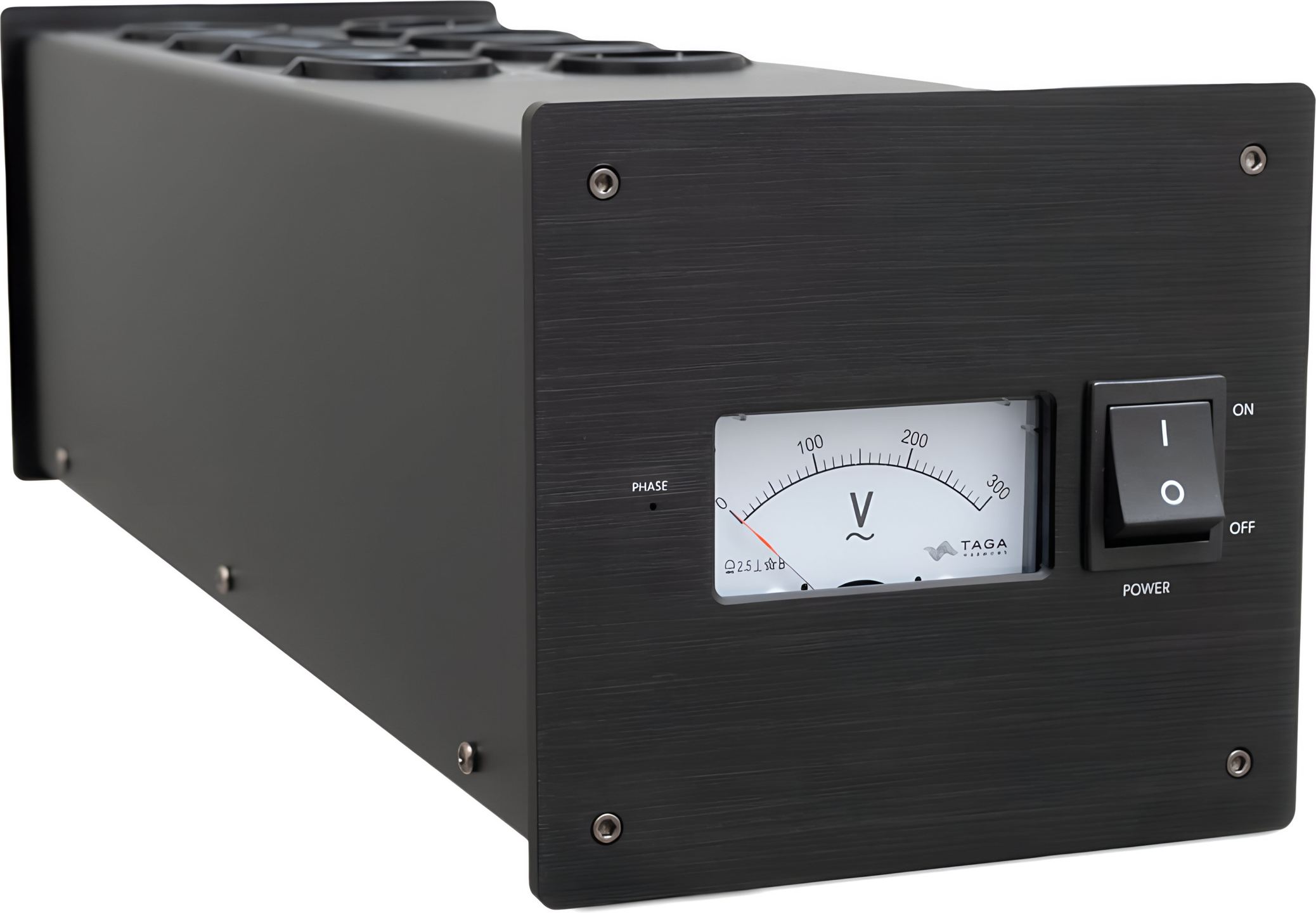
Eight outlets, two complementary technologies: the PF-1000DC combines mains noise filtering and DC component blocking in a single chassis. This evolution of the PF-1000 adds a DC Blocker circuit that tackles vibrations and humming in toroidal transformers. With its four different outlet types, it lets you adapt power conditioning to each component in a hi-fi or home cinema system.
Why filter and block DC?
The household power grid carries two types of disturbances that affect audio-video equipment.
Electromagnetic interference (EMI) comes from devices connected to the same network: refrigerators, air conditioners, dimmers, chargers. These disturbances vary depending on the time of day and activity in the building. They result in hiss from the speakers or image degradation.
The DC component (DC offset) is caused by an imbalance between the positive and negative halves of the AC waveform. Toroidal transformers are sensitive to this: they start to vibrate mechanically, producing an audible hum and increased temperature. This phenomenon often affects integrated amplifiers, phono preamplifiers, and linear power supplies.
Four outlet configurations for four uses
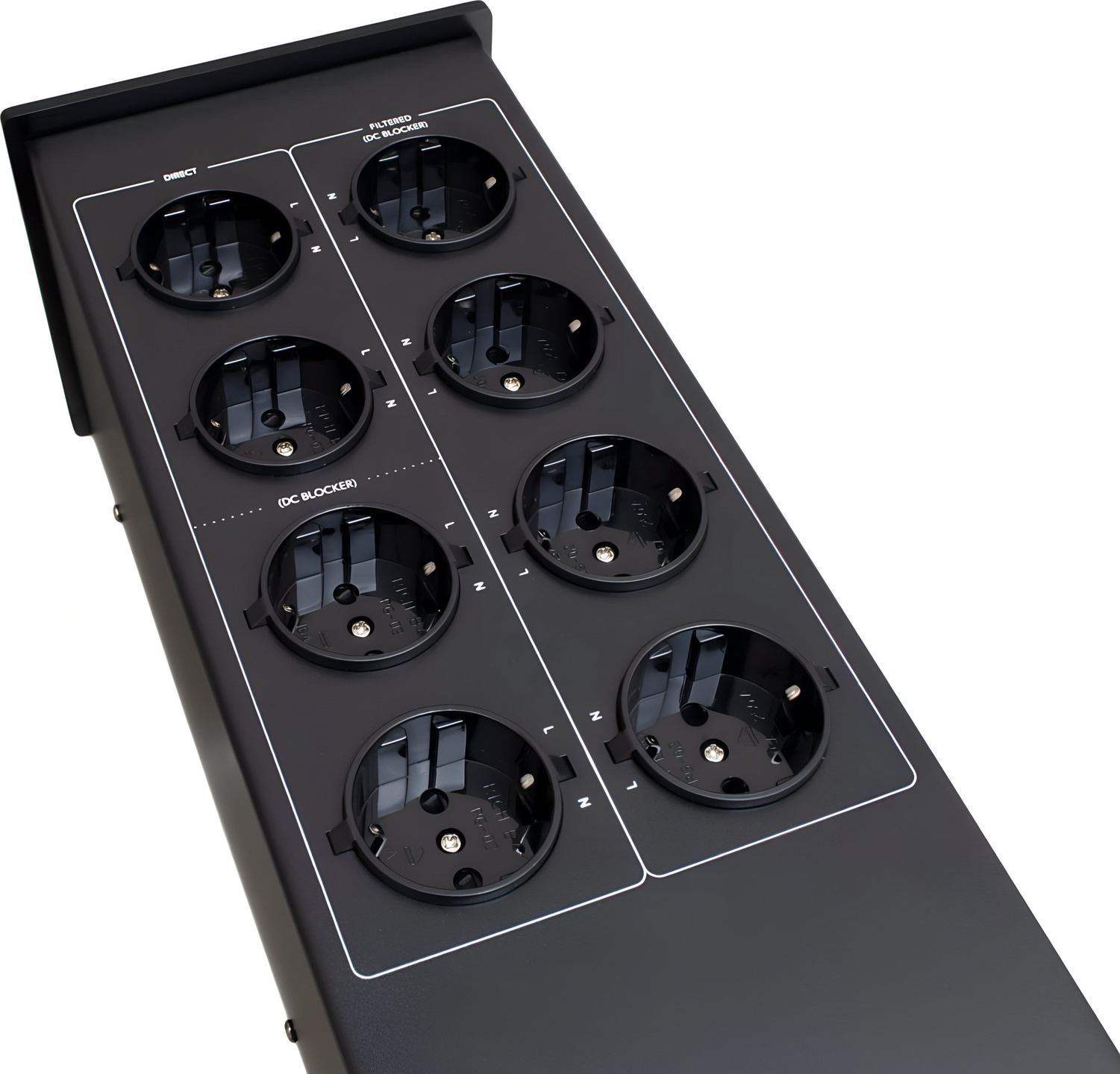
The PF-1000DC offers eight Schuko outputs divided into three distinct groups.
Two outlets pass the current without any treatment (direct outlets). They are suitable for power amplifiers, which do not always respond well to filtering that can restrict dynamics during high current peaks.
Two other outlets add DC blocking without filtering. This configuration targets devices with humming toroidal transformers, such as preamplifiers or linear power supplies, when filtering is not necessary or desired.
The remaining four outlets combine filtering and DC blocking. They are intended for digital sources (CD players, DACs, streamers) and phono preamplifiers, which are more sensitive to high-frequency disturbances.
This segmentation lets you choose the appropriate treatment for each device instead of imposing a single solution.
Construction and finish
The chassis measures 43 cm deep, 14 cm wide, and 13 cm high. It weighs 4.2 kg. The front panel and rear panel are made of brushed aluminum, the rest of the structure is folded steel, painted and internally damped with dense foam that absorbs micro-vibrations. Internal wiring uses thick-gauge conductors with screwed connections to reduce impedance.
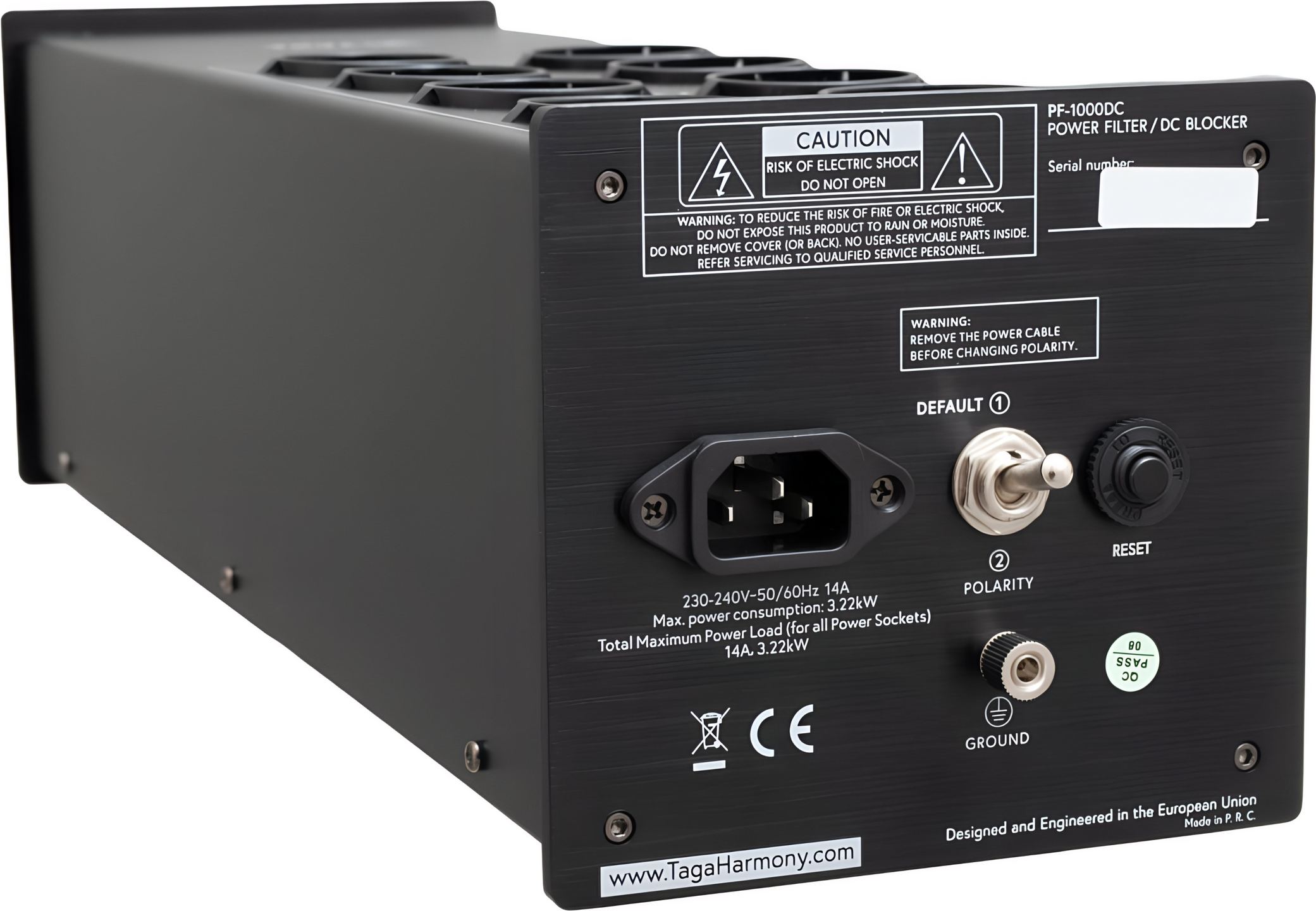
The front hosts an analog voltmeter that displays the mains voltage in real time and a master power switch. On the rear, there is an IEC C14 inlet for the power cord, a polarity reversal switch, a ground terminal, and a resettable circuit breaker.
Built-in diagnostic tools
The phase detector indicates whether the wiring polarity is correct. A switch lets you reverse the phase without having to flip the mains plug. This feature makes it easier to optimize wiring in a setup where multiple components are interconnected: proper phase alignment reduces leakage currents and ground loops.
The voltmeter allows you to monitor the stability of the power supply. Large variations may indicate a problem with the installation or an overload on the circuit.
Surge protection
The PF-1000DC includes protection against voltage spikes. Stated specifications: maximum surge current of 4500 A (8/20 µs impulse), peak voltage of 3000 V over 10 ms, clamping voltage of 775 V. These values correspond to protection against transients caused by indirect lightning strikes or switching events on the grid.
This protection does not replace a panel-mounted surge arrester, but adds an extra line of defense for sensitive equipment.
Power and consumption
The total allowable load is 14 A, i.e. 3220 W at 230 V. This is enough to power a complete system: integrated amplifier, sources, phono preamplifier, and television. Standby consumption remains below 0.5 W.
The filter attenuates noise by more than 10 dB between 2 and 100 MHz, the range where most domestic electromagnetic interference is found.
Technical specifications
Electrical specifications
- Power supply: 230–240 V ~ 50 / 60 Hz
- Maximum total load: 14 A / 3220 W
- Self-consumption: less than or equal to 0.5 W with no device connected
Filtering and protection
- Noise filtering: greater than -10 dB in the 2–100 MHz range
- Surge protection
- Maximum surge current: 4500 A in a single 8 / 20 µs pulse
- Maximum peak voltage: 3000 V for 10 ms
- Maximum clamping voltage: 775 V with an 8 / 20 µs pulse
Connectivity
- 4 direct Schuko outlets
- Including 2 equipped with a DC blocker
- 4 filtered Schuko outlets
- All equipped with an integrated DC blocker
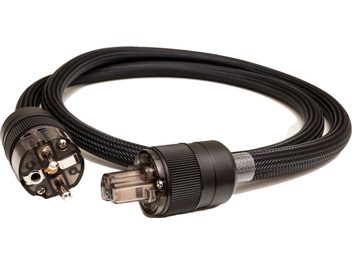
- Removable IEC power cable with the option to upgrade to an audiophile power cable
Advanced features
- Integrated phase detector
- Polarity inversion switch
- Front-panel voltage indicator
- Surge protection
Integrated DC blocker
The integrated DC blocker treats the DC component present on the power grid, which can cause transformer saturation and generate vibrations and mechanical noise.
Advantages of the DC blocker
- Elimination or reduction of the undesirable DC component
- Reduction of transformer hum
- Lower operating temperature
- Improved overall system stability
Dimensions and weight
- Dimensions: 13 × 14 × 43 cm (height × width × depth)
- Weight: 4.2 kg
Why use a mains filter
- Significant reduction of mains noise
- Improved sound quality
- Cleaner, more detailed sound
- Significant reduction of hum
- Quieter and more stable operation
- Reduced transformer heating
- Enhanced surge protection
- Increased longevity of connected devices
- Longer service life for equipment
Frequently Asked Questions
Should the amplifier be connected to a filtered or direct outlet?
It depends on the amplifier. High-dynamic models (high-power class A/B) sometimes benefit from using a direct outlet to avoid any limitation on transients. Moderately powered integrated amplifiers or tube amplifiers generally work well on the filtered outlets with DC Blocker. Ideally, you should try both configurations.
Does the DC Blocker work with all transformers?
The circuit is primarily aimed at toroidal transformers, which are most sensitive to DC offset. Conventional EI transformers are less vulnerable. If your device does not hum, the DC Blocker will not bring any audible improvement, but it will not have any negative effect either.
Can the PF-1000DC be used for a TV or projector?
Yes. The filtering reduces disturbances that can affect the picture (snow, banding, flicker). The 3220 W allowable load is more than enough for video equipment. The block can power a hi-fi system and a home cinema setup at the same time.
What’s the difference compared to the PF-1000 v2 without DC Blocker?
The PF-1000 v2 only offers mains noise filtering. The PF-1000DC adds the DC blocking circuit, which is useful if your devices hum or run abnormally hot. The outlet layout also differs: the PF-1000DC provides four different configurations versus two for the PF-1000 v2.
Does the filter limit amplifier dynamics?
Some amplifiers with very high instantaneous power may experience a slight restriction on the filtered outlets during sudden fortissimos. This is why the PF-1000DC retains two direct outlets (without filtering or DC Blocker) for these specific cases. Moderately powered devices are generally not affected.
Is the ground terminal on the back actually useful?
It lets you connect the filter’s ground to a dedicated earth point or another ground point in the system. This is useful in installations where ground loops cause hum, or to establish a common reference point between several devices.
Can the supplied mains cable be replaced?
Yes. The IEC C14 inlet accepts any standard or audiophile cable terminated with a C13 connector. The recommended gauge is at least 1.5 mm² to support the full 14 A load.
- Eco-contribution included in the sale price.
- GTIN / EAN: 5901589262092