Audioquest Rocket 44 SBA (2 x 2.5m)
Overview
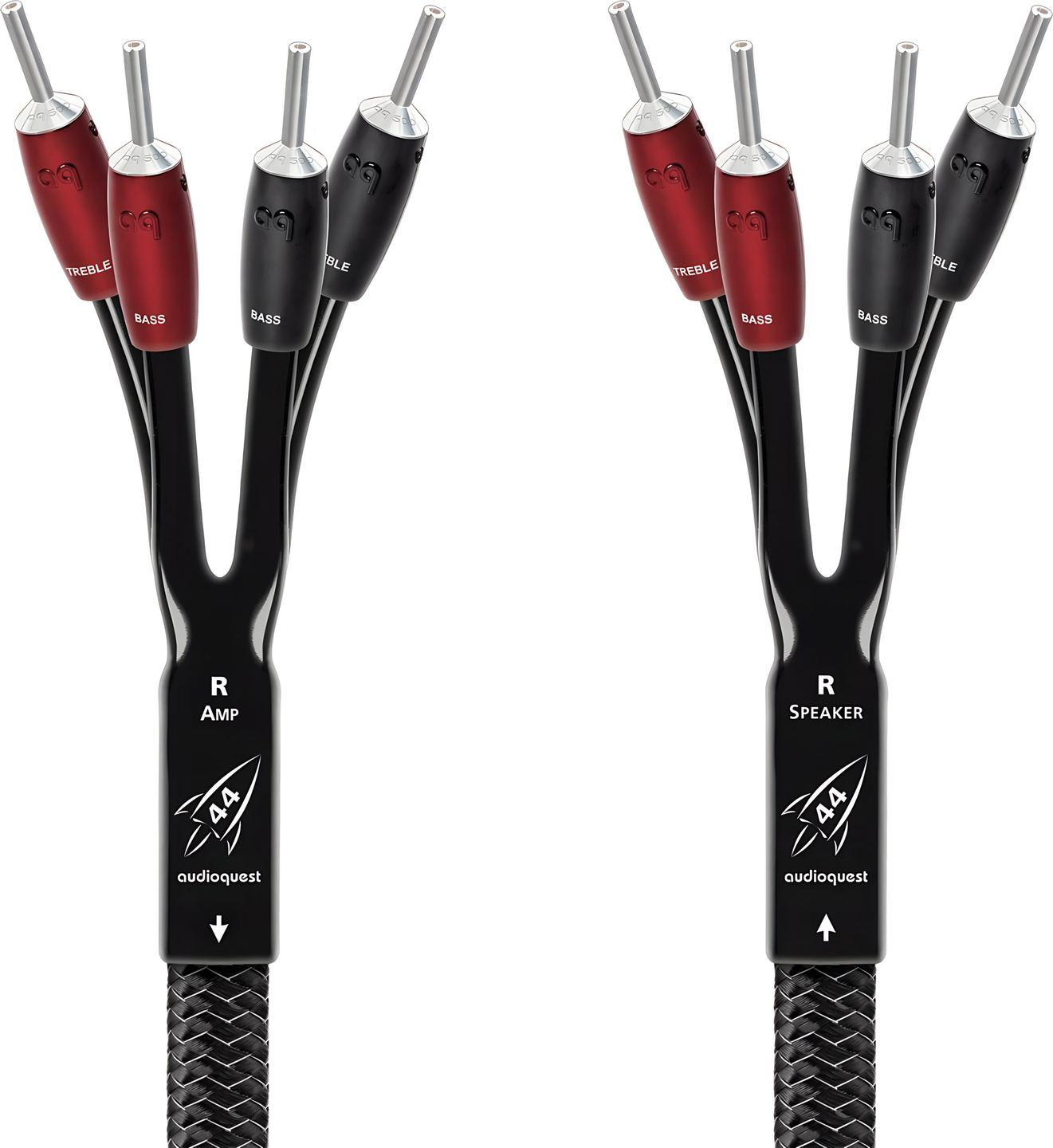
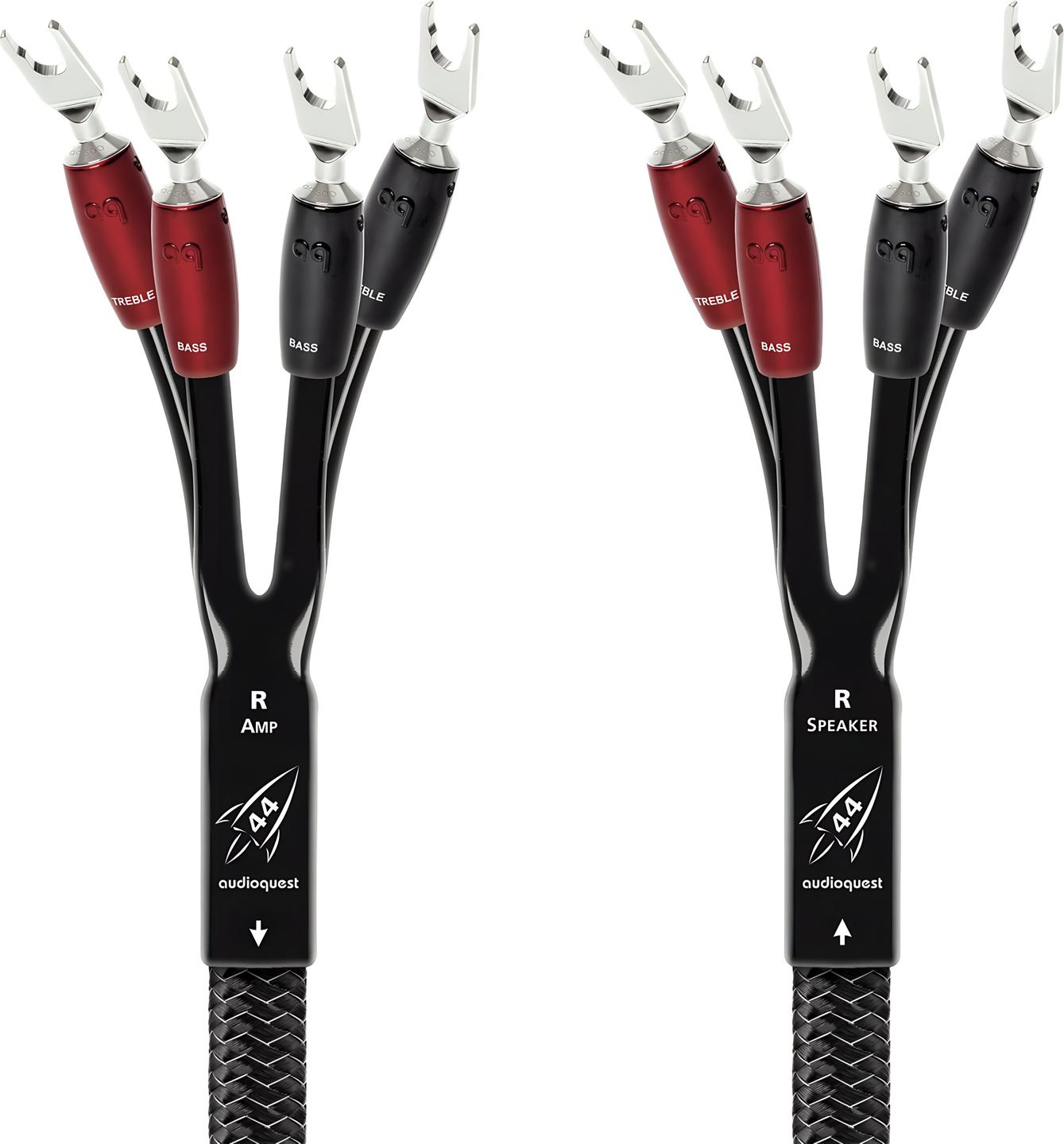
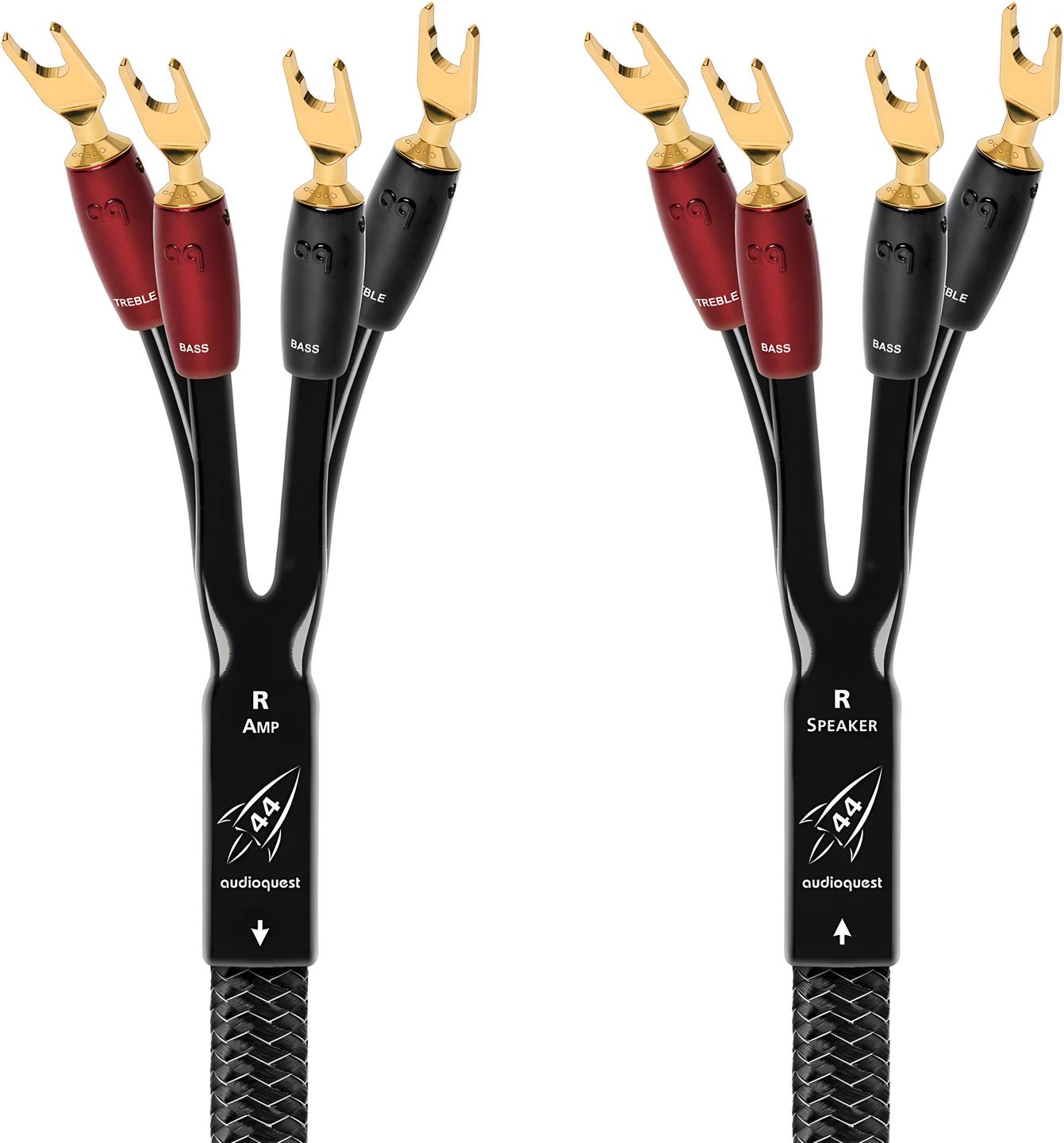
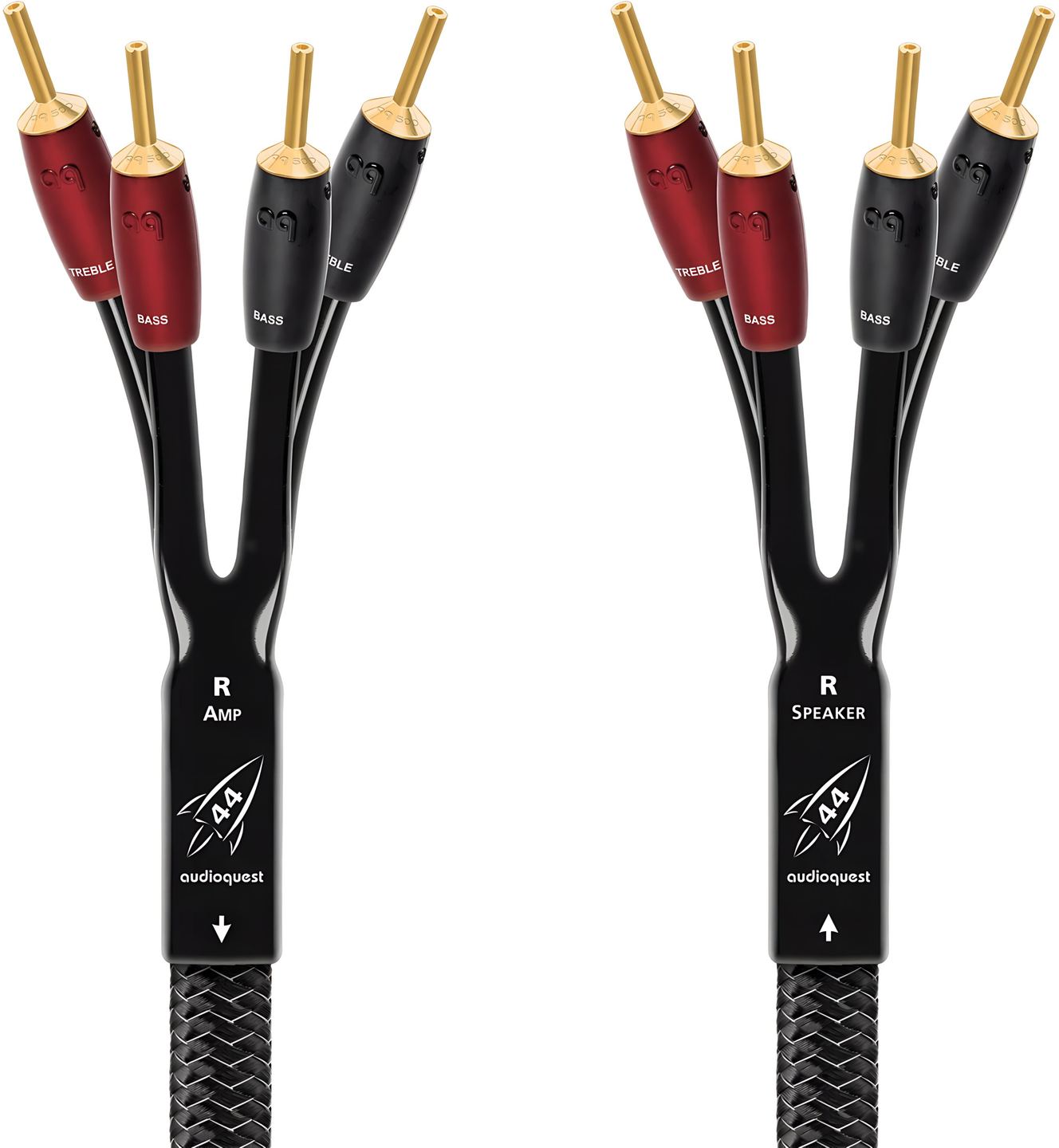
Second most advanced model in the Rocket series, the Rocket 44 stands out for its Double Star-Quad geometry and its blend of two smooth-surface coppers. This SBA (Single Bi-Amp) version comes with four SureGrip 500 banana connectors on each side: two on the amplifier end, two on the speaker end. A cable that takes advantage of bi‑amping without requiring two separate pairs.
Eight solid conductors in a Star-Quad geometry
AudioQuest has chosen solid conductors instead of stranded ones. The reason lies in the electrical interactions between strands in a conventional cable: when the signal flows, the adjacent wires act like many tiny parasitic circuits that blur the current’s path. A solid conductor eliminates this problem at the source.
The Rocket 44 uses eight conductors divided into two Star-Quad groups. This configuration is neither parallel nor a conventional twist. The four wires in each group are arranged in a star shape, which optimizes inductance and capacitance values while reducing electromagnetic interference between polarities. According to AudioQuest, this geometry outperforms parallel-conductor cables in terms of dynamic contrast and clarity of the musical message.
PSC and PSC+: two coppers, two roles
The cable combines two proprietary types of copper. PSC (Perfect Surface Copper) is a high-purity copper whose surface has been treated to eliminate microscopic roughness. These irregularities, found in standard coppers like OFHC or OCC, create breaks in the signal flow, particularly noticeable in the high frequencies.
PSC+ takes this treatment even further. Its surface is even smoother, with fewer grain boundaries in the metal structure. This copper makes up the majority of the Rocket 44’s conductors. The combination of the two types allows for a balanced sound between treble precision (provided by PSC+) and bass body (provided by PSC).
Radio-frequency noise dissipation
The negative conductors of the Rocket 44 are jacketed in a partially conductive, carbon-loaded polyethylene. This material absorbs radio-frequency interference picked up by the cable (Wi‑Fi, Bluetooth, mobile phones) and dissipates it before it can travel back to the amplifier. An external carbon layer adds an extra level of protection against environmental interference.
The positive conductors receive a different insulation: nitrogen-injected, foamed polyethylene. The air trapped in this foam absorbs very little energy. Conventional insulators, on the other hand, store part of the electrical energy and release it with a slight delay, which produces a blurring effect on transients.
Bi-amping: one cable, two paths
On the amplifier side, the SBA version connects to two pairs of binding posts. This configuration works with an amplifier capable of assigning separate channels to the bass and treble sections, or with two distinct amplifiers. On the speaker side, the four connectors are distributed across the dual binding post: two for the woofer/midrange drivers, two for the tweeters.
Each Star-Quad group in the cable has a slightly different “personality.” One favors finesse in the treble, the other power in the bass. In bi‑wiring or bi‑amping, this complementarity fully comes into play, since each frequency range benefits from its own signal path.
SureGrip 500 connectors and directionality
SureGrip 500 banana plugs use a silver-plated copper body. The connection between cable and plug is made by Cold-Weld: calibrated pressure mechanically fuses the two metals without heat, preserving the crystalline structure of the conductor. AudioQuest offers these connectors with silver or gold plating depending on user preference.
The cable has a defined direction of installation. “Amp” and “Speaker” sleeves indicate which end goes where. This directionality stems from the “fish-scale” structure of drawn metal: RF interference, which is sensitive to skin effect, dissipates more effectively when the cable is oriented correctly.
Technical Specifications
- Speaker cable with SureGrip 500 Rocket 44 connectors
- Designed for bi‑amplification
Conductors
- Materials: PSC+ (very high purity) + PSC
- Structure: Solid conductors to minimize electrical interaction and distortion
- Advantage: Smooth surface that almost completely eliminates sonic harshness and increases clarity
Geometry
- Double Star-Quad configuration
- Superior to parallel or twisted conductors
- Reduces distortion and optimizes electrical values (capacitance and inductance)
Noise dissipation
- Carbon-Based Noise Dissipation technology
- Negative conductors coated with partially conductive carbon-loaded polyethylene
- Reduces radio-frequency noise fed back into the amplifier
- Decreases external interference, improves clarity and sound dimensionality
Insulation
- Air-filled foamed polyethylene
- Reduces energy absorption and distortion
- Less blurring effect compared with traditional insulators
Additional technologies
- Direction-controlled conductors: Ensure proper dissipation of induced noise
Performance
- Clear, detailed, and accurate sound
- Reduction of radio-frequency (RF) interference and noise
- Better dimensionality and sonic precision
Frequently Asked Questions
Does bi-amping offer an advantage over bi-wiring?
Bi‑amping separates the bass and treble signals right at the amplifier output, each section receiving its own amplification channel. Bi‑wiring uses a single channel per speaker. The benefit depends on the amplifier: if it offers true channel assignment or if you use two separate power amps, bi‑amping provides better control over the drivers.
My speakers only have a single pair of binding posts. Can I use this cable?
No, the Rocket 44 SBA requires speakers equipped with dual binding posts. For speakers with a single set of terminals, the Full‑Range version of the Rocket 44 is more suitable.
Is PSC+ comparable to a silver cable?
PSC+ is still copper, but its surface treatment aims to reproduce some of silver’s advantages (smoothness in the treble) without its tendency to sound harsh. Silver is more conductive, copper offers a better tonal balance according to AudioQuest.
Does the cable require burn-in?
AudioQuest states that its cables are ready to use thanks to the properties of solid conductors. Some users report sound stabilization after a few dozen hours, but the manufacturer does not recommend any specific burn‑in period.
- Eco-contribution included in the sale price.
- Manufacturer reference: 2.5M PR ROCKET 44 SBA