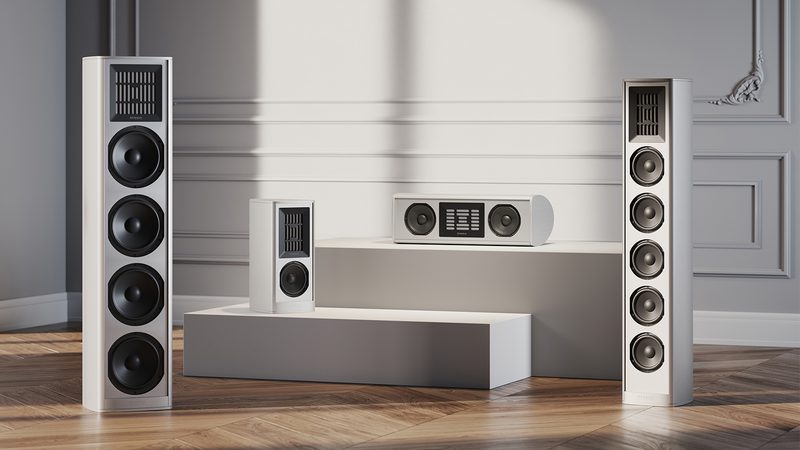
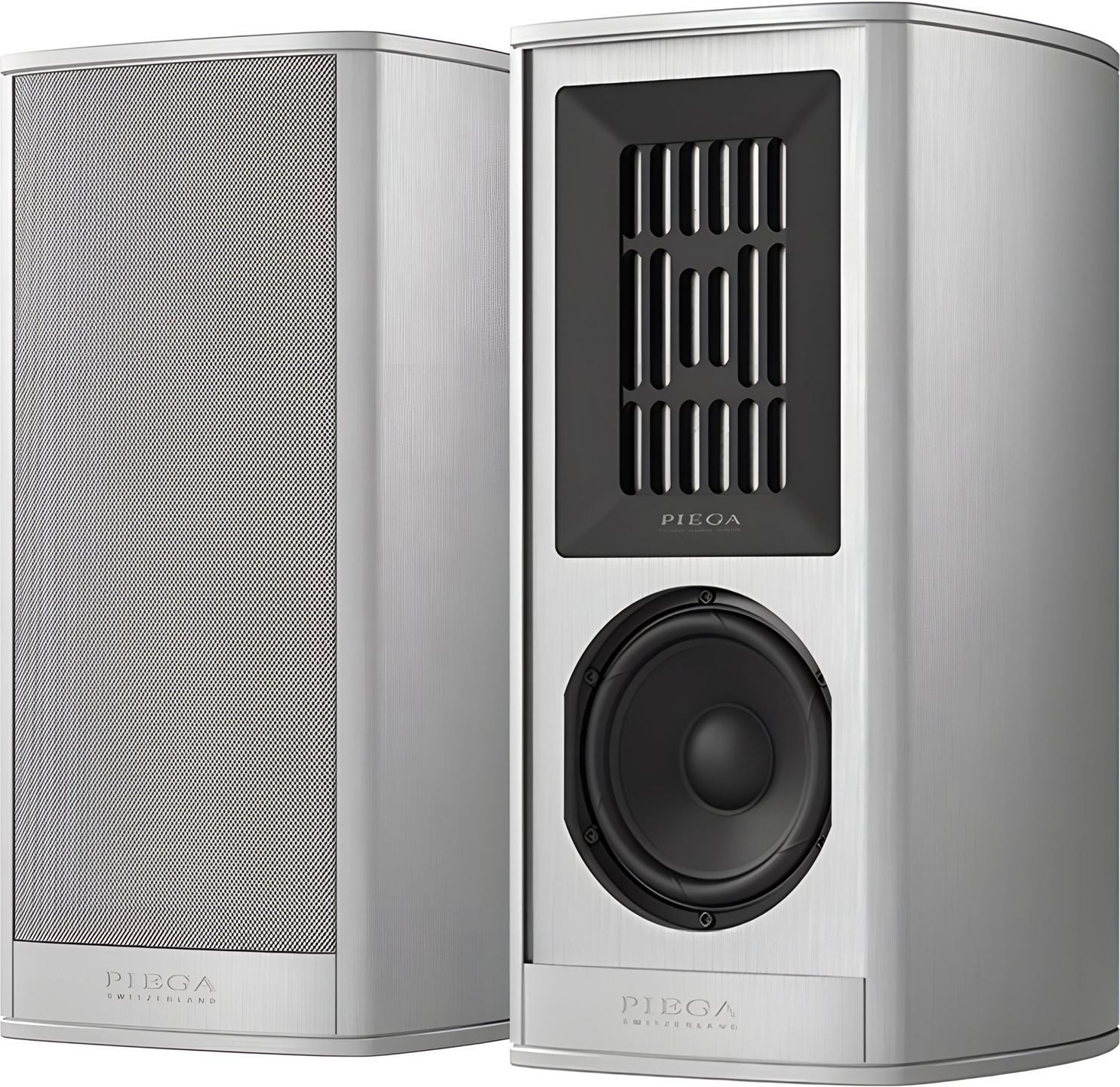
Piega Coax 411 Gen2 silver (pack of 2)


Complementary products
Overview
A 25 kg bookshelf speaker is unusual. This weight reveals Piega’s approach: a one-piece extruded aluminum cabinet, a three-way design where others make do with two, and an in-house–developed and manufactured coaxial mid-treble transducer built in Horgen on the shores of Lake Zurich. The Coax 411 succeeds the Coax 311 with increased internal volume and an extra ten kilos on the scale.
A coaxial ribbon that isn’t quite one
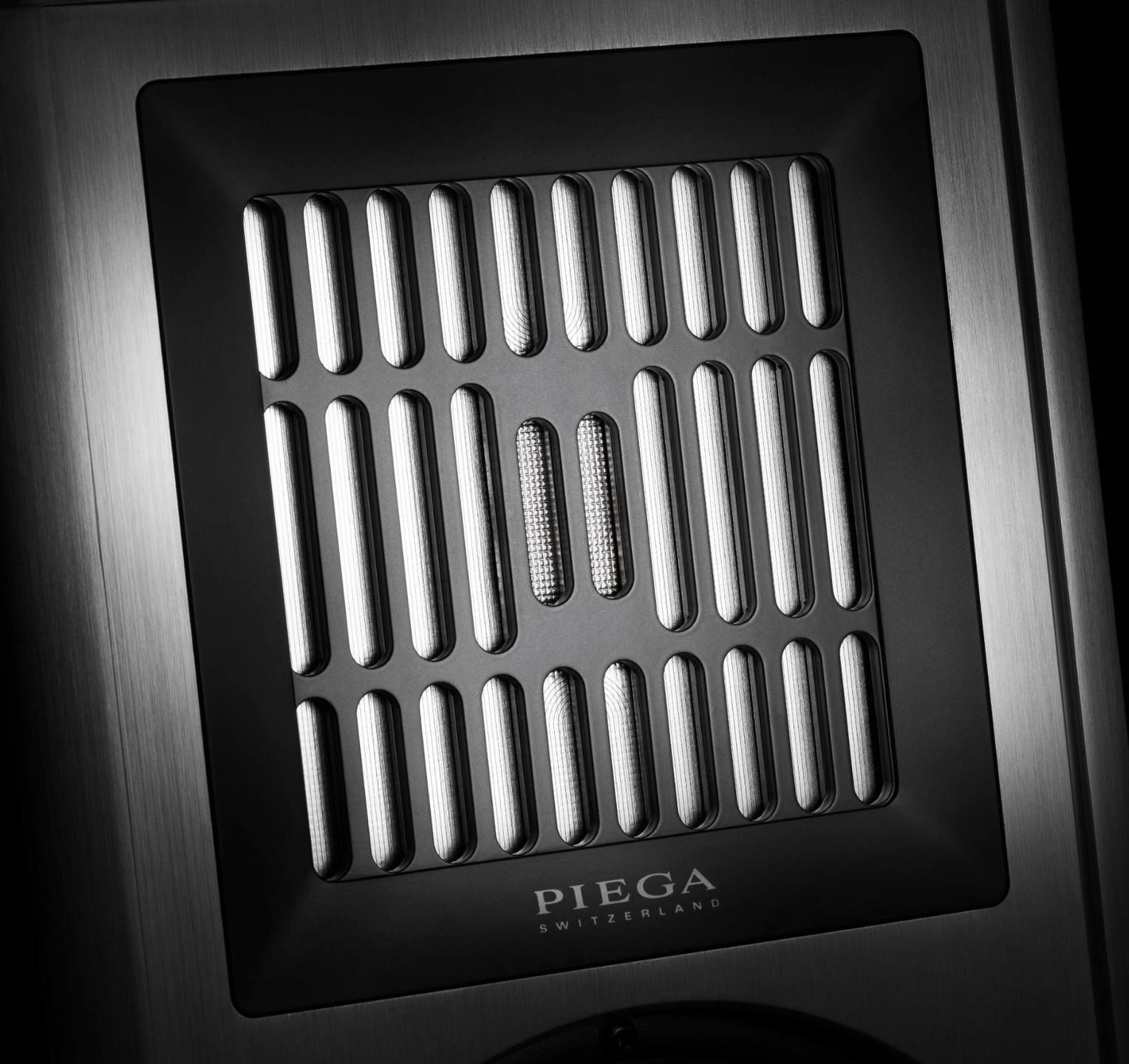
Piega’s C112+ deserves a closer look. Despite its “ribbon” designation, it is technically a planar magnetic transducer: an ultra-thin polymer diaphragm carrying a flat aluminum voice coil on its front side, driven by neodymium magnets positioned behind it. This diaphragm, roughly thirty times lighter than a conventional dome, accelerates and decelerates with a speed that conventional structures struggle to match.
The originality lies in the coaxial architecture: the tweeter occupies the center, framed by the ribbon midrange that symmetrically surrounds it. The two sections share the same plane, forming a point source over a wide frequency range, from 450 Hz up to 50 kHz. This layout eliminates the time offsets between midrange and treble that affect conventional designs where the drivers are physically separated. The soundstage gains in coherence and imaging precision, regardless of listening angle.
Bass that defies the format
The Coax 411 extends down to 35 Hz (±3 dB), a rare performance for a speaker of this size. By comparison, several direct competitors in this price range roll off around 42 to 45 Hz. The reason: a 160 mm UHQD woofer manufactured by SEAS in Norway to a specification drawn up by Piega. Its rigid aluminum cone and specific suspension system allow it to fully exploit the increased internal volume of this generation.
The crossover point, set at 450 Hz, frees the woofer from midrange frequencies and lets it focus on the bass register. This distribution partly explains the authority and control in the lower spectrum, but it also imposes a requirement: the amplifier must be able to drive a 4-ohm load with confidence. Piega recommends between 20 and 200 watts of power, a broad range reflecting the respectable sensitivity of 90 dB/W/m.
Aluminum under tension
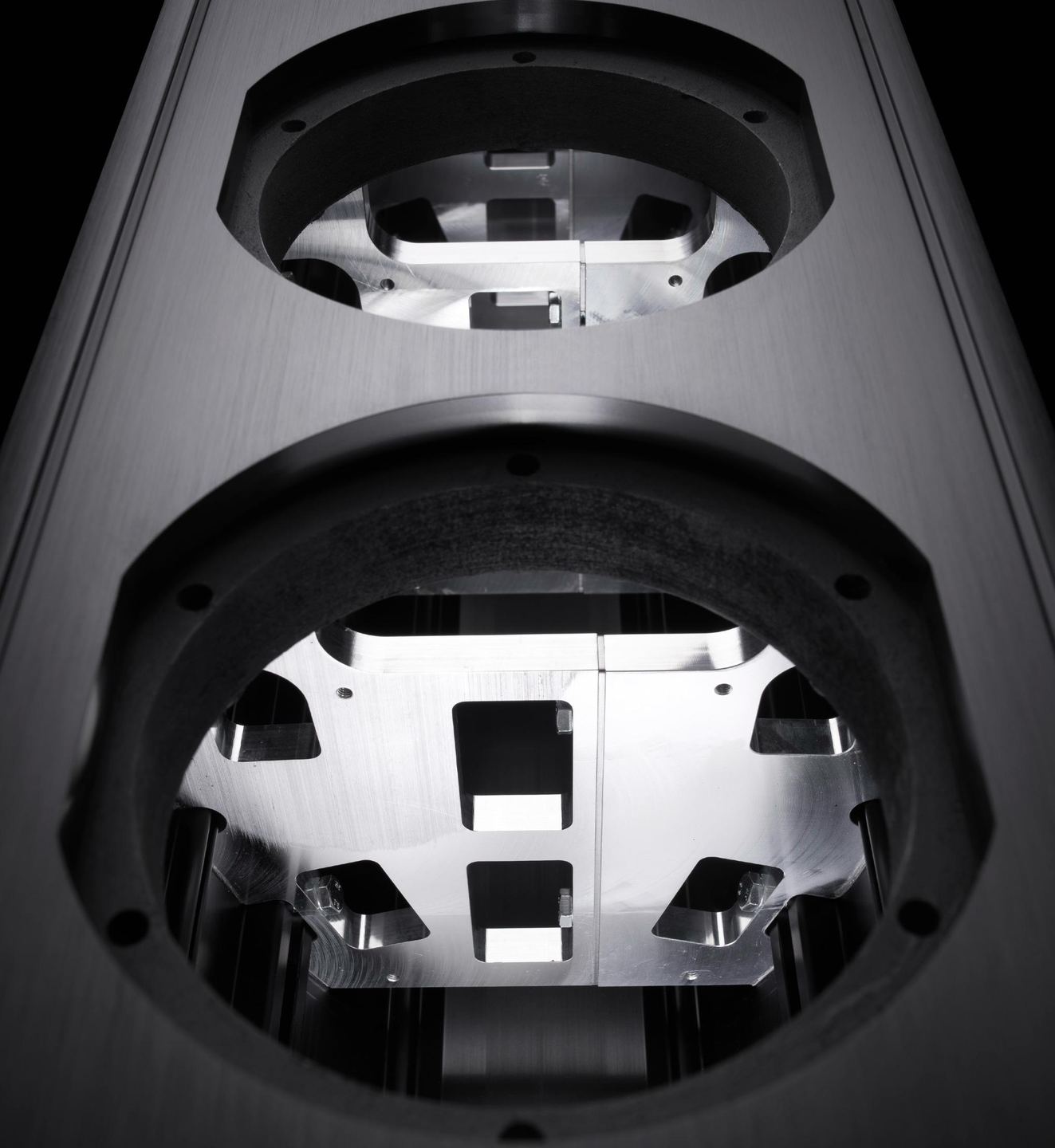
The seamless extruded aluminum cabinet has been a Piega hallmark for decades. Extrusion creates a continuous profile with thick, homogeneous walls, far more rigid than an assembly of MDF panels. The result is evident to the touch: a firm tap of the finger produces a dull, damped sound with no parasitic resonance.
The TIM2 (Tension Improve Module 2) system takes the concept further. Machined alloy elements are press-fitted inside the cabinet to keep the walls under permanent tension. This controlled mechanical stress reduces residual micro-vibrations. Viscoelastic sheets complete the setup by absorbing what the pre-stressing does not eliminate.
The asymmetric silhouette, designed by Stephan Hürlemann, curves the sides towards the rear. Seen from the side, the speaker looks slimmer than it actually is. The bass-reflex port vents to the rear, which requires a minimum distance from the wall (at least around twenty centimeters to avoid excessive bass reinforcement).
Placement and system matching
At 45 cm high, 21 cm wide, and 31 cm deep, the Coax 411 needs stable stands. The 25 kg weight per speaker is no trivial matter: light or flimsy supports should be avoided. The “bookshelf” designation may seem paradoxical given these dimensions and weight, but Piega clearly targets use on dedicated stands, with “bookshelf” referring here to the compact form factor rather than actual shelf placement.
The binding posts support bi-wiring or bi-amping thanks to their double pair of connectors. The 4-ohm impedance and the fairly linear electrical load make it compatible with a wide range of amplifiers, from tube integrateds to solid-state power amps. The Coax 411’s sonic signature leans towards neutrality and transparency: it reveals the strengths and weaknesses of the upstream electronics without sugarcoating.
What this generation changes
The first Coax series, introduced in 2017, replaced Piega’s older “C” models. This Gen2 generation, unveiled at the High End show in Munich in 2022, brings a larger cabinet, a revised TIM2 system, and above all the new C112+ transducer with its reinforced front baffle, an additional neodymium magnet above the tweeter, and a diaphragm with optimized coating for a more linear response in the lower midrange.
The sonic philosophy has also evolved. Older Piega models were known for their roundness and warmth. The new generation adopts a more controlled, faster, more analytical profile. This is a deliberate choice that will not appeal to everyone: the sound gains in precision what it loses in forgiveness towards mediocre recordings.
Technical specifications
Acoustic technologies
- C112+ coaxial ribbon
- New coaxial transducer combining midrange and tweeter on the same axis
- Refined, natural, and lively sound
- Precise and coherent soundstage
- 160 mm UHQD woofer
- Transducer specially developed for Piega by SEAS
- Perfect integration with the coaxial ribbon
- Dynamic, controlled bass
Construction and damping
- TIM2 tension improvement module
- Controlled pressurization of the cabinet
- Effective reduction of vibrations and resonances
- Improved sound purity
- High-end aluminum cabinet
- Seamless extruded aluminum profile
- Exceptional rigidity and premium finish
- Elegant design by Stephan Hürlemann
Technical specifications
- Type: 3-way bookshelf speaker
- Recommended amplifier power: 20 – 200 W
- Sensitivity: 90 dB/W/m
- Impedance: 4 Ω
- Frequency response: 35 Hz – 50 kHz
- Transducers: 1 × 160 mm UHQD woofer, 1 × C112+ coaxial ribbon
- Cabinet: extruded aluminum with TIM2 module
- Dimensions (H × W × D): 45 × 21 × 31 cm
- Weight: 25 kg
Available finishes
- Standard finishes: brushed silver aluminum, brushed black aluminum, white lacquer
Key features
- High-end coaxial technology in a compact format
- Exceptional precision and richness in the midrange and treble
- Remarkably dynamic bass for a bookshelf speaker
- Exclusive aluminum construction
- Timeless design and premium finishes
Frequently asked questions
Can the Coax 411 be used without a subwoofer?
In a room under 25–30 m², extension down to 35 Hz is sufficient for most musical content. A subwoofer will be a welcome addition for home cinema or music genres with a strong infrabass component (electronic, organ), but is not essential for classical, jazz, or rock listening.
What amplifier power should I plan for?
Piega specifies a range from 20 to 200 watts. In practice, a quality amplifier of 50 to 100 watts will be suitable in most situations. The 4-ohm impedance requires an amplifier capable of delivering current: check that your unit can handle this load without difficulty.
Are stands included?
No. Stands and spikes are sold separately. Given the 25 kg weight per speaker, investing in suitable high-quality supports is strongly recommended.
Does the grille affect the sound?
As with most speakers, removing the grille slightly alters the response, particularly in the treble where the metal mesh can introduce subtle diffractions. The differences remain minor, and the choice is as much about aesthetics as acoustics.
What distance from the rear wall is recommended?
The rear bass-reflex port requires a minimum of 15 to 20 cm. Beyond 30–40 cm, the bass integrates better with the rest of the spectrum. Placing the speaker too close to the wall can make the low end overpowering.
Can the Coax 411 be used in a multichannel home theater setup?
Yes. Piega offers the Coax Center 211, a matching center speaker using the same C112+ transducer and identical UHQD woofers, ensuring tonal consistency across the three front channels.
- Eco-contribution included in the sale price.
- Manufacturer reference: 692585