Supra ZAC TosLink 1m
Overview
An optical cable that challenges conventional wisdom. Where glass fiber is often presented as the reference for optical transmission, Supra Cables has chosen to perfect plastic fiber with its ZAC technology. The result: transmission quality equivalent to glass, but with a flexibility and robustness that glass cannot offer. Made in Sweden by Jenving Technology, this cable embodies the brand’s “No-Nonsense” philosophy.
The ZAC Concept, or How to Overcome the Limitations of Plastic Fiber
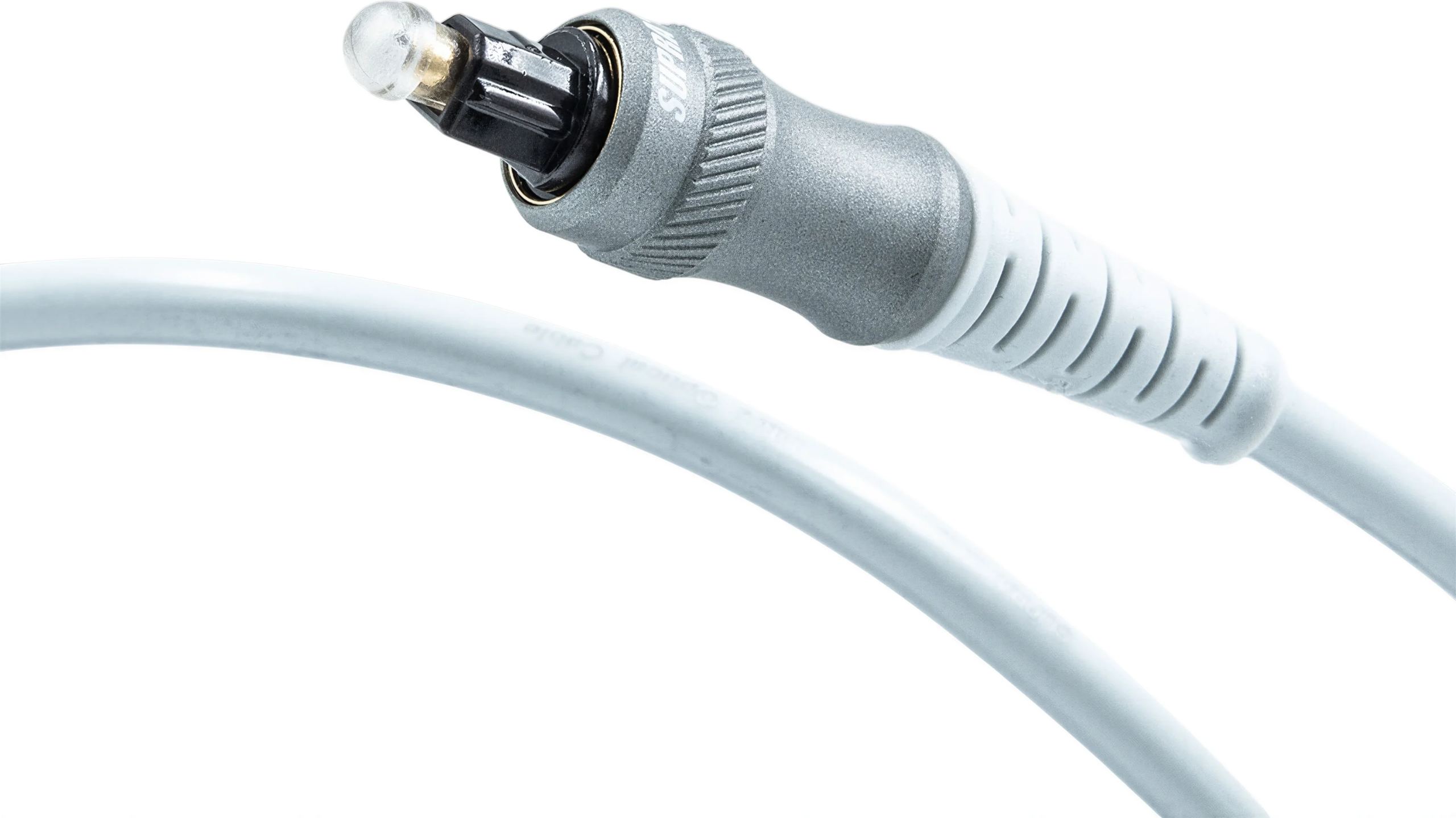
ZAC stands for “Zero Attenuation Concept.” The idea is straightforward on paper: eliminate the signal losses that typically affect plastic fiber. In practice, Supra achieves this through a patented three-step polishing process and a specific curvature of the optical core tip. This particular geometry cancels out losses caused by light divergence — the classic weak point of plastic compared to glass.
The fiber core comes from a Japanese supplier and stands out for its resistance to aging. This is a detail that matters: cheap plastic optical fibers can degrade over time, especially when subjected to repeated stress. Here, Supra bets on durability.
Bandwidth and Compatibility with High-Resolution Formats
The ZAC TosLink’s bandwidth reaches 32-bit / 384 kHz. This level far exceeds the needs of common sources (televisions, consoles, Blu-ray players), but ensures compatibility with high-resolution files and studio formats. In short, the cable will not be the limiting link in the chain, even with a recent audiophile DAC.
This headroom remains relevant even over longer lengths. The cable is available from 30 cm to 15 meters (or even 20 meters depending on the distributor), and Supra guarantees the same performance regardless of the length chosen.
Complete Isolation Against Interference
Optical transmission offers a structural advantage over copper: total immunity to electromagnetic and radio-frequency interference. No magnetic field, no electrical noise from the mains can affect a light signal. The ZAC TosLink also emits no parasitic radiation, preventing any interference with neighboring equipment.
Galvanic isolation is another tangible benefit. Devices connected by this cable have no electrical connection between them. This separation prevents ground loops and issues caused by differing earth potentials — a common situation when connecting a computer, a television, and a home theater amplifier on separate electrical circuits.
Design and Everyday Robustness
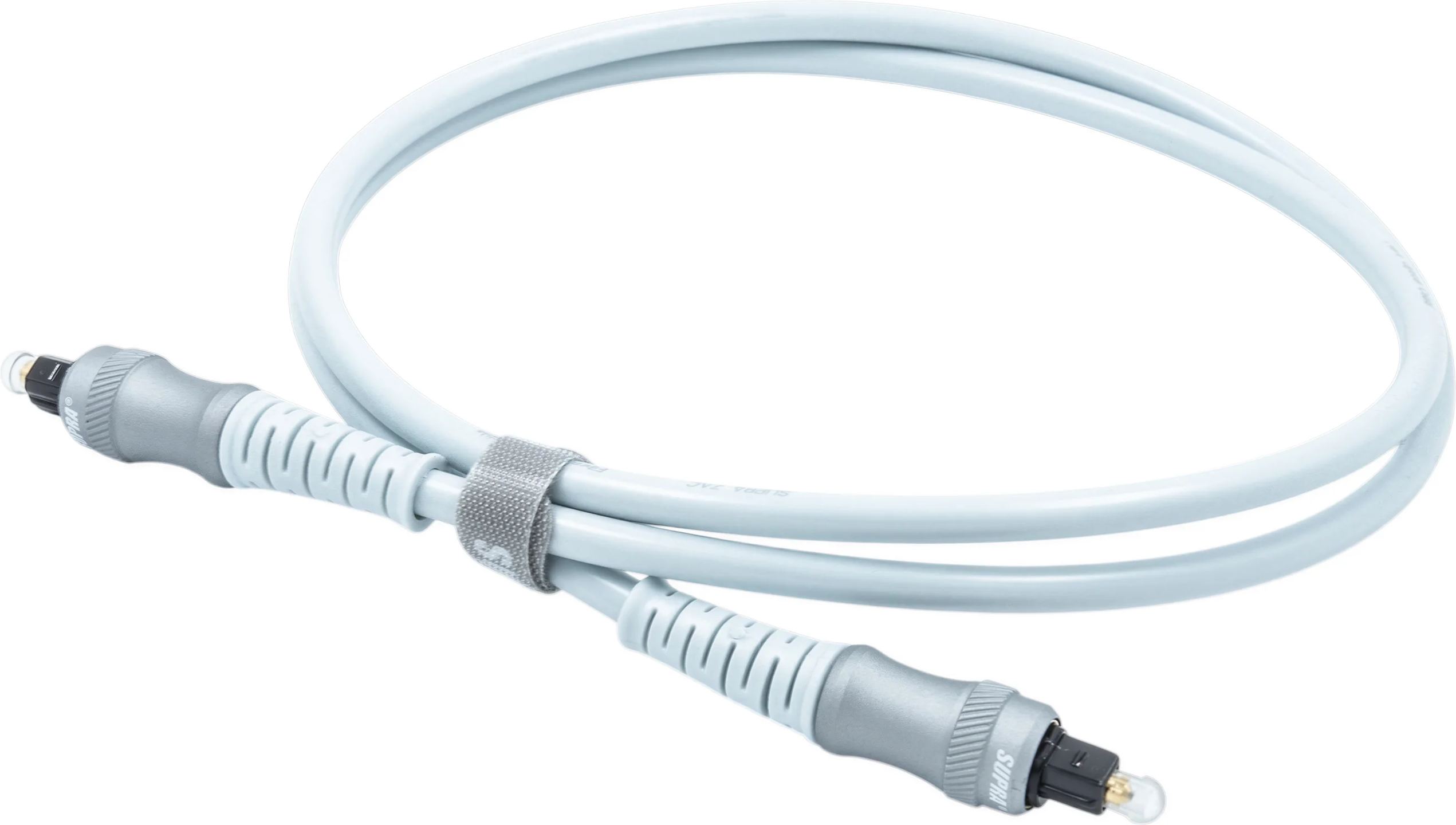
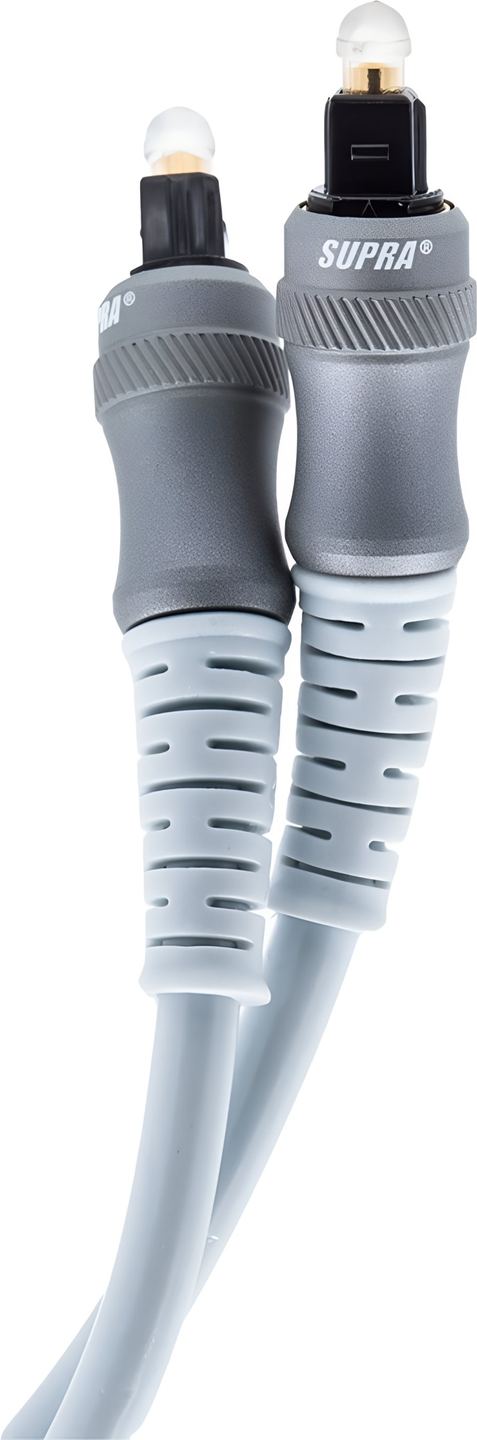
The cable features Supra’s characteristic “Ice Blue” finish — a glacial blue with Scandinavian inspiration that stands apart from anonymous black cables. The connectors are fitted with a spring clip that firmly holds the plug in the device’s TosLink socket. The molded sleeve incorporates bend protection at both ends, where optical fibers are most vulnerable.
Flexibility is described as “medium” by the manufacturer. Less rigid than a glass fiber cable, the ZAC TosLink is easy to handle in the tight spaces of a hi-fi cabinet or home theater rack. This relative flexibility remains a compromise: a cable that is too flexible would offer insufficient protection against excessively tight bend radii.
Typical Uses and Compatible Devices
The TosLink connector (short for Toshiba Link) remains widely used on consumer and audiophile audio-video equipment. The ZAC TosLink is suitable for connecting a source to a converter (DAC), a television to a home theater amplifier (to retrieve audio from a Smart TV), a gaming console to an external audio system, or a network player to an integrated amplifier.
The absence of a mini-TosLink option on this model means you should check the connectivity of your devices. Some laptops or audio dongles use the 3.5 mm optical format: Supra offers other versions of its ZAC cable with this termination.
Technical Specifications
Connectivity
- Connector type (A): Optical Toslink
- Connector type (B): Optical Toslink
- Connector orientation: straight
- Retention system: connectors with spring clip for secure fastening in the chassis
Construction
- Conductor: high-performance plastic optical fiber
- Transmission concept: ZAC (Zero Attenuation Concept)
- Fiber polishing: patented 3-step polishing process
- Cable protection: molded connectors with bend protection
- Flexibility: medium flex for easy installation
Performance
- Maximum bandwidth: up to 32 bits / 384 kHz
- Digital transmission: no loss due to optical divergence
- Interference immunity: immune to electromagnetic and radio-frequency interference
- Galvanic isolation: complete (no electrical connection between devices)
- Stray radiation: none
Compatibility
- Compatible with all devices equipped with an optical Toslink output or input, including:
- Audio DACs
- Home theater amplifiers
- Televisions
- Media players
- Consoles and computers
Certifications
- CE, RoHS 3
General Information
- Brand: Supra Cables
- Model: ZAC Toslink Optical
- Product type: optical digital audio cable
- Category: digital interconnect
- Number of channels: 1 stereo channel
- Color: Ice Blue
- Packaging: 1 piece
Frequently Asked Questions
Does ZAC technology really perform as well as glass fiber?
Supra claims that its polishing process and tip geometry allow it to match the performance of glass fiber for domestic audio applications. The difference becomes theoretical over short distances (less than 10 meters), where even a standard plastic fiber performs correctly. ZAC makes its case over longer lengths and to guarantee a safety margin on bandwidth.
Can I use this cable to connect my television to a soundbar?
Yes, this is one of the most common uses. The optical output of a television generally transmits audio from streaming applications or the TV tuner to an external audio system. The ZAC TosLink’s bandwidth far exceeds this requirement.
What length should I choose?
Measure the actual distance between your devices, taking the cable’s routing into account, then add a margin of 20 to 30 cm to avoid any tension. An excessive length is not an issue with this cable, but it does complicate cable management.
Can the cable transmit Dolby Atmos or DTS:X?
TosLink transmission remains limited to compressed formats (Dolby Digital, DTS) due to the bandwidth of the S/PDIF optical standard itself, not the cable. Lossless Atmos or DTS:X formats require an HDMI eARC connection.
- Eco-contribution included in the sale price.