Audioquest Angel Jack/Jack DBS 5m
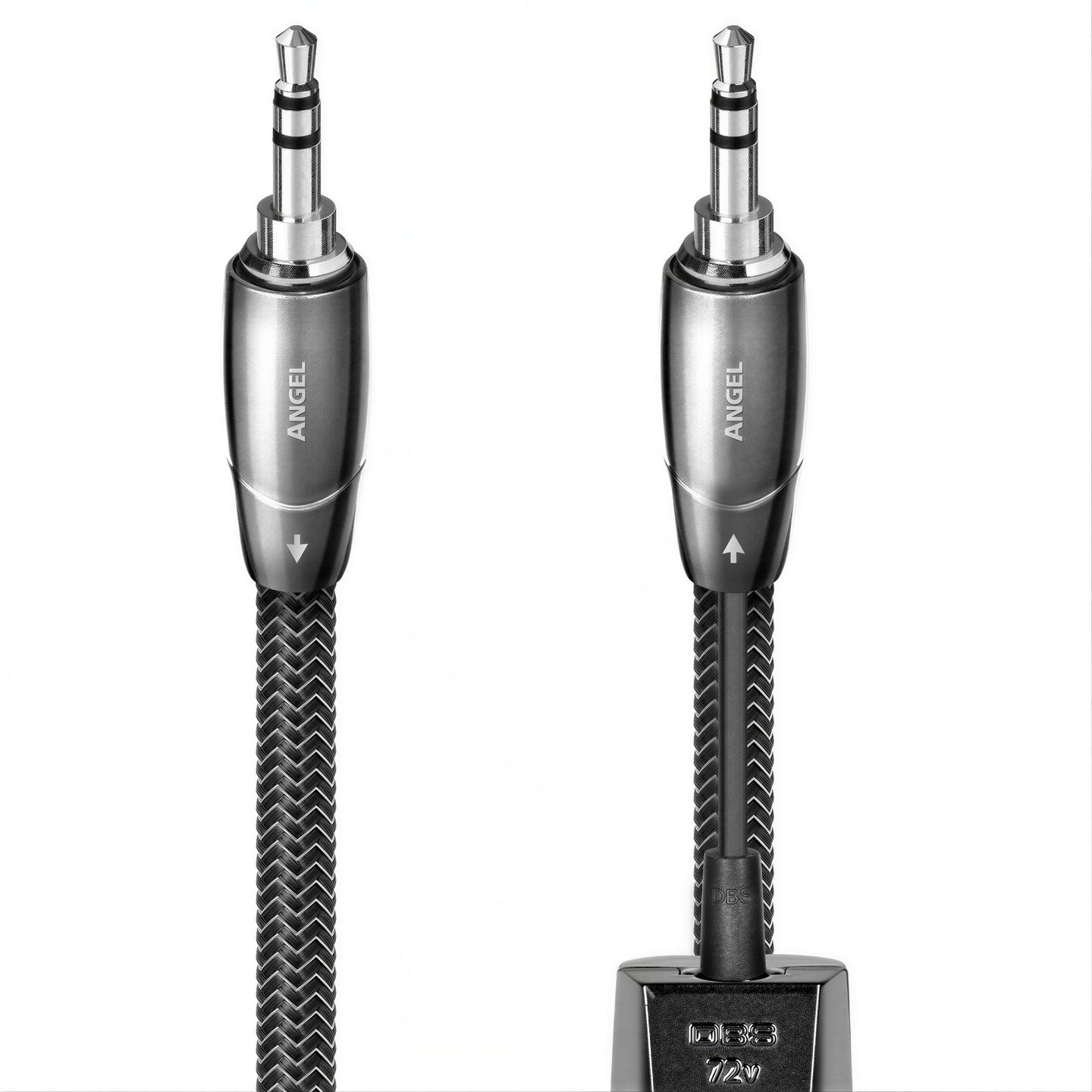
AudioQuest Angel: mini-jack cable with silver conductors and DBS biasing
A 3.5 mm analog cable that combines AudioQuest’s high-end technologies. The Angel sits at the top of the Bridges & Falls series, a range designed for connections between portable devices, DACs, headphone amplifiers, or active speakers. What sets it apart from the other models in the series: solid silver conductors and the DBS dielectric-bias system, two technologies usually reserved for much more expensive RCA or XLR cables.
Solid silver conductors: the choice of the purest material
The Angel uses Perfect-Surface Silver (PSS) solid silver conductors, the highest-quality metal in the AudioQuest range. Very high-purity PSS silver minimizes distortion caused by the grain boundaries present in any metal conductor. Perfect-Surface technology applied to silver of extreme purity delivers remarkable clarity and dynamic contrast.
The conductors are solid (not stranded), which eliminates strand interaction, a major source of distortion in traditional cables. This configuration allows small signals to be transmitted more efficiently than with a multi-strand cable.
FEP Air-Tube insulation: a minimalist dielectric
Any solid material adjacent to a conductor is part of an imperfect circuit. Insulation and circuit-board materials absorb energy, then release it as distortion. To limit this phenomenon, AudioQuest surrounds the conductors with air-filled FEP (fluoropolymer) tubes. Air absorbs virtually no energy, and FEP is the extrudable insulation that absorbs the least.
The treatment differs according to polarity: the positive conductors benefit from near-air insulation to minimize interference, while the negative conductors use deliberately “lossy” insulation that optimizes their return function.
DBS 72V system: permanent dielectric biasing
The Dielectric-Bias System (DBS) is a patented AudioQuest technology (US patents 7,126,055 and 7,872,195 B1). DBS acts on the cable’s electrical properties while remaining completely outside the signal path.
The principle: unpolarized insulation slows certain parts of the signal differently, a major problem for multi-octave audio that is highly time-sensitive. AudioQuest’s DBS creates a strong, stable electrostatic field that saturates and polarizes the molecules of the insulation. This minimizes energy storage in the insulation and the resulting nonlinear time delays.
The DBS pack includes an RF trap (developed for AudioQuest’s Niagara series) that prevents radio-frequency noise from being induced into the signal conductors. The batteries will last 3 to 5 years, about as long as if they had remained on a shelf, since they create an electrical potential without current flow. A test button and LED make it possible to check their status.
NDS shielding and noise dissipation
Achieving 100% shielding coverage is easy. The real challenge is preventing captured RF interference from modulating the equipment’s ground reference. AudioQuest addresses this problem with its three-layer NDS (Noise-Dissipation System), alternating metal and carbon-loaded synthetic materials.
This structure absorbs and reflects most RF energy before it reaches the layer connected to ground. The shielding protects the signal from ubiquitous high-frequency interference (phones, Wi-Fi, Bluetooth).
Asymmetrical double-balanced geometry
Traditional single-conductor cables use a single path for ground and shielding. The Angel’s asymmetrical double-balanced geometry separates these two functions. This geometry, designed specifically for unbalanced (single-ended) applications, offers relatively lower impedance on the ground.
Bridges & Falls format: compact and versatile
All cables in the Bridges & Falls series place their left and right channels in the same jacket and use asymmetrical double-balanced geometry with separate high-quality positive and negative conductors. This design makes it possible to obtain a thin, flexible, and versatile cable.
The 60 cm format suits compact setups: a connection between a portable player and a headphone amplifier, a smartphone connected to a portable DAC, or a source connected to nearby powered speakers. However, the connectors are close together by design: if the L and R inputs of your components are spaced more than 7.6 cm apart, you should consider models from the Rivers or Elements series.
Silver-plated red copper connectors
The 3.5 mm plugs use pure red copper covered with silver by direct plating, without a nickel underlayer (which would introduce distortion). This design enables a solder-free connection, which is a common source of distortion. The cold-weld process avoids any sonic degradation related to heat input.
Technical Specifications
Conductors
- Solid Perfect-Surface Silver (PSS) conductors
- Limited electrical and magnetic interactions
- Reduced distortion and linear dissipation of RF noise
Insulation
- FEP air-tube insulation
- Air-insulated positive conductors to reduce interference
- Negative conductors with intentionally lossy insulation for a complementary role
- Preservation of signal dynamics and clarity
Shielding and noise dissipation
- 3-layer Carbon-based noise dissipation with NDS system
- Alternating layers of metal and carbon-loaded synthetics
- Absorption of most RF noise before it reaches ground
- Protection of the shield against high-frequency interference
Dielectric biasing
- 72 V Dielectric-Bias System (DBS)
- Maintains dielectric stability to prevent phase shift
- Integrated RF trap to prevent noise from being introduced into the signal
- US Patents No. 7,126,055 and 7,872,195 B1
Geometry
- Asymmetrical double-balanced geometry
- Separation of shield and ground for cleaner, quieter performance
- Optimized impedance for richer, more dynamic sound reproduction
Terminations
- Silver-plated pure red copper connectors
- Cold-welded
Audio performance
- Lossless high-fidelity audio transmission
- Reduced noise and interference
- Clearer, more natural, and more dynamic sound reproduction
Use
- Connect one end of the cable to the audio output of the source device
- Connect the other end to the audio input of the playback device
Frequently Asked Questions
Can the Angel be used as a headphone extension cable?
No, the male-to-male jack/jack version presented here connects two devices together (source to amplifier, for example). AudioQuest offers a male/female (M > F) version in the same range for extension use.
Do silver conductors produce a “bright” or aggressive sound?
AudioQuest’s PSS (Perfect-Surface Silver) is treated to provide a very smooth surface, which reduces distortion related to grain boundaries. The result tends toward more detail and transparency rather than artificial treble coloration.
How do I check the cable connection direction?
AudioQuest cables are directional: arrows marked on the connectors indicate the optimal direction for RF noise dissipation. The signal should travel in the direction of the arrows, from the source to the destination.
Is the Angel suitable for balanced connections?
No. The asymmetrical double-balanced geometry is optimized for unbalanced (single-ended) connections such as 3.5 mm mini-jacks. For balanced links, you should use cables with XLR or 6.35 mm TRS jack connectors designed for that purpose.
What is the difference compared with the Yosemite, the model just below it in the range?
The Yosemite uses Perfect-Surface Copper+ (PSC+) conductors, while the Angel uses solid PSS silver. Both include the DBS 72V system and FEP Air-Tube insulation, but silver offers better conductivity and more linear RF dissipation.
- Eco-contribution included in the sale price.
- Manufacturer reference: ANG05M
- GTIN / EAN: 92592075139