

Audioquest JAWS C13 2m
Overview
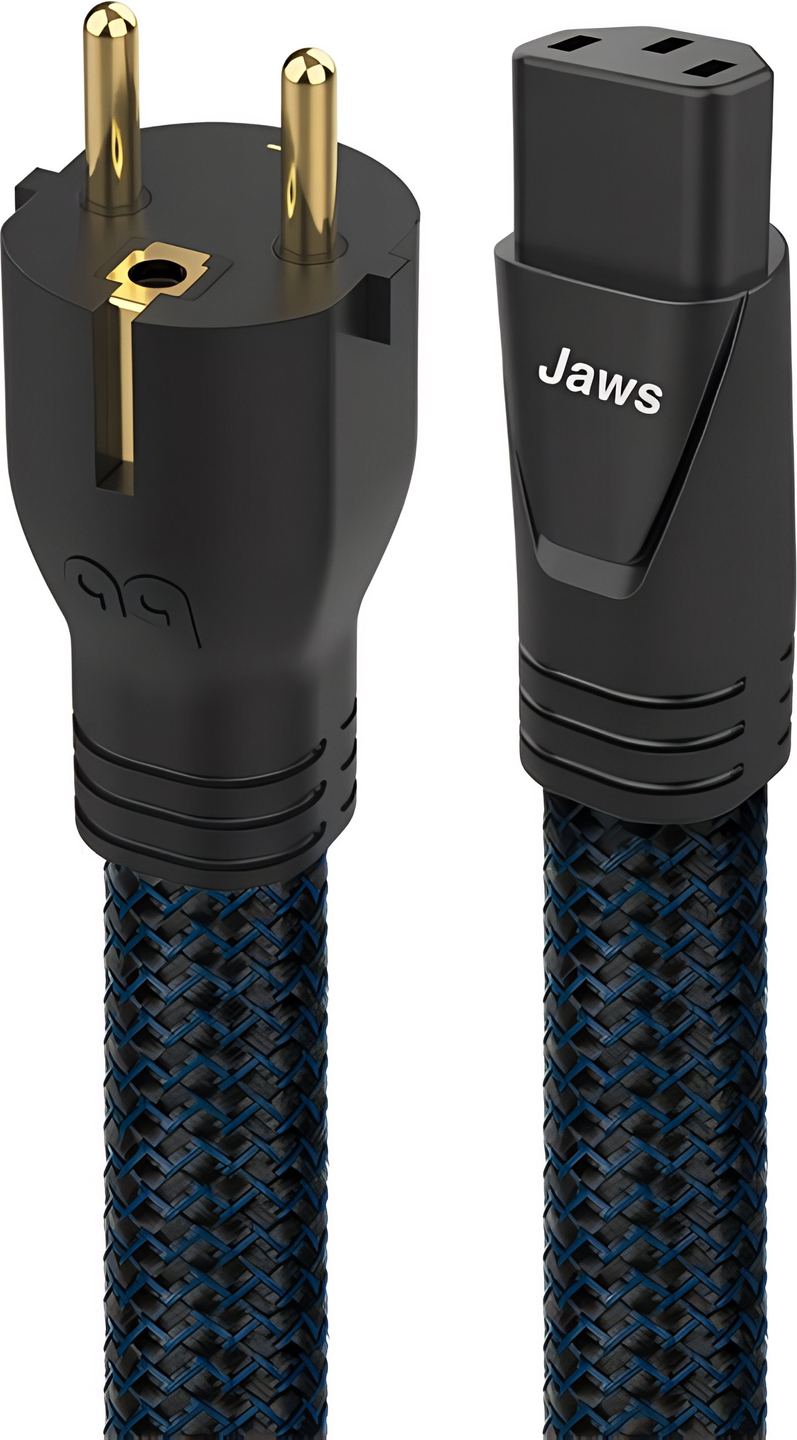
A notch above the Monsoon in AudioQuest’s power-cable range, the JAWS takes up the brand’s in-house technologies (ZERO-Tech, RF/ND-Tech, Ground Noise Dissipation) with two developments: a move to 100% PSC+ copper on all conductors (solid rather than stranded) and the addition of a graphene layer in the shielding. C13 version here, European Schuko on the wall side and three-pin IEC connector on the device side, up to 16 A at 220-240 V.
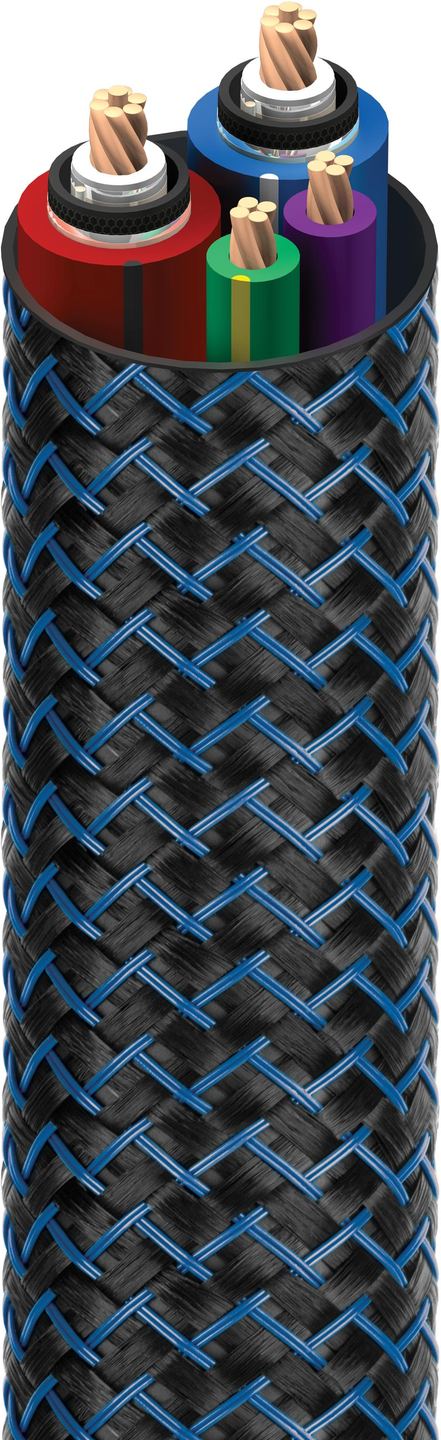
PSC+ copper in solid conductors
Where the Monsoon combines a Long-Grain Copper core wrapped in Perfect-Surface Copper+, the JAWS moves to 100% PSC+. The PSC+ process consists of smoothing the copper surface to limit distortion linked to grain boundaries and surface irregularities.
Another structuring choice: solid-core conductors rather than stranded. Fewer strands, thicker. In a stranded cable, strands that touch intermittently as the cable flexes generate intermodulation distortion on transients, a phenomenon AudioQuest has long sought to eliminate in its interconnect cables. Applying it to power follows the same logic.
As for conductor cross-sections, live and neutral each use 3.31 mm² (equivalent to American 12 AWG), while ground uses 2.08 mm². Enough to carry 16 A continuously at 220-240 V without notable heating.
ZERO-Tech and uncompressed transfer
Most power cables focus on DC resistance: the larger the conductors, the lower it is, and the better average current flows. Except audio does not operate only in a continuous regime. When an amplifier hits the impact of a kick drum or the tutti of an orchestra, it draws a current peak over a few milliseconds. On that timescale, what matters is the cable’s characteristic impedance, not its DC resistance.
ZERO-Tech is AudioQuest’s answer: a geometry designed to cancel the characteristic impedance seen by a transient. In concrete terms, current-demand peaks are no longer compressed by the cable itself. When the effect becomes audible, it results in greater dynamic contrast and firmer control on level peaks.
Four-layer shielding with graphene
Noise treatment is built around two components. First, RF/ND-Tech (US patent 8,988,168): a common-mode cancellation topology that drains radio-frequency noise induced on the line. Then Ground Noise Dissipation, with four-layer shielding including one graphene-based layer.
Graphene remains conductive across a very wide frequency range, which improves dissipation in the gigahertz range, where conventional metal shielding loses effectiveness. The drain wires are themselves directional: AudioQuest listens to each lot of copper to determine the optimal direction, indicated by an arrow printed on the jacket.
The whole is designed to deliver a darker background and preserve more micro-information, a difference that becomes perceptible especially on highly resolving systems, where the electrical noise floor is no longer masked by other flaws.
Cable format and connection
The JAWS has an 18 mm outer diameter. A fairly stiff cable, not difficult to install, but allow a little slack behind the device so as not to put strain on the IEC connector. Wall end: European Schuko, two poles plus ground. Device end: IEC C13, the standard three-pin connector for source components, preamps, and integrated amps up to around ten amps continuously.
Current capacity: 16 A RMS at 220-240 V (50 or 60 Hz). Beyond that, the C19 version of the same cable takes over, with a device connector rated for 20 A.
Connection direction follows the arrow printed on the jacket, toward the device side. Reversed, the cable works, but without the benefit of conductor directionality.
Where to place the JAWS in the system
The JAWS can power both source components and amplifiers, with constant current as well as variable current draw. On a source component (network player, DAC, CD player, phono stage), what matters most is radio-frequency noise dissipation: the cable acts on the noise floor and the restored micro-dynamics.
On an integrated amplifier or a preamp, ZERO-Tech takes on more importance, the amplifier being the link that draws current in the most variable way.
On a power conditioner (PowerQuest, Niagara), the JAWS can serve as the incoming cable between the wall outlet and the unit, in which case it benefits all output sockets downstream. If a power amp draws more than 16 A on sustained peaks, it is better to switch to the C19 version.
Technical specifications
Design and conductors
- Solid PSC+ copper conductors (Perfect-Surface Copper+)
- Solid-conductor structure limiting strand interaction
- Reduced dynamic distortion
- Very high-purity copper for better RF noise dissipation
- Optimized cross-sections
- Live and neutral: 2 x 3.31 mm²
- Ground: 1 x 2.08 mm²
Proprietary technologies
- ZERO-Tech (zero characteristic impedance)
- Eliminates impedance mismatch effects for uncompressed current transfer
- RF / ND-Tech (Radio-Frequency Noise Dissipation)
- Radio interference dissipation system over a wide bandwidth
- Ground Noise Dissipation (GND)
- Multilayer shielding system (4 layers including graphene) to effectively reduce ground noise
- Directional conductors and RF drain wires
- Controlled conductor orientation to channel interference away from sensitive circuits
Connectivity and power
- High-quality power connectors: EU Schuko to IEC C13
- Supported current: 16 A RMS at 220–240 V (50 / 60 Hz)
Construction and dimensions
- Outer diameter: 18 mm
- Optimized geometry to minimize internal electrostatic fields
- High-performance insulation for mains signal stability
Audio benefits
- Significant reduction in background noise
- Improved dynamics and micro-detail
- Better power signal stability
- Cleaner, more precise soundstage
Frequently asked questions
What is the difference between the C13 version and the C19 version?
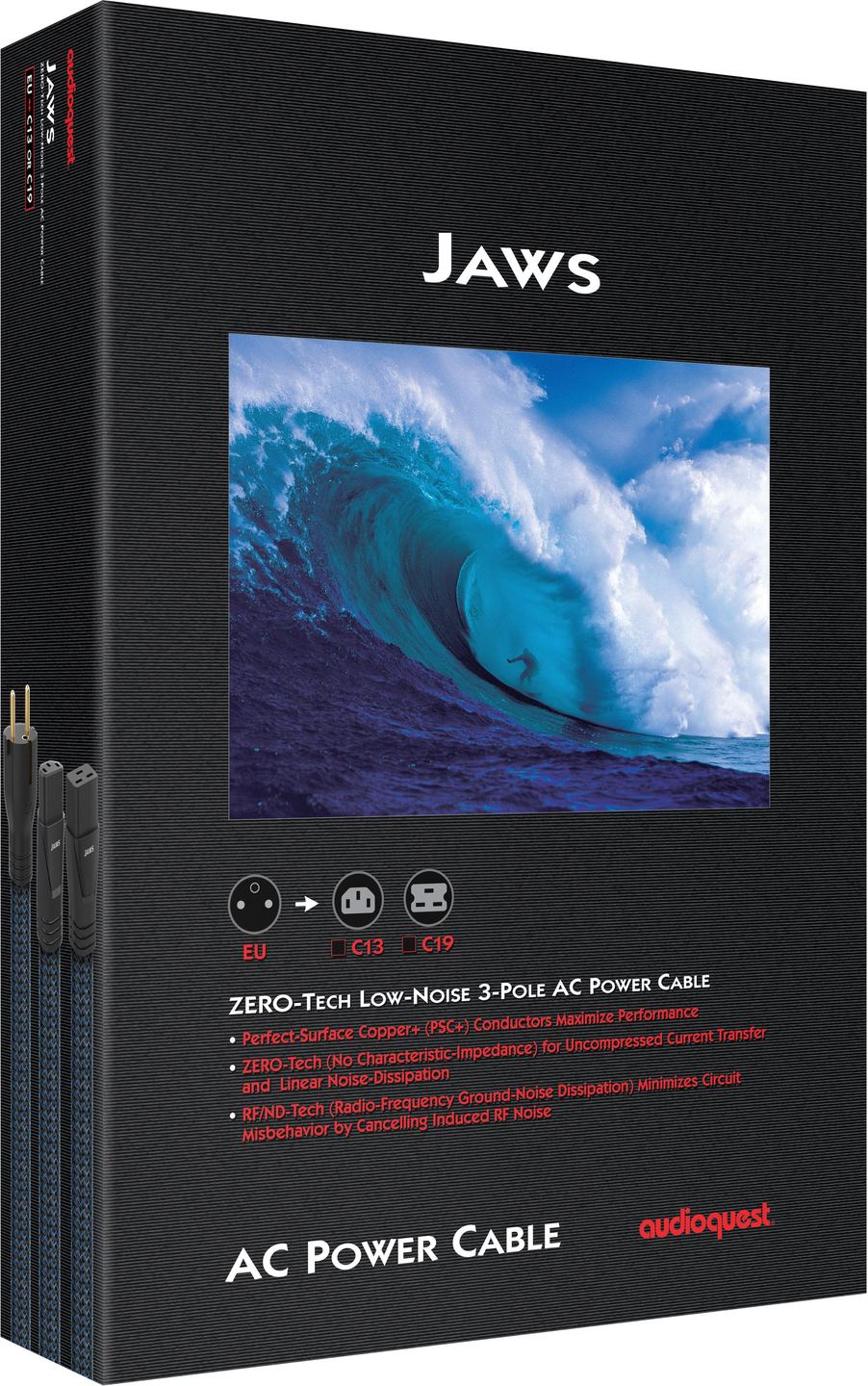
The C13 is the standard three-pin IEC connector, found on the majority of source components and integrated amplifiers. The C19 is larger, with a notched connector, and is found on large power amps and some high-end conditioners. The cable itself remains the same (PSC+ copper, ZERO-Tech, RF/ND-Tech, graphene shielding); only the device connector changes, with capacity increased to 20 A RMS versus 16 A for the C13.
Should a connection direction be respected?
Yes. The conductors are directional: AudioQuest tests each lot of copper to determine the direction in which RF noise is drained to ground rather than toward sensitive circuits. An arrow printed on the jacket indicates the direction toward the device side. Reversed, the cable conducts current without issue, but part of the dissipation work is lost.
What separates the JAWS from the Monsoon?
The Monsoon uses True-Concentric conductors combining PSC+ on the surface and LGC in the core. The JAWS moves to 100% PSC+ in solid conductors, and its Ground Noise Dissipation system includes a graphene layer absent from the lower model. The foundations (ZERO-Tech, RF/ND-Tech, directionality) remain shared between both cables.
Does the JAWS include the 72 V DBS system?
No. The battery-powered Dielectric-Bias System found on cables in the Storm Series (Blizzard, Thunder, Hurricane, Dragon) is not present here. That is one of the markers positioning the JAWS below those models in the brand’s power hierarchy.
- Eco-contribution included in the sale price.
- Manufacturer reference: JAWSEU02
- GTIN / EAN: 92592198814