Van den Hul The Second RCA 1,5m
Overview
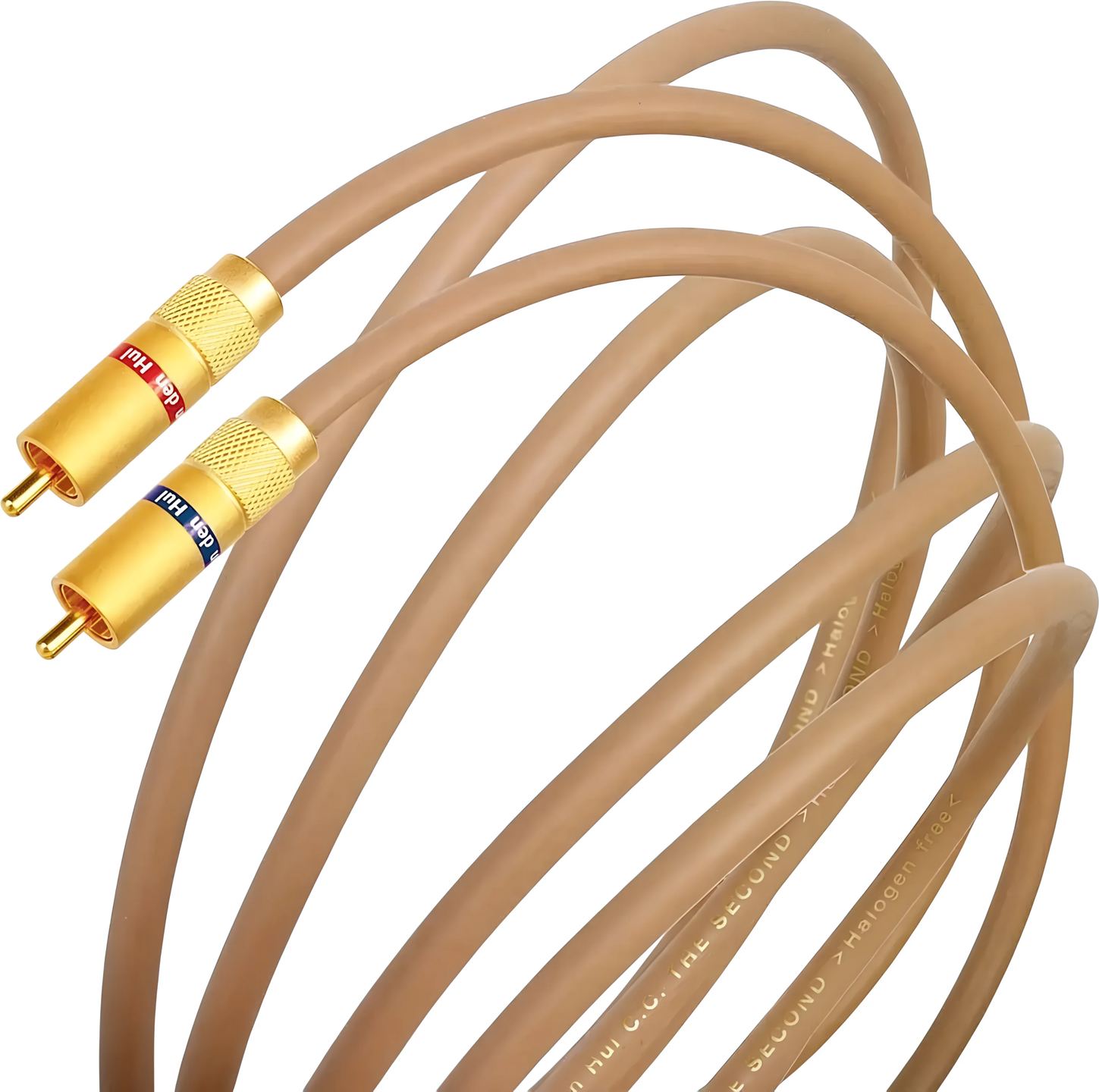
Replacing metal with carbon in the conductors of an audio cable is a technical gamble that Van den Hul has been pursuing since the early 1990s. The Second was born in 1993, as a complement to The First, its coaxial interconnect. This version fitted with RCA plugs shares the same dual carbon conductor structure.
Carbon instead of metal
Where most interconnects carry the signal through copper or silver, The Second uses carbon. Each of its two conductors combines 12,000 Linear Structured Carbon fibres of 7 micrometres, individually insulated. This fibre-to-fibre insulation limits electron transfer between strands, which Van den Hul presents as a source of coloration in conventional metal conductors.
Carbon also offers an immunity to radio frequency interference that metal does not possess to the same degree. The downside: its series resistance is significantly higher, in the order of 36 ohms per metre according to Van den Hul, compared to a fraction of an ohm for an equivalent copper conductor. This value has no impact on a line-level connection, where the input impedance runs into thousands of ohms.
Four layers to shield the signal
The shielding comprises four superimposed layers. Two groups of silver-plated OFC copper strands, wound in a helix, flank two carbon-saturated layers. Van den Hul describes this assembly as a closed envelope, opaque to external signals.
This is what makes The Second a hybrid cable: the signal travels through the carbon, while the shielding remains metallic. The combination aims for a very low noise floor, most noticeable during quiet passages and note decays, where residual hum or hiss is most apparent.
A balanced cable wired for unbalanced use
The Second is primarily a symmetrical dual-conductor structure, derived from The First, its coaxial predecessor. The version presented here is fitted with in-house C-7.3 RCA plugs, factory-terminated, and operates in unbalanced mode, the standard mode for consumer preamplifiers and integrated amplifiers.
The same cable is also available in an XLR version for balanced connections in hi-fi systems and studios. The choice of termination does not change the internal structure, only the way the signal and ground are distributed across the pins.
The Hulliflex jacket and longevity
The outer jacket is made of light brown Hulliflex, a material Van den Hul uses for its mechanical durability and long-term stability. Treated filler fibres resist moisture ingress, keeping the cable’s capacitance stable. Halogen-free and 7.3 millimetres in diameter, the cable remains flexible enough to be routed behind furniture without placing excessive strain on the plugs.
Technical Specifications
Electrical Specifications
- Core resistance: 3.6 Ω / m
- Capacitance: 68 pF / m
- Impedance: 75 Ω digital
Construction
- Conductor type: dual conductor (twin core)
- Technology: Linear Structured Carbon (LSC)
- Conductor: 2 groups of 12,000 insulated LSC fibres of 7 µm
- Quadruple shielding:
- 204 LSC fibres, in 4 layers
- 2 high-density OFC (oxygen-free copper) strand layers
- Helically wound strands
- Silver coating
- 2 LSC-saturated layers
- Insulators:
- Polyethylene foam
- Light brown Hulliflex outer jacket, high mechanical resistance and excellent durability
Dimensions
- Outer diameter: 7.3 mm
- Length: 2 × 1.5 m
Advantages
- Very high protection against interference and external disturbances
- Excellent audio signal transmission
- Background noise reduction
- Long lifespan thanks to the resistant outer jacket
- Suitable for high-end hi-fi and professional audio installations
Frequently Asked Questions
Is The Second RCA sold individually or as a pair?
The standard packaging is a stereo pair, meaning two identical cables for the left and right channels of an analogue connection. For digital use with S/PDIF, a single cable is sufficient, as the connection carries only one channel.
Can this cable be shortened or re-terminated at home?
No. The plugs are factory-fitted by Van den Hul, as connecting the 24,000 carbon fibres of the two conductors requires specific tooling and expertise. The cable is also not sold by the metre on a reel. It is better to choose the right length from the outset rather than planning to cut it later.
Is The Second RCA suitable for connecting a turntable?
Yes, between the turntable output and the phono input of a preamplifier, provided it is used with moving magnet cartridges or high-output moving coil cartridges. Very low-output cartridges require a dedicated cable with lower capacitance and particular attention to grounding.
Does the high resistance of carbon cause any audible issues?
Not on a line-level connection. An amplifier input presents an impedance of several tens of thousands of ohms, against which the few tens of ohms of the conductor count for almost nothing. This resistance does, however, rule out any use as a speaker cable, where the current involved is of an entirely different magnitude.
Is a burn-in period required before making a judgement?
Van den Hul does not specify a particular burn-in period for this model. As with most cables, it is better to leave it in place for a few days and evaluate it on familiar tracks rather than on first connection. The differences to be expected on a line-level connection are in any case subtle.
- Eco-contribution included in the sale price.
- Manufacturer reference: B47BA015