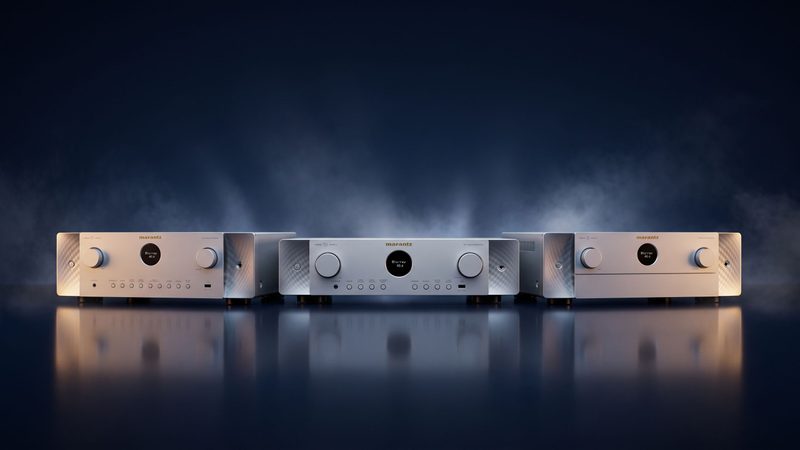
Marantz Cinema 70s Series 2 black


Specifications and features


Overview
Eleven centimetres high: that is the constraint Marantz maintains to house seven amplification channels, six HDMI inputs and a complete network module in a living room cabinet, where a conventional audio-video receiver requires almost twice as much. This second generation of the 70s retains the same dimensions and places its improvements elsewhere, in digital conversion, acoustic calibration and adjustment tools.
A size that dictates everything else
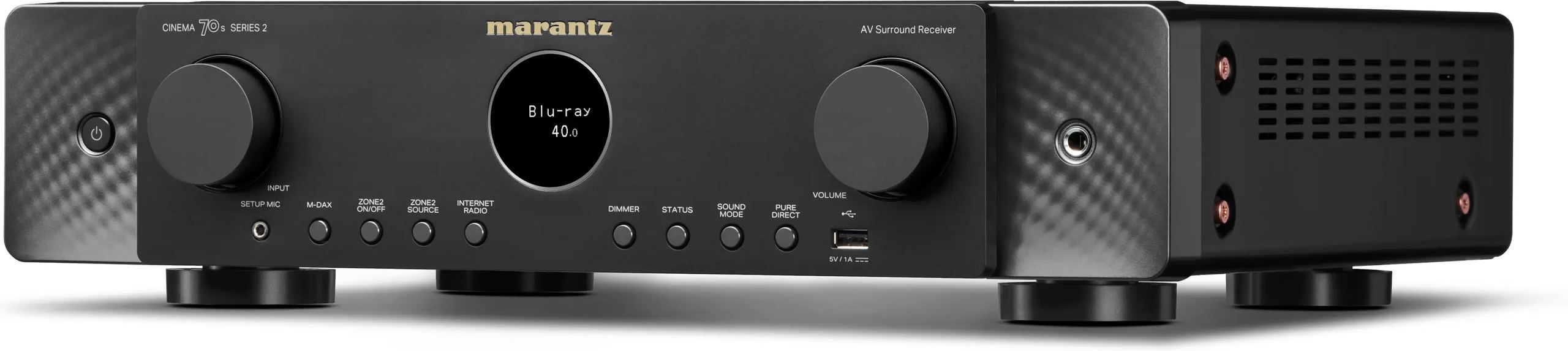
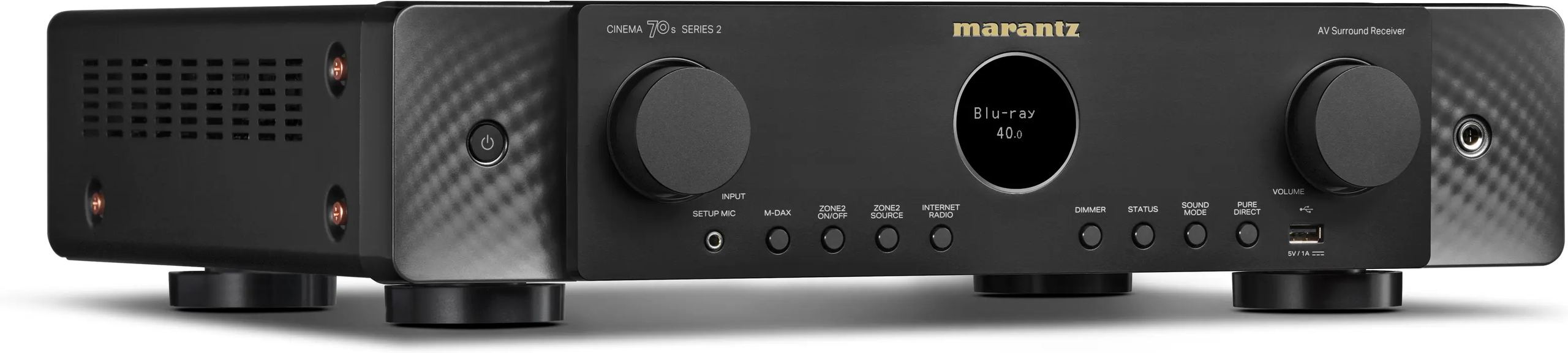
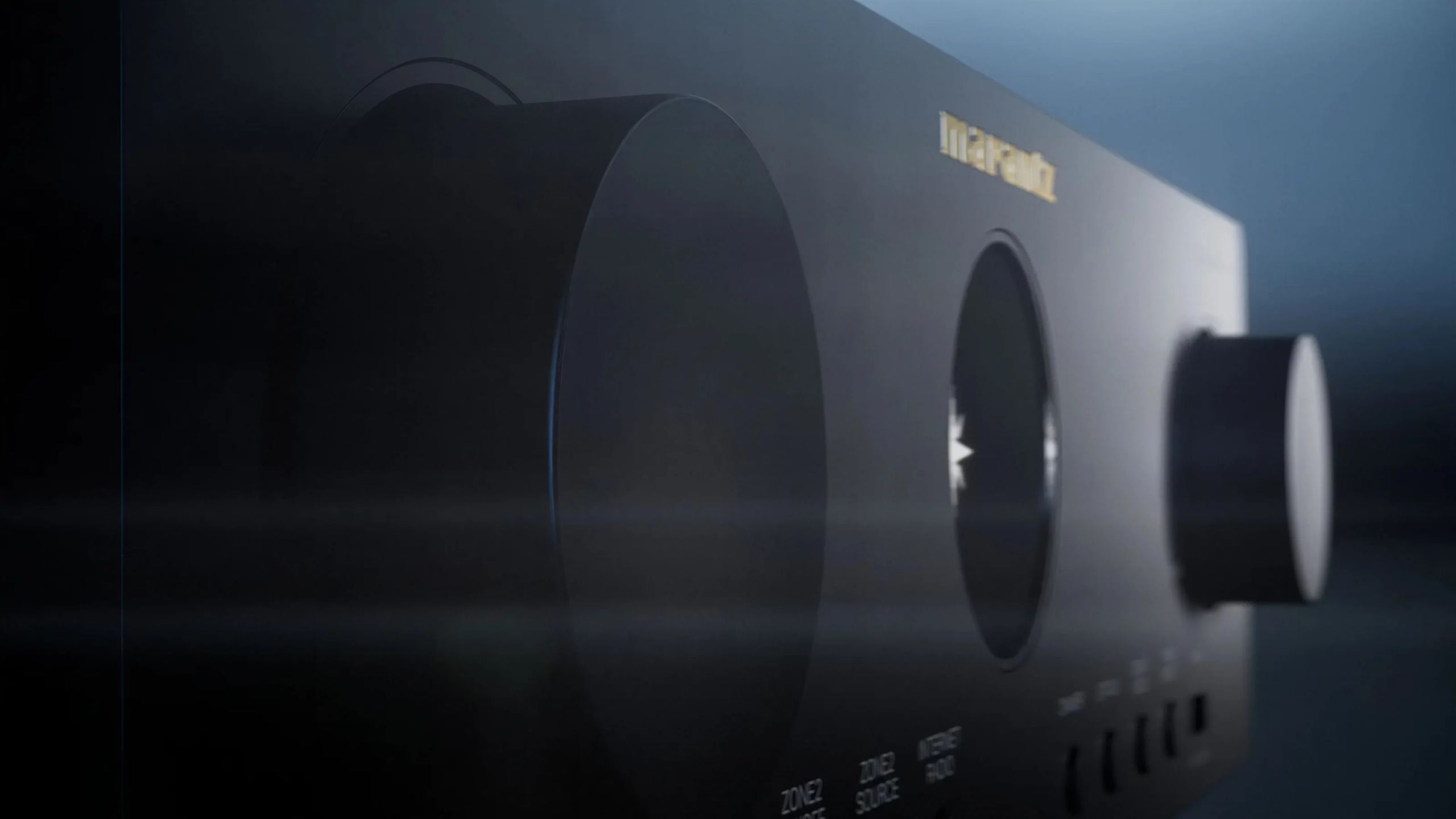
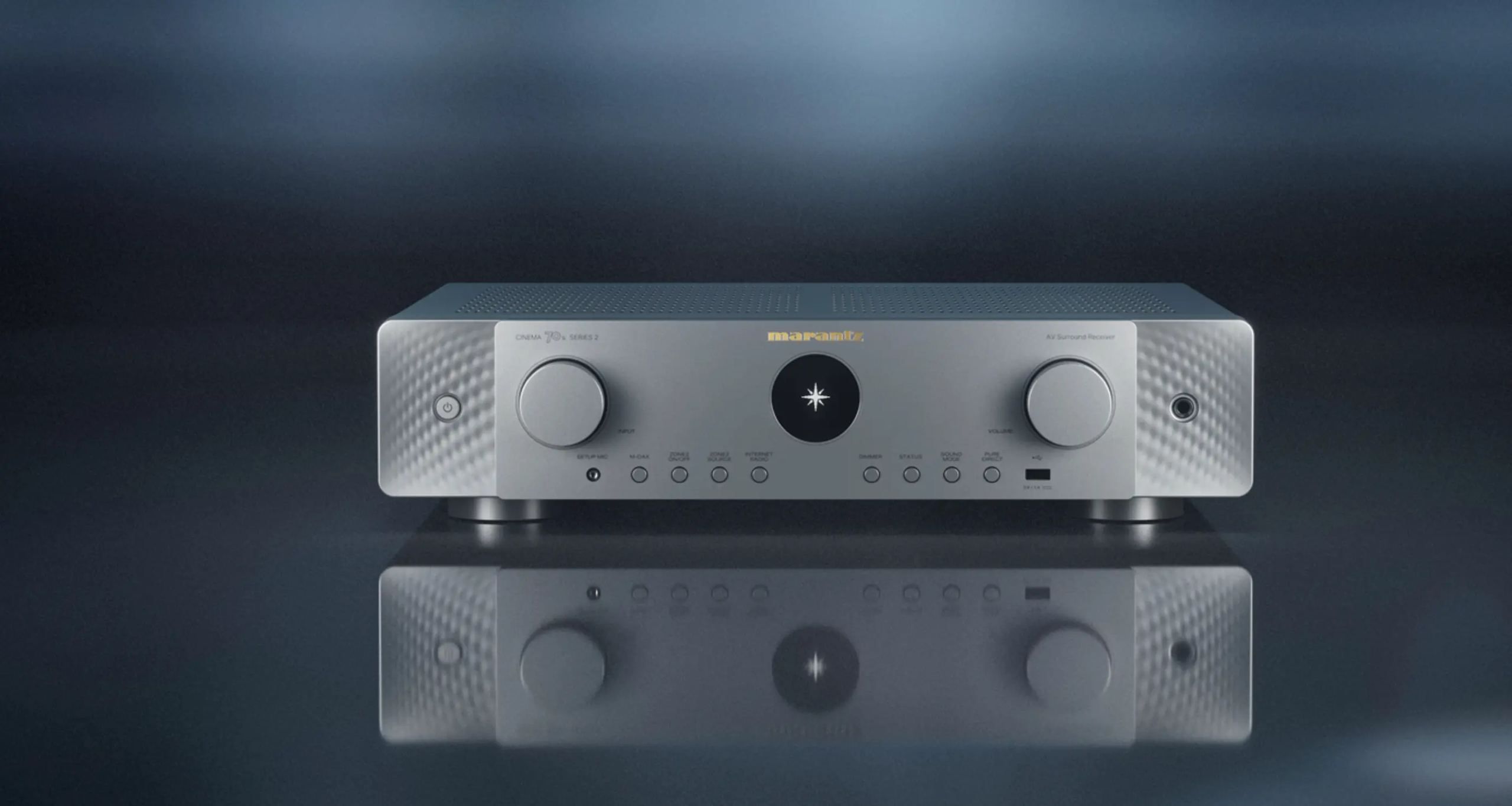
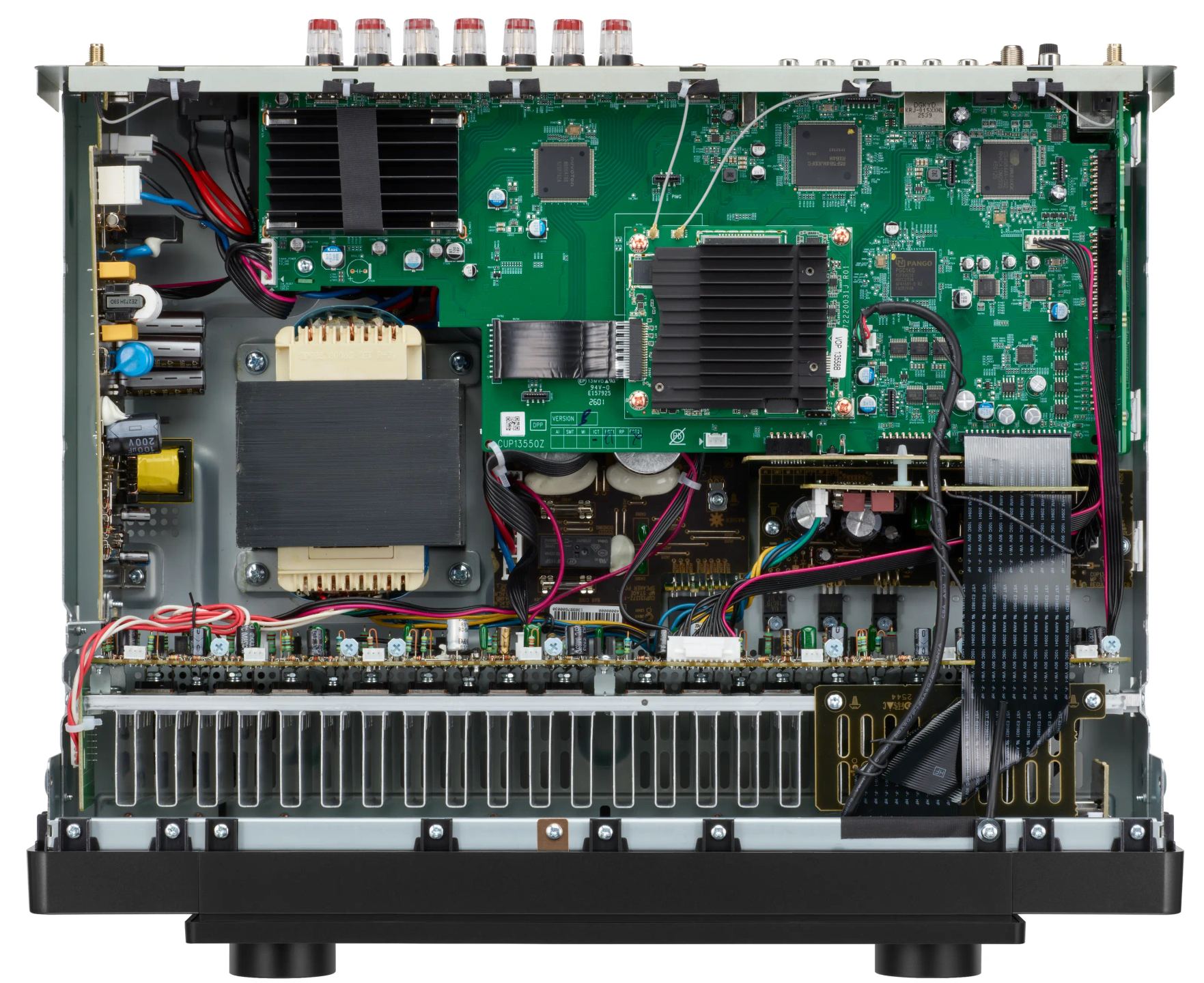
The chassis measures 442 × 372 × 109 mm without the antennas, 384 mm deep once they are folded horizontally, and weighs 8.7 kg. The front panel features the OLED porthole and the brand’s star logo, with diamond-patterned side panels that the CINEMA series uses across all its models. Two finishes are available: black and silver-gold.
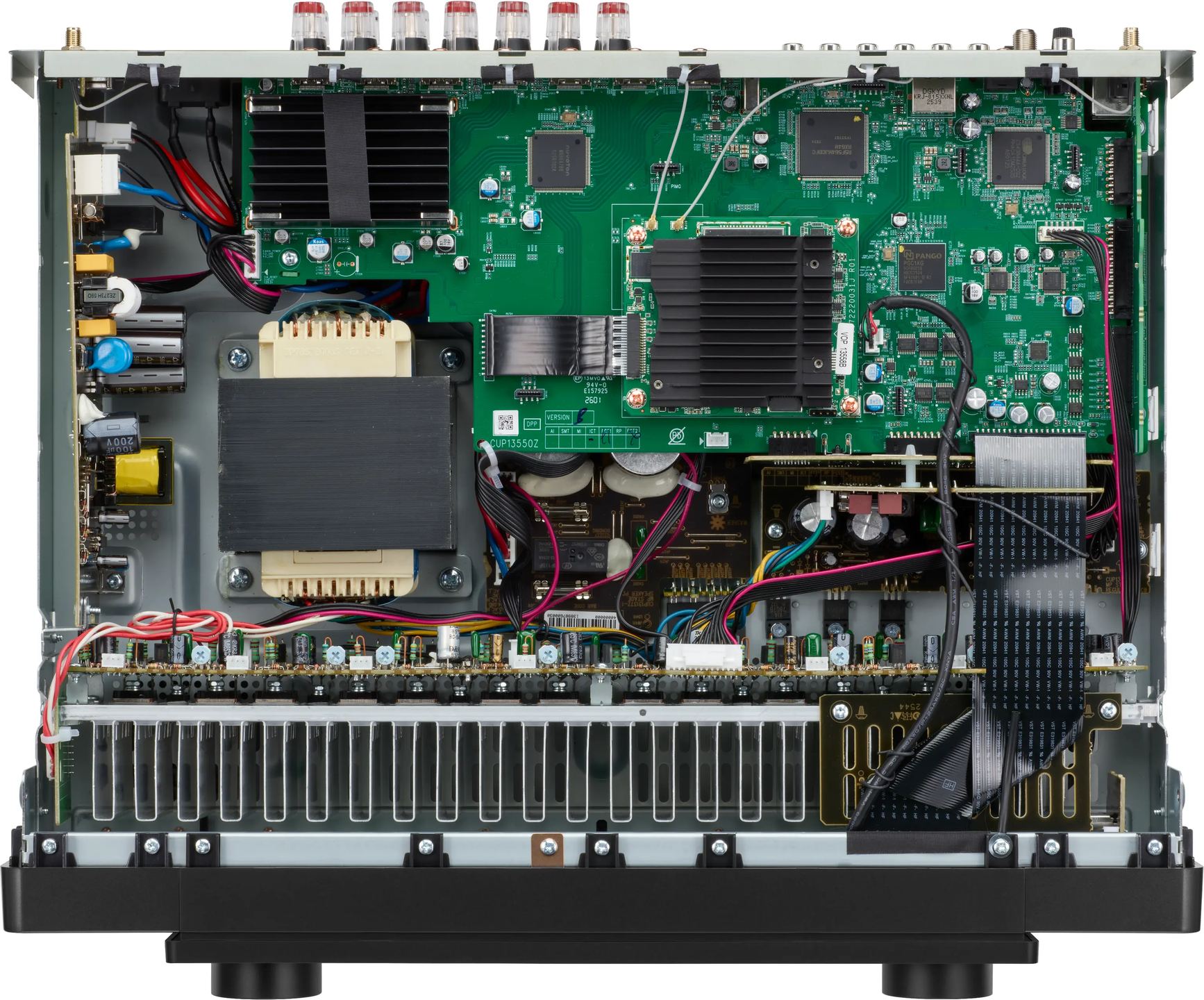
This format comes at the expense of two points worth knowing before purchase. The front panel is not metal, unlike the higher-end models in the range, and the power supply uses an EI transformer rather than a toroidal one. The power stage remains discrete-component, Class A/B, and power consumption is capped at 250 W (0.2 W in standby, less than 2 W in network standby).
The new eight-channel 32-bit converter
This is the most significant change in this Series 2. The 32-bit digital-to-analog converter processes all eight channels simultaneously rather than sequentially, reducing synchronization differences between channels. On a multichannel soundtrack, soundstage coherence depends directly on this simultaneity: a delay of a few microseconds between the front right speaker and the rear surround blurs the positioning of effects.
Two digital filters can be selected, one with a gentle slope (rounder sound), the other with a steep slope (sharper attack). MDAX2 processing restores part of the spectrum lost in compressed files, while Pure Direct mode bypasses processing for stereo listening. In network or USB playback, the CINEMA 70s SERIE 2 supports FLAC, WAV and ALAC up to 192 kHz/24-bit, plus DSD at 2.8 and 5.6 MHz, with gapless playback between tracks.
Audyssey included, Dirac Live optional
The Audyssey measurement microphone and its stand are included, along with MultEQ XT calibration and Dynamic EQ and Dynamic Volume processing. The former compensates for bass and treble loss at low volume, while the latter smooths volume differences between programmes.
The new feature is support for Dirac Live, previously reserved for higher-end models in the series. The device is ready for Dirac Live Room Correction acoustic correction, with the licence sold separately. Two limitations apply: only room correction is offered on this model, without the bass management or active processing modules that Marantz reserves for the CINEMA 50 SERIE 2, and Dirac calibration requires a compatible measurement microphone, not the Audyssey one.
Six HDMI inputs, three 8K-compatible
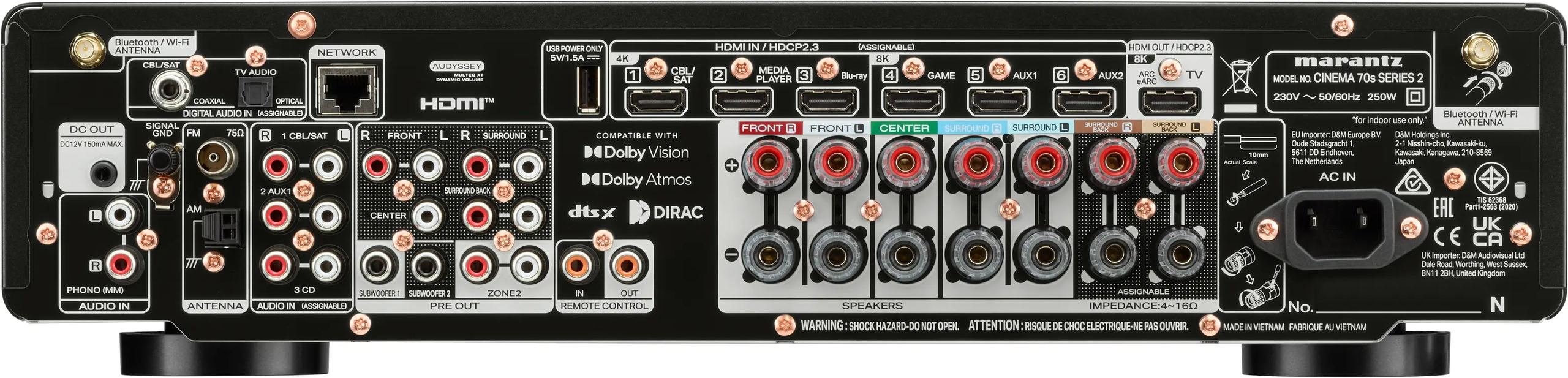
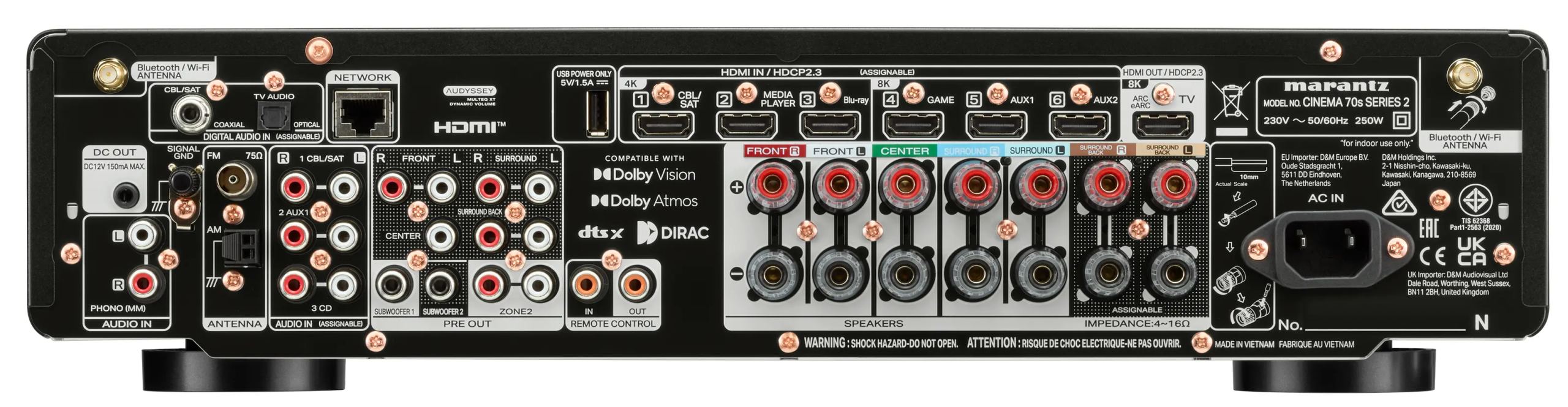
Of the six inputs, three support 40 Gbit/s and accept 8K at 60 Hz as well as 4K at 120 Hz, while the other three remain at the 2.0b standard. The single output supports eARC, the only connection capable of returning a Dolby TrueHD or DTS-HD Master Audio track from the apps of a television. All common HDR formats are supported—HDR10, HDR10+, HLG and Dolby Vision—with standby signal pass-through and internal upscaling up to 8K.
Gaming capabilities improve. VRR, ALLM and Quick Frame Transport were already present; 1440p pass-through and AMD FreeSync compatibility on inputs 4 to 6 are now added, two features expected by users connecting a PC to their television. As there is only one HDMI output, a projector and a television cannot be connected in parallel without an external switch.
Seven channels, two subwoofers, one Zone 2
The seven power blocks deliver 50 W per channel into 8 ohms, measured across the full 20 Hz-20 kHz range with 0.08% distortion and two channels driven. The widely quoted 70 W figure applies to 6 ohms, at 1 kHz only and 0.7% distortion: two different test protocols, two figures that cannot be compared. In an average-sized room with reasonably sensitive speakers, these 50 W hold up well; in large spaces or with demanding speakers, dynamic headroom runs out more quickly.
Processing is limited to 7.1 channels, allowing a 5.1.2 configuration with two height speakers, or conventional 7.1. 5.1.4 and 7.1.2 configurations are beyond its scope. Two subwoofer outputs are available, but in standard mode: they receive the same signal and cannot be adjusted independently. Dolby Atmos Height and DTS Virtual:X virtualization simulate height channels when ceiling speakers are absent, with the limitations inherent to any psychoacoustic processing.
The 7.2 preamplifier output covers all channels. It opens two paths: assign the front channels to an external power amplifier, or use the CINEMA 70s SERIE 2 as a complete preamplifier-processor without changing equipment. The speaker terminals also support bi-amplification and an A/B speaker set, or powering a second zone whose sources are limited to analogue, digital and network inputs (no HDMI).
A phono input and HEOS multiroom
The moving magnet phono input is worth noting on a device of this size: a turntable can be connected directly, without an intermediate preamplifier. Alongside it are three RCA line inputs, one optical input, one coaxial input, a front USB port and an FM/AM tuner.
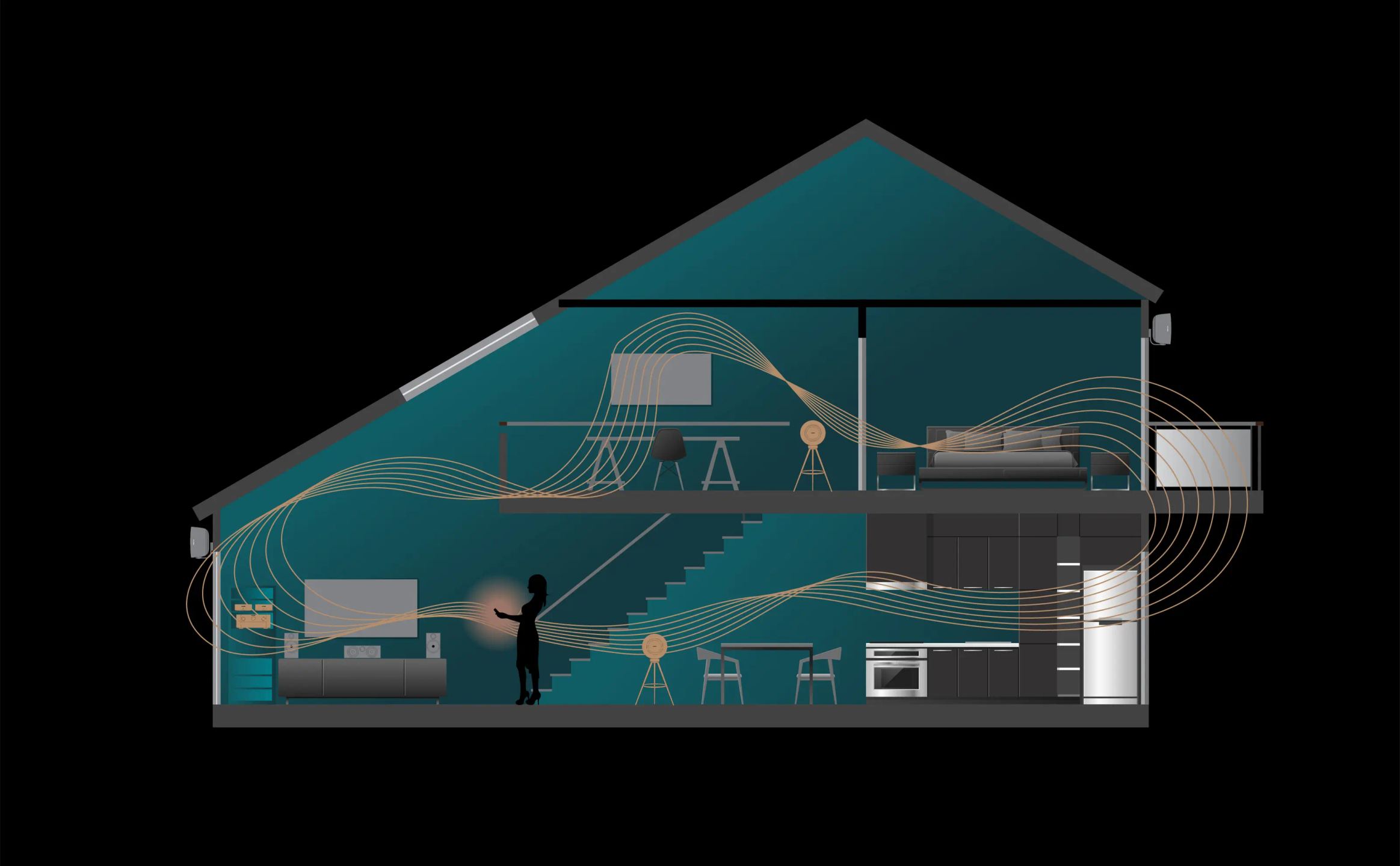
On the network side, the HEOS module has been revised for this generation. It provides access to Spotify Connect, Tidal Connect, Qobuz Connect, Amazon Music, Deezer and TuneIn internet radio, along with AirPlay 2, Roon Ready certification and network file sharing. Dual-band Wi-Fi sits alongside an Ethernet port, which is more reliable for multichannel network playback. Bluetooth also works as an output to headphones, including volume control, for listening without waking the household. Marantz announces the arrival of low-latency Bluetooth LE Audio via an update, a feature to consider promised rather than delivered.
Settings through a browser
The Web Control 2.0 interface allows the device to be configured from a phone or computer on the same network, without using the on-screen display. The HDMI diagnostic tool includes a test-pattern generator and Hot Plug monitoring, enough to identify a temperamental connection without dismantling the cabinet. A level monitor displays the activity of each channel in real time, making a poorly wired speaker visible within seconds.
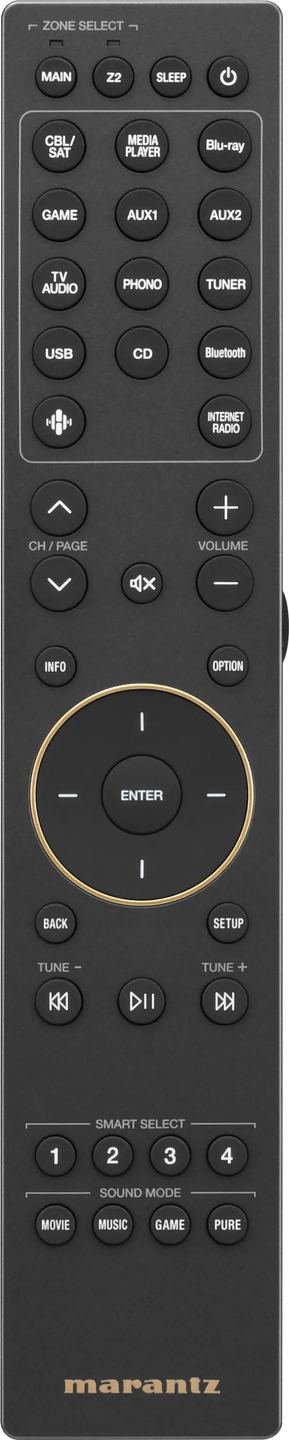
The rest concerns integration: IP control, IR Flasher input, Marantz remote-control bus, 12 V trigger output, firmware updates via network or USB key, setup assistant and Smart Select shortcuts. A rear USB port provides 5 V and 1.5 A to power an accessory, such as a video streaming stick.
Technical specifications
Overview
- Slim 7.2-channel audio-video receiver
- Immersive Dolby Atmos experience
- Dirac Live room correction
- Built-in HEOS multiroom and streaming
- 4K / 8K HDMI connections
- Enhanced 32-bit D/A converter
- 50 W per channel output
- Sound reproduction optimized by the Sound Master
- Compact and elegant Marantz design
- Designed for movies, music and video games
Multichannel surround technologies
- DTS-HD, DTS:X
- DTS Neural:X
- DTS Virtual:X
- Dolby TrueHD, Dolby Atmos, Dolby Atmos Height Virtualization, Dolby Atmos Music
- Dolby Surround
- Multichannel stereo
- Maximum number of preamp processed channels: 7.1
Processing and amplification
- Discrete amplification
- EI power transformer
- Pure Direct mode
- Audyssey MultEQ XT
- Audyssey Dynamic EQ and Dynamic Volume
- Standard subwoofer mode
- Upgradeable to Dirac Live room correction
- MDAX2 compressed file restoration
- Number of amplification stages: 7
- Output power
- 50 W per channel (8 ohms, 20 Hz - 20 kHz, 0.08% THD, 2 channels driven)
- 70 W per channel (6 ohms, 1 kHz, 0.7% THD, 2 channels driven)
Network and streaming
- HEOS multiroom and streaming
- Bluetooth transmission to headphones
- Bluetooth transmitter volume adjustment
- Network audio sharing
- Lossy formats: MP3, WMA, AAC
- Lossless formats: FLAC HD 192/24, WAV 192/24, ALAC 192/24
- DSD streaming (2.8 and 5.6 MHz)
- Gapless playback in FLAC, WAV, ALAC and DSD
- AirPlay 2
- TuneIn internet radio
- Spotify Connect
- Tidal Connect
- Qobuz Connect
- Other services: Amazon Music, Amazon Music HD, TIDAL, Deezer, iHeart Radio, SoundCloud, Mood Mix
- Roon Ready
- Control via Marantz AVR Remote and HEOS smartphone apps
- Android, iOS and Amazon Kindle tablet apps
- Connectivity: Wi-Fi, Bluetooth and Ethernet
HDMI and video
- HDMI inputs: 6 on the rear panel
- Main HDMI output: 1
- HDCP 2.3 support
- HDMI-to-HDMI upscaling: 1080p and 4K to 8K
- HDMI 2.1: 8K/60 Hz and 4K/120 Hz
- 8K/60 Hz and 4K/120 Hz passthrough: 3 inputs and 1 output up to 40 Gbit/s
- eARC and ARC
- HDR, HLG, Dolby Vision, HDR10+, Dynamic HDR
- ALLM passthrough for video games
- Variable Refresh Rate (VRR) and Quick Frame Transport (QFT)
- AMD FreeSync compatible on HDMI inputs 4 to 6
- 3D signal passthrough
- HDMI standby passthrough
- CEC control and automatic lip sync
- HDMI diagnostic function
Connectivity
- HDMI inputs / HDMI output: 6 / 1
- Analog inputs: 3
- MM phono input
- Digital inputs: 1 optical and 1 coaxial
- Analog multiroom output: 1
- 7.2-channel multichannel preamp output
- Subwoofer outputs: 2
- Standard screw-type speaker terminals
- Number of speaker terminals: 7
- Configurable A / B speakers
- Configurable bi-amp mode
- Configurable multiroom speaker terminal
- Front USB input
- USB Audio playback
- Rear USB power supply: 5 V / 1.5 A
- FM and AM tuner
Multiroom and integration
- Built-in HEOS multiroom
- HEOS Link compatibility via IR and IP
- Multiroom zones: 2
- Zone 2 sources: optical and coaxial (2 channels), network, USB, analog
- Zone output via speakers or preamp output
- IP, web and app control
- IR flasher input and Marantz remote control bus
- 12 V trigger output: 1
Settings and interface
- Automatic speaker setup via microphone: Audyssey MultEQ XT, optional Dirac Live Room Correction
- Front OLED porthole display
- HD graphical interface
- Interface languages: 9
- Setup assistant and Smart Select
- Firmware update via network and USB
- Variable crossover frequency and optimized bass management
- ECO mode, automatic shutdown and sleep timer
Power supply and consumption
- Power consumption: 250 W
- Consumption with no signal: 30 W in ECO mode, 40 W outside ECO mode
- Standby power consumption: 0.2 W
- CEC standby power consumption: 0.5 W
- Network standby power consumption: less than 2 W
Dimensions and weight
- Dimensions with antennas horizontal: 442 × 384 × 109 mm
- Dimensions with antennas vertical: 442 × 384 × 178 mm
- Dimensions without antennas: 442 × 372 × 109 mm
- Weight: 8.7 kg
Included accessories
- Remote control
- Batteries
- FM and AM antennas
- Cable identification labels
- Quick start guide
- Audyssey microphone and stand
- Two removable antennas
- Power cord
Frequently Asked Questions
What is the difference compared with the first-generation CINEMA 70s?
The chassis, amplification and connectivity remain unchanged. What changes are the converter, now 32-bit with eight simultaneously converting channels, support for Dirac Live, 1440p pass-through with AMD FreeSync, the HEOS module and installation tools (Web Control 2.0, HDMI diagnostics, channel level monitor). An owner of the first generation who is satisfied with their setup has no compelling reason to upgrade; a buyer hesitating between the two would do well to consider version 2.
Do you need two subwoofers to use both outputs?
No. Both outputs deliver the same signal and work perfectly with a single subwoofer. The second subwoofer is used to smooth the bass response by distributing low-frequency sources throughout the room, which reduces dips and peaks caused by room modes. On this model, the two outputs cannot be adjusted separately, which limits asymmetric placement.
How do I activate Dirac Live on this device?
The device is ready for Dirac Live Room Correction, but the license must be purchased separately from Dirac and linked to a user account. Measurements are taken using a compatible measurement microphone and the Dirac Live app on a computer or phone, not the supplied Audyssey microphone. Audyssey MultEQ XT remains available at no extra cost for those who do not wish to take this step.
Can it drive 4-ohm speakers?
The unit supports a 4-ohm impedance setting in its menu, which limits the available power to protect the output stage. With demanding 4-ohm speakers, the cleanest solution remains the 7.2 preamplifier output paired with an external power amplifier for the front channels, while the unit retains processing, calibration, and source switching.
Which HDMI cable is required for 8K inputs?
A certified Ultra High Speed cable. The device’s HDMI 2.1 inputs operate at up to 40 Gbit/s, below the full standard’s 48 Gbit/s, but sufficient for 4K at 120 Hz and 8K at 60 Hz in commonly broadcast formats. An older High Speed category cable causes image dropouts or a down-negotiation of the resolution.
Is an FM/AM tuner still useful?
It is for those who listen to FM radio, using the supplied wire antenna. Stations available via digital streaming can be accessed through TuneIn internet radio, often with higher quality and no reception issues. This version does not have a DAB+ tuner; at Marantz, this is reserved for models bearing the DAB designation.
- Eco-contribution included in the sale price.
- Manufacturer reference: CINEMA70S2N1B
- GTIN / EAN: 747192148263