HLG Format Decoded: The HDR Revolution Compatible with Your Old TV
April 18, 2025
Contents
In a British television studio in the mid-2010s, BBC engineers were observing a frustrating paradox. Their cameras captured images with striking contrasts, subtle nuances in the shadows, and dazzling highlights in the bright areas—but once these images reached viewers’ screens, their magic was lost, flattened by the technical limitations of traditional broadcasting. How could this visual richness be transmitted without leaving half the audience in the dark? This challenge gave birth to HLG, a solution as elegant as it is little-known in the world of HDR.
One Curve to Rule Them All
Hybrid Log Gamma (HLG) is much more than just a technical acronym. This innovation, the result of a collaboration between the British BBC and Japan’s NHK, answers a fundamental question: how can HDR (High Dynamic Range) images be broadcast to all viewers, whether they own a state-of-the-art TV or an older model?
The answer lies in a hybrid mathematical curve that, as its name suggests, combines two approaches. For the dark and mid-tone areas of the image, HLG uses a traditional gamma curve—the same one standard TVs have used for decades. But for the highlights, where the human eye perceives more subtle intensity variations, the curve becomes logarithmic, preserving more information in the brightest areas.
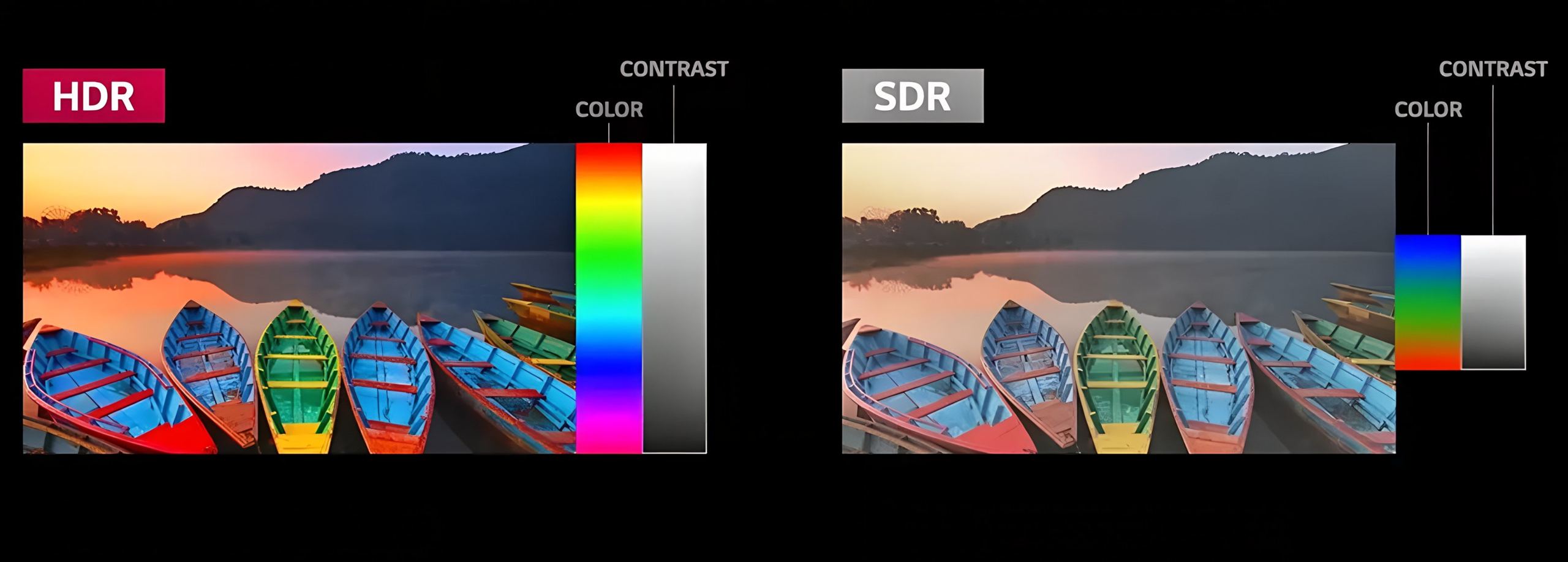
A standard TV will interpret the HLG signal according to the first part of the curve, producing a perfectly acceptable SDR (Standard Dynamic Range) image. An HDR TV, on the other hand, will use the entire curve to reveal the full richness of the image, from the deepest shadows to the brightest highlights.

A Format Born for Live Broadcasting
If you follow tech news, you’ve probably heard of other HDR formats like HDR10, HDR10+, or Dolby Vision. So why pay attention to HLG? Because it has a major advantage: it was specifically designed for television broadcasting.
Unlike its competitors, HLG does not require metadata—those extra pieces of information that accompany each image to tell the TV how to interpret it. The absence of metadata offers two crucial advantages for TV broadcasting:
- Technical simplicity: a single video stream can be sent to all viewers
- Compatibility with live broadcasting: no need to pre-analyze images to generate metadata
“HLG is like a musical score that automatically adapts to the quality of the instrument playing it,” explained a BBC engineer during its presentation. A Stradivarius violin (HDR TV) will extract all its nuances, while a more modest instrument (SDR TV) will produce a correct melody, without a false note.
The Illusion of Rediscovered Colors
Beyond brightness, HLG comes with an expanded color gamut. In practical terms, this means images can display a significantly richer palette of colors than traditional TV standards.
The BT.2020 color space, associated with HLG, can reproduce about 75% of the colors perceptible to the human eye, compared to only 35% for BT.709 used in SDR television. This difference results in more saturated, more accurate, and more lifelike colors.
The red of a poppy, the deep green of a forest, or the intense blue of a summer sky appear with newfound vibrancy, yet without seeming artificial. This color richness, combined with better contrast management, creates a sense of immersion that broadcasters quickly embraced for sports events, nature documentaries, and concerts.
Between Simplicity and Performance: HLG’s Positioning
In the HDR world, HLG occupies a middle ground. It doesn’t reach the qualitative heights of Dolby Vision, which uses dynamic metadata to optimize each scene individually, but it far surpasses the capabilities of traditional SDR.
This middle position comes with considerable practical advantages. For TV broadcasters, HLG represents a smooth transition to HDR. No need for dual production, no complex infrastructure to set up—just a single stream, compatible with all TVs.
For consumers, HLG means a frictionless experience. No specific logo to look for, no special settings to adjust—when a program is broadcast in HLG, a compatible TV will automatically display it in HDR quality.
HLG in Everyday Life: Where Can You Find It?
If you own a recent TV (from around 2016 onwards), there’s a good chance it’s HLG compatible. This technology has gradually become the standard for HDR broadcasting on TV channels.
In Europe, several broadcasters have adopted HLG for their flagship programs, especially major sporting events like the Olympic Games, the FIFA World Cup, or Roland-Garros. The BBC in the UK was a pioneer, followed by France Télévisions and other European public broadcasters.
Streaming platforms like YouTube also support the HLG format, allowing content creators to share their HDR videos without worrying about compatibility with different viewing devices.
More discreetly, some high-end smartphones now include the ability to film in HLG, thus democratizing HDR content creation for demanding enthusiasts.
The Future of HLG in a Changing Audiovisual Landscape
HLG is not intended to supplant all other HDR formats. Instead, it fits into a complex ecosystem where each technology finds its niche. For home cinema and premium content, Dolby Vision and HDR10+ will likely continue to play a leading role thanks to their optimal quality.
But for everyday television, live broadcasts, and mainstream content, HLG has decisive advantages that ensure it a promising future. Its technical simplicity and backward compatibility make it a pragmatic choice for broadcasters.
As the number of HDR TVs grows, HLG may well become invisible to the general public—not because it disappears, but because it integrates so naturally into our daily audiovisual consumption that we no longer even notice its presence, all while benefiting from its superior quality.
HLG perfectly illustrates how a technological innovation can take hold not by abruptly revolutionizing habits, but by fitting in harmoniously, improving the experience without disrupting routines. A lesson in wisdom in a tech world often hungry for disruption.