

Gold Note PA-1175 MKII black


Overview
Twenty years after its last power amps, Gold Note introduced the PA-1175 MKII, a stereo amplifier designed to drive different types of speakers thanks to its adjustable damping factor. It delivers 200 watts per channel into 8 ohms in stereo mode and 520 watts in bridged mono. This class A/B amplifier in dual-mono configuration incorporates optical devices to regulate bias and protect the loudspeakers. It is also inspired by the architecture of the older single-ended Demidoff amplifiers developed by Gold Note.
Dual-mono design and the Demidoff legacy
The PA-1175 MKII marks Gold Note’s return to stereo power amplification, the first stereo amplifier created by the brand in more than 20 years of electronic design. It merges the expertise gained with the well-known single-ended Demidoff amplifiers and a level of power never before reached. The Demidoff, integrated solid-state amplifiers operating in single-ended mode in the manner of triodes, are renowned for their fluid, natural musicality. The PA-1175 MKII adopts this philosophy while using a balanced push-pull class A/B topology, better suited to power demands.
The amplifier uses a dual-mono configuration with 4 matched pairs of transistors per channel, for a total of eight transistors per side. Each channel operates in fully balanced class A/B push-pull, delivering 200 watts per channel into 8 ohms in stereo mode. This complete separation of left and right channels limits interference and improves stereo separation. The chassis, made of a solid steel frame covered with thick aluminum panels, helps contain electromagnetic interference (RFI and EMI).
Optical BIAS: regulation by light
The optical BIAS regulation controls the reference voltage with much greater precision and stability compared with traditional systems. Instead of using conventional electronic components to adjust the bias of the output transistors, Gold Note employs optoelectronic devices. Being far more stable than traditional electronic devices, the optical components ensure outstanding audio performance.
Two circuits use this optical design: the first regulates the bias of the bipolar output transistors, the second monitors the maximum output power to engage protection if the current exceeds a predefined safe value. The optical analysis of the signal takes place separately from the audio path, ensuring loudspeaker protection and unbeatable performance. This separation guarantees that the protection circuits introduce no degradation into the musical signal.
An adjustable damping factor for all speakers
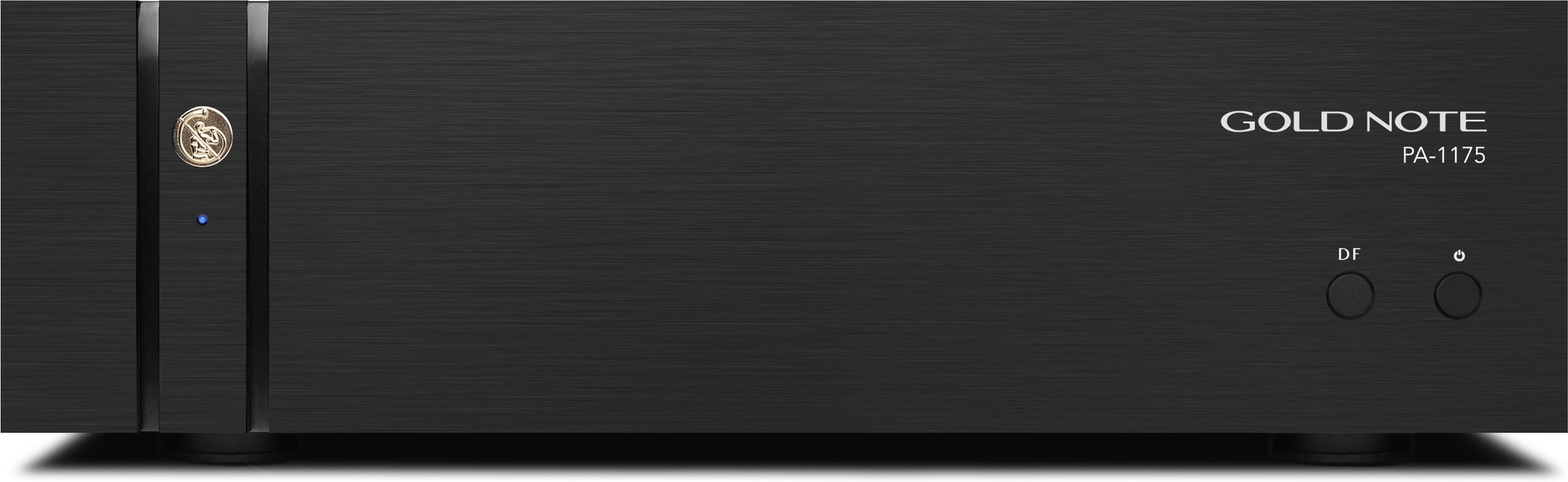
The PA-1175 MKII features technology that allows you to select the damping factor directly from the front panel. A button labeled “DF” lets you choose between two values: 250 or 25. This changes the output impedance from 0.03 to 0.3 ohm. A blue LED indicates the high-impedance mode (250), a green LED the low (25).
Setting the damping factor to 250DF lets you exploit the full potential of large, low-sensitivity loudspeakers. With this high value, the amplifier exerts tight control over cone movement, particularly in the bass. The low frequencies are taut, articulate, with a fast transient response.
The 25DF value is ideal for high-efficiency speakers or small monitors that do not appreciate the high output current of powerful amplifiers. By lowering the damping factor, the amplifier behaves like a low-power tube amp, allowing the cone more freedom of movement. This can add a certain roundness and depth to the bass, with speakers that prefer a less rigid grip.
This duality is unique in the solid-state amplifier market. It allows the PA-1175 MKII to be used with speakers of very different character without compromising sound quality.
BTL mode: doubling power in mono
BTL (Bridge-Tied-Load) technology allows you to bridge the stereo amplifier to turn it into a mono amplifier, increasing its output power from 200W@8Ω per channel to 520W@8Ω. Under 4 ohms, power reaches 300 watts per channel in stereo and 600 watts in BTL mono mode.
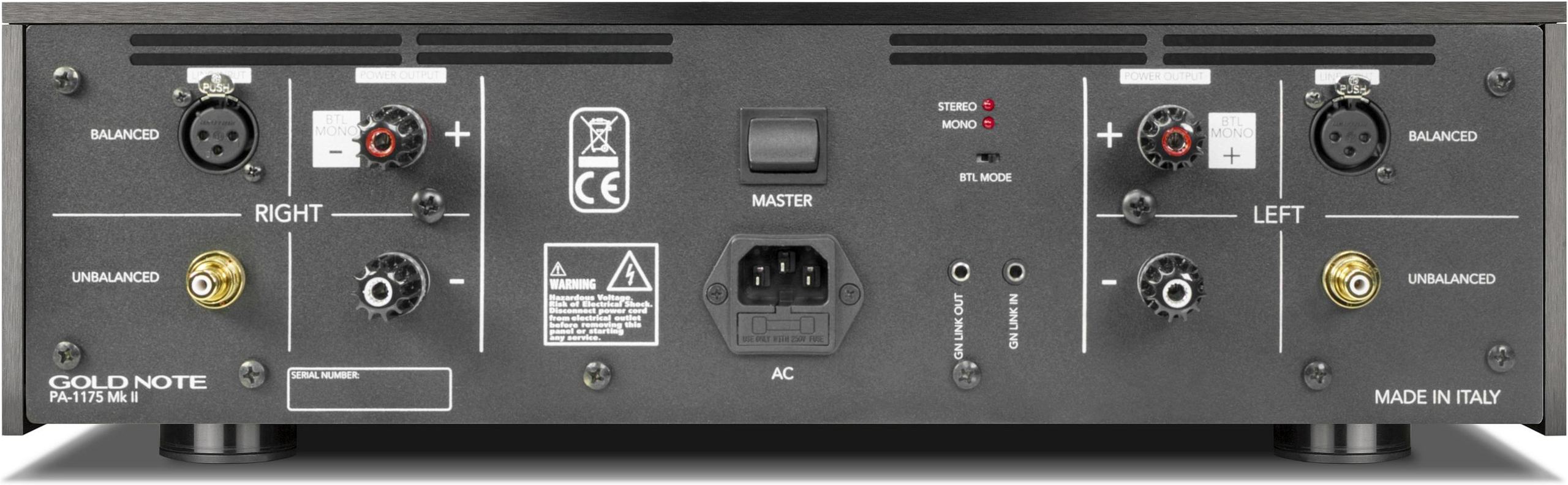
To activate this mode, a small switch located on the rear panel, labeled BTL Mode, converts the amplifier into a bridged mono block delivering 520 watts. In mono mode, you must connect the negative plug (usually black) to the red binding post on the left side of the rear panel (marked “-” in the white square) and use the red posts of both channels for the mono output. The amplifier must be connected correctly for the output to be in phase.
This doubling of power is particularly relevant for speakers with demanding current requirements or vertical bi-amping configurations. Mono mode also strengthens the bass register, bringing the perceived power of the midrange and low frequencies closer together.
A toroidal power supply with spiral core
The amplifier benefits from a very high-quality power supply using a 640 VA toroidal transformer equipped with a spiral core machined from a single piece. This refined mechanical process makes the core completely stable, eliminating any mechanical vibration to guarantee remarkable performance and perfect isolation.
This 630-volt transformer with a special core is said to be mechanically rock silent, yet it is still decoupled via viscoelastic isolators which also appear as Vibrastop engine mounts on Ducati racing motorcycles. These high-quality silicone dampers, originally used to isolate engines from vibrations on racing bikes, limit the transmission of transformer vibrations to the chassis.
This power supply is coupled with numerous capacitors to maximize current capacity and respond instantly to musical demands. The power supply contains 80,000 µF of substantial capacitance, a reserve that allows the amplifier to handle power peaks without faltering. A second transformer powers auxiliary functions with dedicated circuits separated from the audio path; this 6 VA transformer handles control tasks without polluting the musical signal.
Connectivity and ergonomics
On the back of the robust aluminum chassis, the PA-1175 MKII offers an unbalanced RCA input and a balanced XLR input. It can therefore be easily paired with any hi-fi preamplifier or home theater processor. Input sensitivity is 1 volt on RCA and 4 volts on XLR, with an input impedance of 47 kilohms.
Proprietary GN Link connectors allow you to set the amplifier to master or slave mode with other compatible equipment. That way you can switch all components in your hi-fi system on and off simultaneously. Trigger sockets located just below the BTL Mode switch allow the amplifier to power up when you turn on your preamplifier.
The rear panel features heavy-duty binding posts as well as the balanced XLR and unbalanced RCA inputs. The speaker terminals are gold-plated, ensuring a stable, oxidation-resistant connection. The minimalist front panel has only two small buttons on the right-hand side: one labeled “DF” for the damping factor, the other serving as the power on/off switch. On the left side, two channels cut into the front reduce visual fatigue from the large metal surface, and house the Gold Note emblem inset like a coin, along with a blue/green LED indicating the selected damping factor.
Evolution from the MKI
The PA-1175 MKI, the first version of the amplifier, delivered 175 watts per channel into 8 ohms and 350 watts into 8 ohms in BTL mono mode. The MKI also used a 630 VA toroidal transformer and already featured the adjustable damping factor and optical BIAS regulation.
The move to the MKII brought several improvements. Power per channel increased from 175 to 200 watts into 8 ohms in stereo, and from 350 to 520 watts in mono. The internal design evolved significantly between the two versions, with the transformer moving from 630 to 640 VA and changes in component layout. When 75 days had passed without delivery, Gold Note confirmed they were updating the design to improve it inside and out, which was taking longer than expected.
Documentation
Technical specifications
Power and audio performance
- Output power
- Stereo mode: 200 W per channel into 8 Ω
- BTL mono mode: 520 W into 8 Ω
- Frequency response: 1 Hz–100 kHz, ± 1 dB
- Total harmonic distortion: less than 0.01% between 20 Hz and 20 kHz
- Signal-to-noise ratio: 110 dB
- Slew rate: 20 V/µs
- Damping factor: selectable between 25 (low) and 250 (high)
Connectivity
- Audio inputs
- Unbalanced RCA input: sensitivity 1 V, impedance 47 kΩ
- Balanced XLR input: sensitivity 4 V, impedance 47 kΩ
- Audio outputs
- Gold-plated speaker binding posts
Power supply
- Power consumption
- Maximum: 1200 W
- Standby: 1.2 W
- Mains voltage: 100–120 V or 220–240 V, 50/60 Hz
- Transformers
- Main toroidal transformer: 640 VA
- Secondary transformer for auxiliary functions
- Fuses
- 6.3 A T for 220/240 V supply
- 10 A T for 100/120 V supply
Dimensions and weight
- Dimensions (W × H × D): 430 × 135 × 370 mm
- Net weight: 20.5 kg
- Shipping weight: 27 kg
Advanced features
- BTL mode: converts stereo mode to mono mode to increase output power
- Damping factor selector: allows adjustment of the response according to speaker sensitivity
- Optical BIAS technology: ensures low distortion and precise control of the reference voltage
- Speaker protection: independent optical analysis of the audio path for optimal protection
Construction and protection
- Solid aluminum panels: robust construction minimizing radio-frequency and electromagnetic interference
- Spiral toroidal power supply: guarantees maximum mechanical stability and perfect isolation
Frequently Asked Questions
Can I use the RCA and XLR inputs simultaneously?
No, it is not recommended to connect two preamplifiers simultaneously via RCA and XLR. Both inputs are always active, with no selection. If you want to use two different preamplifiers, unplug the inputs of one before using the other. You select your source and use either RCA or XLR.
Does BTL mono mode require two amplifiers?
No, a single PA-1175 MKII is sufficient to operate in mono. The BTL switch on the back bridges the two internal channels to create a 520-watt mono amplifier. If you want to drive a pair of speakers in a vertically bi-amped configuration, you will then need two amplifiers, each set to mono mode.
Can the PA-1175 MKII be used with 4-ohm speakers?
Yes, the amplifier delivers 300 watts per channel into 4 ohms in stereo mode and 600 watts in BTL mono mode. Measurements show distortion below 0.03% under this load. 4-ohm speakers pose no problem, as the generous power supply and robust output transistors can handle this impedance with ease.
What is the sonic difference between the MKI and MKII?
Beyond the power increase (175 watts vs. 200 watts), the MKII benefits from internal improvements in component layout and the transformer (640 VA instead of 630 VA). Both versions share the same core technologies (optical BIAS, adjustable damping factor), but the MKII offers a slightly larger power reserve and even tighter control in dynamic passages.
Do the Ducati silent blocks really make a difference?
These viscoelastic dampers, originally developed to isolate racing motorcycle engines from vibrations, effectively reduce the transmission of mechanical vibrations from the transformer to the chassis. While their contribution is subtle, they help keep the signal clean by limiting micro-vibrations that could modulate sensitive components. Their use illustrates the attention to detail in the design of the PA-1175 MKII.
- Eco-contribution included in the sale price.
- Manufacturer reference: PF-MILLE-PA-175-B