

Canton Atelier InWall 11 white


Overview
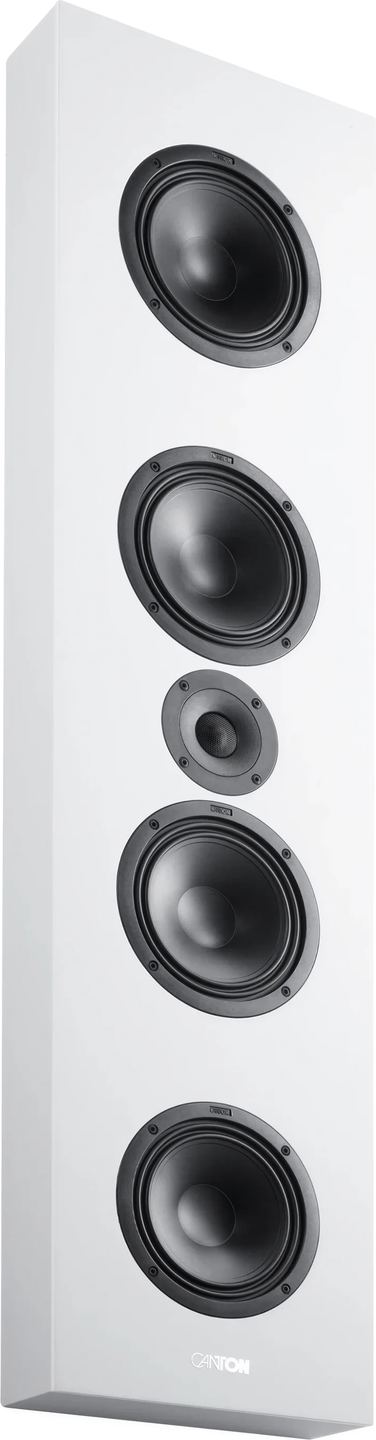
A wall speaker that disappears from sight while fully commanding the sonic space: that is the challenge taken up by the new Atelier generation from Canton. With the InWall 11, the German manufacturer applies to in-wall installation the transducer technologies usually reserved for its traditional hi-fi ranges, notably the ATB aluminium-titanium membranes and the Wave suspension. The vertical column format, standing over a metre tall, conceals a complete three-way configuration with dual passive radiators.
A complete three-way system in 85 mm of depth
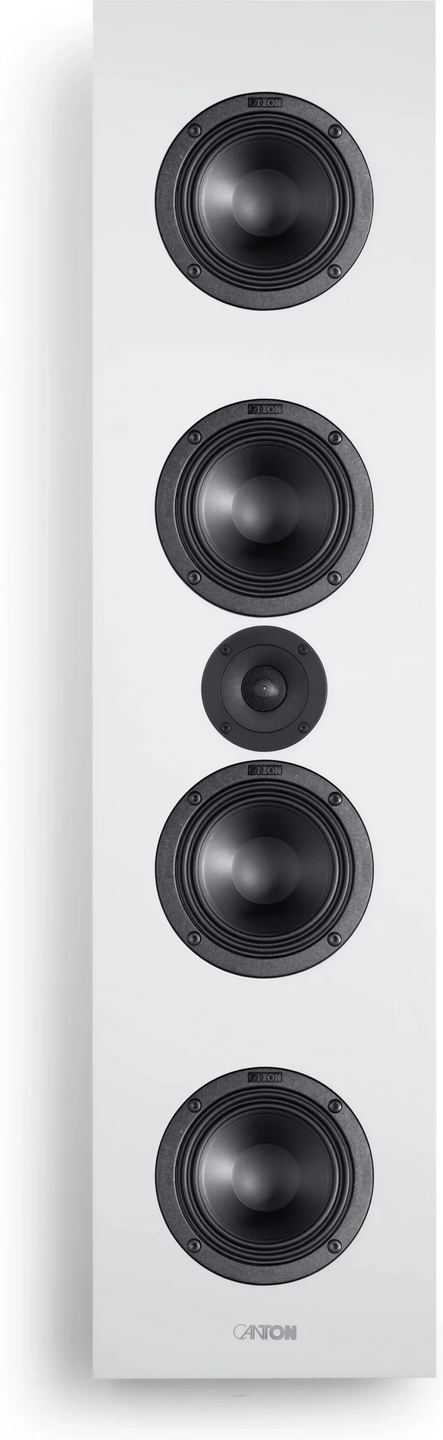
The InWall 11 chassis houses five transducers in a remarkably narrow enclosure. Two 174 mm drivers share the workload: one handles the midrange frequencies, the other the bass. Both use ATB (Aluminium Titanium Black) membranes, a composite combining the rigidity of titanium with the lightness of aluminium, mounted on Canton’s patented triple-fold Wave suspension. This suspension allows for a long excursion, which partially compensates for the constraints imposed by the shallow depth of the cabinet.
Two passive radiators of the same diameter and ATB technology extend the low-frequency response. This technical choice makes it possible to achieve a stated lower limit of 32 Hz, an unusually ambitious figure for an in-wall speaker. The 25 mm black aluminium tweeter, fitted with an acoustic lens, takes over from 3,000 Hz and reaches up to 40,000 Hz.
The nominal impedance ranges between 4 and 8 ohms depending on frequency. The sensitivity of 89.5 dB (2.83 V/1 m) is within the norm for this type of speaker and does not require excessive amplification, although the 140 W continuous and 200 W peak ratings allow for comfortable listening levels in a living room or dedicated home theater space.
An installation designed for new builds and renovations alike
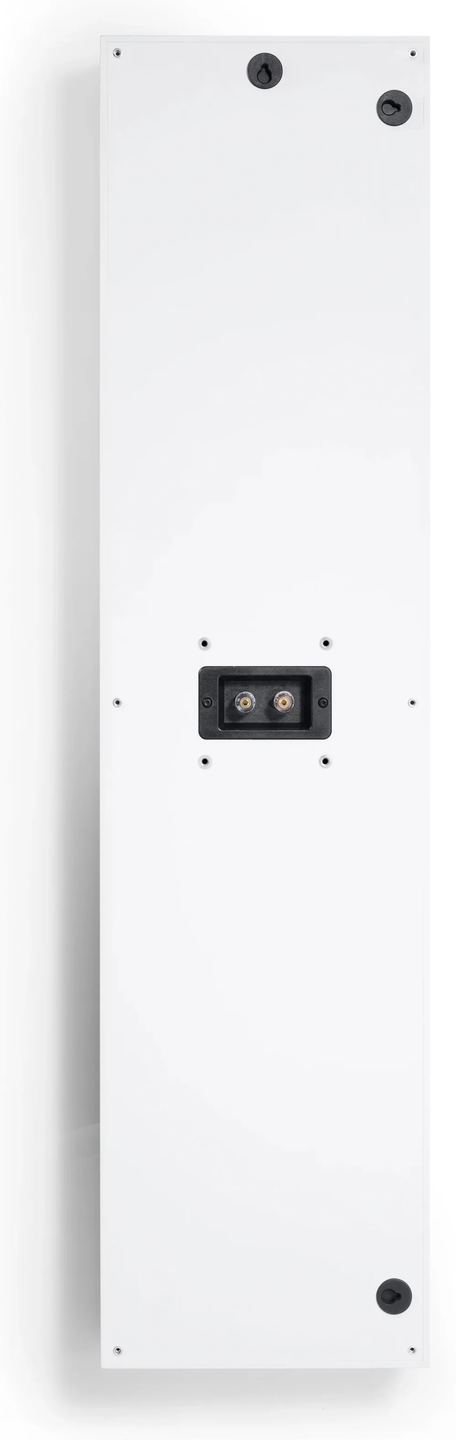
The InWall 11 is recessed into drywall or plasterboard using a clamping system. This fixing works with various wall thicknesses and does not require a pre-existing support structure in most cases. The required wall opening measures approximately 275 × 1100 mm to accommodate the cabinet, which then protrudes by just a few centimetres.
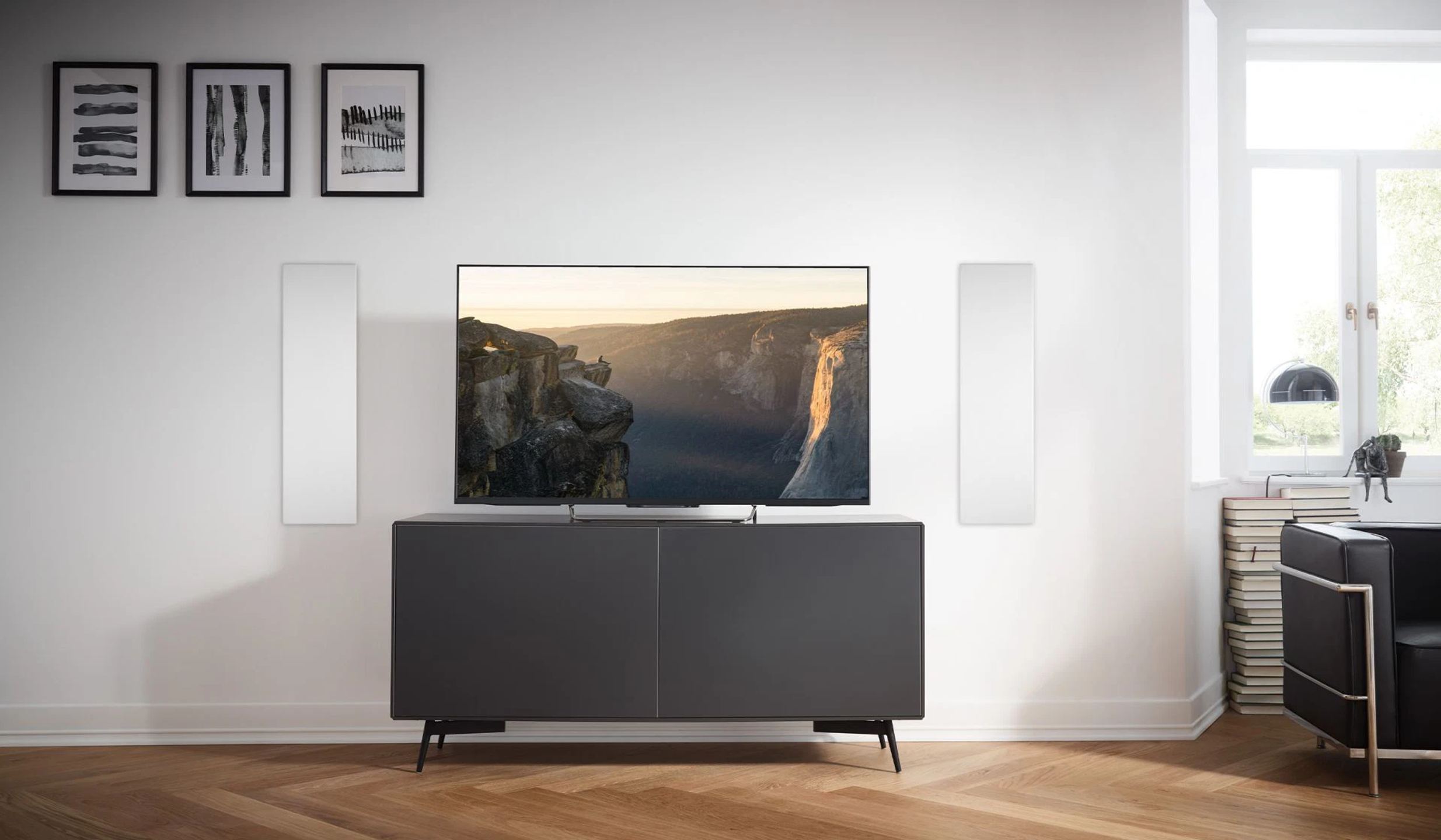
The magnetic textile grille, deliberately oversized (325 × 1150 mm), completely conceals the fixings and the junction between the speaker and the wall. The fabric is acoustically neutral according to Canton. This frameless finish distinguishes the InWall models from their OnWall counterparts in the same range, which retain a lacquered surround. Cables run behind the partition wall, eliminating any visible routing.
The speaker can be oriented vertically or horizontally. The vertical position corresponds to the classic placement of front or surround speakers. The horizontal orientation, on the other hand, is better suited to a centre channel role beneath a screen, although Canton offers a dedicated variant for this purpose, the InWall 11 C, with a symmetrical arrangement of drivers around the tweeter.
Where to place the InWall 11 in an audio system
In stereo, a pair of InWall 11s can serve as the main speakers in a system integrated into a TV unit or media wall. The near-zero visual footprint frees up living space without sacrificing sound quality. In a home theater configuration, they can be used as left and right front speakers, paired with an InWall 11 C as the centre channel and surround speakers from the same Atelier range.
The 4 to 8 ohm impedance and sensitivity of nearly 90 dB make the InWall 11 compatible with most hi-fi amplifiers or home theater receivers on the market. Canton recommends its Smart Amp 5.1 as a natural partner, but this is of course not a requirement.
The stated frequency response extends down to 32 Hz, which may be sufficient for balanced music listening. For film soundtracks with heavy low-frequency content, the addition of a subwoofer is still advisable. The two passive radiators are no substitute for a dedicated subwoofer at the deepest frequencies.
Comparison with the previous Atelier 1100 generation
The InWall 11 succeeds the Atelier 1100, which used plain aluminium membranes and an aluminium-manganese tweeter. The new ATB drivers adopt the technology introduced in Canton’s GLE S2 series, with increased rigidity to reduce membrane distortion at high output levels. The frequency response gains a few hertz in the bass (32 Hz versus the stated 35 Hz) and extends further into the treble (40 kHz versus 30 kHz).
The mounting system has also evolved. The Atelier 1100 used metal hooks anchored into the partition wall. The InWall 11 switches to an integrated clamping system, which is more universal and faster to install. The oversized textile grille is a new feature: on the previous generation, a lacquered frame surrounded the front panel even in recessed installations.
The weight is slightly reduced (12 kg versus 13.1 kg for the Atelier 1100), despite comparable external dimensions. The installation depth remains under 10 cm, allowing the speaker to fit within most standard partition walls.
Documentation
Technical specifications
Acoustic characteristics
- Acoustic principle: 3-way, bass-reflex with passive radiators
- Frequency response: 32 – 40000 Hz
- Crossover frequency: 3000 Hz
- Impedance: 4 – 8 ohms
- Sensitivity: 89.5 dB
- Measurement conditions: 2.83 V / 1 m
Power handling
- Nominal power: 140 W
- Music power: 200 W
Drivers
- ATB (Aluminium Titanium Black) drivers with Wave surround:
- 1 × 174 mm midrange
- 1 × 174 mm woofer
- 2 × 174 mm passive radiators
- Tweeter: 1 × 25 mm AB (Aluminium Black)
Dimensions and weight
- Dimensions:
- Without grille: 275 × 1100 × 85 mm
- With grille: 325 × 1150 × 91 mm
- Weight: 12 kg
General information
- Type: in-wall loudspeaker (InWall)
- Applications: home cinema, integrated hi-fi installations
- Highlights:
- Discreet in-wall integration with frameless fabric grille
- Easy installation thanks to the supplied kit
- Balanced and immersive sound despite a discreet design
Frequently Asked Questions
Can the InWall 11 be installed in a concrete or brick wall?
The speaker is designed for dry partition walls (plasterboard, Fermacell, etc.). Installation in a masonry wall would require creating a recess to the exact dimensions and providing a suitable fixing system. Canton does not supply a specific kit for this type of wall.
What cable cross-section does Canton recommend for connection?
The terminal block accepts standard cable cross-sections, up to approximately 4 mm². For longer cable runs (over 10 metres), a minimum cross-section of 2.5 mm² is recommended to minimise losses.
Can the InWall 11 operate on its own, or does it require a subwoofer?
The frequency response extends down to 32 Hz, which covers the vast majority of the musical spectrum. For home theater use with demanding low-frequency effects (LFE), a subwoofer will usefully complement the system.
What finishes are available?
The InWall 11 is available in semi-gloss white and silky matt black. The textile grille is matched to the cabinet.
Can the speaker be painted to blend into a coloured wall?
The textile grille is not designed to be painted. However, some installers offer custom grilles covered in acoustic fabric in the desired colour.
What is the minimum wall depth required?
The cabinet measures 85 mm in depth excluding the grille. With the mounting clamps and some allowance for cabling, a wall depth of at least 100 mm is recommended.
Is the InWall 11 compatible with multiroom systems?
Yes, provided it is paired with a compatible amplifier or streamer (Sonos Amp, Bluesound Powernode, etc.). The speaker itself is passive and does not feature built-in wireless connectivity.
- Eco-contribution included in the sale price.
- Manufacturer reference: 04601
- GTIN / EAN: 4010243046013