Cardas XLR Parsec 1.5m
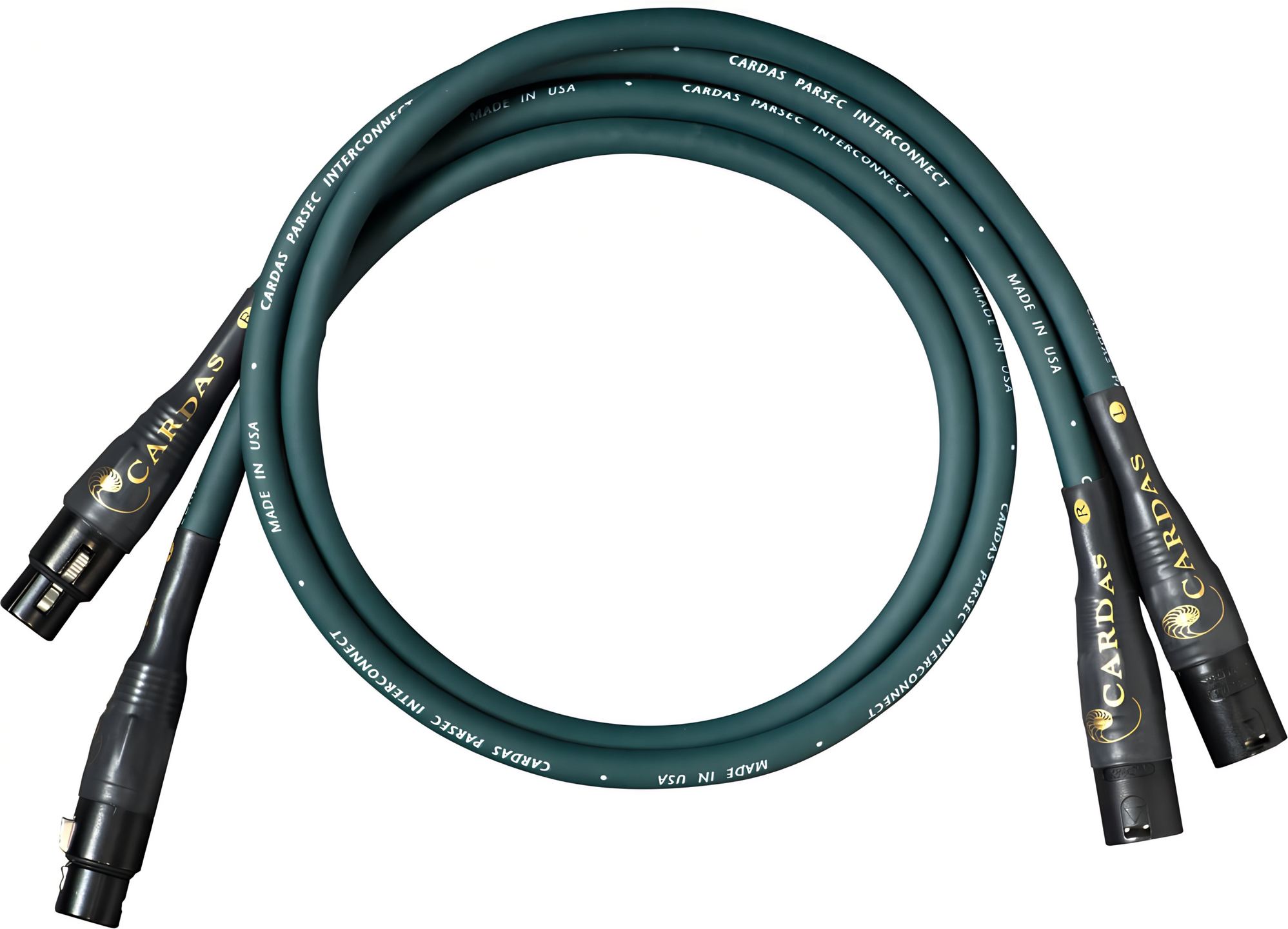
Overview
The Quadlink was long a reference in the Cardas lineup for its musical character and warmth. The Parsec carries over its DNA while grafting on Matched Propagation technology, previously reserved for the Clear series. This combination yields a cable with a strong personality, more agile and more articulate than its predecessor, without sacrificing the midrange fullness that built the brand’s reputation.
Geometry designed to control resonances
George Cardas built his reputation on applying the golden ratio to audio cable design. Patented in the mid-1980s, this approach consists in sizing each strand layer according to the 1:1.618 ratio. The finest strands are found at the center of the conductor, the thickest on the outside. The principle: no layer shares a common harmonic multiple with another, preventing resonances from adding up and coloring the signal.
The Parsec XLR takes this logic further with Cross-field geometry. Each layer of strands is braided in the opposite direction to the previous one. This alternation reduces the dipole antenna effect that turns conventional cables into transmitters and receivers of electromagnetic interference. The tinned copper braided shield, kept at a distance from the conductors by compressed polyethylene air tubes, completes this protection system.
Conductors synchronized with their insulation
In a conventional cable, the electrical signal propagates through copper at the speed of light, but the energy stored in the dielectric (the insulator) is released about 20 to 30% more slowly. This offset creates a smearing of micro-information, a sort of blur affecting fine details and transients.
The Cardas solution? Deliberately slow the propagation in the conductor so that it coincides with that of the dielectric. This is the principle behind Matched Propagation conductors, achieved by precisely controlling the twist pitch of each Litz strand layer. The Parsec is the first cable in the Cross range to benefit from this technology, originally developed for the Clear series.
Copper, Kevlar, and Litz construction
The copper used here is Grade 1 OFC (Oxygen Free Copper) with 99.9999% purity, drawn through diamond dies in a hydrogen-reducing atmosphere. Each strand immediately receives a urethane insulating coating (Litz technique) that protects it from oxidation and prevents interaction between adjacent strands. This construction preserves the copper’s qualities over the long term.
The central Kevlar core ensures the mechanical stability of the whole. The cable does not deform under its own weight and maintains its geometry even after many handling operations. The outer Alcryn jacket, an extruded elastomer, offers welcome everyday flexibility: the Parsec bends without excessive resistance and does not retain the memory of its curves.
Termination and finish
Neutrik XLR connectors equip the standard version. Cardas also offers its own CG XLR connectors as an option. Each cable is terminated by hand in the Bandon, Oregon workshop by a team of specialized technicians. This US-based manufacturing comes with a lifetime warranty.
With an outer diameter of 9.14 mm and a gauge of 2 × 23.5 AWG, the Parsec remains an easy-to-handle cable, simple to route behind a rack without taking up excessive space.
What kind of sound signature can you expect?
The Parsec retains the full-bodied midrange and rich harmonics that characterize the Cardas sound. The difference from the Quadlink comes in the transparency and definition of the soundstage: layering is better separated, transients are cleaner, and bass is more responsive. The overall presentation leans slightly to the warm side of the spectrum without tipping into softness.
This character will suit systems that lack body or whose treble tends toward the analytical. On an already warm system, the Parsec may accentuate that tendency.
Technical specifications
Connectivity
- Standard terminations: Neutrik XLR
Conductors
- Central Kevlar core for mechanical stability
- Grade 1 oxygen-free copper (99.9999% purity)
- Transparent SPN coating (Litz technology)
- Cross-section calibrated according to golden ratio proportions
- Multilayer braided cross-field geometry
- FEP tape insulation with protective sheath
Geometry
- Shielded twisted pair
- Polyethylene air tubes bonded with carbon-impregnated FEP tape
- Outer layer with compressed polyethylene air tubes
- Shield suspended by this layer
- Tinned copper braided shield
- Extruded Alcryn rubber outer jacket
- Kept at a distance from the conductors to limit interactions
Dimensions
- Gauge: 2 × 23.5 AWG
- Outer diameter: 9.14 mm
Frequently asked questions
Does the Parsec require burn-in?
Cardas recommends a burn-in period of around 100 hours for the cable to reach its optimal performance level. This duration may vary depending on the signal passing through it. After handling or moving the cable, a shorter stabilization time (a few hours to a day) may be necessary.
What’s the difference between Neutrik connectors and Cardas CG XLR?
Neutrik connectors are reliable, widely used professional connectors. Cardas CG use solid copper contacts plated with rhodium/silver and a construction optimized for conductivity. Upgrading to the CG version represents an extra cost, justified if the rest of the system is capable of revealing the benefits.
Can the Parsec be used as a studio cable?
Its shielded construction and resistance to interference make it suitable for studio use. However, its slightly warm tonal character can color the recording. For strictly neutral monitoring, other options will be more appropriate.
Is the Parsec suitable for use with a phono preamp?
Yes, its effective shielding and low capacitance make it a good candidate for phono connections, where the signal is particularly sensitive to interference. The XLR version will be relevant if the preamp has balanced inputs.
- Eco-contribution included in the sale price.