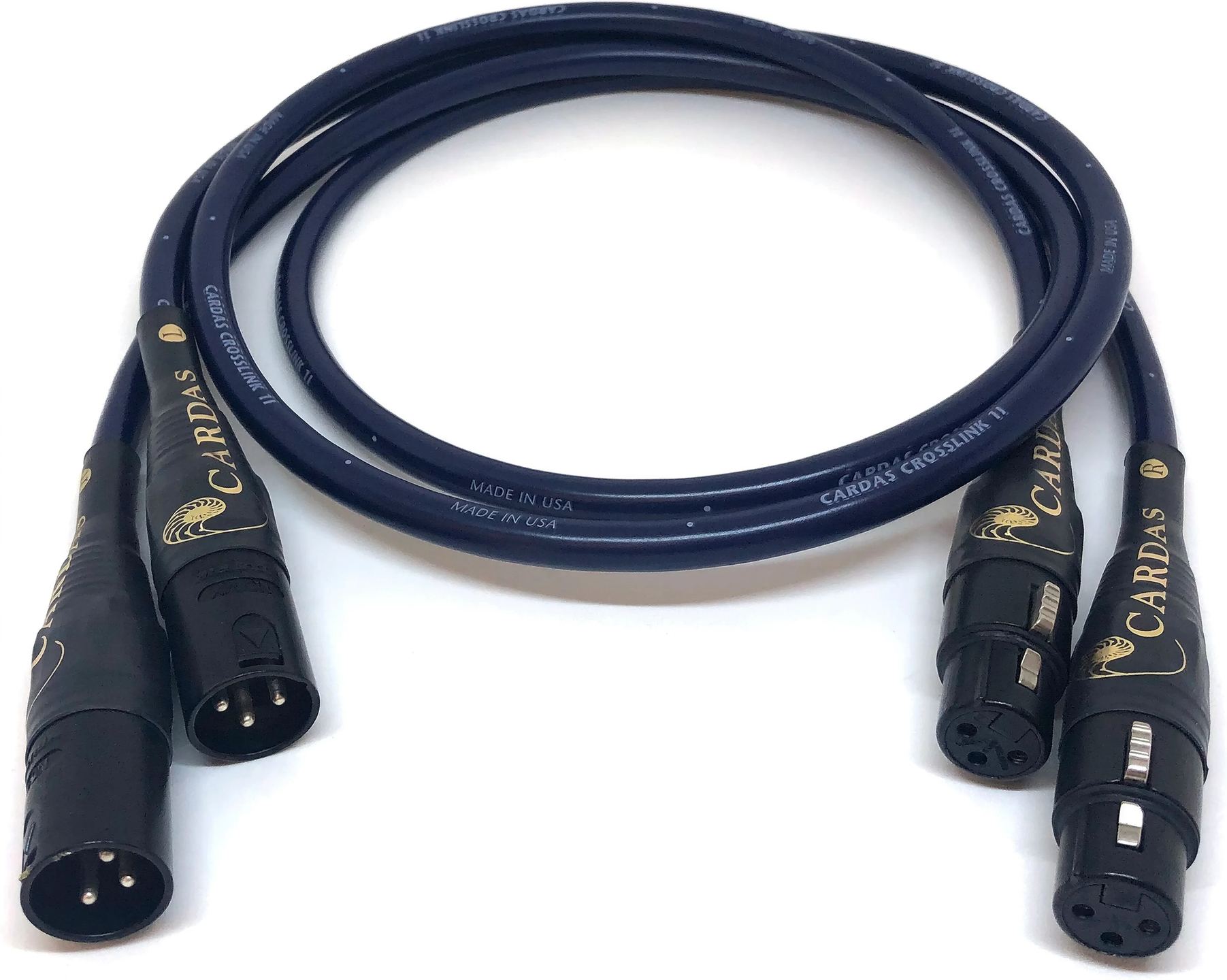
Cardas XLR Crosslink 1.5m
Overview
A balanced XLR interconnect cable that incorporates the American manufacturer’s proprietary technologies at a more accessible price. The Crosslink is based on the principle of the “silent” conductor patented by George Cardas, where the copper strands are sized according to golden ratio proportions to control internal resonances. It is the only model in the Cardas range available as bulk cable by the meter for assemblers, which speaks to its versatility.
Golden ratio in your audio links
George Cardas holds two US patents (4,980,517 and 4,628,151) for his golden-section stranding technique. The principle: arrange copper strands whose diameters vary according to a 1:1.618 ratio, the famous golden ratio. The thinnest strands are located at the center of the conductor, with each subsequent layer increasing according to this proportion. This layout prevents the strands from entering into common resonance, since none of them shares a harmonic multiple with its neighbor.
The idea comes from an unexpected field. Before founding Cardas Audio in 1987 in Ontario, California, George worked as a line engineer for a telephone company while racing cars semi-professionally. With his machinist Mike Colver, he discovered that applying the golden ratio to intake and exhaust systems yielded results so impressive that some designs were banned from races. He later applied this concept to audio conductors.
Construction and materials of the Crosslink
The cable uses grade 2 oxygen-free copper with 99.99% purity. Each strand receives a transparent SPN insulating coating that characterizes Cardas’ Litz construction: this layer eliminates capacitive interactions between strands and prevents copper oxidation. The Crosslink totals 68 discrete strands organized in a “Crossfield” geometry, where the layers alternate to minimize electromagnetic interference.
The twisted pair is supported by a natural cotton filler, a material chosen for its stable dielectric properties. The assembly is wrapped with FEP tape before being covered with a spiral shield of tinned copper. The flexible PVC outer jacket gives the cable a final diameter of 7.69 mm.
In XLR configuration, the measured capacitance reaches 22.8 pF per foot (about 74.8 pF/m), a moderate value that preserves high frequencies over reasonable lengths.
CE XLR connectors
The CE XLR plugs are the third generation of Cardas budget connectors. The body is machined from high-copper-content brass, a non-magnetic alloy. The contact surfaces receive a silver plating. These connectors accept cables from 3.3 to 9 mm in diameter, and the 7.69 mm Crosslink fits comfortably within this range.
The CE range now equips Cardas Crosslink, Iridium, Parsec, Sky, and Cygnus cables. Less elaborate than the CG XLR (which add rhodium plating and RF shielding at the ends), they offer better build quality than generic connectors without driving up the bill.
A defined sonic character
Cardas describes the Crosslink as “warm and forgiving,” a warm and tolerant signature. In practice, this means a dense midrange, rounded treble, and a focus on bass weight rather than razor-sharp definition. This sonic color can compensate for the harshness of some entry-level digital players or systems with aggressive highs.
The flip side: on an already round or dark system, the Crosslink may accentuate this tendency. According to Cardas, detail retrieval remains good, but it would be an overstatement to expect the transparency level of the Clear or Parsec ranges. The positioning is honest: this cable is aimed at entry- to mid-range hi-fi and home theater systems.
Technical specifications
Connectivity
- Standard terminations: CE XLR
- Compatibility: stereo and home theater applications, entry to mid-range
Conductors
- Grade 2 oxygen‑free copper (99.99% purity)
- Transparent SPN coating (Litz technology)
- Cross-sections sized according to golden ratio proportions
- Multi-layer cross-field geometry
- Insulation in a polyurethane jacket
Geometry and construction
- Twisted pair with natural cotton filler
- Assembly held by FEP tape
- Spiral shielding in tinned copper
- Outer PVC jacket
Dimensions
- Gauge: 2 × 20.5 AWG
- Outer diameter: 7.69 mm
Sound performance
- Warm and forgiving sonic signature
- Detailed and musical reproduction
Frequently Asked Questions
Can the Crosslink XLR connect a preamplifier to a power amplifier?
Yes, that is one of its typical uses. The balanced XLR link rejects interference by common-mode cancellation, which is useful for runs of several meters or electrically noisy environments. For distances under one meter in a quiet environment, the RCA version may be sufficient.
Is there a speaker version of the Crosslink?
Cardas does indeed offer a Crosslink Speaker cable, built on the same principles but with a cross-section suited to carrying current to loudspeakers. Both references share the Golden Ratio geometry and grade 2 copper Litz conductors.
What is the difference between Cardas copper grades?
Cardas mainly uses two grades. Grade 1 is used in the high-end ranges (Clear, Parsec): it is their purest copper, produced using a proprietary method with the last American foundry capable of making it. The Crosslink’s grade 2 reaches 99.99% purity, already higher quality than standard OFC copper.
Can I use this cable in a multichannel home theater setup?
The Crosslink is suitable for analog connections between home theater processors and amplifiers. To equip a 5.1 or 7.1 system, count as many pairs as there are channels to be connected. Its entry-level pricing makes this configuration more affordable than with higher-tier references.
Are the CE XLR connectors compatible with all devices?
The plugs comply with the 3-pin XLR standard. They fit all standardized female (for the male plug) and male (for the female plug) XLR sockets. The latch mechanism ensures a stable connection.
- Eco-contribution included in the sale price.