The AV100 from Atoll Electronique is a 3‑channel power amplifier designed to bring musicality to home cinema systems. Developed and manufactured in Normandy, this unit delivers 100 watts per channel into 8 ohms thanks to a discrete‑component topology and MOS-FET transistors. It is aimed at those who want to entrust amplification of the three front channels (left, center, right) to a dedicated external power amp, in order to ease the load on their AV receiver and gain in sound quality.
Design and power supply: technical choices
The AV100 is built around two 340 VA toroidal transformers, for a total capacity of 680 VA. This energy reserve feeds a filtering section totaling 44,210 µF of capacitance. These figures may seem generous for an amplifier of “only” 3 × 100 W, but they reflect Atoll’s desire to provide an oversized power supply capable of responding to current demands without weakening.
The output stages use MOS-FET transistors in a symmetric discrete configuration. This type of transistor is characterized by a very high input impedance and an electrical behavior close to that of tubes, which has earned it a reputation for smoothness and fluidity in the audio world. Atoll’s MOS-FETs operate in class A/B, a compromise between efficiency and sound quality that avoids the excessive heat of pure class A amplifiers.
The 1.3 µs rise time and 5 Hz to 200 kHz bandwidth showcase the speed of the electronics, while the 100 dB signal-to-noise ratio and specified distortion of 0.05% (measured at 10 W into 1 kHz) put the unit in line with expectations for this category.
Design and build: functional simplicity
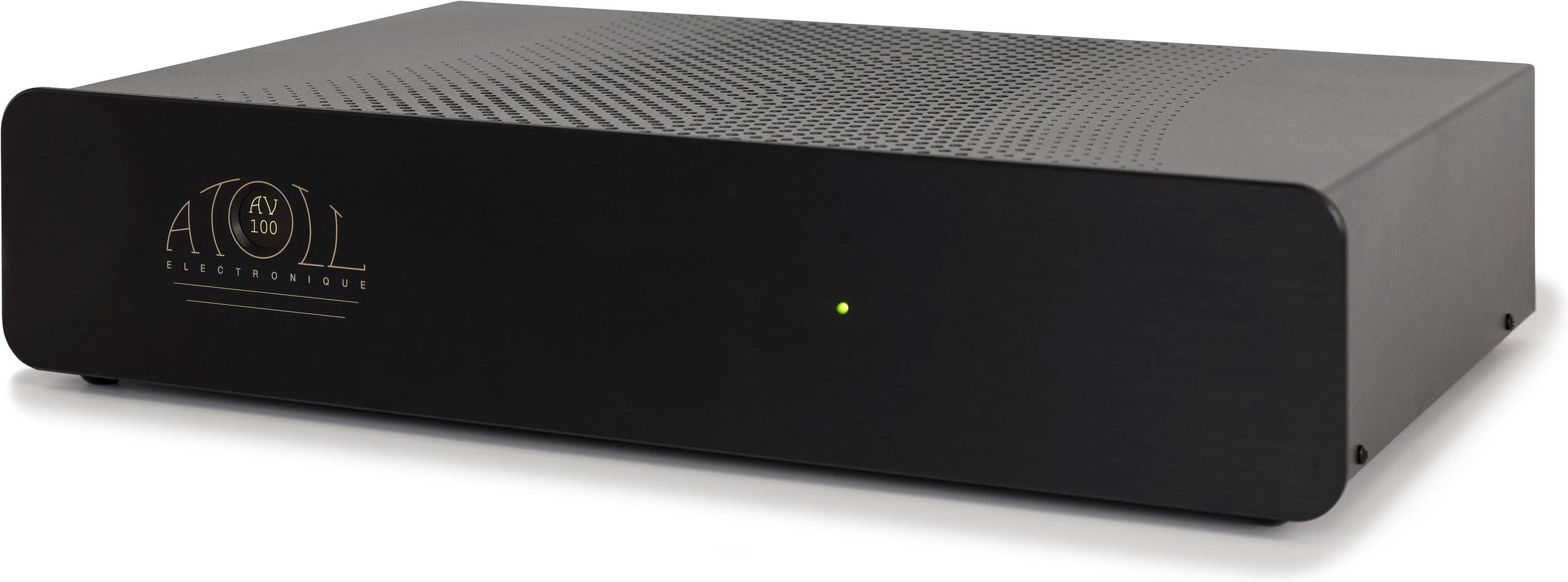
The AV100 comes in a compact chassis measuring 440 × 291 × 95 mm and weighing 11 kg. The slightly curved 4 mm brushed aluminum front panel features only the Atoll logo and a status LED. No buttons, no display: the unit focuses on essentials.
The 1.5 mm steel chassis is topped and sided with panels perforated with small ventilation holes arranged in concentric patterns. This aesthetic choice also contributes to passive cooling of the internal components. The AV100 is available in a standard black finish, with a natural aluminum option to match other components.
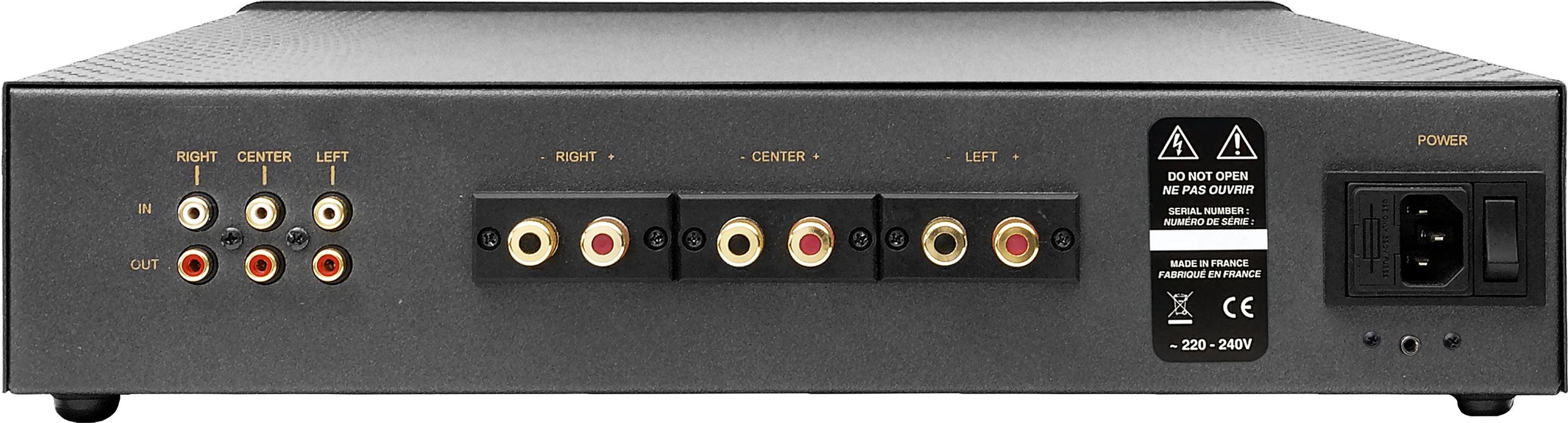
On the rear, there are three RCA inputs (left, center, right), three RCA outputs for potential bi-amping, and three pairs of large cross-section speaker terminals accepting banana plugs. The IEC mains socket allows the supplied power cable to be replaced if desired. The power on/off switch is also located on the rear, which means you’ll need to leave the unit in standby if you want automated power-up.
Positioning in the range and typical use
The AV100 sits between the brand’s stereo power amplifiers (such as the AM100 or AM200) and the 5‑channel AV500 block. Its primary purpose is to handle the three front channels of a home cinema system: the left and right speakers, plus the center speaker.
In this configuration, the AV receiver retains control of the surround channels, rear surrounds, and possibly Atmos speakers. By offloading amplification of the three most heavily used channels from the main unit, you free up its power supply section for audio processing and the remaining channels.
The AV100 can also be used in more unusual setups: active tri-amping of three‑way speakers, amplification for high‑efficiency systems, or simply as a power amp for stereo listening using two of the three channels.