
Laurent
Very good cable with exceptionally high-quality sound reproduction
Comment from September 04, 2026 — Experience from August 20, 2026
Automatically translated — Show original (French)
Très bon câble au rendu sonore de très haute qualité
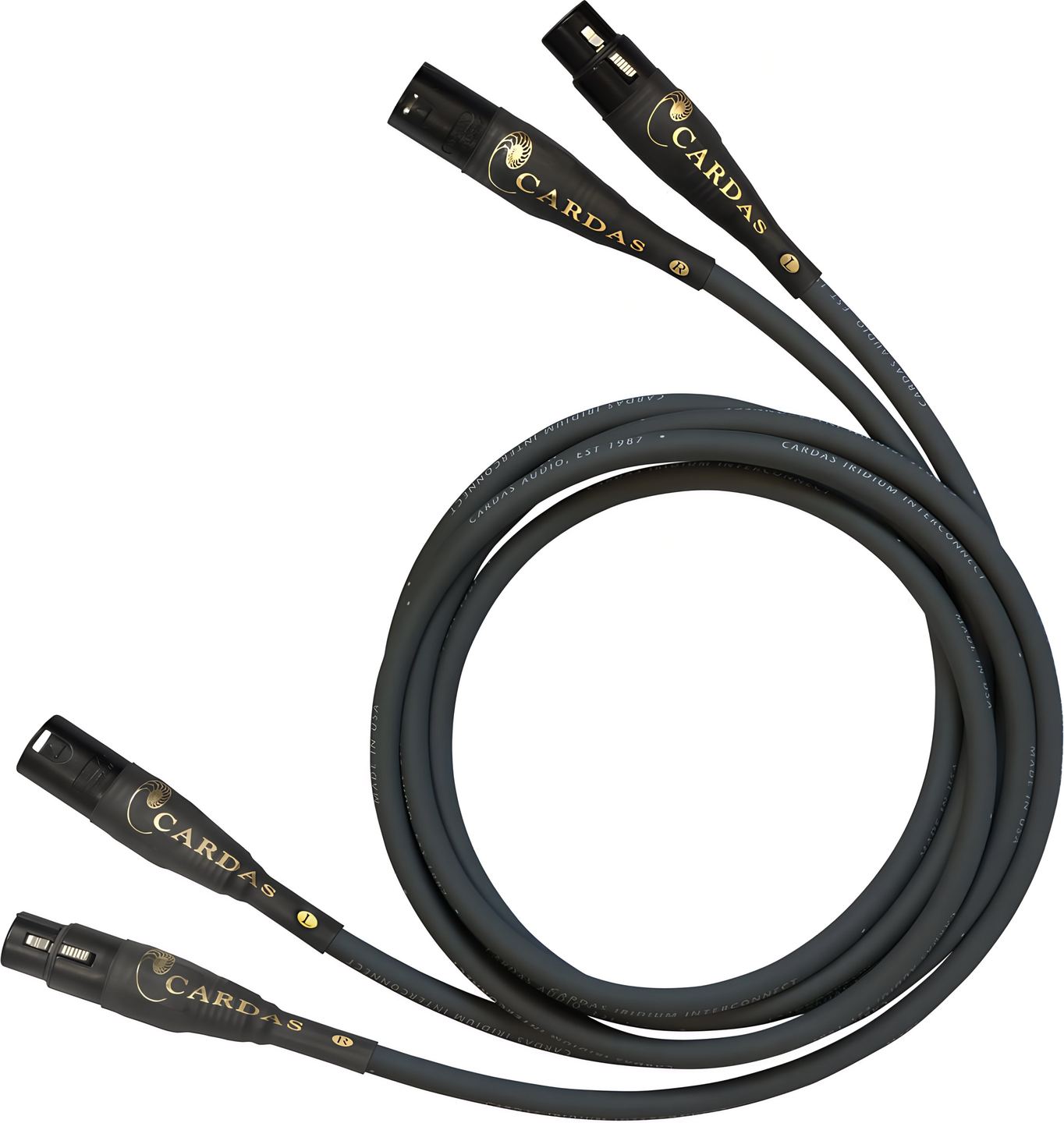
Successor to the Microtwin, the Iridium is the first cable in the Cardas range to incorporate Golden Ratio Litz conductors. This technical choice, usually reserved for the brand’s high‑end models, puts this XLR interconnect cable in a unique position: an entry‑level product that benefits from the same fundamentals as the Clear and Clear Reflection references.
The Iridium uses four 24.5 AWG conductors arranged in a Star‑Quad geometry, a configuration that promotes the cancellation of electromagnetic interference. Each conductor is made up of Grade 1 OFHC copper strands with 99.9999% purity, coated with SPN (Single Poly Nylon) insulating varnish. This Litz technology, which insulates each strand individually, reduces skin effects that can impair signal transmission at high frequencies.
The strand gauges follow a progression based on the Golden Ratio (1:1.618 ratio). The thinnest wires are placed at the center, with an increasing diameter toward the periphery of the conductor. This concentric layout, patented by George Cardas in the 1980s, is designed to reduce micro‑resonances between strands.
The cable combines two layers of protection against interference. A spiral of tinned copper surrounds the conductors, complemented by a carbon‑impregnated PTFE tape. This combination provides protection against both radio frequencies and low‑frequency electromagnetic disturbances.
The FEP (fluoropolymer) dielectric and PTFE tape ensure insulation between conductors. The outer TPR jacket, with a diameter of 7.62 mm, remains flexible and easy to handle—a noticeable improvement over the Microtwin, whose stiffness could sometimes make installation difficult in tight spaces.
The Neutrik connectors on this XLR version are hand‑soldered in the Cardas workshop in Bandon, Oregon. Terminating Litz conductors requires specific work: the insulating varnish on each strand must be burned off with flux before soldering, a manual operation that partly explains the higher cost of Litz cables compared to bare conductors.
The Iridium’s tonal balance leans toward a presentation that is slightly warmer than strict neutrality. The midrange is full and textured, the highs remain natural without harshness, and the bass is articulate with good solidity in the upper‑bass region. This character suits systems that would benefit from a bit more roundness or whose top end lacks sweetness.
The trade‑off for this signature: micro‑detail resolution and bass dynamics that do not reach the level of the Clear models. For an already warm system, the cumulative effect might lack openness.
According to Cardas, the Iridium offers more precise imaging, higher‑quality terminations, and a much more flexible TPR jacket. The four‑conductor Star‑Quad geometry replaces the Microtwin’s twisted pair. The hybrid copper/carbon shielding is also an evolution compared with its predecessor.
Technically yes, but this conversion cancels out the advantages of a balanced connection (common‑mode interference rejection). If your equipment only has RCA inputs, the RCA version of the Iridium with Cardas GRMO connectors will be more suitable.
The Parsec occupies the next step up. It incorporates Matched Propagation technology, which synchronizes the signal propagation speed in the conductor with that of the dielectric. This technology, absent from the Iridium, is a hallmark of the Clear and Clear Reflection ranges.
Its slightly warm character may not match the neutral monitoring requirements of a professional studio. For a home studio or pleasure listening, however, its musicality and non‑fatiguing nature can be appreciated during long sessions.
The Iridium range also includes speaker cables, phono cables (RCA to RCA or DIN to RCA), and power cables. All share the same Golden Ratio Litz conductors and are manufactured in the United States.
Laurent
Very good cable with exceptionally high-quality sound reproduction
Comment from September 04, 2026 — Experience from August 20, 2026
Maxime
Excellent, the Cardas interconnect cables in RCA and XLR are probably among the best
Comment from October 28, 2025 — Experience from October 17, 2025
Alain
The Cardas Iridium cables are shielded and extremely flexible, with a very nice finish on the GRMO connectors. They are a bit pricey, but the quality is there.
Lots of detail, warmth, and a very beautiful soundstage!
These Cardas cables give you your money's worth with a smooth midrange, fast punchy bass, and natural highs. I will definitely continue my setup with Cardas, as these cables are a marvel for the ears.
Comment from June 26, 2024 — Experience from June 15, 2024





