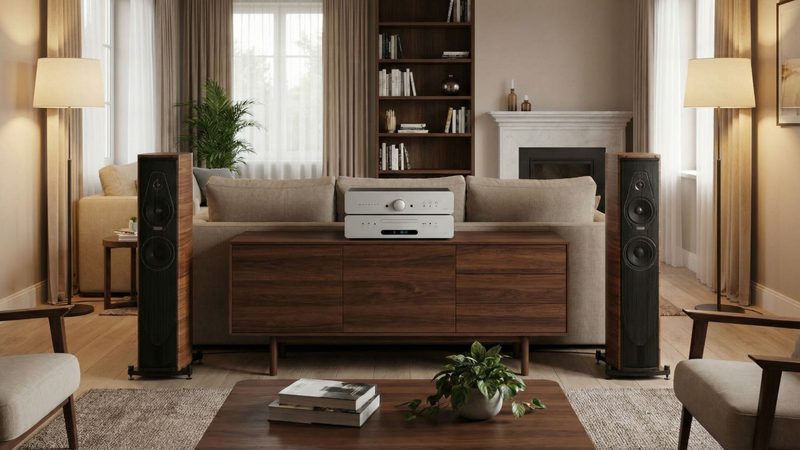
The Atoll IN50 Signature delivers 50 watts per channel into 8 ohms and succeeds the IN50 SE with a redesigned power supply circuit and modular upgradeability. This stereo integrated amplifier, designed and assembled in Brécey in Normandy, uses a discrete-component topology and MOS-FET transistors in class A/B. Its 4 mm brushed aluminum front panel conceals electronics that benefit from over 25 years of continuous optimization, while its optional phono and DAC boards allow the unit to be adapted to the real needs of each system.
A chassis designed to last and dissipate heat
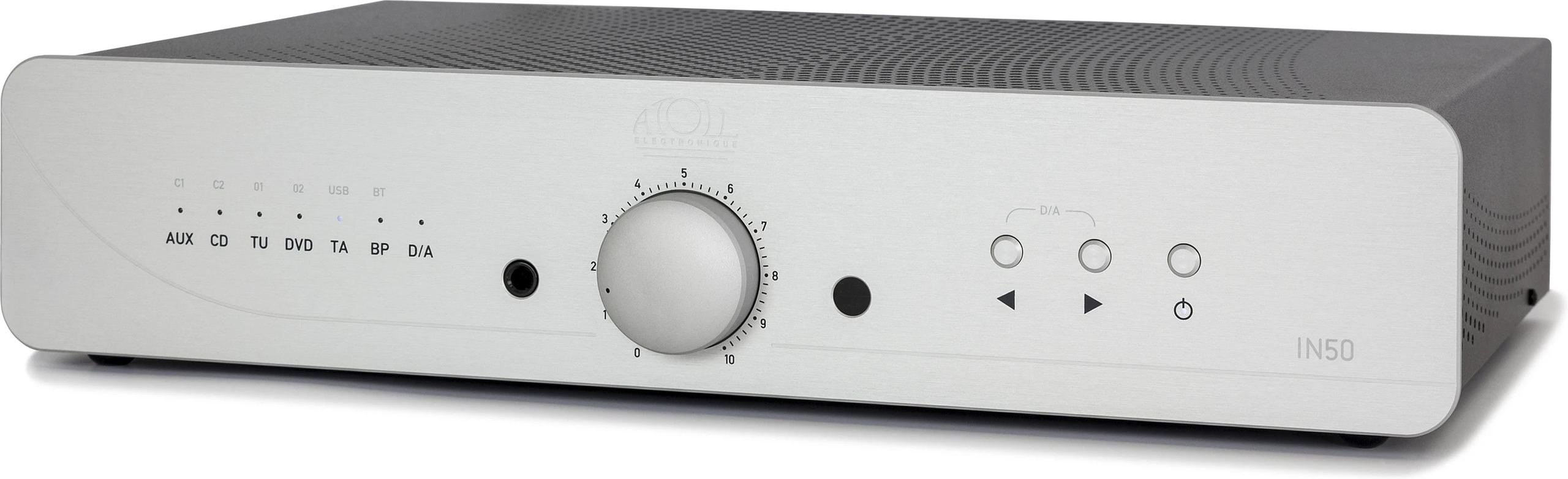
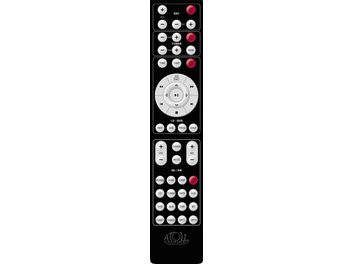
The IN50 Signature follows the aesthetic codes established by the IN300, the higher-end model in the range. Its slightly curved 4 mm brushed aluminum front panel is available in natural aluminum or black anodized finish. Seven light-emitting diodes aligned on the left indicate the selected source. In the center, the motorized ALPS volume control responds to both manual adjustment and the optional remote control. Two touch buttons on the right let you scroll through the inputs. A 6.35 mm headphone jack completes the front panel, alongside an infrared receiver and the standby button.
The 1.5 mm steel chassis adopts a functional design: the top and sides are perforated with multiple small holes arranged in concentric patterns. These perforations are not just an aesthetic choice. They create natural airflow that evacuates the heat generated by the power stages, whose class A/B bias produces constant thermal dissipation. The finned aluminum heatsinks are individually attached to each MOS-FET transistor, mechanically decoupled from the main chassis to prevent any intermodulation effects.
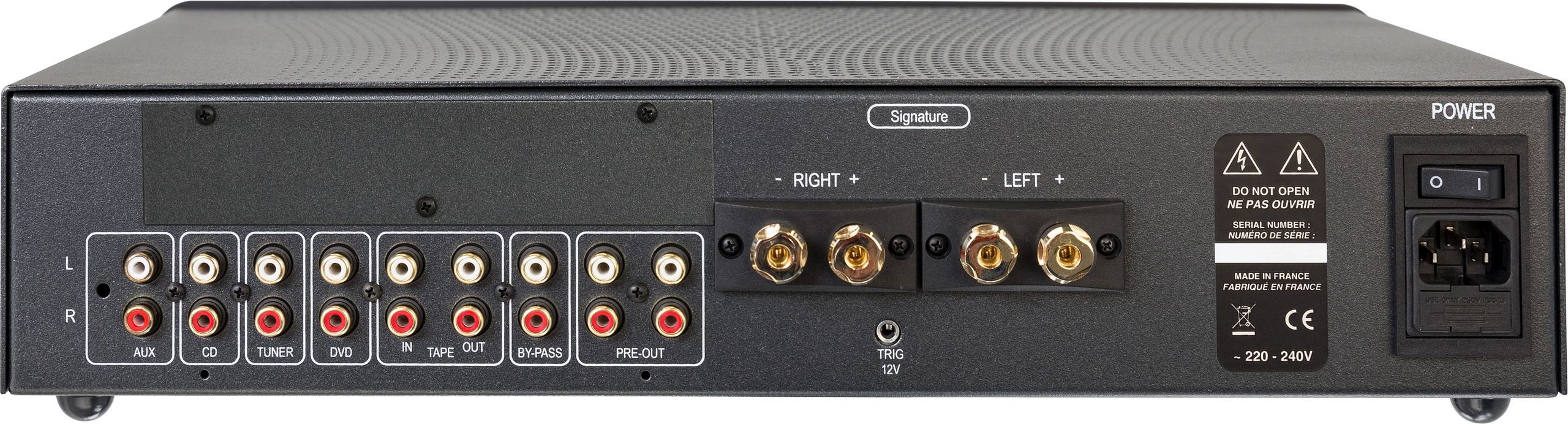
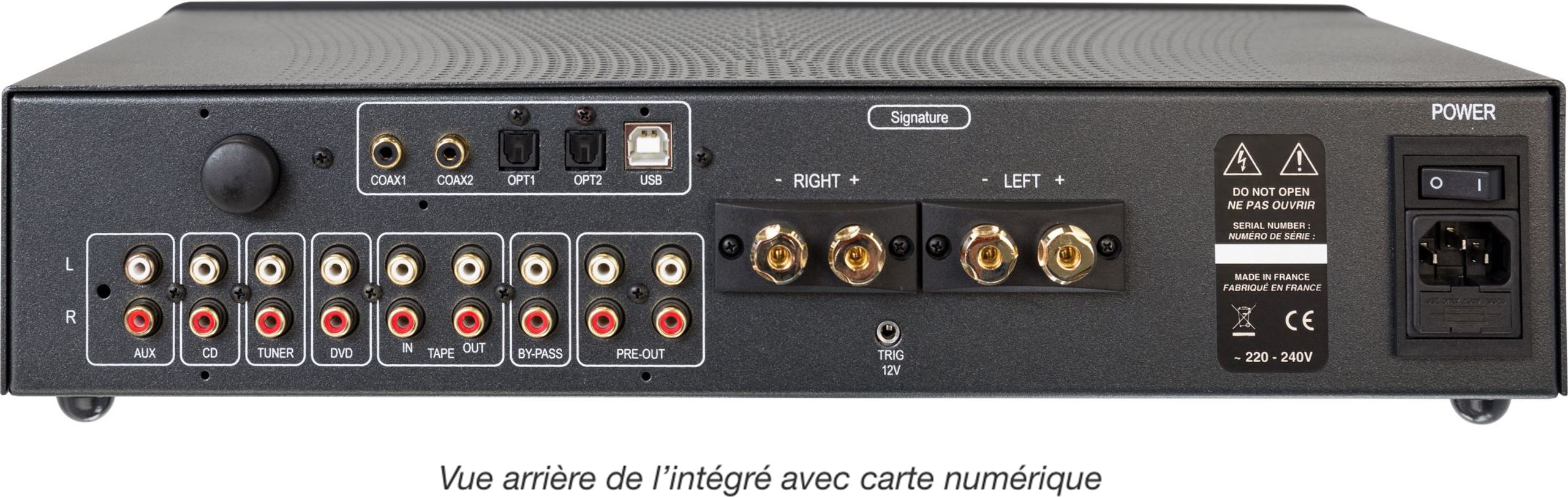
At the rear, connectors span the full width of the panel. Five RCA inputs accept analog sources: auxiliary (replaced by a phono or DAC board if installed), CD, tuner, DVD, and tape with record loop. A sixth input, labeled By-Pass, turns the unit into a pure power amplifier by bypassing the preamplifier. Two RCA pre-out outputs allow connection of an external power amplifier or an active subwoofer. Two pairs of binding posts accept speaker cables, while a 12 V trigger output synchronizes power-on with other components. The IEC mains inlet allows the power cord to be replaced.
An audiophile topology with no compromises on the power supply
Opening the IN50 Signature reveals a dual-mono layout, with the exception of the power transformer. This 170 VA Diemen Efiter toroidal transformer occupies the left side of the chassis, separated from the audio stages by the heatsinks. Its toroidal shape confines the magnetic field and reduces electromagnetic interference that could contaminate the PCB. The 170 VA rating may seem modest, but it has been precisely calibrated to feed the power stages and compensate for the additional demands of the motorized volume control and any optional boards.
Two Nippon Chemi-con filter capacitors of 6,800 µF each, rated at 63 V, are located as close as possible to the power stages. Combined with the other capacitors in the circuit, they provide a total capacitance of 17,874 µF, creating an energy reservoir capable of absorbing dynamic peaks without sagging. This total capacitance explains why the amplifier maintains strong low-frequency control even with demanding speakers.
The main printed circuit board, made of glass epoxy with nickel/gold plating, extends across nearly the entire chassis. It uses a discrete-component configuration: there is no operational amplifier anywhere. The input and driver stages employ bipolar transistors, while the output stages are based on complementary pairs of MOS-FET transistors (International Rectifier IRFP9140N and IRFP140N) in a push-pull arrangement and biased in class A/B. Atoll manually matches these transistors to ensure perfect symmetry between the two channels and minimize crossover distortion.
Vishay MKP (metalized polypropylene) coupling capacitors are distributed along the signal path. These components, known for their neutrality and speed, preserve the integrity of musical transients. The star-ground topology, with a single central grounding point, eliminates unwanted ground loops. Source selection is handled by relays, avoiding mechanical switches prone to wear and micro dropouts.
MOS-FET output stages that respond instantly with no memory effect
MOS-FET transistors are at the heart of Atoll’s sound philosophy. Unlike conventional bipolar transistors, MOS-FETs offer high input impedance and remarkable linearity across their entire operating range. Above all, they deliver current instantaneously, without the delay characteristic of bipolar junctions. This responsiveness results in a direct rendering of attack transients, particularly noticeable on percussive instruments and complex orchestral passages.
Class A/B biasing represents a carefully considered compromise between efficiency and sound quality. For the first few watts, the transistors operate in pure class A, with each transistor conducting continuously. Beyond this threshold, the amplifier switches to class B, where the transistors take turns handling the positive and negative halves of the signal. This transition occurs without any perceptible discontinuity thanks to precise adjustment of the bias current. Atoll has reduced the amount of negative feedback in this Signature generation, favoring the circuit’s intrinsic linearity over heavy corrective feedback loops.
The rated power of 50 watts per channel into 8 ohms and 70 watts into 4 ohms tells only part of the story. The peak power of 90 watts indicates its ability to deliver short bursts without compression. The 2.5 microsecond rise time confirms its responsiveness to transient signals. The 5 Hz to 100 kHz bandwidth comfortably covers the audible spectrum, while the 100 dBA signal-to-noise ratio ensures a silent noise floor. The 0.05% harmonic distortion at 10 watts attests to the circuit’s linearity.
Modular upgradeability to match your current sources
The IN50 Signature employs a modular concept that is rare at this price level. In its basic configuration, it functions as a pure analog integrated amplifier, accepting only line-level sources. But two slots at the rear allow optional boards to be installed, expanding its capabilities without changing the main circuit.
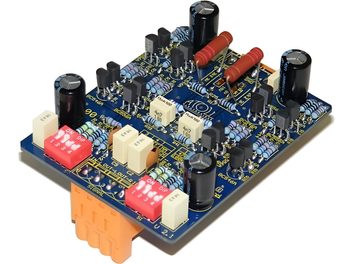
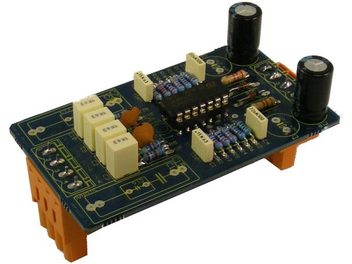
The first option covers vinyl playback. Two phono boards are available: the P50, dedicated to moving magnet (MM) cartridges, and the P100, compatible with both MM and moving coil (MC). The latter offers three selectable gain settings (40, 42, or 56 dB) to accommodate a wide range of cartridges. An input capacitance of 100 pF can be enabled or disabled according to the cartridge manufacturer’s recommendations. These boards replace the auxiliary input and can coexist with a digital board.
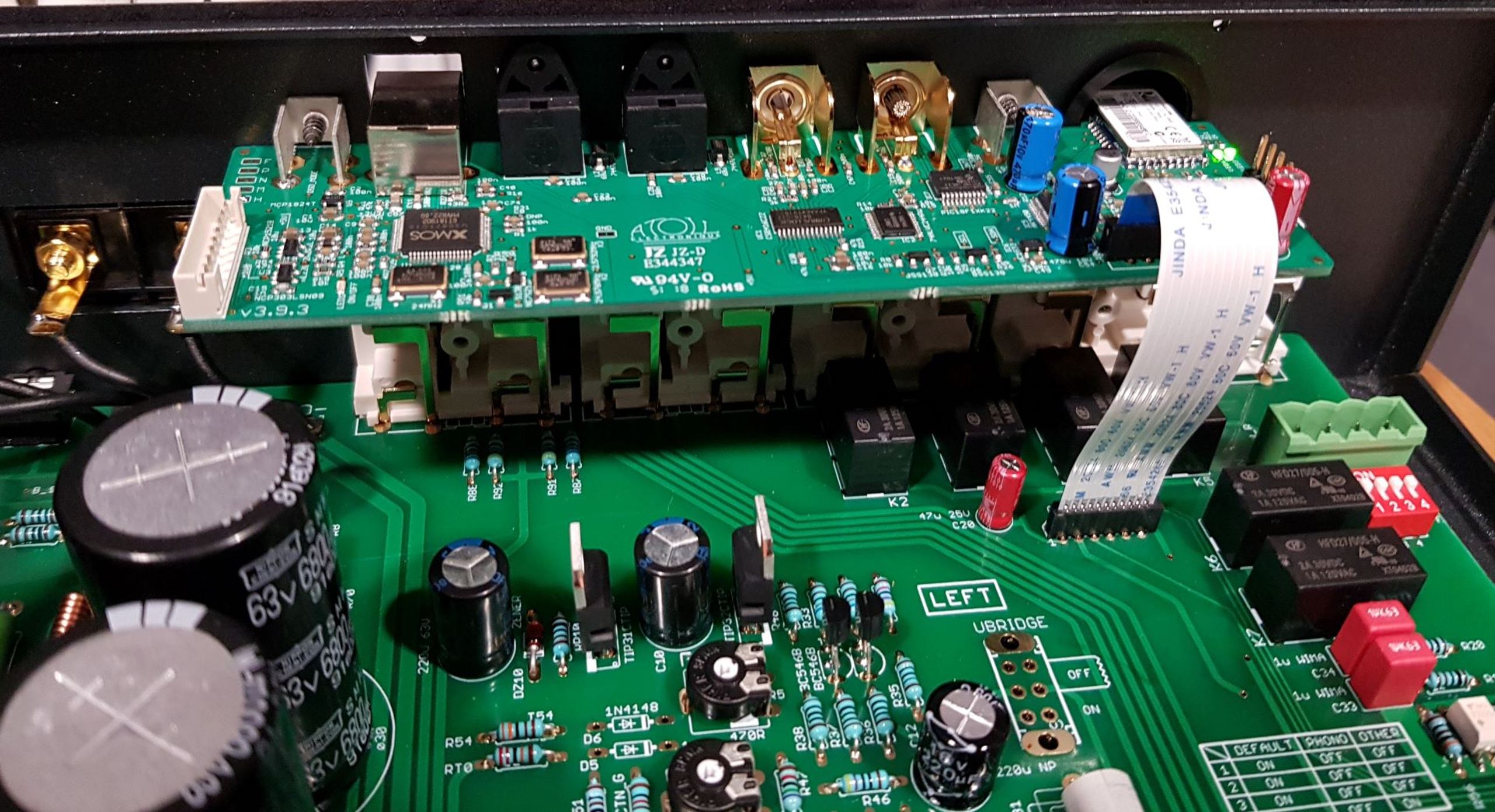
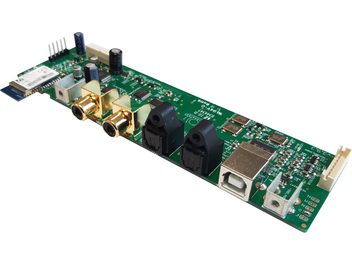
The digital boards address the growth of dematerialized sources. Two versions exist. The Signature board (identical to the one used in the IN200 and IN300) includes an AKM AK4490 converter, an XMOS USB interface supporting PCM up to 384 kHz and DSD128, a Bluetooth receiver, two coaxial inputs, and two optical inputs at 24-bit/192 kHz. A simplified, more affordable version uses a Burr Brown PCM1744 converter and retains only the four coaxial and optical inputs at 24-bit/192 kHz. This SPDIF board is sufficient for connecting a network player, game console, or TV.
Installing a board requires no soldering. The user removes the top cover, disconnects the ribbon cable linking the auxiliary input to the main circuit, plugs the board into its connector, and closes the case. The internal software automatically detects the presence of the board and adjusts signal routing accordingly. On macOS and Linux, no driver is required for USB. Windows requires a driver downloadable from Atoll’s website.
Smart pairing with bookshelf speakers and affordable floorstanders
With 50 watts into 8 ohms, the IN50 Signature is well suited to speakers with sensitivities between 86 and 90 dB. It works particularly well with bookshelf speakers using 15 to 20 cm bass drivers, as well as medium-sized floorstanders equipped with two 13 to 16 cm mid-bass drivers. Its generous power supply allows it to handle 4-ohm loads without strain, then delivering 70 watts per channel.
Speakers with soft-dome tweeters and polypropylene or cellulose mid-bass cones pair harmoniously with the amplifier’s character. Its sound favors fluidity and tonal coherence over showy effects. The bass extends low and remains firmly controlled, with no boom or overhang. The midrange reveals richly textured timbres and transparency that bring out mix details usually masked. The treble stays open and clear without ever turning harsh, even during dense orchestral passages.
In a 20 to 40 m² room, the IN50 Signature maintains authority and presence that exceed what its nominal power might suggest. Its ability to deliver instantaneous current peaks compensates for the absence of sheer wattage. Transitions between intimate passages and fortissimos are handled without audible compression. The soundstage expands in width and depth, building a three-dimensional image that precisely locates each instrument within the stereo panorama.