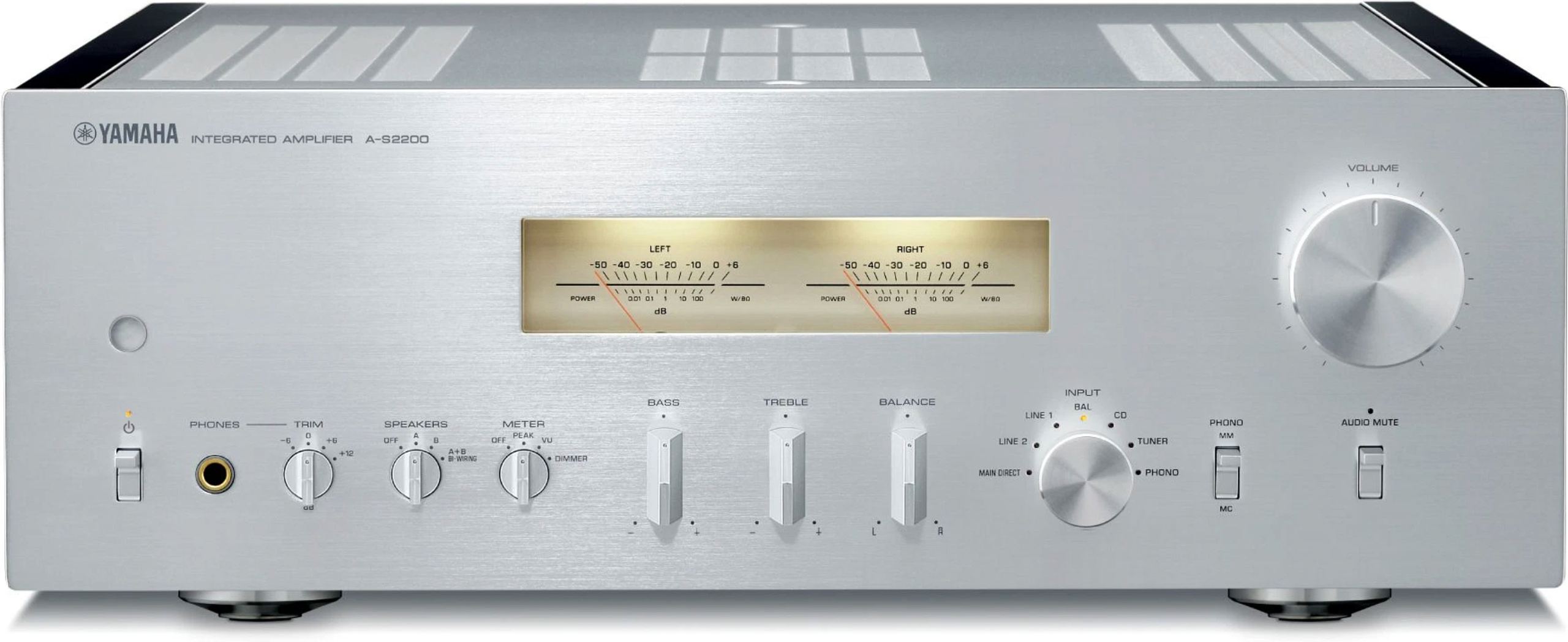
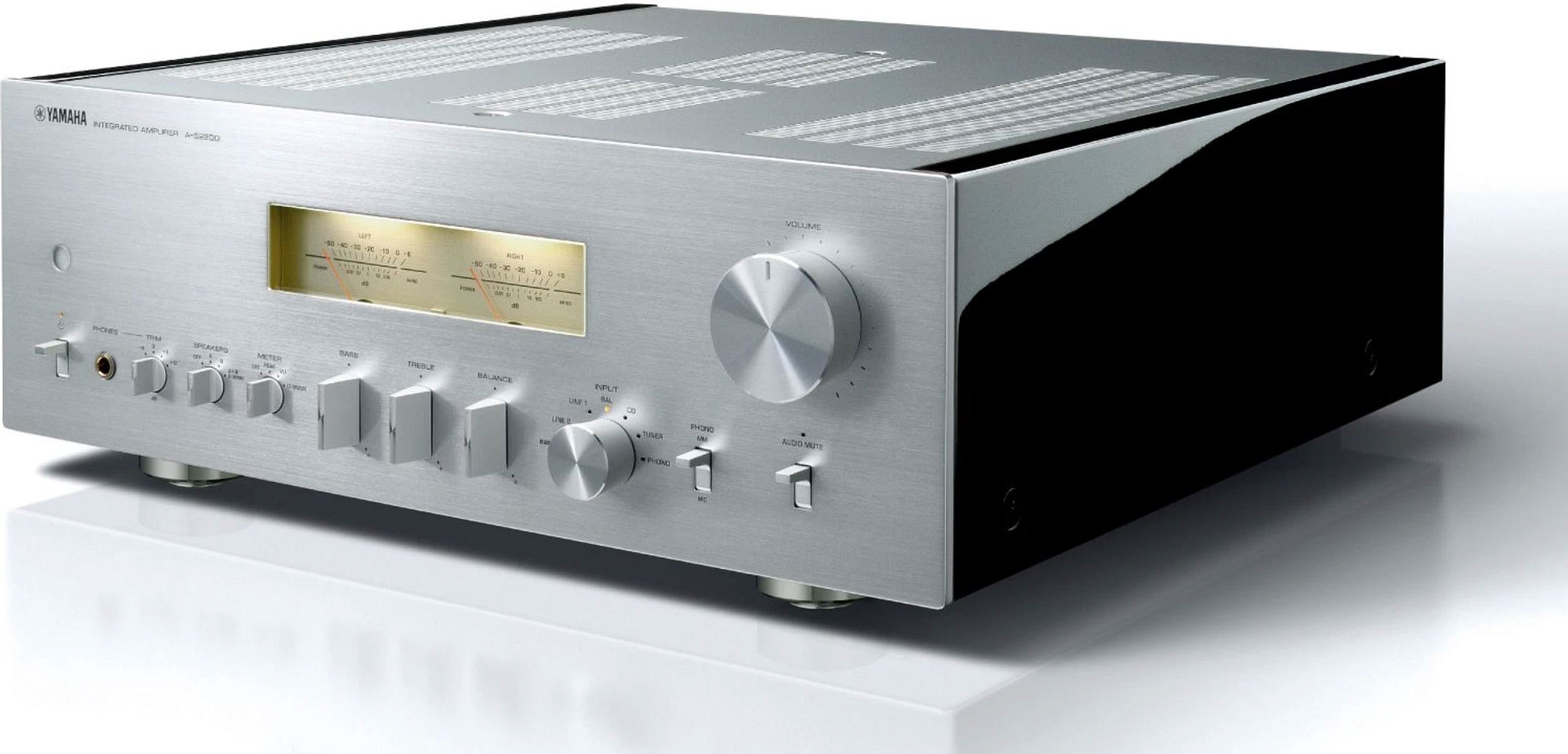
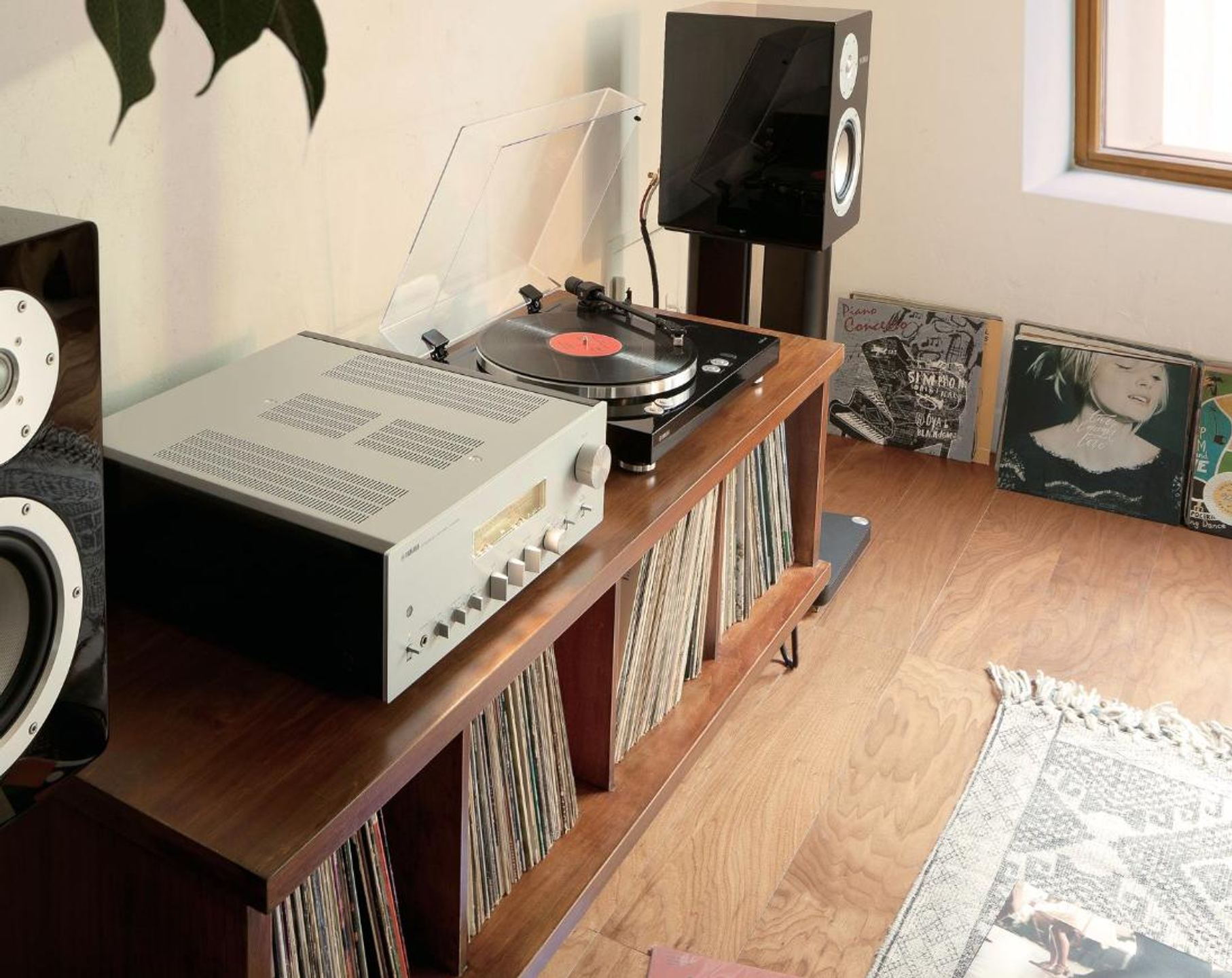
The A-S2200 from Yamaha offers a specific approach to modern hi-fi amplification. Positioned in the middle of the Japanese manufacturer’s premium range, this unit combines precise technical choices with a design based on several decades of experience. It delivers 90 watts per channel into 8 ohms, features a high-capacity toroidal transformer, and uses a fully symmetrical architecture. This stereo integrated amplifier is designed to operate in a purely analog mode, without any built‑in digital functions.
Mechanical construction that defies current standards
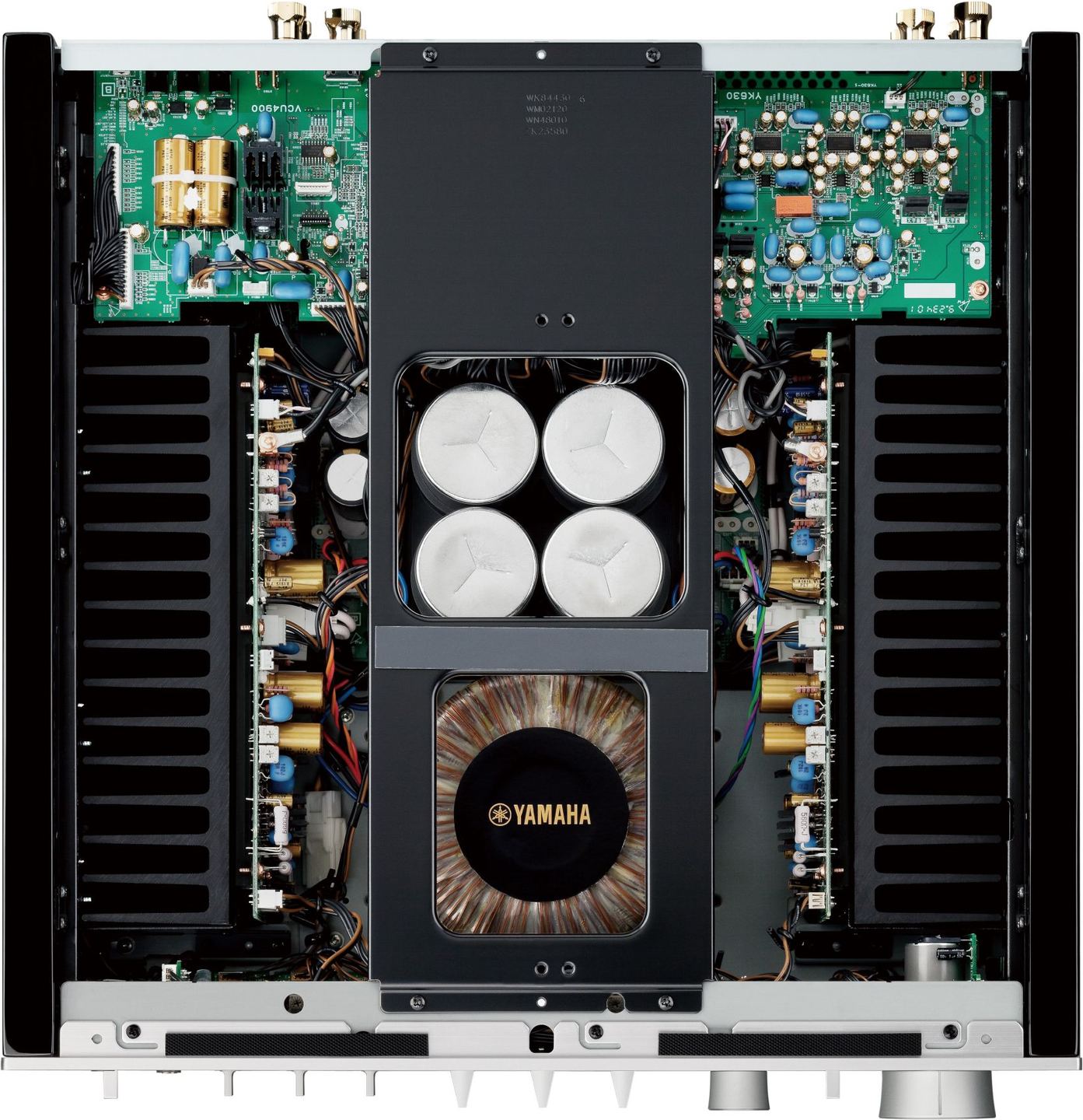
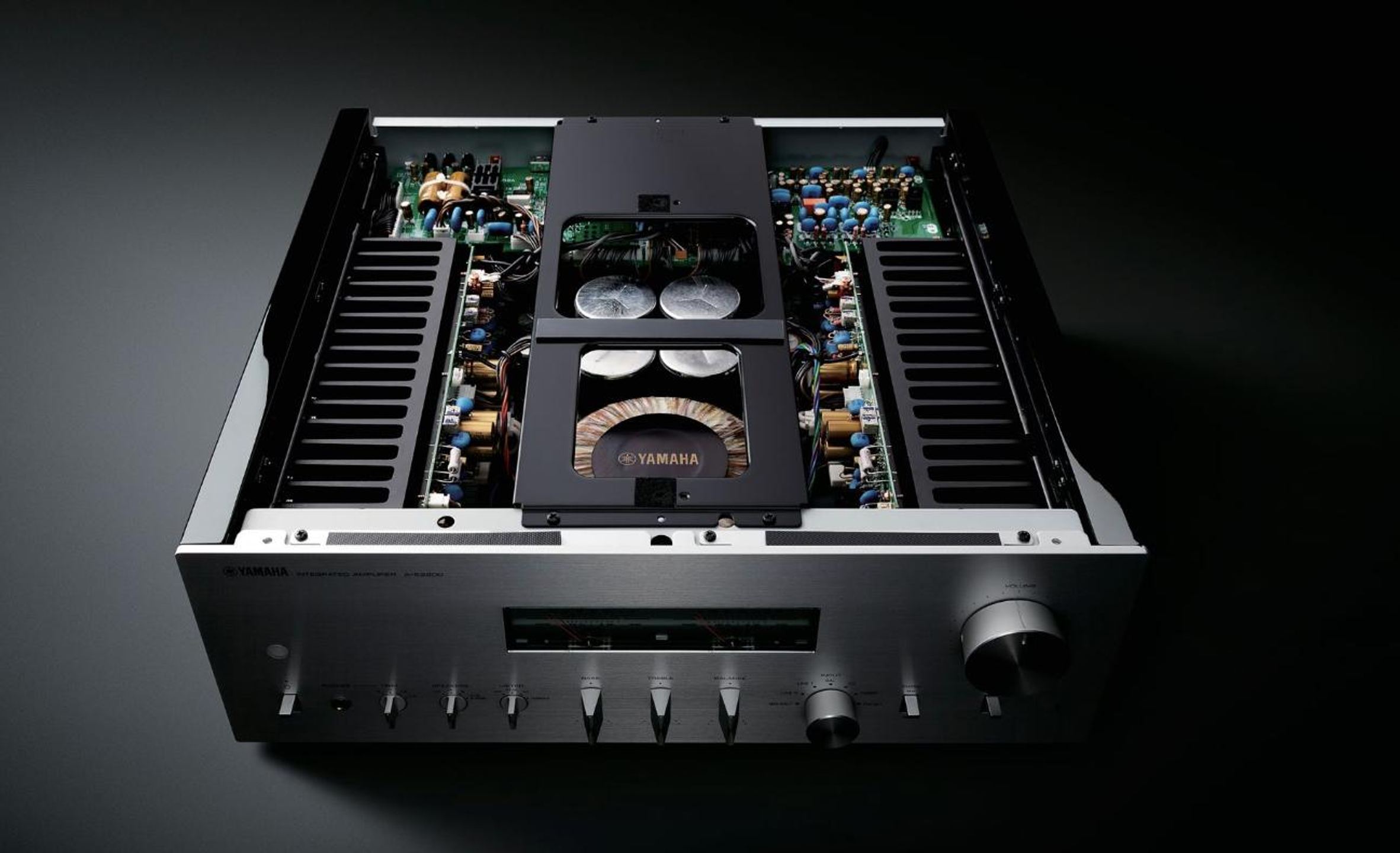
The design philosophy of the Yamaha A-S2200 is based on a core principle called the “Mechanical Ground Concept.” This construction approach aims to create an extremely rigid structure to minimize any unwanted vibration that could alter the audio signal. The high‑power toroidal transformer, the four 22,000 μF filter capacitors, and the large heat sinks are directly bolted to the main chassis. The particularly massive chromed brass feet are soldered directly to the main structure rather than simply screwed on, further reinforcing this pursuit of mechanical integrity.
The external finish reflects special care given to details. The three side panels feature a piano‑black lacquer of remarkable depth, while the brushed aluminum front panel, available in black or silver finish, has a pleasantly smooth texture to the touch. This construction results in a total weight of 22.7 kg, attesting to the density of the internal components and the overall robustness of the unit.
The choice of toroidal transformer deserves special attention. Unlike the E‑core transformer used in the previous A-S2000 model, this topology allows for better energy retention with minimal magnetic flux leakage. The copper wire is drawn directly from the wound core, reducing energy loss compared to conventional solutions. This technical feature translates into an increased ability to maintain musical dynamics, especially during heavily modulated passages.
Electronic architecture: the quest for perfect symmetry
The A-S2200 adopts a fully symmetrical topology from the inputs to the speaker outputs. This differential architecture theoretically cancels common‑mode noise and delivers a particularly favorable signal‑to‑noise ratio. The power amplifier circuits are configured in dual mono, with physical left/right separation around the central power supply, optimizing channel crosstalk.
The internal wiring uses PC‑Triple C wire, a high‑purity copper conductor developed using a continuous forging process that aligns the metal’s crystalline structure. The ground connections use conductors with particularly generous cross‑section, helping maintain low overall impedance throughout the circuit. This attention to signal paths extends all the way to the output terminals, machined from solid brass and able to accept large‑gauge cables, banana plugs, or spades.
The built‑in phono stage deserves special mention. Unlike many current amplifiers that externalize this function or treat it as secondary, Yamaha has developed a fully discrete phono circuit, with a dedicated preamplifier for moving‑coil (MC) cartridges and a separate equalization stage. The input impedance is set to 47 kΩ for MM cartridges and 50 Ω for MC, values that will suit the majority of cartridges on the market, even if some may regret the absence of adjustable impedance matching for MC cartridges.
The VU meters: far more than a simple decorative element
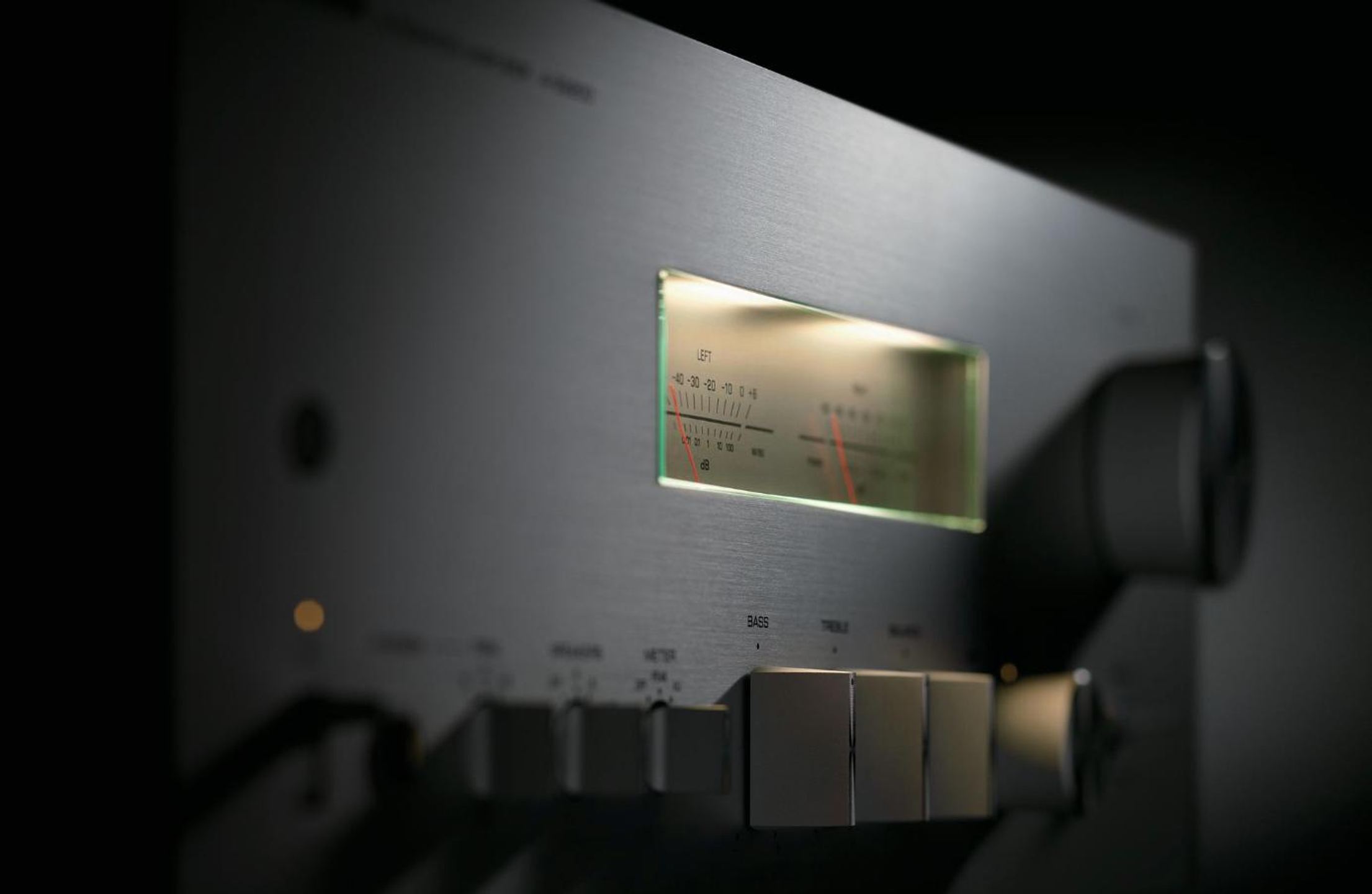
The two large analog VU meters dominating the front panel are not just a nostalgic nod to amplifiers from the 1970s. These measuring instruments, backlit by soft LEDs rather than traditional bulbs, display in real time the power delivered on each channel. Beyond their technical function, they create a visual connection with the music, allowing you to observe the dynamic variations and rhythmic impulses of the audio signal.
The motorized volume control features a particularly refined design detail: when the mute function is activated, the potentiometer physically rotates to reduce the level, providing immediate visual feedback on the system’s status. This attention to ergonomic detail is evident across all controls, from rotary selectors to toggle switches, all designed to offer a precise and reassuring tactile feel.
Connectivity and upgrade options
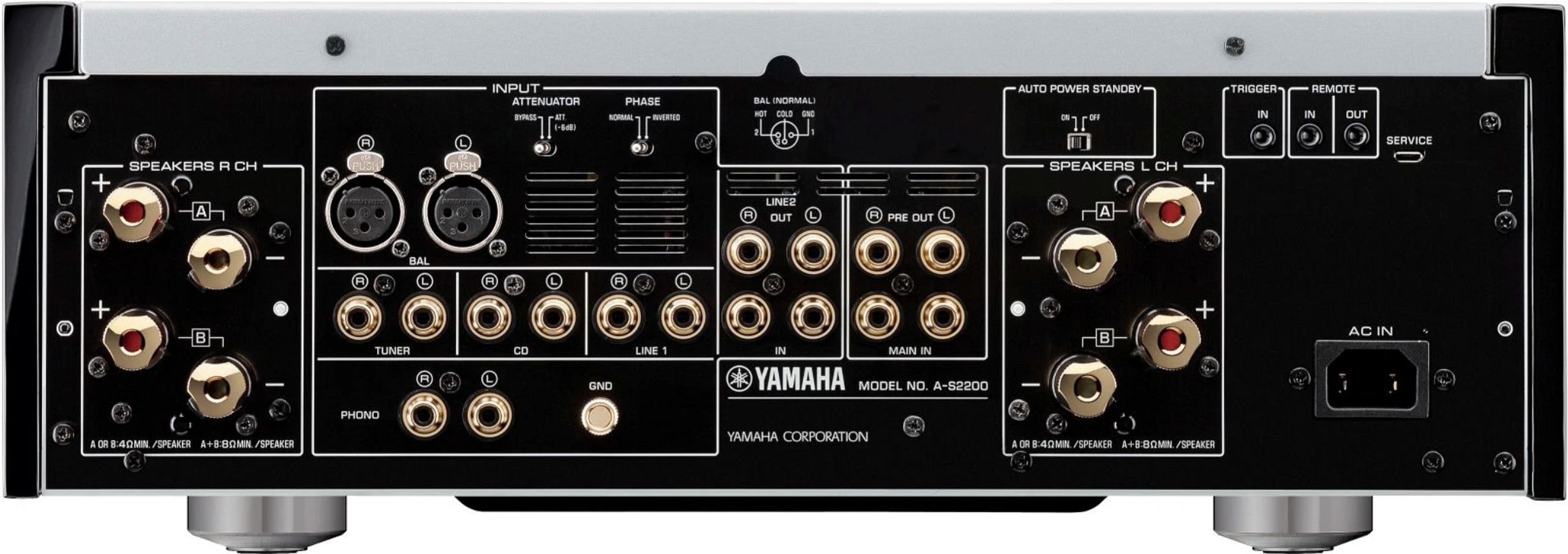
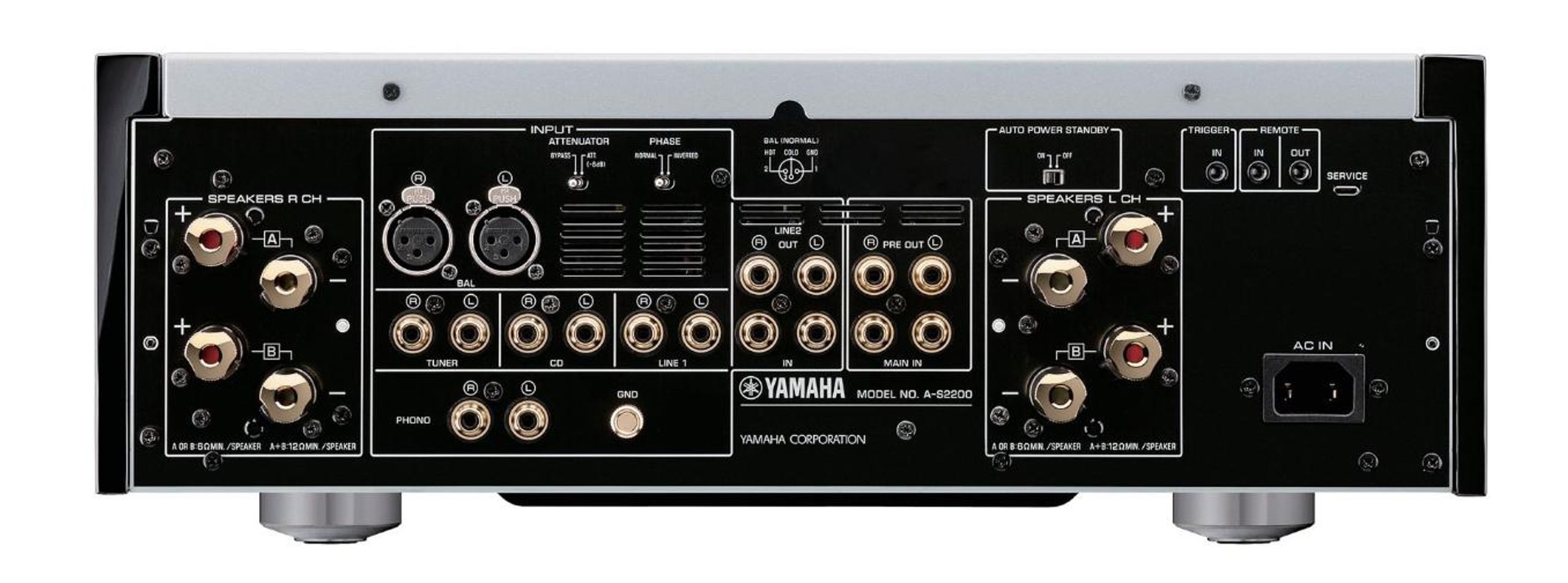
The A-S2200 clearly favors analog, with connectivity dedicated exclusively to non‑digital sources. A balanced XLR input provides optimal connection to high‑end sources, with the ability to invert polarity and adjust attenuation. Five unbalanced RCA inputs complete the offering, including dedicated inputs for a tuner and CD player, as well as a phono input switchable between MM/MC directly from the front panel.
The presence of a “Main In” input turns the unit into a pure power amplifier, bypassing the preamplification stages. This feature offers interesting upgrade paths, allowing the A-S2200 to be integrated into a more complex system with a separate preamplifier. Conversely, the “Pre Out” output allows the addition of an external power amplifier, turning the A-S2200 into a preamplifier.
Tone controls, often absent from modern electronics, are fully embraced here. The bass and treble knobs provide ±9 dB adjustment, with turnover frequencies set at 350 Hz and 3.5 kHz respectively. A switch allows them to be completely disabled for a “direct” signal, preserving signal integrity for purists.
A sonic approach that favors density and space
Technical measurements reveal a frequency response extending from 5 Hz to 100 kHz (±3 dB), with a damping factor greater than 250 at 1 kHz. Dynamic power reaches 220 watts into 2 ohms, suggesting substantial current reserves to handle difficult loads. The 110 dB signal‑to‑noise ratio on the line input attests to the cleanliness of the circuits.
In contrast to the race for digital features that characterizes many contemporary amplifiers, the A-S2200 deliberately opts for analog purity. No built‑in DAC, no streaming, no room‑correction processor: the unit focuses exclusively on amplifying the analog signal. This minimalist approach finds its justification in the quality of playback achieved, particularly with vinyl sources that fully benefit from the care given to the phono stage.
Rated output power (20 Hz to 20 kHz, total harmonic distortion (THD) 0.07% on two channels)
90 W + 90 W at 8 Ω
150 W + 150 W at 4 Ω
Dynamic power
105 W + 105 W at 8 Ω
135 W + 135 W at 6 Ω
190 W + 190 W at 4 Ω
220 W + 220 W at 2 Ω
Audio Performance
Bandwidth (THD 0.1%, 45 W): 10 Hz to 50 kHz at 8 Ω
Damping factor (1 kHz): 250 or more at 8 Ω
Frequency response
5 Hz to 100 kHz +0 / −3 dB
20 Hz to 20 kHz +0 / −0.3 dB
Input Sensitivity and Impedance (1 kHz, 100 W / 8 Ω)
Moving coil (MC) cartridge: 150 μV RMS / 50 Ω
Moving magnet (MM) cartridge: 3.5 mV RMS / 47 kΩ
CD player (or similar source): 200 mV RMS / 47 kΩ
Main input: 1 V RMS / 47 kΩ
Maximum Input Voltage (1 kHz, THD 0.5%)
Moving coil (MC) cartridge: 2.0 mV RMS
Moving magnet (MM) cartridge: 50 mV RMS
CD player (or similar source): 2.80 V RMS
Nominal Output Voltage and Impedance
Line output 2: 200 mV RMS / 1.5 kΩ
Preamp output: 1 V RMS / 1.5 kΩ
Signal-to-Noise Ratio (JEITA, IHF-A network)
Moving coil (MC) cartridge: 90 dB
Moving magnet (MM) cartridge: 96 dB
CD player (or similar source): 110 dB
Tone Controls
Bass
Boost/cut: 50 Hz / ±9 dB
Turnover frequency: 350 Hz
Treble
Boost/cut: 20 kHz / ±9 dB
Turnover frequency: 3.5 kHz
Connectivity
1 XLR analog audio input
3 RCA analog audio inputs
1 phono input
1 line output
1 preamp output
1 main input
1 12V trigger input
1 remote control input/output
1 service port
1 IEC power socket
Physical Characteristics
Power supply: 230 V AC, 50 Hz
Power consumption
In operation: 350 W
In standby: 0.2 W
Dimensions (W × H × D): 435 × 157 × 463 mm
Weight: 22.7 kg
Frequently Asked Questions
What is the main difference between the A-S2200 and the previous A-S2100 model?
+
The major change lies in the adoption of a high‑capacity toroidal transformer, replacing the conventional transformer of the A-S2100. The A-S2200 also features higher‑quality PC‑Triple C internal wiring and more massive chromed brass feet for better mechanical decoupling. These modifications result in sound reproduction with greater control and dynamics, particularly noticeable on fast transients.
Is the lack of digital connections a drawback in 2025?
+
This characteristic splits opinion. For those who favor analog sources (vinyl, tuner) or who already have a high‑quality external DAC, Yamaha’s purist approach ensures an optimized circuit with no compromises. Streaming enthusiasts or users of dematerialized sources will indeed need a separate digital‑to‑analog converter, which can represent a significant additional investment.
Are the rated 90 watts enough to drive demanding speakers?
+
Nominal power tells only part of the story. With 150 watts into 4 ohms and a current capability allowing it to deliver 220 watts into 2 ohms in dynamic conditions, the A-S2200 has substantial reserves. The high‑capacity toroidal transformer and four 22,000 μF capacitors ensure a stable power supply even during complex passages. The vast majority of home speakers, including models known to be difficult to drive, will find a suitable partner here.
How does the built‑in phono stage compare to a separate phono preamplifier?
+
The fully discrete phono circuit of the A-S2200 offers remarkable performance for an integrated stage. With a signal‑to‑noise ratio of 90 dB in MC and 96 dB in MM, it rivals entry‑level standalone phono preamplifiers. The lack of adjustable impedance for MC cartridges (fixed at 50 ohms) may limit optimization with certain specific cartridges, but will be perfectly suitable for the vast majority of setups.
Can the VU meters be turned off for night‑time listening?
+
Yamaha has provided this option. A switch allows you to completely turn off the VU meter backlighting, preserving the atmosphere of listening sessions in the dark. The needles, however, continue to move, allowing you to keep visual control of the power output if needed, even without illumination.
User reviews
Mickael
Very good product, works wonderfully with Klipsch RP8000F. Break-in time should be respected.
Comment from April 18, 2026 — Experience from November 02, 2025
Automatically translated — Show original (French)
Très bon produit, fonctionne à merveille avec des klipsch rp8000f.
Temps de rodage à respecter.
Fabrice
Magnificent, it has everything I was looking for in an amplifier. Only a small downside: since everything is analog, it's impossible to think about controlling it via smartphone.
Comment from April 10, 2025 — Experience from March 30, 2025
Automatically translated — Show original (French)
Magnifique, il a tout ce que je cherchais dans un amplificateur. Seul, petit, bémol: vu que tout est analogique impossible de penser à le commander via smartphone.
David Emanuel
La première fois que j'ai vu ce modèle, je suis tombé amoureux, un design très beau et une qualité sonore excellente !
Eco-contribution of €2.58 included in the sale price.
GTIN / EAN: 4957812653183
Thank you for choosing us
To better understand our visitors, measure marketing effectiveness and personalise ads, we and our partners use cookies and mobile advertising identifiers on your device. This data makes it possible to display personalised and non-personalised ads and measure their performance. Some cookies, which are technically necessary, are exempt from consent. You can accept those that require your consent, refuse them by clicking "Refuse", or customise your choices via the settings screen.
To find out how Google uses the data collected once you have given your consent, see Google’s Business Data Responsibility site.
You can change or withdraw your consent at any time via the "Consent and cookies" link. Your choices will apply on our site for 12 months.