A global reference, What Hifi? is one of the most comprehensive magazines covering Home Cinema and Hifi.
The "5 stars" award distinguishes the highest quality products, according to this British magazine.
Overview
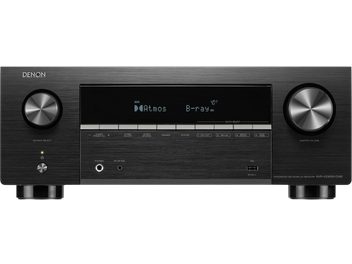
The Denon AVR-X2800H DAB is a 7.2-channel audio-video amplifier that succeeds the AVR-X2700H model. It offers extended HDMI 2.1 connectivity, an updated user interface, and technical adjustments to audio processing. It delivers 95 watts per channel (at 8 ohms, 20 Hz–20 kHz, 0.08% THD, two channels driven) and supports Dolby Atmos and DTS:X formats. The model features a built-in DAB+ tuner as well as the HEOS multiroom platform, enabling compatibility with streaming services and connected sources, including the latest generation consoles.
Controlled Technical Evolution Compared to the Previous Model
The AVR-X2800H builds on the foundation of the AVR-X2700H while introducing targeted improvements that justify its positioning. The most notable difference lies in its HDMI connectivity, now offering three HDMI 2.1 certified inputs compared to just one on the previous model. This upgrade meets the current needs of PlayStation 5 and Xbox Series X consoles, which fully utilize 4K 120 Hz streams.
The user interface has been completely redesigned with a more modern and intuitive full-screen 1080p display. The network module has also been updated, now featuring Bluetooth 5.0 instead of the predecessor’s 4.2 version. These enhancements are accompanied by extended AL32 audio processing for multichannel, promising greater precision in digital signal reproduction.
In terms of amplification, the power output remains the same at 95 watts per channel at 8 ohms, but Denon claims higher current capabilities and a more robust power supply (500W versus 440W). This results in better control of demanding speakers and increased dynamics during complex passages. The unit’s weight, steady at 9.5 kg, reflects careful construction despite the use of plastic materials for the front panel.
Denon Sound Signature and Advanced Audio Technologies
The AVR-X2800H continues Denon’s reputation for sound quality, delivering a performance described as warm, musical, and particularly balanced. Tests highlight a notable improvement over the previous model, with bolder highs that do greater justice to both cinematic soundtracks and music listening. This signature avoids harshness while retaining the punch and dynamics expected from an amplifier in this category.
Soundstage is a remarkable strength, with the amplifier favoring a wide sonic image over extreme pinpointing. This approach is especially beneficial for immersive formats like Dolby Atmos and DTS:X, creating an enveloping sound bubble without artificial projection effects. Dolby Atmos Height and DTS Virtual:X virtualization technologies provide convincing height effects even without dedicated speakers.
The Audyssey MultEQ XT calibration system analyzes the room’s acoustics using the supplied microphone and applies corrections at up to 8 measurement points. While this technology is less advanced than the MultEQ XT32 found in higher-end models, it delivers effective results for optimizing speaker integration. One point to note: default settings can sometimes overly emphasize the midrange, requiring manual adjustment or the purchase of the paid Audyssey MultEQ Editor app for finer control.
Modern Connectivity and Extensive Video Features
The AVR-X2800H’s video section is one of its major strengths, with six HDMI inputs, three of which are 2.1 certified, allowing native handling of 8K 60 Hz and 4K 120 Hz streams. This setup meets the demands of the latest sources while maintaining compatibility with existing devices. The two HDMI outputs include an eARC connection to simplify pairing with compatible TVs.
The amplifier supports all current HDR formats: HDR10, HDR10+, Dolby Vision, and HLG, ensuring optimal compatibility with 4K and 8K content. The 8K upscaling function enhances lower-resolution sources, though the benefit remains limited in the absence of truly mainstream 8K displays.
Gamers will especially appreciate the integrated gaming technologies: VRR (Variable Refresh Rate) to eliminate screen tearing, ALLM (Auto Low Latency Mode) to automatically reduce latency, and QFT (Quick Frame Transport) to optimize smoothness. These features, part of the latest HDMI 2.1 specifications, truly transform the experience with next-gen consoles.
However, the lack of a front HDMI port may be a limitation for users accustomed to temporarily connecting portable sources. This omission is part of the cost optimization typical of this price range.
HEOS Multiroom Ecosystem and Audio Streaming
The integrated HEOS multiroom system turns the AVR-X2800H into the central hub of an extended home audio ecosystem. This platform, shared by Denon and Marantz, allows wireless music streaming to other compatible devices throughout the home. The recently updated HEOS app, featuring a redesigned interface, offers unified control of up to 32 different zones.
Compatibility with major streaming services (Spotify, Tidal, Deezer, Amazon Music HD) makes it easy to access extensive music catalogs. Support for high-resolution formats up to 24-bit/192 kHz and DSD 5.6 MHz satisfies demanding audiophiles. AirPlay 2 and Bluetooth 5.0 protocols round out the wireless streaming options, enabling seamless integration with Apple and Android devices.
Integration with voice assistants (Alexa, Google Assistant, Siri) greatly simplifies daily use. You can control playback, adjust volume, or change sources with simple voice commands, transforming the user experience. This modern convenience contrasts with the sometimes technical approach of traditional home theater amplifiers.
The built-in DAB+ tuner deserves special mention, as it remains relatively rare in this price range. This feature provides access to digital radio stations with higher quality than traditional FM, significantly enriching the available content offering.
What the press says
The AVR-X2800H raises the bar with more HDMI 2.1 inputs, a new user-friendly interface, and most importantly, more responsive, cohesive, and spacious sound. It retains the authoritative weight of Denon's signature, but refines and balances it with a bolder top end that can better do justice to both music and movies.
Automatically translated — Show original (French)
L'AVR-X2800H fait monter les enchères avec plus d'entrées HDMI 2.1, une nouvelle interface conviviale et, surtout, un son plus réactif, cohérent et spacieux. Il conserve le poids autoritaire de la signature de Denon, mais l'affine et l'équilibre avec une extrémité supérieure plus audacieuse qui peut mieux rendre justice à la fois à la musique et aux films.
What are the main differences between the AVR-X2800H and its predecessor, the AVR-X2700H?
+
The main improvements concern HDMI connectivity, with three 2.1 inputs instead of just one, allowing better use of next-gen consoles and 8K sources. The user interface has been completely redesigned with a more modern 1080p display. The network module has been upgraded with Bluetooth 5.0, and AL32 audio processing now extends to multichannel. Sonically, the X2800H delivers a more balanced sound with better-controlled highs. The trade-off is a launch price about €150 higher.
How does the Audyssey calibration system work, and is it really effective?
+
Audyssey MultEQ XT analyzes your room’s acoustics using the supplied microphone, placed in up to 8 different positions. The system automatically detects connected speakers, checks their polarity, calculates optimal distances and levels, and then applies frequency correction. The results are generally convincing, especially for integrating the subwoofer. However, be aware that default settings can sometimes overly emphasize the midrange—manual adjustment or the paid MultEQ Editor app may be necessary for optimal results.
Can the amplifier really power 7 speakers at full power simultaneously?
+
No, and that’s normal for this product category. The stated 95W power is measured with two channels driven. When all seven channels are used simultaneously, the available power per channel decreases proportionally, limited by the 500W power supply. This is consistent with typical use: compact home theater speaker packs and bookshelf speakers for which this amplifier is designed. For large floorstanding speakers, higher-end X series models offer more generous power supplies.
Can the amplifier be used without an Internet connection, and what features are lost?
+
The AVR-X2800H works perfectly offline for all traditional uses: decoding Dolby/DTS formats, Audyssey calibration, managing HDMI and analog sources. You only lose access to online streaming services (Spotify, Tidal, etc.), automatic firmware updates, control via the HEOS app, and voice assistant integration. The DAB+ tuner and Bluetooth connectivity remain operational. This autonomy protects your investment even if your home network ecosystem changes.
What are the main limitations of this amplifier?
+
The main limitations are the absence of a front HDMI port for temporary connections, the plastic front panel design which may not suit all environments, and limited power when all channels are driven simultaneously. Audyssey MultEQ XT, while effective, is less sophisticated than the XT32 found in higher-end models. The placement of the transformer under the HDMI board raises questions about long-term reliability. Finally, the advanced Audyssey app is paid, unlike some competitors who offer free calibration tools.
Is the gaming connectivity really up to the standards of next-gen consoles?
+
Absolutely. The three HDMI 2.1 inputs natively handle 4K 120 Hz streams from PlayStation 5 and Xbox Series X, with full support for VRR (Variable Refresh Rate), ALLM (Auto Low Latency Mode), and QFT (Quick Frame Transport) technologies. These features eliminate screen tearing, reduce latency, and optimize display smoothness. The amplifier automatically switches to low latency mode based on detected content. This gaming compatibility significantly extends its use beyond just movie watching, meeting the contemporary demands of home entertainment.
To better understand our visitors, measure marketing effectiveness and personalise ads, we and our partners use cookies and mobile advertising identifiers on your device. This data makes it possible to display personalised and non-personalised ads and measure their performance. Some cookies, which are technically necessary, are exempt from consent. You can accept those that require your consent, refuse them by clicking "Refuse", or customise your choices via the settings screen.
To find out how Google uses the data collected once you have given your consent, see Google’s Business Data Responsibility site.
You can change or withdraw your consent at any time via the "Consent and cookies" link. Your choices will apply on our site for 12 months.