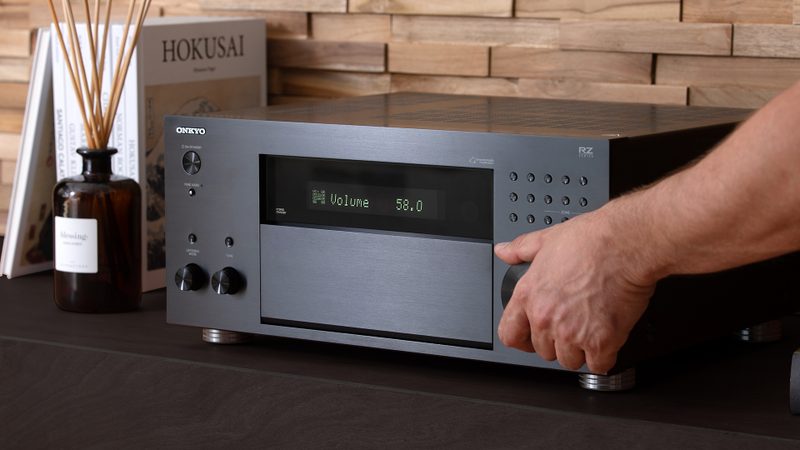
Nine amplification channels, built-in Dirac Live room correction at no extra cost, and connectivity ready for 8K and 120 Hz gaming: the TX-NR7100 brings together in a single chassis features usually reserved for higher-end models. THX Select certified and compatible with object-based audio formats, this AV receiver lets you build a 5.1.4 or 7.1.2 system without external amplification.
An amplification section worthy of large systems
The TX-NR7100 houses nine amplification stages capable of delivering 100 W per channel into 8 ohms in hi-fi conditions, and up to 250 W peak into 3 ohms. This power reserve makes it easy to drive 5.2.4 setups with four in-ceiling speakers or height speakers, or 7.2.2 setups with rear surround speakers. THX Select certification, which requires thousands of tests throughout the processing chain, guarantees faithful reproduction of the source material in rooms up to around 55 m³.
Onkyo’s “Dynamic Audio Amplification” philosophy is reflected in the circuit architecture: TI PCM1690 32-bit DACs feed the main section (7.1 channels) with a dynamic range of 113 dB, while the proprietary VLSC (Vector Linear Shaping Circuitry) technology comes into play after conversion to smooth the signal and eliminate residual impulse noise. The bandwidth extends from 10 Hz to 100 kHz, putting the amp in an ideal position for playing high-resolution files up to 192 kHz / 24-bit and DSD 5.6 MHz.
Dirac Live and AccuEQ: two approaches to room correction
The TX-NR7100 stands out thanks to the native integration of Dirac Live in its full-band version, covering the entire spectrum from 20 Hz to 20 kHz. This Swedish technology analyzes the room’s acoustics from several listening positions and corrects both the frequency response and time alignment of the speakers. Calibration is carried out via the Onkyo Controller app on a smartphone or via the Dirac Live software on a computer for more fine-tuned adjustment, with the option to manually tweak target curves.
The in-house AccuEQ alternative remains available for those who prefer a quicker setup. This built-in system measures up to nine positions and applies automatic correction, often resulting in more pronounced bass. The two systems cannot be used simultaneously: you choose one during configuration. Comparative tests show that Dirac Live generally offers a more coherent soundstage and better three-dimensional imaging, while AccuEQ focuses on bass impact.
HDMI 2.1 and gaming: ready for current consoles
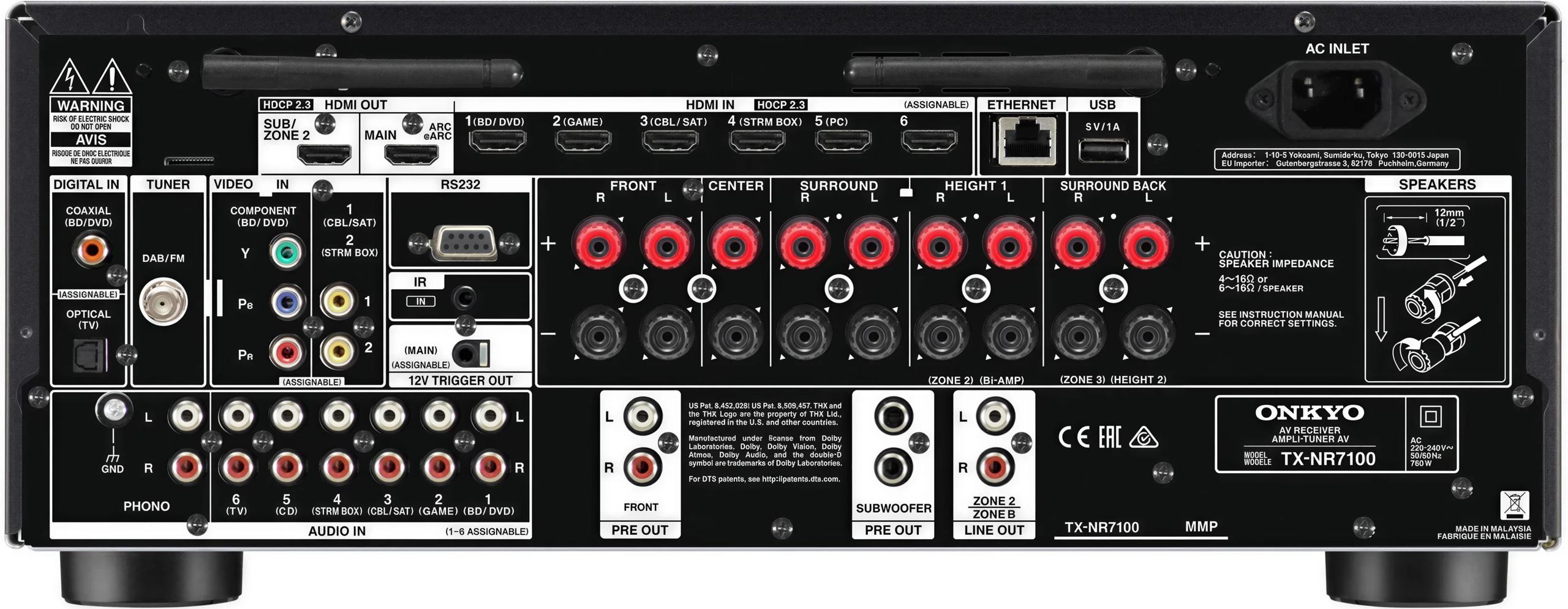
The video section is built around seven HDMI inputs, including one on the front, and two outputs. The first three rear inputs (1 to 3) support a 40 Gbps bandwidth, allowing 8K 60 Hz or 4K 120 Hz signals to pass through without compression. Inputs 4 to 6 are limited to 24 Gbps, sufficient for 4K/120 with DSC compression. The front input remains HDMI 2.0 and is limited to 4K/60.
All HDMI 2.1 gaming features are present: VRR (Variable Refresh Rate) synchronizes the display with the source frame rate to prevent stuttering, ALLM (Auto Low Latency Mode) automatically switches the TV to game mode, and QFT (Quick Frame Transport) reduces display latency. HDR support covers HDR10+, Dolby Vision, HDR10 and HLG. The main HDMI output includes eARC to retrieve uncompressed audio streams from TV apps, while the second output can feed a zone 2 in 4K/60.
Audio formats and listening modes
Native decoding includes Dolby Atmos and DTS:X for object-based soundtracks, with their respective upmixers (Dolby Surround and DTS Neural:X) to spatialize stereo or traditional 5.1 content. IMAX Enhanced certification ensures optimized handling of films mastered to this standard. The four THX modes (Cinema, Music, Games, Surround EX) apply specific processing validated by THX engineers.
For setups without height speakers, Dolby Atmos Height Virtualizer simulates a vertical dimension from a conventional system. Theater Dimensional mode, for its part, attempts to create a surround effect with only two or three front speakers. A partnership with Klipsch has also resulted in Klipsch Optimize mode, which automatically applies crossover settings tailored to the brand’s Reference and Reference Premiere speakers.
Comprehensive connectivity for varied sources
Beyond HDMI, the TX-NR7100 accommodates analog sources via six stereo RCA inputs and an MM phono input for turntables. Digital sources can use two optical and two coaxial inputs. Dual-band Wi‑Fi, Ethernet and aptX HD Bluetooth (transmit and receive) round out the connectivity options.
Network integration provides access to streaming services Spotify, Tidal, Deezer, TuneIn and Pandora directly from the receiver. AirPlay 2 compatibility lets you stream from Apple devices and integrate the amp into a multiroom system. Chromecast built-in and DTS Play-Fi further extend the options. “Works with Sonos” certification allows control via the Sonos app when the receiver is paired with a Sonos Port, with volume and input selection management.
Alexa and Google Assistant voice assistants are supported via compatible external devices. Three zones can operate simultaneously: the main zone, a zone 2 with audio and video, and a zone 3 limited to audio. The speaker terminals accept impedances from 4 to 16 ohms. Two subwoofer outputs are available, but they are treated as a single channel (no independent management).
Ergonomics and build
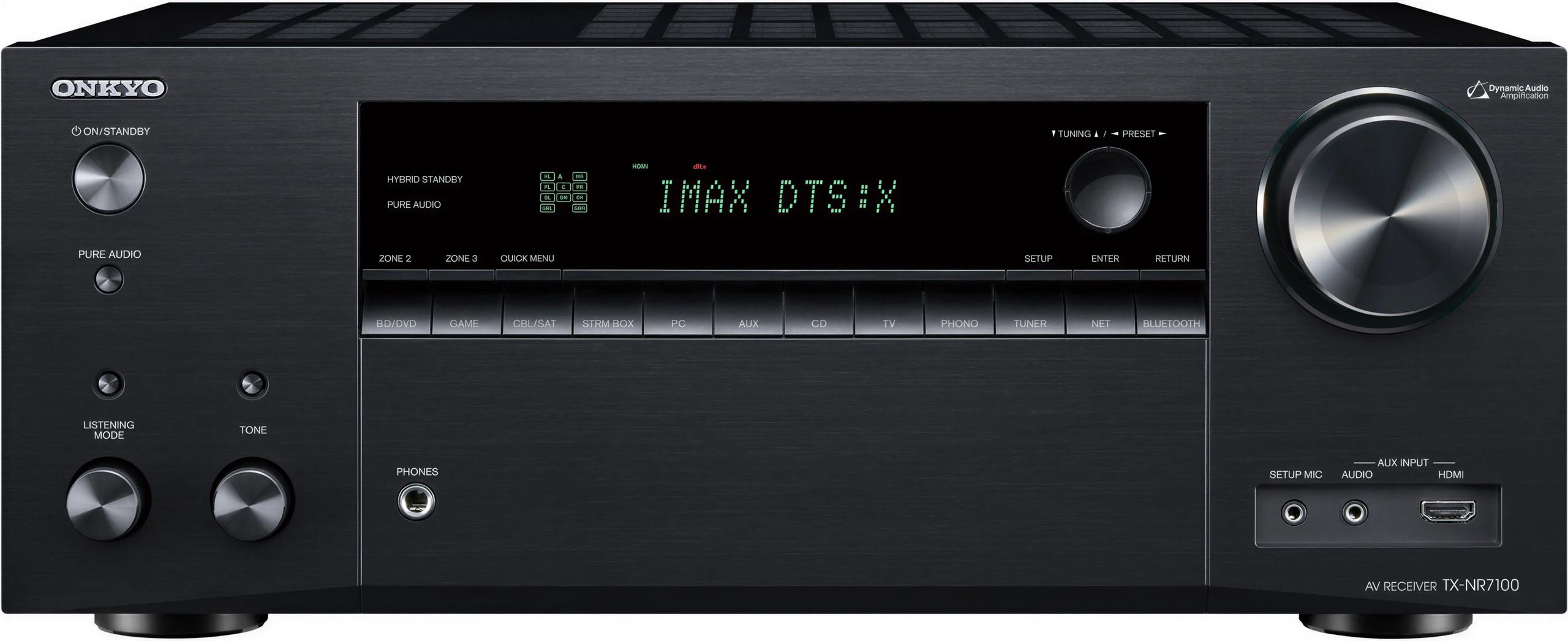
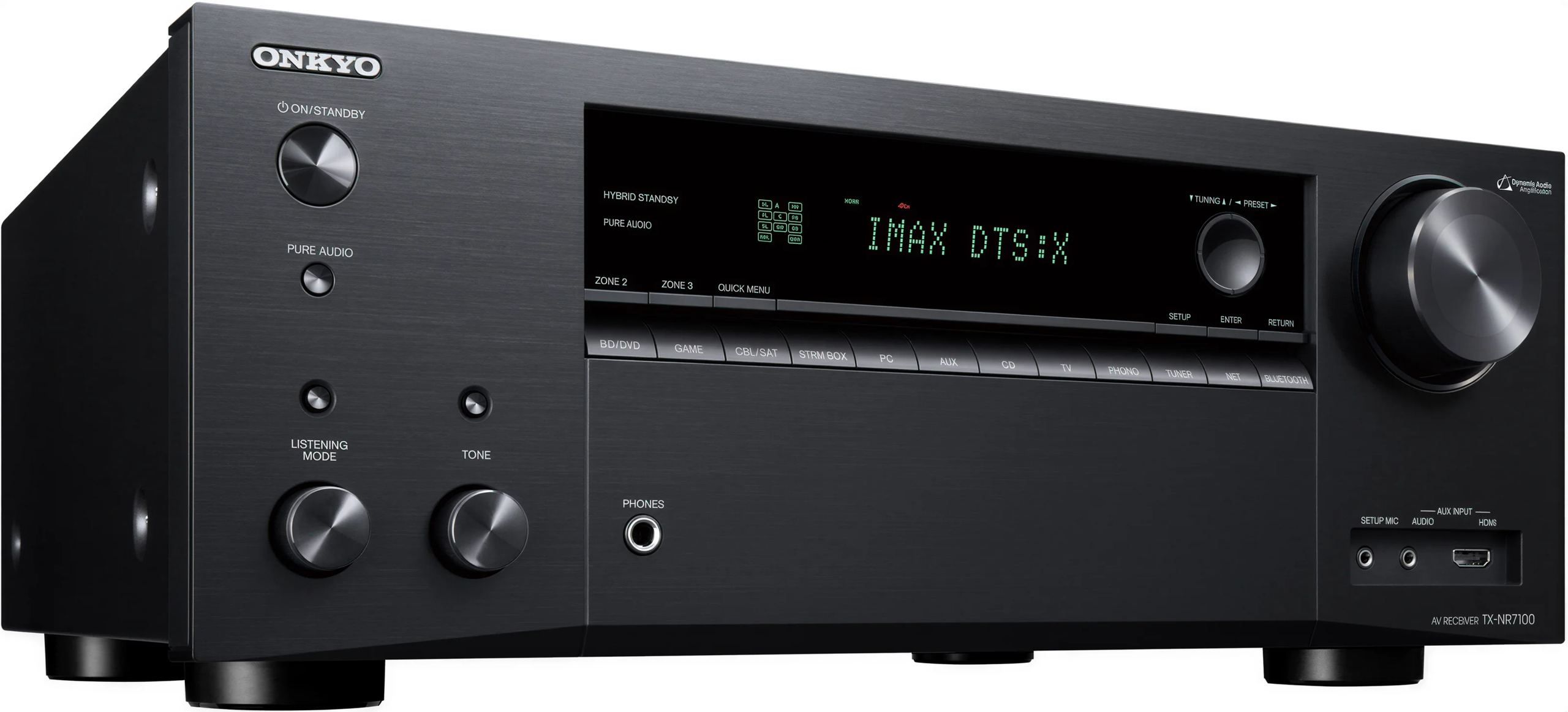
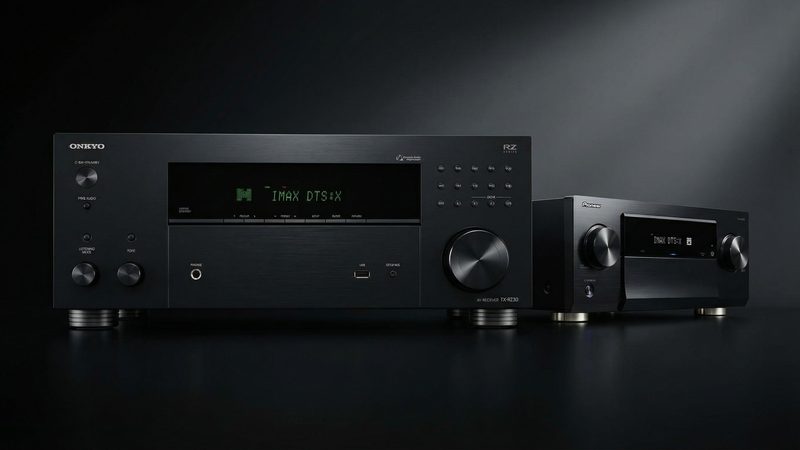
The TX-NR7100’s design follows the established NR series codes: a sober black front with a large green fluorescent display, three rotary knobs (volume, sound mode, tone), and a row of buttons for direct source selection. The removal of the flip-down panel found on older models frees up space and simplifies access to the front HDMI socket, the mini-jack audio input and the 6.35 mm headphone output.
Inside, the layout remains classic with the power transformer on the left and the amplification stages on the right, flanked by two filter capacitors. An internal fan may kick in under heavy load, but remains inaudible in most usage conditions. The metal chassis is lighter than on the higher-end RZ series models, and the speaker terminals use screw connectors instead of widely spaced banana posts.
The supplied remote control is compact, with white markings on a black background, but does not have backlighting. The Onkyo Controller smartphone app offers a more comfortable alternative for menu navigation and Dirac Live calibration. The on-screen menus (OSD) displayed on the TV are comprehensive and allow access to all settings.
A clearly assumed mid-range positioning
Within the Onkyo lineup, the TX-NR7100 sits at the top of the NR series, just below the RZ models with their more upmarket design and more robust construction. It shares much of its digital platform with the TX-RZ50, including the same TI Aureus and Cirrus Logic DSPs for audio processing. The difference lies in the finish, the power supply section, and the absence of full pre-outs for external amplification (available only for the main channels and subwoofers on the NR7100).
Pure Direct mode bypasses DSP processing for more direct listening, while ECO mode reduces power consumption. Bi-amping the front speakers is possible by reassiging the rear surround channels. Speaker distance settings are adjusted in 3 cm steps, a precision considered sufficient for most installations but less fine than the 1 cm increments offered by some competitors.
Does the included Dirac Live cover all frequencies or just the bass?
+
The Dirac Live license built into the TX-NR7100 is a full-band version, able to correct the spectrum from 20 Hz to 20 kHz. Some competing receivers only offer a version limited to low frequencies (usually up to 500 Hz) and charge extra for an upgrade. This full inclusion is a notable advantage at this price point.
Can the AccuEQ and Dirac Live calibration systems be used at the same time?
+
No, the two systems are mutually exclusive. Running calibration with one overwrites the settings of the other. You must choose between AccuEQ, integrated into the receiver menus and simpler to set up, or Dirac Live, which is more precise but requires the use of the mobile app or computer software.
Can the TX-NR7100 stream to multiple rooms simultaneously?
+
The receiver manages up to three zones: the main zone with all channels, a zone 2 with audio and video (up to 4K/60), and a zone 3 with audio only. Zones 2 and 3 can use reassigned surround channels or dedicated line outputs. With three Sonos Ports, each zone can play a different stream.
Do all HDMI inputs support 4K/120 Hz for gaming?
+
All rear HDMI inputs (1 to 6) accept 4K/120 Hz, but only inputs 1 to 3 offer 40 Gbps bandwidth for this mode without compression. Inputs 4 to 6 use DSC compression to achieve 4K/120. In practice, with current consoles like the Xbox Series X or PS5, all six inputs work at 4K/120 Hz.
User reviews
Review highlights
Customers are almost unanimously enthusiastic and recommend this home theater receiver, which they consider excellent.
Several buyers praise the sound quality, describing a very cinematic experience with films, especially action films.
Its power is impressive, with plenty of headroom even at high volume in a dedicated room.
Speaker setup and calibration are described as simple, with guidance from the assistant or app.
Several customers, including some switching from a Yamaha or Sony, see it as a clear improvement.
Based on reviews from customers who purchased this product, summarised by AI
Firmino
The product arrived after just three days, which is unbelievable. I installed it in place of the Yamaha 675. After setting it up, the Onkyo 7100 AV receiver surprised me and works wonderfully. Very powerful and with many strengths, both in terms of inputs and outputs and sound quality. A product I highly recommend.
Comment from September 07, 2026 — Experience from August 27, 2026
Automatically translated — Show original (Italian)
Il prodotto è arrivato dopo solamente tre giorni, una cosa da non credere. L'ho installato al posto del Yamaha 675 . Il sintoamplificatote onkyo 7100 dopo la messa in funzione mi ha stupito e va che è una meraviglia. Molto potente e con tanti pregi sia dal punto di vista delle entrate e uscite sia dalla timbrica del suono. Un prodotto da me consigliatissimo.
Mirko
Good morning, fully satisfied with the switch to an Onkyo TX -NR7100; it has been a significant upgrade compared to the previous system, without taking anything away from the intrinsic quality of the product itself; Through the app, the amplifier's plug-and-play approach is made easier, making the initial installation task straightforward; The strong point is the transition to professional adjustments, which however require more attention and time; Calibration with Dirac Live is an essential strength; it manages to maximize and significantly improve listening in the room. In fact, it has revived the acoustics and harmony of the existing, dated speakers, renewing the desire and enthusiasm to watch films and listen to music while fully perceiving the subtle nuances, often overwhelmed by reverberation and room imperfections! Excellent product; I thank HOMECINE SOLUTIONS for their professionalism and the attention received; I consider them a serious and professional company! Excellent experience!
Comment from August 28, 2026 — Experience from August 17, 2026
Automatically translated — Show original (Italian)
Buongiorno, soddisfatto a pieno per il passaggio ad un Onkyo TX -NR7100, è stato un upgrade notevole rispetto al precedente sistema, questo non toglie però la qualità intrinseca del prodotto stesso;
Tramite app viene facilitato l'approccio plug and play dell'amplificatore, rendendo leggero il compito di prima installazione; Il punto di forza è il passaggio a regolazioni pro che richiedono però più attenzioni e tempo;
La calibrazione con il Dirac Live è un punto di forza essenziale, riesce a massimizzare e migliorare notevolmente l'ascolto ambientale, di fatto ha resuscitato l'acustica e l'armonia dei diffusori esistenti e datati, rinnovando la voglia e l'entusiasmo di guardare film ed ascoltare musica percependo fino in fondo le micro sfumature, spesso sovrastate da riverberi e difetti ambientali!
Ottimo prodotto;
Ringrazio la professionalità e le attenzioni ricevute da HOMECINE SOLUTIONS che ritengo un'azienda seria e professionale!
Ottima esperienza!
Jean claude
Seems to be good quality, but I chose the Onkyo brand for its reputation and the good compatibility with my Klipsch speakers And also for the free version of Dirac Live, and here I’m a bit more mixed; I was used to calibration on Denon or Pioneer, but it’s nothing like it—you really have to master the sound, so I test test test test test........??.
Comment from August 12, 2026 — Experience from July 30, 2026
Automatically translated — Show original (French)
Semble de bonne qualité mais j’ai choisi la marque onkyo pour sa réputation et la bonne prise en charge avec mes enceintes klipsch
Et également pour la version de dirac live gratuite et la je suis un peu plus mitigé j’avais l'habitude des calibration sur denon ou pioneer mais rien à voir il faut vraiment maîtrisé le son alors je test test test test test........??.
To better understand our visitors, measure marketing effectiveness and personalise ads, we and our partners use cookies and mobile advertising identifiers on your device. This data makes it possible to display personalised and non-personalised ads and measure their performance. Some cookies, which are technically necessary, are exempt from consent. You can accept those that require your consent, refuse them by clicking "Refuse", or customise your choices via the settings screen.
To find out how Google uses the data collected once you have given your consent, see Google’s Business Data Responsibility site (opens in a new window).
You can change or withdraw your consent at any time via the "Consent and cookies" link. Your choices will apply on our site for 12 months.