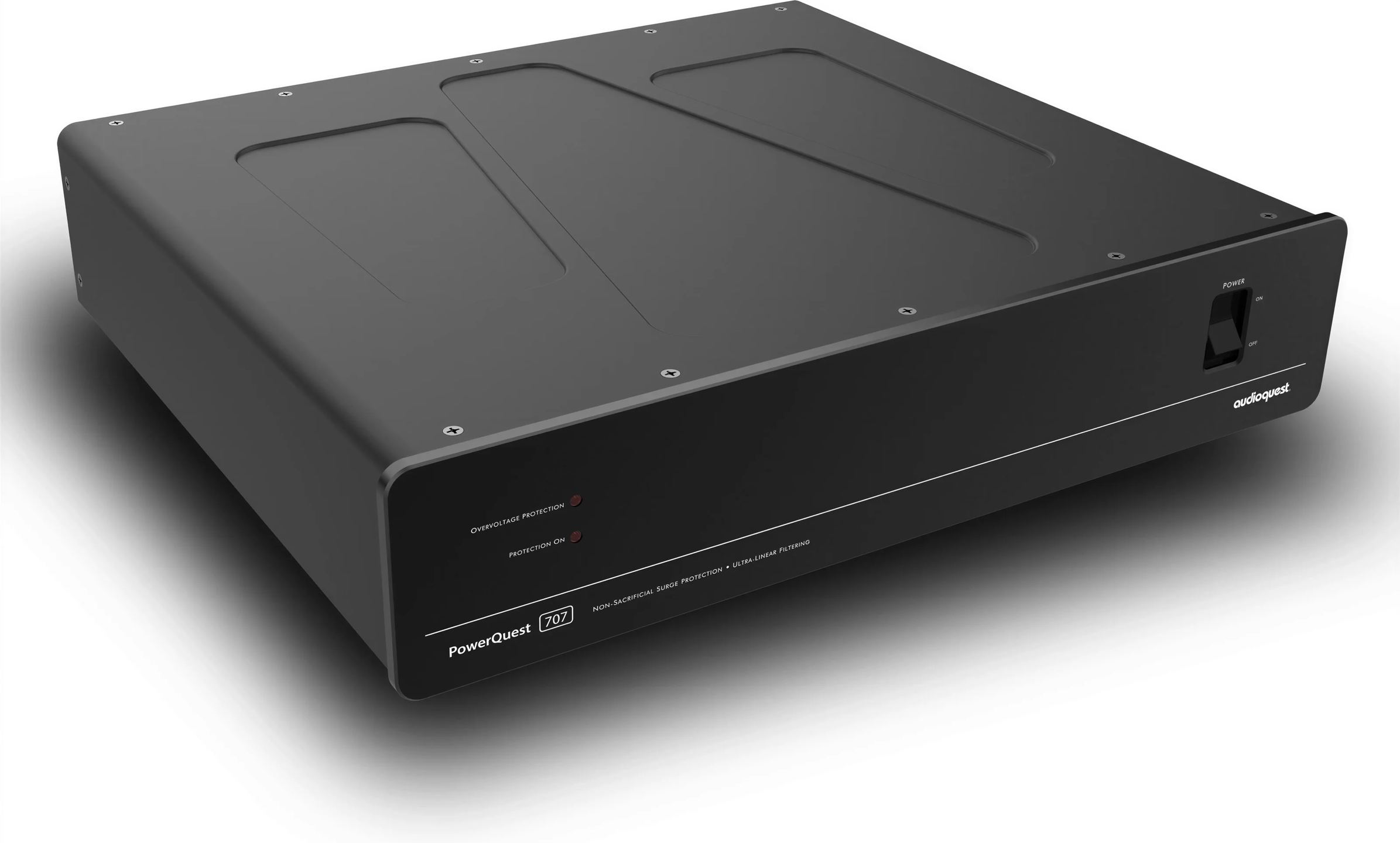
The PowerQuest 707 is the most advanced model in AudioQuest’s PowerQuest range. This power conditioner is designed for demanding hi-fi and home theater systems. It offers twelve outlets distributed according to the needs of different types of devices, a transient power correction capacity of 45 amps, as well as a PQ-715 power cable supplied by the manufacturer. The whole package aims to ensure stable power distribution tailored to audio and video equipment.
A technical design engineered for absolute versatility
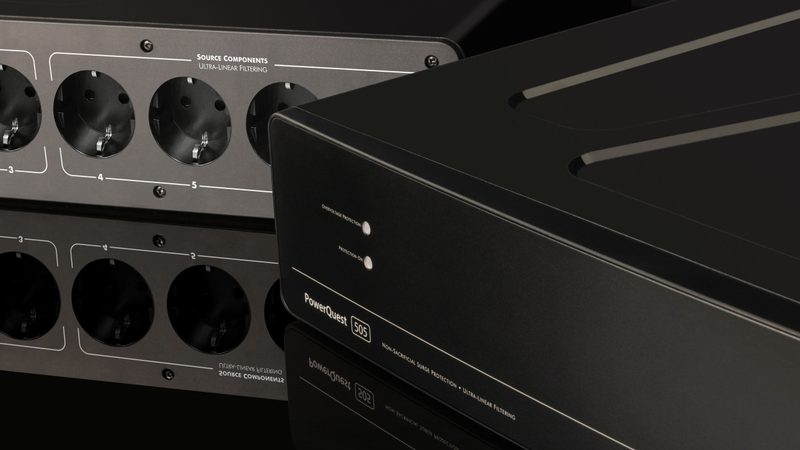
The PowerQuest 707 adopts a robust 2U metal chassis, designed to integrate perfectly into professional racks thanks to the included mounting brackets. This 7.6 kg construction reflects substantial internal engineering, far removed from simple overpriced power strips. The front panel features discreet yet informative LED indicators: a green LED confirms normal operation while a red LED signals activation of surge protection.
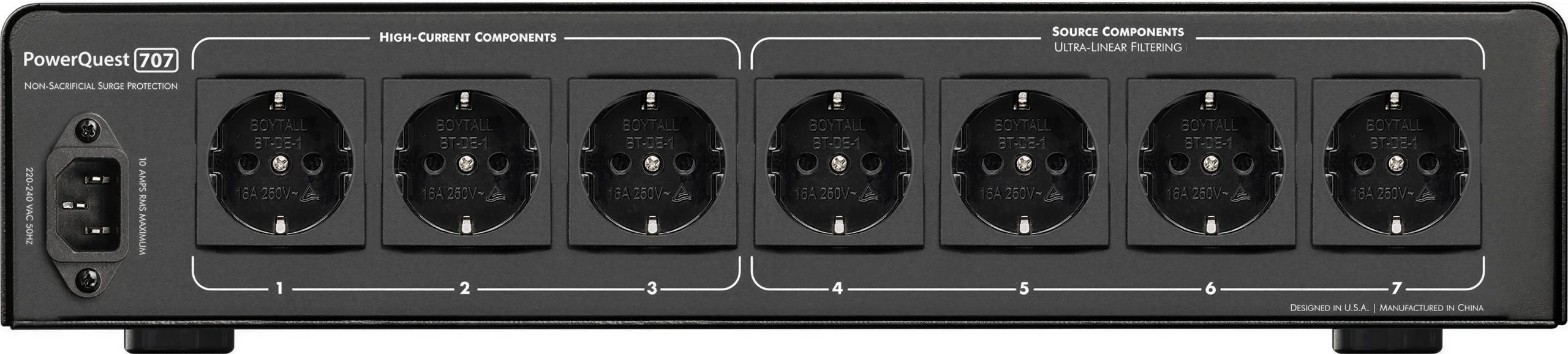
The rear layout reveals a meticulous organization of the 7 AC outlets. The three high-current outputs are specifically designed for power amplifiers and subwoofers, while four linearly filtered outputs accommodate source components. This separation is not cosmetic: each bank of outlets benefits from dedicated electrical isolation, minimizing parasitic interactions between devices.
The ultra-linear noise dissipation system operates across a particularly wide spectral range. The PowerQuest 707 provides more than -22 dB of noise attenuation with differential-mode filtering between 30 kHz and 1 GHz and common-mode filtering between 30 kHz and 100 MHz. This bi-modal approach effectively addresses asymmetric disturbances present on the power grid as well as symmetric interferences picked up from the environment.
Transient power correction: the 707’s trump card
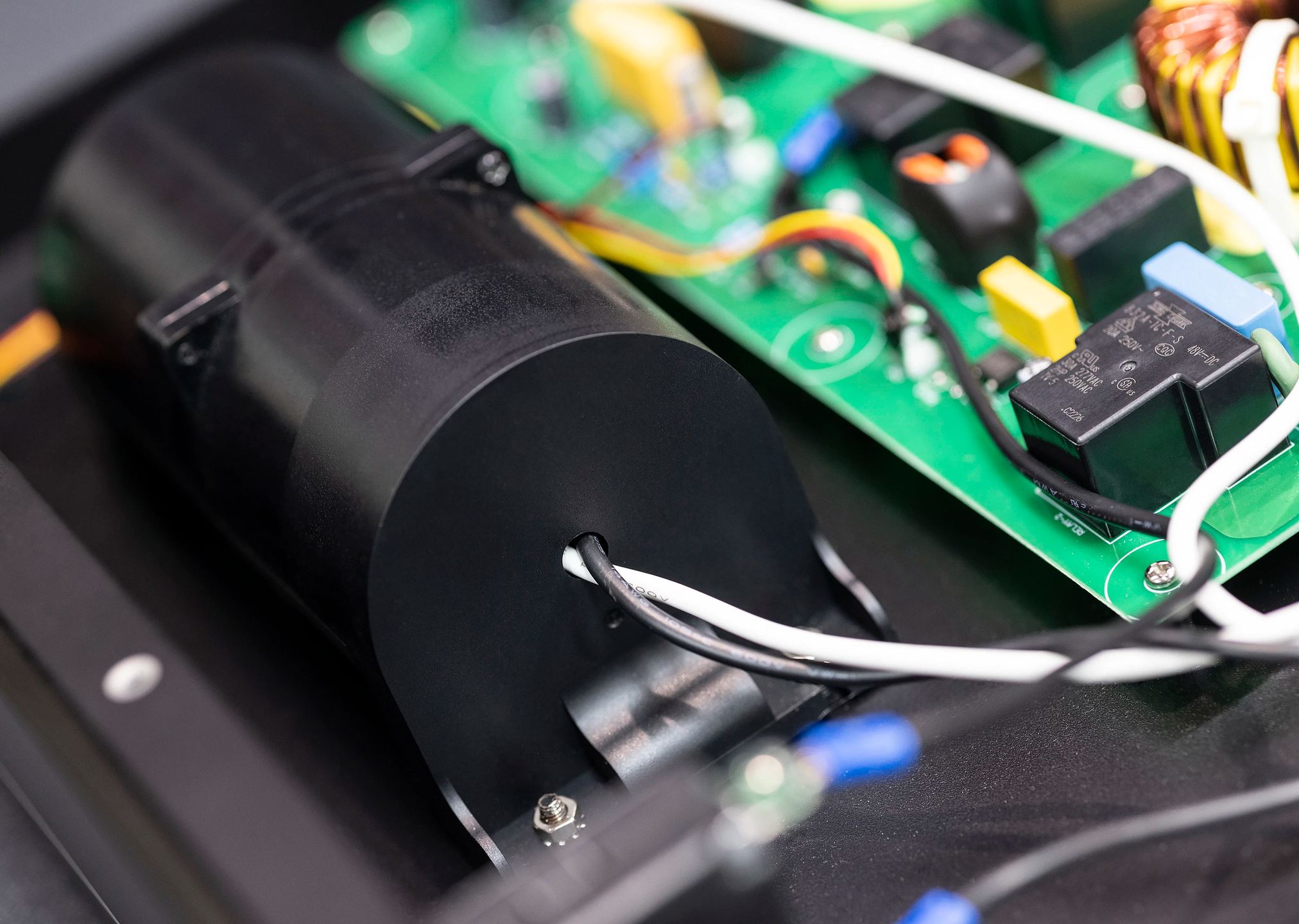
The major differentiating element of the PowerQuest 707 lies in its transient power correction technology. AudioQuest states that this function provides a current reservoir delivering up to 45 amps of peak power on demand to any amplifier (for up to 25 ms). This system works like an instant energy reserve, allowing amplifiers to handle the most demanding dynamic passages without compression or sluggishness.
Unlike the Niagara 1200 offered at the same price, the PowerQuest provides this transient power correction, which the Niagara does not include. This technical feature positions the 707 as particularly suitable for systems that include power-hungry amplifiers or active subwoofers requiring significant current reserves during musical transients.
The implemented technology maintains an extremely low output impedance on the high-current outlets, ensuring connected amplifiers can draw the required current instantly without restriction. This technical approach results in a more faithful rendering of dynamic contrasts and better control of the low-frequency range.
Surge protection: a non-sacrificial philosophy
The PowerQuest 707 uses AudioQuest’s non-sacrificial surge protection technology, capable of withstanding repeated input surge tests of 6000 V/3000 A. This approach differs radically from conventional surge protectors whose protective components degrade after each surge event.
The automatic over-voltage shutdown system provides additional safety. The automatic shutdown function triggers at 140 VAC, opening the main power relay in 0.25 seconds, then automatically resets when the power stabilizes. This intelligent protection safeguards connected equipment from dangerous fluctuations on the power grid while avoiding unnecessary interruptions.
The PQ-715 cable: far more than an accessory
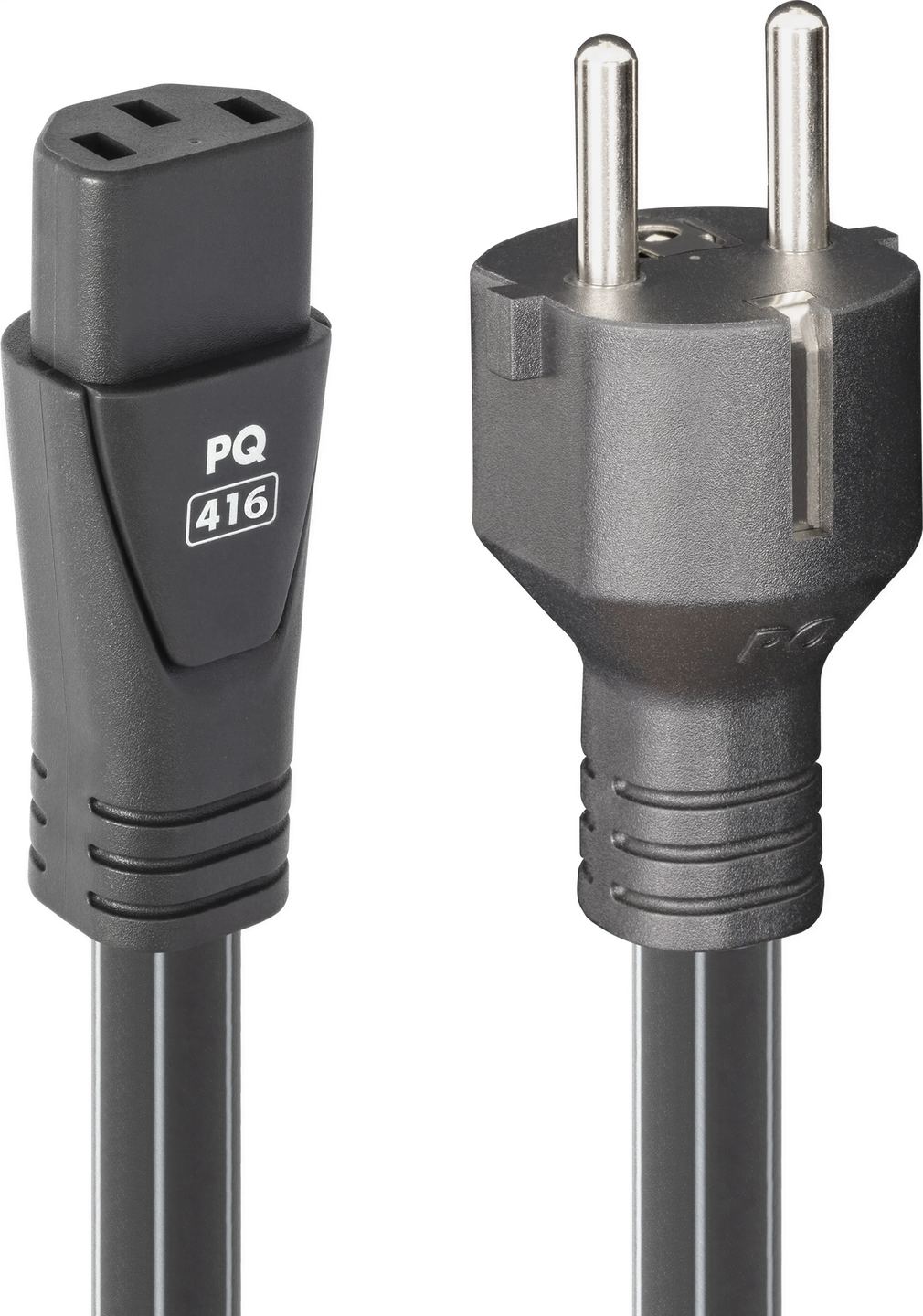
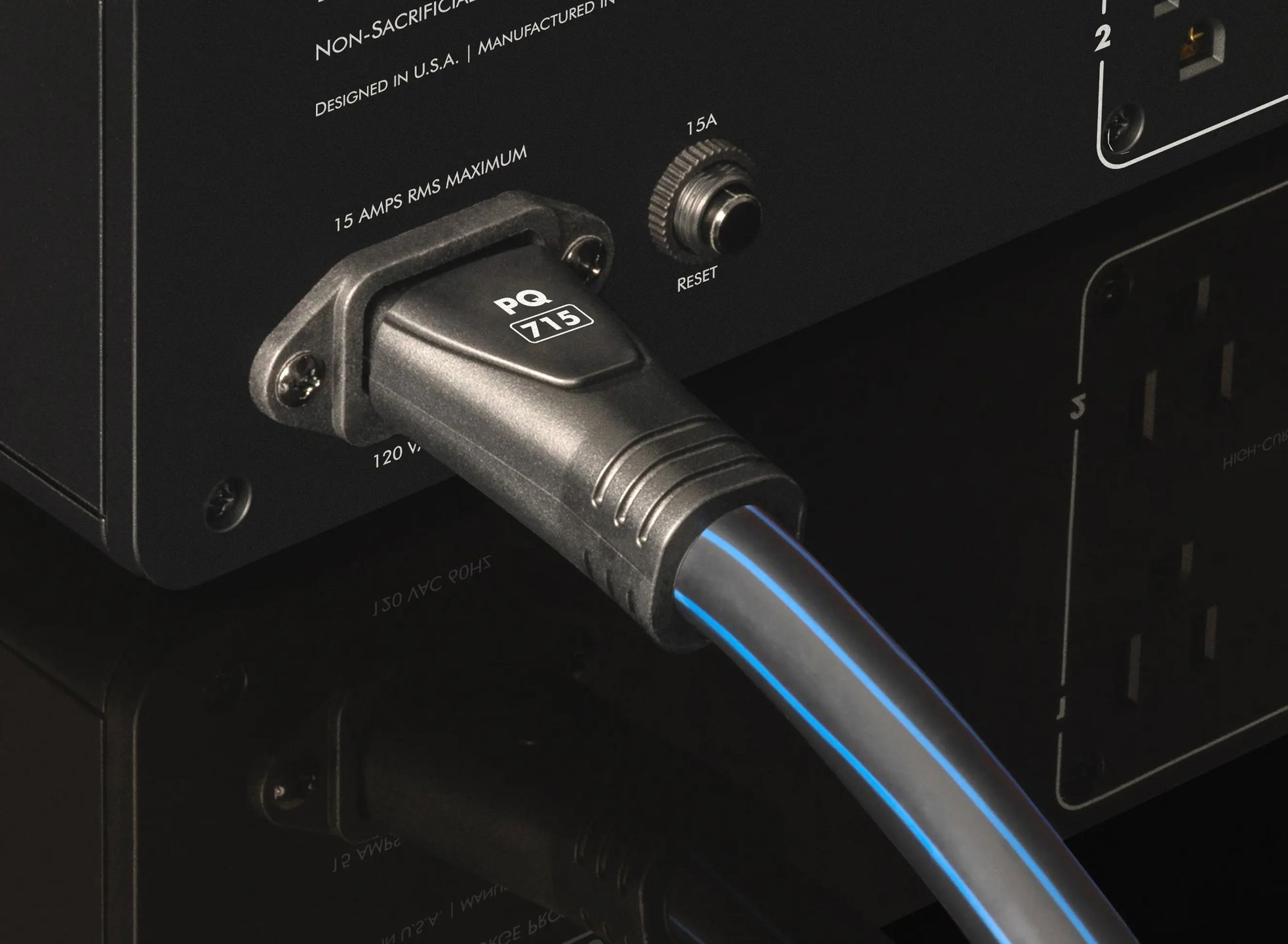
AudioQuest supplies the PowerQuest 707 with its two-meter PQ-715 power cable, a technical component in its own right. This cable uses semi-solid long-grain copper conductors and incorporates the brand’s ZERO and RF/ND technologies. The 45-degree flat mains plug makes installation easier in tight spaces behind furniture or in racks.
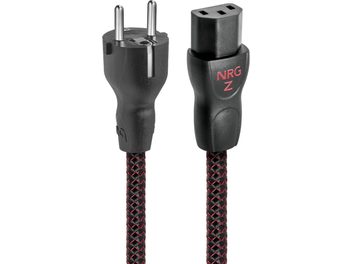
The NRG-Z3 introduced a higher dynamic range and better contrast in comparative tests with other cables in the range, suggesting that the included PQ-715 already provides a solid foundation for optimizing the conditioner’s performance.
Positioning versus the Niagara 1200
Comparison with the Niagara 1200, offered at the same price, reveals distinct sonic philosophies. The Niagara 1200 creates a more forward image, where musicians sound more holographic. The PowerQuest, on the other hand, sounds cleaner and more dynamic. The PowerQuest 707 also has a practical advantage with its twelve outlets versus seven for the Niagara, making it better suited to complex installations.
Garth Powell, Senior Director of Engineering at AudioQuest, confirms that the Niagara 1200 is built to considerably higher component and feature specifications for truly high-fidelity systems. However, the 707’s transient power correction—normally reserved for the $3,900 Niagara 3000—constitutes a compelling technical argument for users with demanding amplifiers.
Sonic impact: beyond the specifications
User feedback converges on perceptible improvements in sound reproduction. The PowerQuest 707 enhances technical capabilities and is likely superior in terms of dynamic range, resolution, and image sharpness. Users consistently report a blacker background, allowing micro-details to emerge with increased clarity.
The PowerQuest 707 sharpens imaging qualities by significantly darkening your system’s background. It brightens the sound and provides an image with higher resolution and better definition. This improvement in spectral cleanliness is particularly evident in the treble, where unwanted sibilance and digital glare recede in favor of a more natural texture.
The soundstage also benefits from the treatment: With the PowerQuest, the soundstage expands further in width and depth. There is better layering and texture across the entire spectrum. This three-dimensional expansion of the sonic space contributes to a more realistic and engaging presentation.