

Pro-Ject Phono Box S2 Ultra black


Overview
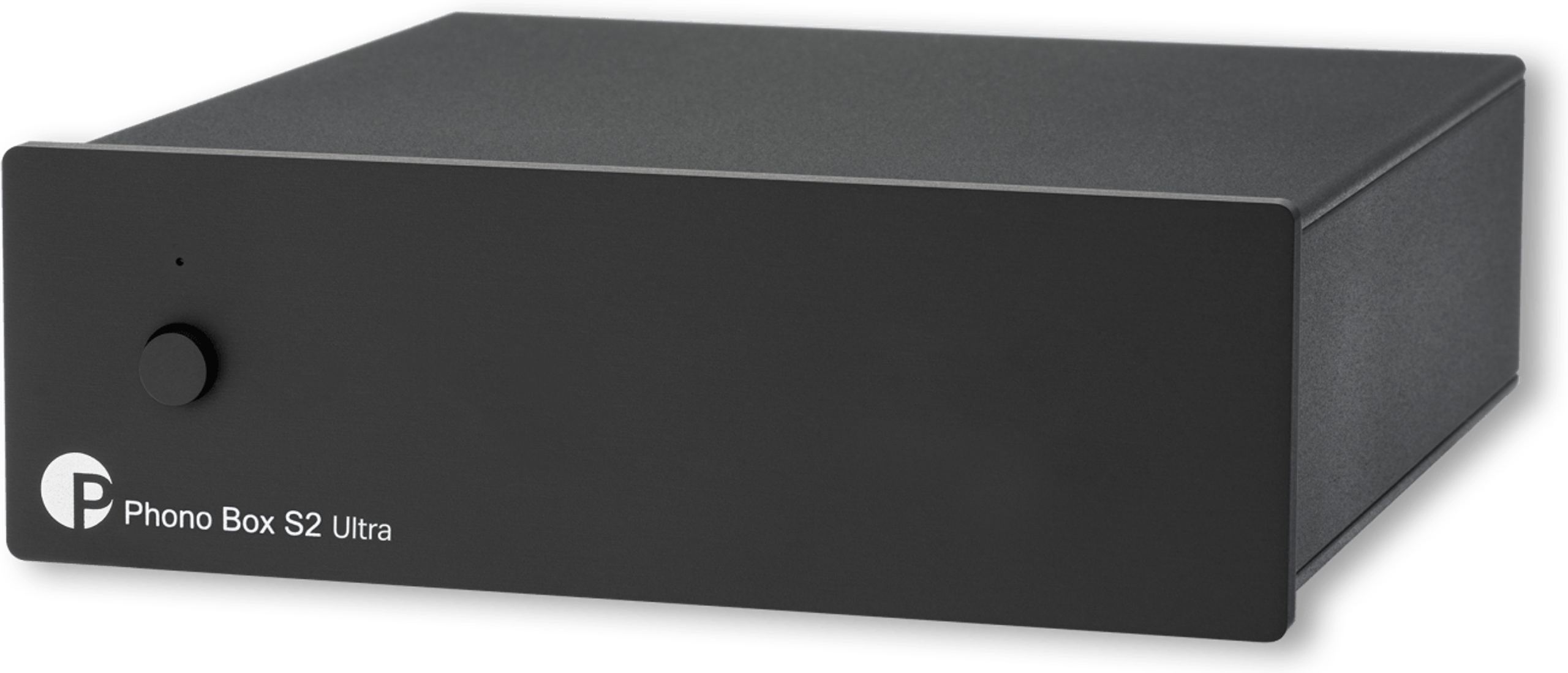
Connecting a turntable to an amplifier without a phono input requires an intermediate stage designed to restore the RIAA equalization curve and amplify a very weak signal. Pro-Ject offers this function in the second generation of its Phono Box S, a compact unit compatible with moving magnet cartridges (MM) and moving coil (MC) cartridges, with impedance, capacitance, and gain settings accessible underneath the chassis.
Internal dual-mono design
Inside, each channel has its own amplification stage: the dual-mono configuration limits crosstalk between the right and left channels. Pro-Ject claims audiophile-grade amplification modules and WIMA polypropylene capacitors for RIAA correction. The values stated by the manufacturer place RIAA accuracy below 0.4 dB over the 20 Hz to 20 kHz range, signal-to-noise ratio at 85 dB, and total harmonic distortion plus noise at 0.01% in MM, 0.05% in MC.
Fine adjustments for each cartridge
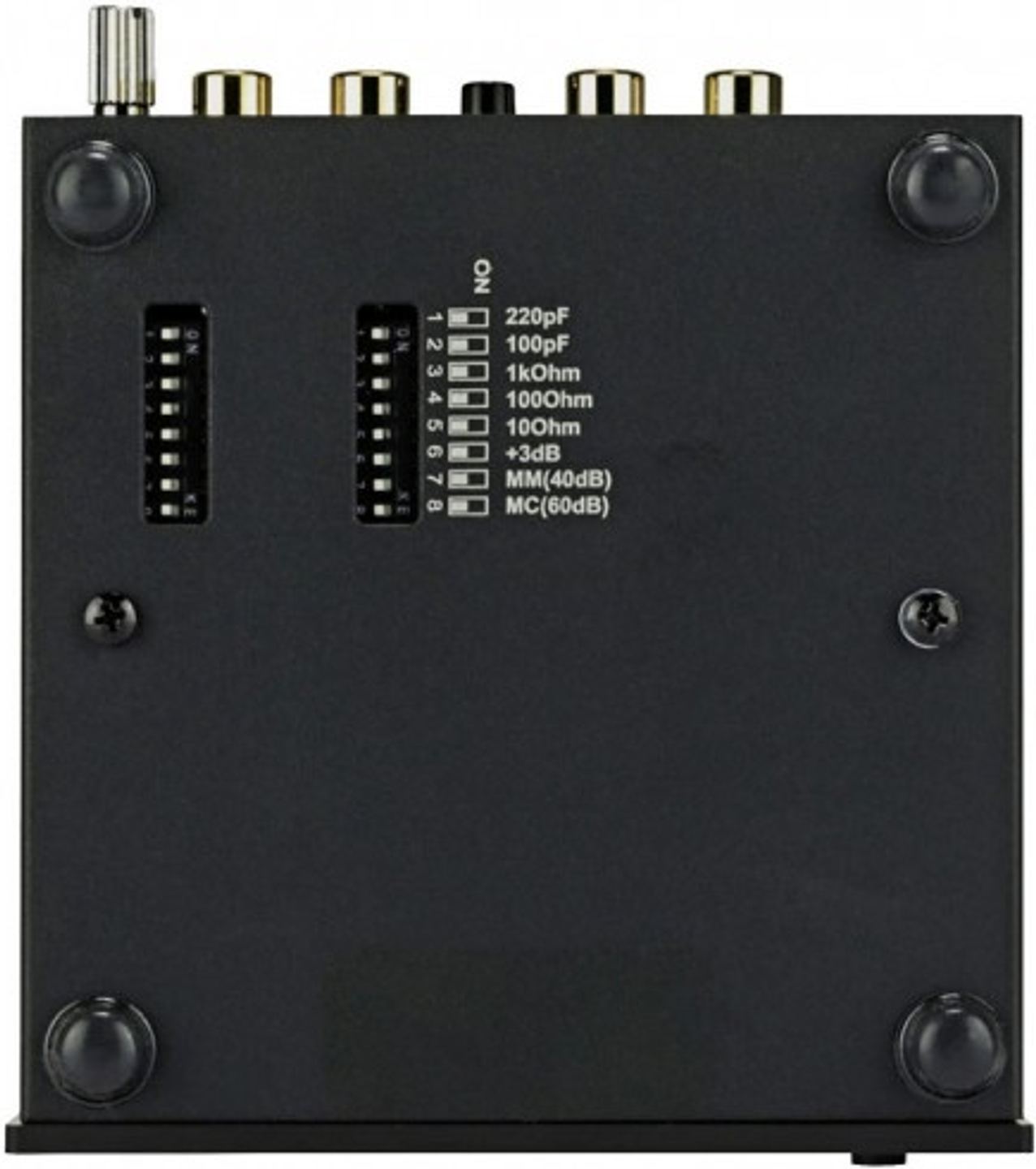
Four switches under the chassis adapt the Phono Box S2 to the turntable cartridge. Input impedance can be set to 10, 100, 1,000, or 47,000 ohms; input capacitance to 100, 200, 320, or 420 pF; gain to 40, 43, 60, or 63 dB. The two lowest gain settings are intended for MM cartridges, the two highest for MC cartridges. A switchable subsonic filter attenuates the signal by 12 dB at 20 Hz, useful for limiting the rise of very low frequencies caused by a warped record, imperfect turntable isolation, or tonearm-cartridge resonance.
Sandwich enclosure and external power supply
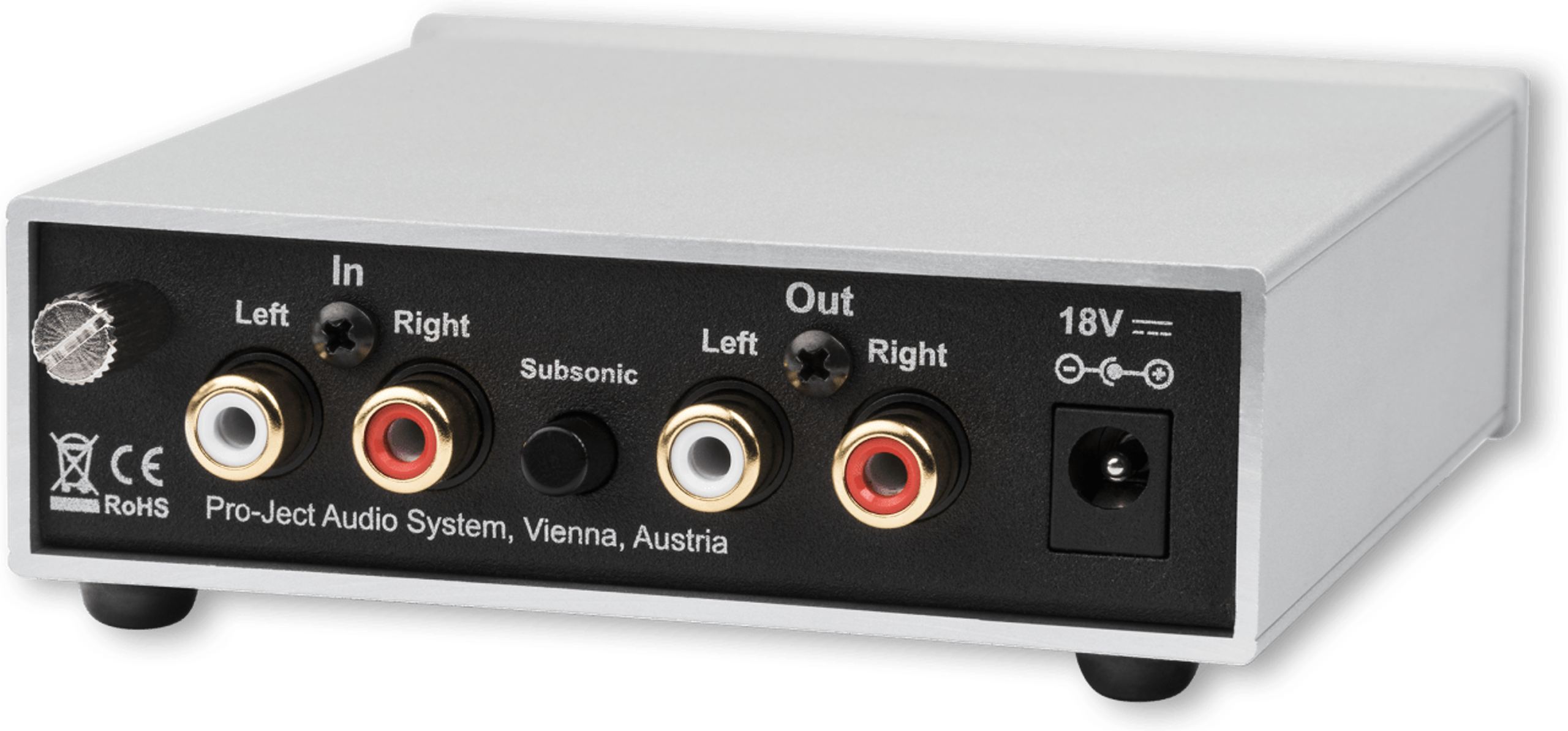
The S2 enclosure uses an aluminum and metal sandwich construction, presented by Pro-Ject as shielding against electromagnetic interference and vibrations transmitted to the printed circuit board, two sensitive parameters in a phono preamp where the input signal is measured in millivolts or microvolts. The front panel is available in silver or black, for a net weight of 570 g. Connectivity is limited to one pair of RCA inputs and one pair of RCA outputs, accompanied by a ground terminal for the turntable ground wire. The power supply is externalized: an 18 V DC / 500 mA power adapter comes with the device, moving rectification and filtering outside the audio circuit.
Technical Specifications
Main Features
- Discrete phono preamplifier for moving magnet (MM) / moving coil (MC) cartridges
- Audiophile-grade performance
- No operational amplifiers
- Audiophile-quality polystyrene capacitors
- Precise RIAA equalization
- Switchable subsonic filter − 18 dB at 20 Hz
- Switchable input impedance/capacitance
- Four adjustable gain levels
- Solid metal casing for interference protection
- Exceptional sound quality
Technical Specifications
- Input impedance: 10, 100, 1 k, 47 k Ω
- Input capacitance: 100, 220 pF
- Gain selector: 40, 43, 60, 63 dB
- Subsonic filter: − 18 dB at 20 Hz
- Signal-to-noise ratio: − 89 dB V (MM)
- Total harmonic distortion: 0.00052%
- RIAA accuracy: < 0.4 dB / 20 Hz - 20 kHz
Connectivity and Power Supply
- Input/output connectors: 1 pair RCA
- Power consumption: 18 V / 80 mA
- External power supply: 18 V DC / 500 mA
Physical Characteristics
- Dimensions (W × H × D): 103 × 37 × 119 mm
- Color: Silver or Black
- Weight: 570 g without power supply
Frequently Asked Questions
What is an external phono preamp used for?
A turntable cartridge produces a signal of a few millivolts (MM) or a few microvolts (MC), far too weak to feed a line input directly. The phono preamp amplifies this signal and applies RIAA correction, the inverse curve of the one used when cutting the record, which restores the original tonal balance. Many recent amplifiers do not include a phono input, or offer one of variable quality: a dedicated unit like the Phono Box S2 takes over.
How do you set the switches under the unit?
The values depend on the cartridge installed on the turntable. Cartridge manufacturers generally specify in the manual the recommended load impedance and capacitance, as well as the output voltage that guides the gain choice. An MM cartridge usually uses 47,000 ohms and a gain of 40 or 43 dB; a low-output MC cartridge requires lower impedance (10 or 100 ohms) and a gain of 60 or 63 dB. Since the switches are located under the chassis, the unit must be turned over with the power off before each adjustment.
Does the Phono Box S2 work with all cartridges?
The preamp supports the vast majority of MM cartridges and most MC cartridges on the market thanks to its four levels of impedance, capacitance, and gain. Very low-output MC cartridges, whose output voltage drops below 0.3 mV, may however lack gain headroom and produce audible background noise: this cartridge profile is better suited to higher-category phono preamps or a step-up transformer. High-output MC (HOMC) cartridges are handled like MM cartridges, with the lowest gain setting.
Should the subsonic filter be activated?
The filter cuts the lowest frequencies, below 20 Hz, which are rarely musical and often come from tonearm-cartridge resonance, a warped record, or vibrations transmitted to the platter. Filtering them prevents unnecessary strain on the bass speakers and amplifier, without affecting the audible range. On a well-isolated turntable and a flat record, the filter can remain out of the circuit; it becomes useful as soon as the system is exposed to parasitic vibrations or the woofer cone moves abnormally during playback.
Can the external power supply be replaced?
The Phono Box S2 comes with an 18 V DC / 500 mA power adapter. Moving the power supply outside the audio enclosure limits electromagnetic pollution on the circuit, but the supplied adapter remains a switching type. Pro-Ject offers separate linear power supplies in the Box Design range, intended to replace the original adapter and stabilize the voltage delivered to the preamp. The power connector follows the 18 V DC standard.
- Eco-contribution of €0.08 included in the sale price.
- GTIN / EAN: 9120082382120