Gold Note DS-10 EVO LINE black



Complementary product
Specifications and features


Overview
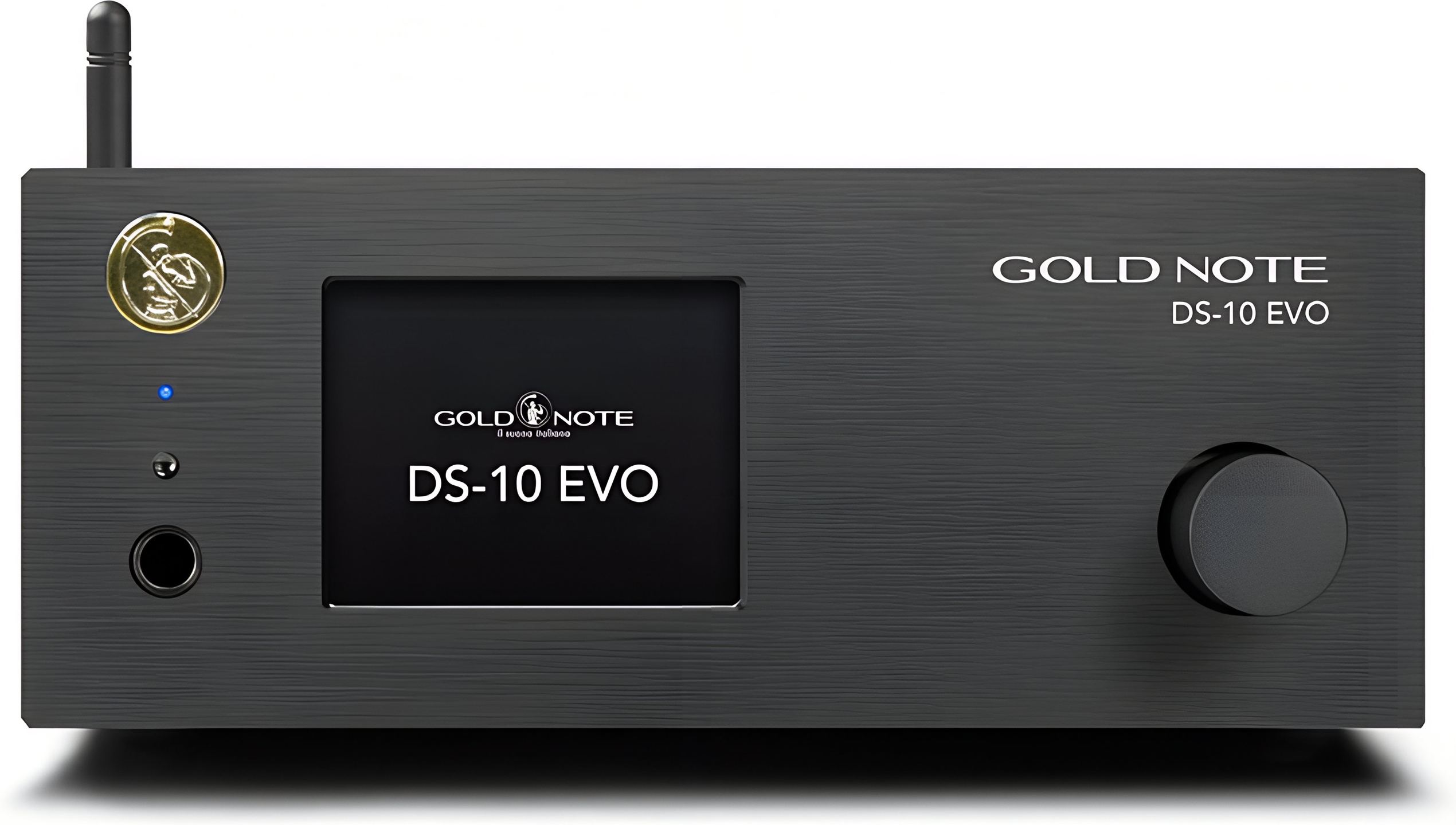
The DS-10 EVO LINE from Gold Note brings together five functions in a compact chassis: network streamer, digital-to-analog converter, line preamplifier, headphone amplifier, and Bluetooth receiver. Equipped with the AKM AK4493 converter and its adjustable “Chameleon” mode, this Italian device offers a modular approach to digital audio playback, compatible with high-resolution files up to PCM 32bit/384kHz and DSD512.
A half-width enclosure with carefully studied proportions
The DS-10 EVO LINE adopts a compact format of 200 mm wide, 80 mm high, and 260 mm deep, with a net weight of 4 kg. This size corresponds to half a standard width, allowing two devices to be installed side by side on the same shelf. The anodized aluminum chassis is available in three finishes: black, silver, or gold, all with a matte brushed look. The sides and top feature chevron-shaped vents, a visual hallmark of the brand, now chamfered to avoid any risk of cutting during handling.
The front panel consists of a 2.8-inch TFT display occupying a large portion of the surface, a single SKC (Single Knob Control) rotary button, and a 6.35 mm headphone jack. This clean design makes it easy to integrate into an existing system without visual overload. A discreet LED indicator changes color depending on the power mode: blue for the internal power supply, green when the external PSU-10 EVO is connected. On the rear panel are all the digital and analog connectors, as well as an IEC inlet for the mains cable and an 8-pin DIN socket for the optional external power supply.
The AKM AK4493 converter and its implementation
At the heart of the DS-10 EVO LINE is the AKM AK4493 chip, a 32-bit stereo converter featuring Velvet Sound technology developed by the Japanese manufacturer. This circuit accepts PCM streams up to 768 kHz and DSD up to 22.4 MHz (DSD512) natively. In practice, the DS-10 EVO LINE handles PCM up to 32bit/384kHz via the USB-B input and DSD up to DSD512 via the same input. The other digital inputs (coaxial, AES/EBU, optical) are limited to PCM 24bit/192kHz.
The AK4493 offers measured performance of 123 dB signal-to-noise ratio, 120 dB dynamic range, and total harmonic distortion below 0.001%. The circuit includes an OSR Doubler switched-capacitor filter that reduces out-of-band noise while keeping power consumption low. Six types of 32-bit digital filters are available, allowing the frequency response to be adjusted according to listening preferences or system characteristics.
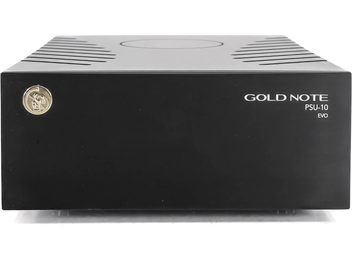
Gold Note has designed a proprietary multi-transformer internal power supply delivering 35 W. This power supply is structured around several independent sections to isolate the digital, analog, and preamplification stages. Users seeking further improvement can connect the PSU-10 EVO, an external linear power supply equipped with four transformers and using a hybrid topology that combines inductive filtering with a cascaded architecture. According to the manufacturer’s measurements, this auxiliary unit lowers the noise floor by more than 80 dB.
Chameleon mode: 48 combinations to tailor the sound
The DS-10 EVO LINE incorporates a feature called “Chameleon mode” that allows real-time modification of the converter’s sound profile without degrading signal quality. Unlike the simple digital filter changes offered by most DACs, this system acts on three independent parameters:
- The PCM equalization curve (low-pass filter) with several roll-off profiles: sharp (steep transition), slow (gentle transition), or intermediate
- The high-frequency de-emphasis curve to compensate for pre-emphasis applied to certain recordings
- The DSD filter and the DAC’s internal current level, adjustable to alter dynamics and sonic presentation
These three parameters combine to offer 48 distinct configurations that the user can test and compare during playback. The system allows three favorite presets to be saved for quick access via the menu. This flexibility is useful for adapting the DS-10 EVO LINE to the acoustic characteristics of the listening room, the tonal color of the speakers in use, or simply personal taste depending on the musical genre being played.
This approach differs from standard digital filters because it also affects the analog output stage and the power management of the DAC circuit. A “sharp roll-off” filter combined with a high DAC current produces a more energetic sound with fast transients, while a “slow roll-off” filter with moderate current yields a smoother, more organic presentation.
Comprehensive, multi-service network connectivity
The DS-10 EVO LINE connects to the home network via Ethernet cable or dual-band Wi-Fi 802.11 a/b/g/n/ac (10/433 Mbps). This dual option simplifies installation in setups where wired cabling is not practical. The network card integrates UPnP and DLNA protocols to access NAS music servers or external hard drives. A USB-A input accepts FAT32- or NTFS-formatted USB sticks and hard drives (32 GB limit for USB sticks), enabling direct playback of locally stored files.
The device natively supports the following streaming services: Roon Ready, Tidal and Tidal Connect, Qobuz, Deezer, Spotify Connect, AirPlay, and vTuner for internet radio. Roon Ready certification ensures automatic recognition within the Roon ecosystem and bit-perfect transmission of audio streams. The Tidal Connect function allows direct streaming from the Tidal mobile app to the DS-10 EVO LINE without using a third-party app.
The HD Bluetooth 5.0 receiver accepts 44.1 kHz/16-bit streams, offering a convenient option for playing music from a smartphone or tablet. For external digital sources, the DS-10 EVO LINE provides a coaxial S/PDIF RCA input, a balanced AES/EBU input, two optical TOS-Link inputs, an asynchronous USB-B input, and a USB-A input. An analog 3.5 mm mini-jack input completes the connectivity, making it possible to integrate an external analog source such as a portable player or a phono preamp.
Supported audio formats include PCM up to 32bit/384kHz, DSD64 to DSD512 (DSF and DFF files), AIFF, ALAC, WAV (packed and unpacked), FLAC, MP3, Apple Lossless, OGG, and Monkey’s Audio. Firmware updates are performed OTA (Over The Air) directly via the network connection, avoiding complex manual update operations.
Analog preamp stage and headphone amplification
The DS-10 EVO LINE includes a switchable line preamp that operates entirely in the analog domain. When activated, this stage allows volume control either via the front SKC knob, the supplied remote control, or the GN Control app. The potentiometer acts on the analog signal after conversion, thus preserving the full digital resolution of the audio stream.
Two pairs of audio outputs are available on the rear: one unbalanced RCA pair and one balanced XLR pair, both delivering 2 Vrms. These outputs can operate in fixed mode (constant level for connection to a separate preamp) or variable mode (adjustable level for direct connection to a power amplifier). The 50 Ω output impedance is suitable for most power amplifiers and preamps on the market. Switching from DAC mode to preamp mode is done in the setup menus, electronically disabling volume control when an external preamp is used.
The front headphone output offers two gain levels (High/Low) selectable in the settings. Low gain is suitable for sensitive in-ear monitors and portable headphones, while high gain provides sufficient power to drive magnetic planar headphones or high-impedance models. This built-in headphone amplification avoids the need to purchase a dedicated amplifier for users who want to alternate between speaker and headphone listening.
Intuitive interface and control apps
The 2.8-inch TFT display permanently shows the signal format (PCM or DSD), sampling frequency, selected input, operating mode (fixed DAC or variable preamp), and volume level. Brightness can be set to four levels: 100%, 50%, 25%, or off, to match room lighting conditions and avoid distracting light pollution in a dark environment.
The single SKC button handles all navigation functions: press to enter the menus, rotate to scroll through options, press again to confirm. This minimalist approach simplifies the physical interface while still providing access to all settings: source selection, volume control, Chameleon mode configuration, preamp activation, headphone gain setting, and screen brightness.
The multifunction remote control replicates most of the front-panel commands, with volume adjustment remaining particularly easy to read from a normal listening distance. The GN Control app (available free on iOS and Android) displays detailed information about the track being played on your smartphone or tablet: title, artist, album, and actual format and resolution. The app interface has been redesigned in the EVO version for improved smoothness and ergonomics compared to the first-generation DS-10. Roon users can also control the DS-10 EVO LINE directly from the Roon interface, which automatically detects the device as a certified endpoint.
Documentation
Technical specifications
Digital-to-analog conversion
- Converter chip: AKM AK4493
- Frequency response: 20 Hz – 20 kHz (± 0.1 dB)
- Total harmonic distortion: 0.001% maximum
- Signal-to-noise ratio: 125 dB
- Dynamic range: 120 dB
- Preamplifier volume control: enabled / disabled
Supported audio formats
- PCM up to 32-bit / 384 kHz
- DSD up to DSD512 (DSF, DFF)
- AIFF (.aif, .aiff, .aifc)
- ALAC
- WAV (compressed / uncompressed)
- FLAC
- MP3
- Apple Lossless
- OGG
- Monkey’s Audio
Network connectivity and streaming
- Local network and Wi-Fi: 802.11a / b / g / n / ac, dual band (10 / 433 Mbps)
- Bluetooth: HD 5.0 (44.1 kHz / 16-bit)
- Compatible streaming services: Roon Ready, Tidal, Tidal Connect, Qobuz, Deezer, Spotify Connect, AirPlay, vTuner
- Media servers: UPnP, DLNA, Roon
- The UPnP server must support DSD streaming to play DSD files
- Firmware update: remote (OTA)
Connectivity
- Digital inputs
- 1 × coaxial RCA (PCM up to 24-bit / 192 kHz)
- 1 × AES / EBU (PCM up to 24-bit / 192 kHz)
- 2 × optical TOSLink (PCM up to 24-bit / 192 kHz)
- 1 × asynchronous USB-B (DSD512 and PCM 32-bit / 384 kHz)
- 1 × USB-A (DSD256 and PCM 32-bit / 384 kHz, FAT32 / NTFS, 32 GB maximum)
- Analog input
- 1 × 3.5 mm mini-jack (10 kΩ impedance)
- Audio outputs
- Converter outputs
- 1 × unbalanced RCA 2 Vrms
- 1 × balanced XLR 2 Vrms
- Preamplifier outputs
- 1 × unbalanced RCA
- 1 × balanced XLR
- 1 × 6.3 mm headphone output (front panel, dual gain)
- Converter outputs
Power supply
- Voltage: 100 – 240 V / 50 – 60 Hz
- Power consumption: 35 W
- Fuse: 2 A T
- Type: multi-rail power supply with proprietary transformer
Dimensions and weight
- Dimensions (W x H x D): 200 × 80 × 260 mm
- Net weight: 4 kg
- Packaged weight: 5 kg
Package contents
- Multifunction remote control
- Power cable
- Documentation
Frequently asked questions
What is the difference between the DS-10, DS-10 PLUS, and DS-10 EVO LINE?
The standard DS-10 (2019) is the base of the range. The DS-10 PLUS adds a 3.5 mm mini-jack analog input and an improved internal power supply. The DS-10 EVO LINE takes the features of the standard model but includes a redesigned user interface, a more responsive mobile app, and OTA (Over The Air) firmware updates. All three versions use the same AKM AK4493 converter and offer comparable sound performance.
Is the external PSU-10 EVO power supply essential?
No, the DS-10 EVO LINE works perfectly with its multi-transformer internal power supply. The PSU-10 EVO is an upgrade option for demanding setups or highly revealing systems. It mainly provides a reduction in background noise and improved power supply stability, resulting in a noise floor lowered by more than 80 dB according to Gold Note. Investing in this external power supply is most relevant in an already optimized system where marginal gains are audible.
Does Chameleon mode really change the sound, or is it just a marketing gimmick?
Chameleon mode genuinely acts on three independent parameters of the conversion circuit: PCM low-pass filters, the de-emphasis curve, and the DAC supply current. These changes affect the slope of the reconstruction filters, the signal phase, and the dynamics of the output stage. The changes remain subtle – it is not an equalizer – but they allow fine-tuning of the sound to the room acoustics or system voicing. Some configurations prioritize transient precision, others favor a smoother, warmer presentation. The benefit lies in the ability to test and compare settings in real time during playback.
What is the maximum resolution available through the different inputs?
The asynchronous USB-B input accepts PCM up to 32bit/384kHz and DSD up to DSD512. The USB-A input (for sticks and drives) is limited to PCM 32bit/384kHz and DSD256. The S/PDIF coaxial, AES/EBU, and optical TOS-Link inputs peak at 24bit/192kHz in PCM and do not transmit DSD natively. Network streaming (Ethernet or Wi-Fi) supports PCM up to 32bit/384kHz and DSD depending on the capabilities of the UPnP server used, provided it handles DSD streaming.
Does the DS-10 EVO LINE fully replace a dedicated preamp?
The DS-10 EVO LINE can indeed replace a preamp in an all-digital setup. Its analog preamplification stage operates after conversion and controls volume without resorting to digital attenuation. However, it only provides a single analog input (3.5 mm mini-jack), which limits integration of multiple analog sources. For a system including several analog sources (phono, tuner, tape deck), a dedicated preamp remains preferable. For a system focused on digital sources with at most one additional analog source, the built-in preamp is sufficient and simplifies the signal chain.
Can network streaming and another digital input be used simultaneously?
No, the DS-10 EVO LINE does not allow mixing multiple sources. You must select one input at a time via the SKC button, the remote control, or the app. To switch from one source to another, you must manually change the active input. This limitation is common to almost all audio converters and ensures signal path integrity by avoiding extra conversions or mixing that could degrade sound quality.
Does the DS-10 EVO LINE work properly with all headphones?
The DS-10 EVO LINE includes a headphone amplifier with two gain levels (High/Low). Low gain is suitable for in-ear monitors and sensitive headphones (impedance below 32 ohms, sensitivity above 100 dB/mW). High gain delivers increased power for high-impedance headphones (250 to 600 ohms) or less sensitive magnetic planar models. However, for very demanding headphones or electrostatic models, a dedicated headphone amplifier is still recommended, as the DS-10 EVO LINE’s output, while competent, cannot compete with specialized amplifiers in terms of control and power reserves.
- Eco-contribution included in the sale price.
- Manufacturer reference: PF-DIECI-DSL-001-B
- GTIN / EAN: 8050054560731