Élysium Screens Edge|One PureView 120"

Overview
A 10 mm frame. That’s all that separates the image from your wall. Élysium Screens’ Edge|One PureView takes discretion to its ultimate conclusion: once installed, the screen looks more like a window than a piece of equipment. This 120-inch diagonal in 16:9 format offers a surface 2.65 m wide by 1.49 m high, or nearly 4 m² of image. The total frame exceeds the edges of the screen surface by only 2 cm, preserving integration in spaces where every centimeter counts.
A frame that disappears to let the image speak
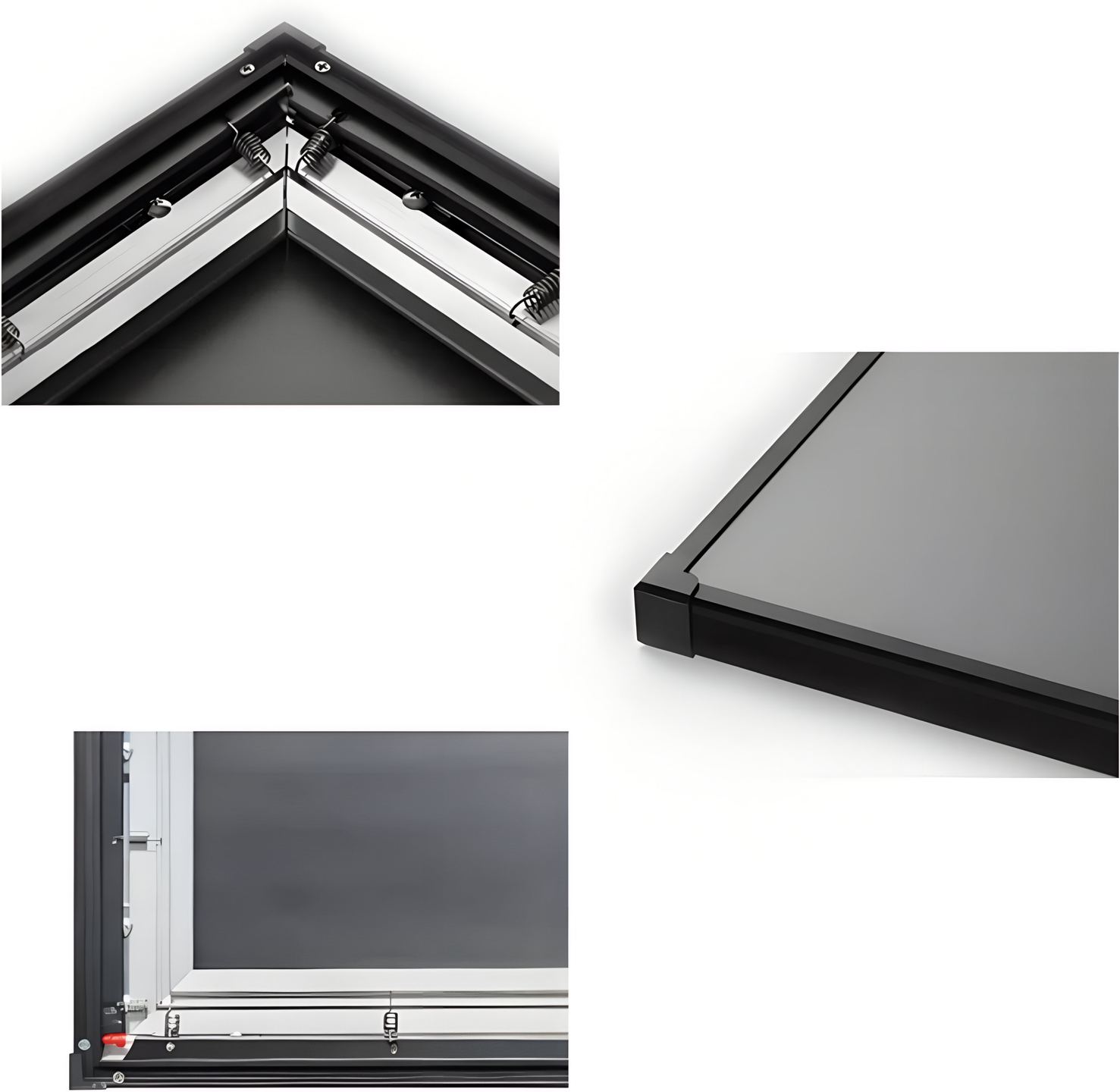
The aluminum profile measures less than one centimeter thick. That’s three to four times thinner than the classic frames in the segment, which generally range between 3 and 6 cm. This design choice has obvious visual consequences: the eye no longer catches on a massive frame before reaching the image. The beveled black edges absorb stray reflections and create a clean transition between the screen surface and the wall. This bevel is not a cosmetic detail: it prevents the projector’s light from bouncing off the frame and contaminating the dark areas of the image, a recurring problem on flat-border screens.
Aluminum, rigid and lightweight, keeps the structure perfectly flat over time. A total weight of 11 kg for a screen of this size makes handling during installation easier and reduces stress on the wall mounts.
PureView screen surface: versatility rather than specialization
The PureView screen surface is a white PVC surface with a gain of 1.1. This gain, slightly above 1 (the standard of a perfectly diffusing surface), modestly increases perceived brightness without creating a hotspot at the center of the image. The viewing angle remains wide, which suits living rooms or rooms where viewers are not all seated in line with the projector.
This standard white screen surface works with all types of video projectors: long throw, short throw, laser, DLP, LCD. It does not filter ambient light like ALR screens (ambient light rejecting) do, which makes it better suited to rooms where lighting can be controlled. In return, it preserves color accuracy without alteration, a parameter that gray or silver technical screens can compromise.
Élysium offers four other screen surface models compatible with the same frame. This modularity makes it possible to adapt the screen to specific constraints, such as a bright room or the use of an ultra-short-throw projector, without changing the structure.
Spring tensioning: long-lasting flatness without intervention
The tensioning system relies on springs integrated into the frame. The screen surface remains under constant tension, which eliminates the visible ripples that appear on roll-down screens or on statically tensioned frames after a few months of use. This constant flatness is particularly important for 4K and 8K content, where the slightest surface deformation becomes noticeable.
The rigid structure combined with permanent tension also prevents the “waves” phenomenon caused by variations in temperature or humidity. The PVC surface, thinner and more flexible than woven screens, responds better to this type of tensioning.
Installation in less than 30 minutes
The spring wall-mounting system simplifies hanging. This is not a matter of screwing the screen in point by point like a heavy picture: the springs allow height and level adjustment after mounting, which compensates for imperfections in the wall or drilling. An illustrated manual comes with the screen.
Assembly of the frame itself, delivered in sections, does not require any specific tools. The corner brackets and connectors fit together, the screen surface is tensioned onto the finished frame, then the whole assembly is mounted to the wall. Two people are enough to handle the assembled screen.
Flat storage, recommended by the manufacturer, preserves the flatness of the screen surface over the long term. A screen stored rolled up can develop shape memory that affects tension once deployed.
Dimensions and footprint
The image area (2657 × 1495 mm) corresponds to the exact proportions of the 16:9 format. The frame adds 20 mm on each side, bringing the overall dimensions to 2677 × 1515 mm. This minimal difference between image and total footprint distinguishes the Edge|One from competing models where the frame can add 10 to 15 cm on each side.
For installation, allow for a clear wall space at least 2.70 m wide and 1.55 m high. The recommended viewing distance for a 120” screen varies between 3 and 4.5 meters depending on viewing preferences and projector resolution.
Documentation
French
Technical specifications
Frame
- Thickness: less than 1 cm (ultra-thin, almost invisible)
- Material: rigid and lightweight aluminum
- Beveled black edges: absorption of stray reflections and enhanced contrast
- Perfect tension: rigid structure ensuring lasting flatness, without waviness
- Maintenance: durable and easy to clean
Screen material: PureView
- Type: standard white PVC screen material
- Gain: 1.1
- Ideal for all uses
- 5 screen material models available covering all uses
Dimensions
- 16:9 ratio
- 10 mm frame width
- Diagonal: 120 inches
- Image dimensions (W × H): 2657 × 1495 mm
- Frame size (W × H): 2677 × 1515 mm
- Gross weight: 11 kg
Installation
- Mounting system: wall mounting with springs (smart and simplified)
- Assembly time: less than 30 minutes
- Illustrated instructions included
- Storage: flat
Key features
- Ultra-thin frame for maximum immersion
- Perfect and lasting tension thanks to the springs
- Quick and simplified installation
- Smart wall mounting
- Durable and easy to maintain
Frequently asked questions
Is the PureView screen surface suitable for ultra-short-throw (UST) projectors?
Yes, but with reservations. Standard white screen surfaces technically work with UST projectors, but they do not optimize ambient light rejection like dedicated ALR screens. If you use a UST projector in a room with stray light coming from the ceiling, one of the four other screen surfaces in the Élysium catalog will be more suitable.
Can the screen surface be replaced without changing the frame?
The spring tensioning system allows the screen surface to be detached from the frame. Replacement is possible if you want to switch to another type of surface or if the screen surface is damaged.
Is the screen compatible with active 3D projection?
The PureView screen surface, as a white gain 1.1 surface, is compatible with active 3D projection. It does not polarize light and preserves the brightness necessary for active glasses to work properly.
How do you clean the PVC screen surface?
A soft, slightly damp cloth is enough to remove dust. For stains, a mild soapy water solution can be used. The PVC surface withstands handling better than woven screens, but avoid abrasive products or solvents.
What projection distance for a standard-throw projector?
For a 120-inch image with a standard-throw projector (throw ratio between 1.5:1 and 2:1), the projector-to-screen distance is generally between 4 and 5.5 meters. Consult your projector’s specifications for a precise calculation.
- Eco-contribution included in the sale price.
- Manufacturer reference: EONE-120-PVW
- GTIN / EAN: 3760442540294