

Tandem OLED: what is it and which TVs use it?
September 23, 2026
Contents
The cheapest Tandem OLED TV in our catalogue is a Samsung, the TQ48S95H, at €1,329. Yet Samsung makes its own competing technology, QD-OLED. But it does not produce it in 48 inches, so it buys this panel from its competitor LG Display. Tandem OLED is neither a brand nor a TV range. It is a way of building the panel, found in 2026 at Panasonic, Samsung, Philips and LG, whose real benefits you need to understand before paying the premium. What makes this panel so special? We explain everything, simply.
If you only have a minute, here are our highlights.
- A Tandem OLED panel stacks several light-producing layers; LG Display’s current version has four: two blue, one red and one green.
- The improvement is most noticeable in HDR and in a lit room; on an entirely white image, an OLED still trails a good Mini LED.
- Each layer operates with less current, reducing the heat and wear that cause burn-in.
- Three series in our catalogue use it: the Panasonic Z95B in 55, 65 and 77 inches, and Samsung’s TQ48S95H and TQ83S99H.
- The series name is not enough: at Samsung, only the 48- and 83-inch sizes use Tandem.
What is a Tandem OLED panel?
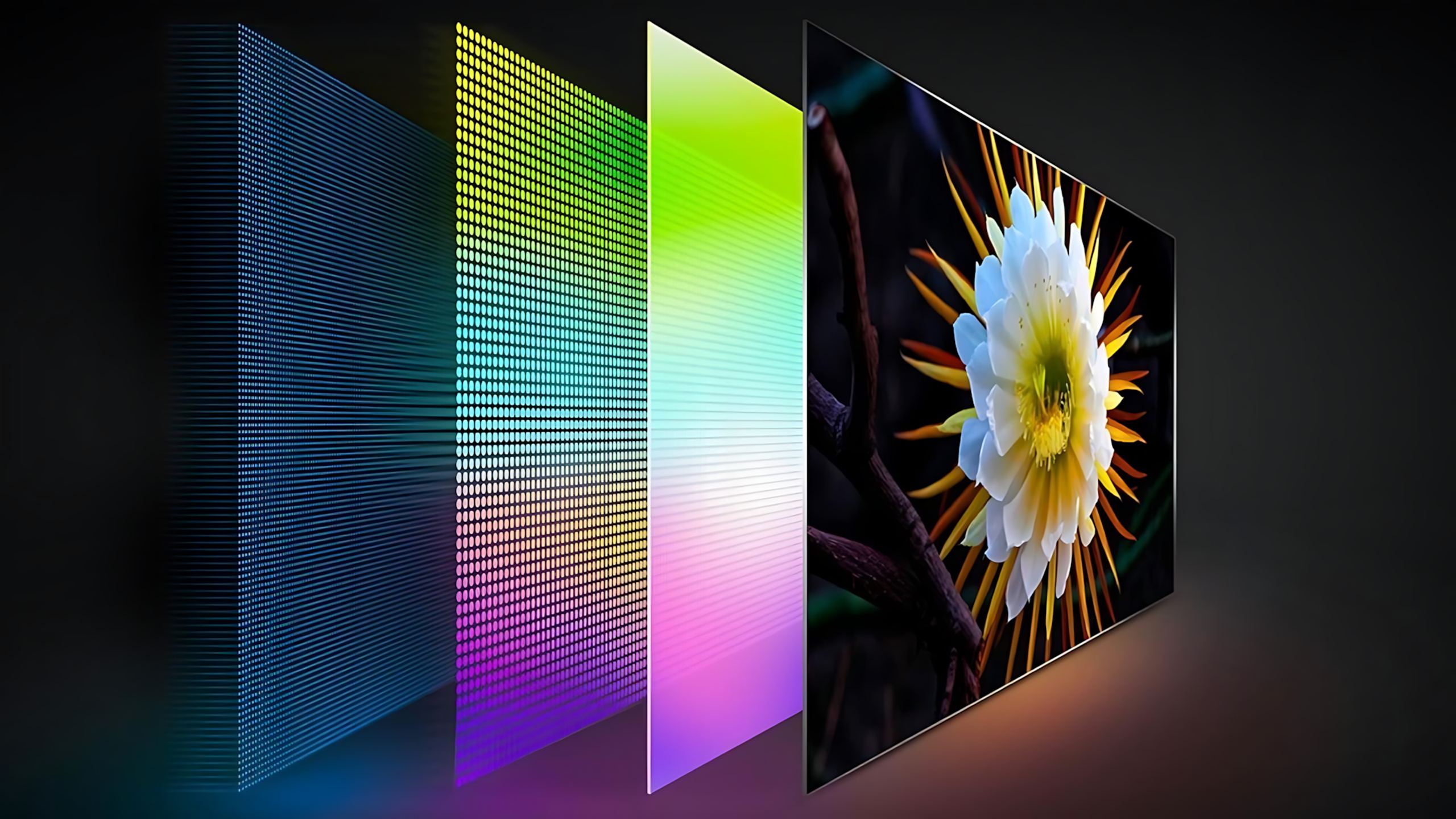
On an OLED TV, each pixel produces its own light through an organic material carrying an electric current. It switches off completely to display black, with no backlight spilling out around a white subtitle. The word “tandem” refers to the stacking of several emissive layers, meaning layers that emit light, separated by a thin layer that distributes electrical charges between them. Imagine several light bulbs lined up: each layer adds its light to the whole, and none needs to work hard to produce a bright image.
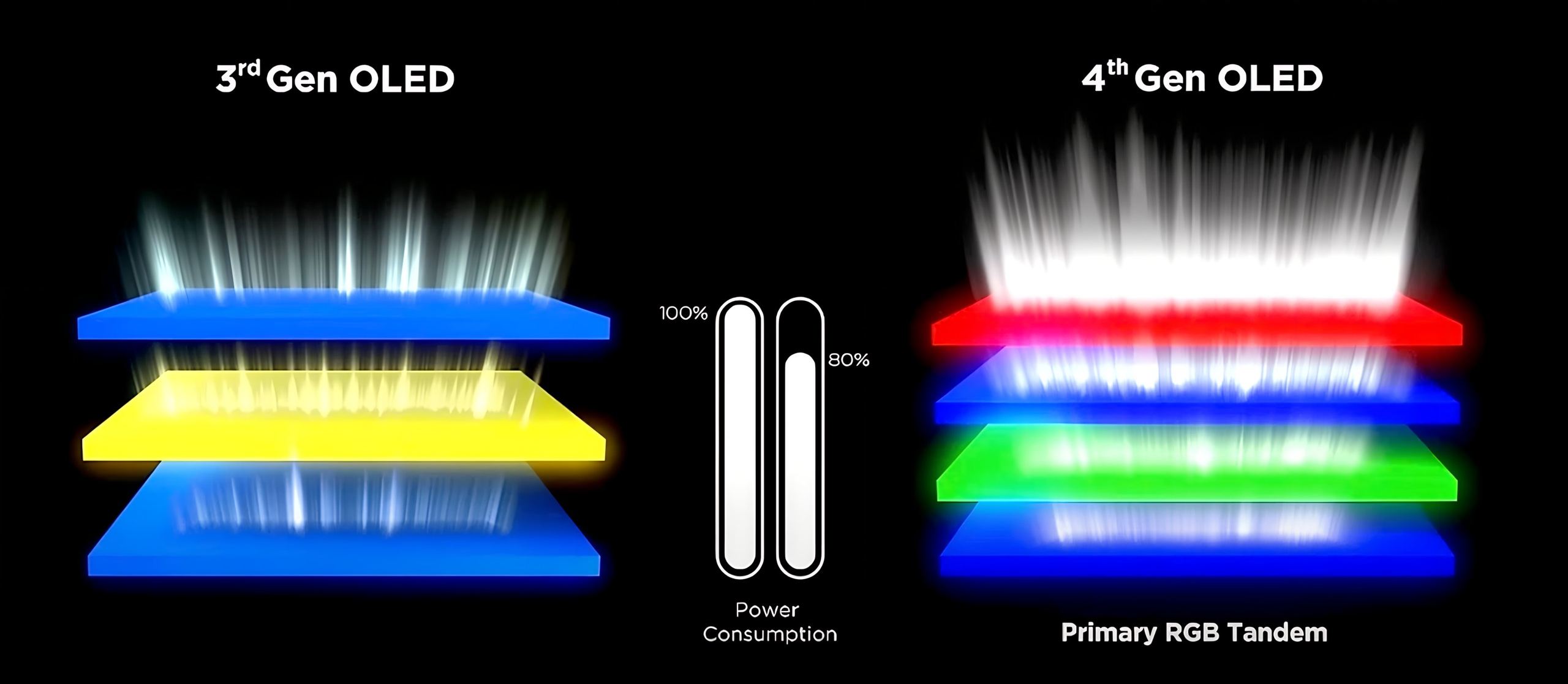
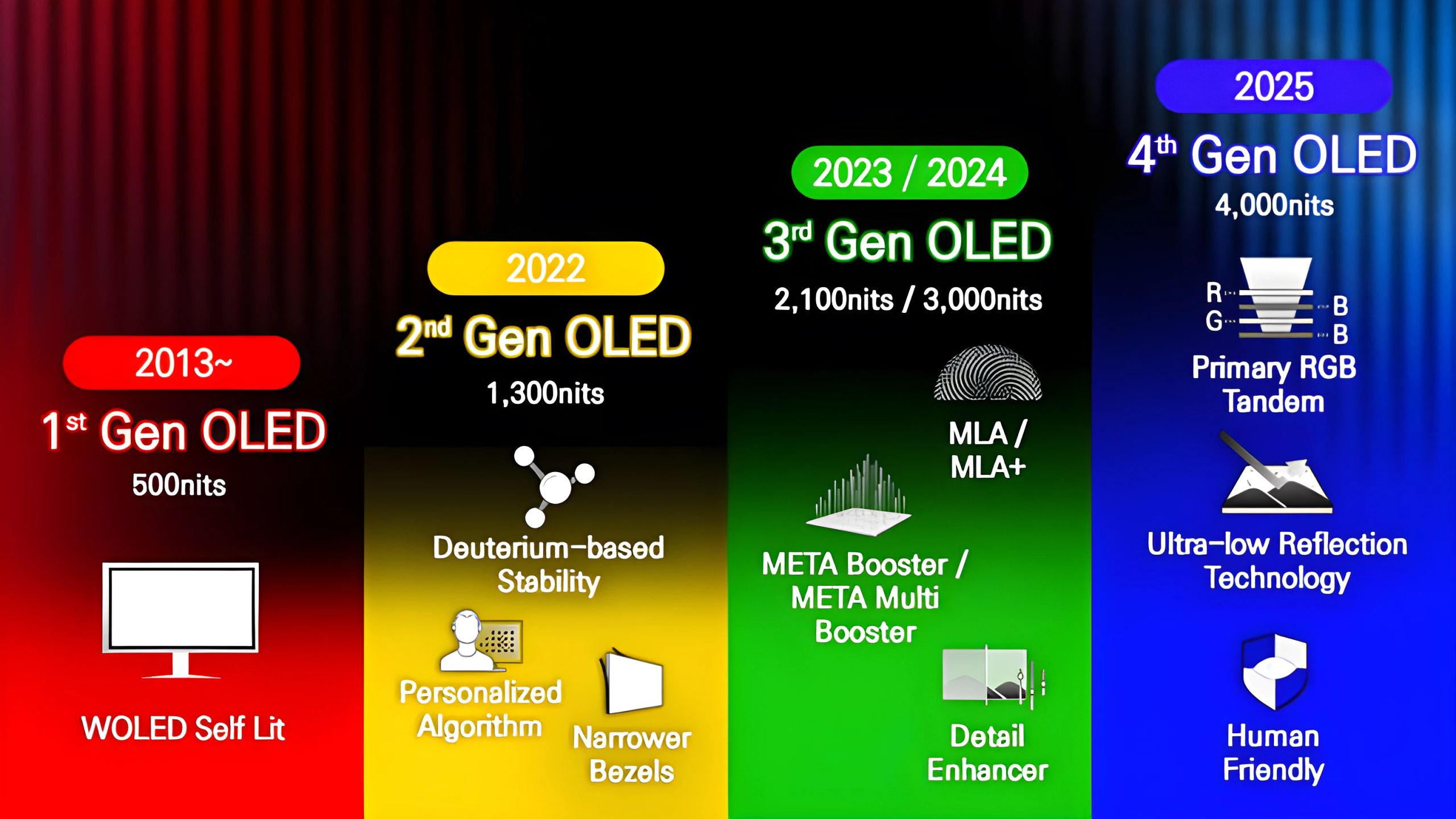
The idea is not new. LG Display’s W-OLED panels already stacked three layers, including one that mixed several colours. The Primary RGB Tandem structure, introduced in 2025 on high-end models, moves to four layers: two blue layers surround a red and a green layer, now separate. Each primary colour is emitted more purely, and luminous efficiency improves by around 40%.
In 2026, LG Display optimised this stack under the name Primary RGB Tandem 2.0. The number of layers remains unchanged, but the subpixel structure and drive system extract more light from the same stack.
What difference does Tandem OLED make on screen?
This layering has three effects: greater brightness, less panel wear and lower power consumption at the same brightness. The first is immediately visible. For its 2026 models equipped with the Tandem 2.0 panel, Philips claims 4,500 nits (or cd/m², the unit of brightness) on a small area covering 3% of the screen, compared with 3,700 for its 2025 models, and 400 nits on a full white screen, compared with 350. These are manufacturer figures. A finished TV set to cinema mode remains well below this: our guide to Samsung’s 2026 panels puts high-end W-OLED at around 3,100 cd/m² over 2% of the surface. In HDR, an explosion or a setting sun stands out with greater brilliance, without a halo.
The second effect concerns reflections. LG Display claims a reflectance of 0.3% for its Tandem panel. By comparison, its entry-level OLED SE panel, which lacks a polariser (the filter that absorbs ambient light), reaches 4.4%, equivalent to a typical LCD. With a lamp or window facing the screen, blacks remain deeper. The surface treatment added by the brand also matters, such as Samsung’s matte Glare Free coating.
More light also means more heat. Panasonic has therefore added the ThermalFlow system to the Panasonic TV-55Z95B, rearranging the rear of the chassis to expel hot air. A better-cooled panel sustains its peak brightness for longer.
The limitation remains the same as for any OLED. On an entirely white image, such as a ski slope or a web page, brightness drops back to around a few hundred nits. A high-end Mini LED TV performs better in this respect.
Tandem OLED and burn-in: is image retention less likely?
Burn-in is a permanent ghost image left by a logo or banner displayed in the same place for thousands of hours. It comes from uneven pixel wear, which heat accelerates. On a four-layer panel, each layer operates at a lower current density to produce the same light. It generates less heat and ages more slowly.
However, our feature on OLED burn-in in 2026 notes that these panels are recent: more time is still needed to assess their behaviour over seven to ten years of use. For varied use, including films, series, sport and gaming, the risk is already very low on a recent OLED panel, Tandem or otherwise. It remains real for a news channel watched for several hours a day, with its fixed banner.
Tandem OLED or QD-OLED: which has the best colours?
Tandem OLED reproduces purer colours than older panels. A W-OLED panel retains a white subpixel alongside red, green and blue, increasing brightness at the cost of a slight loss of saturation in very vivid colours. With the Primary RGB Tandem structure, red and green are emitted by separate layers: each primary is more distinct, an advantage for HDR films and video games.
Samsung Display’s QD-OLED takes a different approach. It produces blue light and converts it into red and green using quantum dots, nanocrystals that change the colour of light. It retains a measurable advantage in highly saturated colours at high brightness.
LG Display’s Tandem has closed most of the brightness gap: Samsung also claims the same 4,500-nit peak for its 2026 QD-OLEDs. The difference mainly comes down to ambient lighting. QD-OLED allows room light to raise the black level slightly, an effect that the 2026 matte coatings significantly reduce. Tandem maintains its blacks more consistently.
The choice therefore depends on the room. In a bright living room, Tandem is by no means a second-best option. In a dark room used mainly to watch very colourful HDR films, a QD-OLED such as the Samsung TQ55S95H, at €1,890 in 55 inches, still has its strengths.
Which Tandem OLED TVs are available in 2026: Panasonic, Samsung, LG, Philips, Sony?
The Panasonic Z95B, launched in 2025, continues into 2026 without a successor. It uses the first-generation four-layer Primary RGB Tandem panel in 55, 65 and 77 inches, with ThermalFlow. Its Technics-tuned audio system distributes 160 W across seven channels and a subwoofer. For gaming, two HDMI inputs support 4K at up to 144 Hz, one of which also supports eARC for connecting an amplifier. All three sizes are listed as coming into stock soon, at €2,290, €2,499 for 65 inches and €3,990 for 77 inches.
At Samsung, only two sizes use Tandem, those that Samsung Display does not produce in QD-OLED. The Samsung TQ48S95H gets a W-OLED Tandem panel from LG Display, while the 55-, 65- and 77-inch S95H models use QD-OLED. It retains the Glare Free treatment and four HDMI 2.1 inputs supporting 4K at 165 Hz, with 60 W 2.1.2 sound, less powerful than on the larger sizes. The Samsung TQ83S99H does the same in 83 inches, with third-generation Glare Free and 70 W 4.2.2 sound.
At Philips, the OLED+911 and OLED+951 use the Primary RGB Tandem 2.0 panel, with four HDMI 2.1 inputs at 165 Hz. The 911 stands out for its 81 W Bowers & Wilkins 3.1 audio system, and the 951, in 65 and 77 inches, for its dual processor. These two series, detailed in our article on the Philips OLED+951 and OLED+911, are not offered on our site.
At LG, the G6 uses the Tandem 2.0 panel, and the C6 gets it in 77 and 83 inches only (C6H version), with the other sizes remaining on conventional W-OLED. The wireless W6 model also uses it. These series, presented in our guide to LG’s 2026 OLEDs, are not offered on our site.
Finally, Sony has no Tandem OLED in 2026. The Bravia 8 II remains QD-OLED, and the new Bravia 6 uses a W-OLED SE panel, more affordable but more susceptible to reflections.
How can you tell whether a TV really has a Tandem panel?
Size matters as much as the series. Samsung does not state the panel type on its specifications, but the full model reference reveals it. The model name is followed by a three-letter suffix: an E in the last position (HAE, HFE) indicates an LG Display panel, while a T or F (HAT, HAF) indicates a QD-OLED panel. This code appears on the box label and on the back of the TV.
Panel trade names also muddy the waters. OLED EX refers to an earlier generation from LG Display, without a four-layer stack. OLED SE refers to the entry-level panel without a polariser. Only the terms Tandem or Primary RGB Tandem guarantee the structure described here. For example: the Philips 48OLED811, a 2026 model at €1,299, uses an OLED EX panel.
Will Tandem OLED be used in all screens?
The technology is not limited to TVs. Apple has used it in the iPad Pro since 2024, and several high-end laptops have adopted it. With its gains in brightness and efficiency, it could become the standard for OLED screens in the coming years, and make its way into more affordable TVs, as LG’s C6H in 77 and 83 inches already demonstrates.
Comparison of Tandem OLED TVs in the catalogue
| Model | Size | Panel | What the brand adds | Gaming: high-refresh-rate 4K inputs | Built-in sound | Price and availability |
|---|---|---|---|---|---|---|
| Samsung TQ48S95H | 48 inches | W-OLED Tandem (LG Display) | Matte Glare Free coating | 4 inputs, 165 Hz | 2.1.2, 60 W | €1,329, in stock |
| Panasonic TV-55Z95B | 55 inches | Primary RGB Tandem | ThermalFlow cooling | 2 inputs, 144 Hz | 160 W, tuned by Technics | €2,290, in stock soon |
| Panasonic TV-65Z95BEG | 65 inches | Primary RGB Tandem | ThermalFlow cooling | 2 inputs, 144 Hz | 160 W, tuned by Technics | €2,499, in stock soon |
| Panasonic TV-77Z95BEG | 77 inches | Primary RGB Tandem | ThermalFlow cooling | 2 inputs, 144 Hz | 160 W, tuned by Technics | €3,990, in stock soon |
| Samsung TQ83S99H | 83 inches | W-OLED Tandem (LG Display) | 3rd-generation Glare Free | 4 inputs, 165 Hz | 4.2.2, 70 W | €5,190, to order |
| Non-Tandem reference: Panasonic TV-55Z90B | 55 inches | Conventional W-OLED | Same processor as the Z95B | Up to 144 Hz | 60 W | €1,499, in stock in a few weeks |
Prices recorded in October 2026, subject to change.
The test to do before paying for Tandem
On a 55-inch Panasonic, the Z95B’s Tandem panel costs €791 more than the Z90B, which retains the same processor and HDR formats, but with a conventional W-OLED panel and 60 W sound instead of 160 W. To find out whether your room justifies it, a simple test at home is enough.
Sit in your usual spot, at the time you watch TV most, with the lamps on as usual. Turn off your current TV and look at its black screen: if it clearly reflects a window, a lamp or your own silhouette, ambient light will spoil dark scenes, and that is where Tandem and its low reflectance make the difference. If you can see two TVs switched on side by side, compare them using the same night scene with a few bright highlights, then an entirely white page: the first shows Tandem’s benefit, the second its limitation.
If the screen reflects a window when switched off and you watch during the day, the Panasonic Z95B in 55 or 65 inches is the most complete choice, with Dolby Vision and the most powerful sound. Above 77 inches, the Samsung TQ83S99H is the only Tandem in the catalogue, provided you are willing to forgo Dolby Vision. For an office, a bedroom or PC and gaming use, the Samsung TQ48S95H brings Tandem at the lowest price. If the screen stays dark and you mainly watch in the evening, the Panasonic TV-55Z90B is enough, and the €791 saved can fund a soundbar. Tandem OLED redefines what we expect from a high-end TV, but your room determines whether it is worth the premium.
Frequently asked questions
Can my 2025 Tandem TV be upgraded to Tandem 2.0 via an update?
No. The panel structure is physical; it does not change with a software update. The 2025 Primary RGB Tandem models, such as the Panasonic Z95B, retain the first-generation four-layer structure.
Does a Tandem OLED TV consume more power than a conventional OLED TV?
At the same brightness, somewhat less: four-layer panels consume around 20% less power with standard content, according to LG Display. Power consumption depends mainly on size and settings. The Samsung TQ83S99H, rated energy class E, consumes 123 W in eco mode, but can reach up to 650 W at full brightness.
Do all Tandem TVs support Dolby Vision?
No, HDR formats depend on the brand, not the panel. The Samsung TQ48S95H and TQ83S99H support HDR10+ but not Dolby Vision. The Panasonic Z95B supports both dynamic formats, Dolby Vision IQ and HDR10+ Adaptive. The Philips OLED+911 and OLED+951 are the first OLEDs certified for Dolby Vision 2 Max, a format that still has almost no content.
Does Tandem OLED retain its colors when viewed from the side?
Slightly worse than a QD-OLED. LG Display’s W-OLED panel loses a little saturation as you move off-axis, whereas the triangular QD-OLED subpixel structure maintains colors better when viewed from the side. This matters most with a corner sofa.
Does a 48-inch Tandem OLED make a good PC monitor?
Yes, with one precaution. W-OLED displays sharper text at close range than QD-OLED, whose triangular subpixel layout creates a slight colored fringe around the edges of letters. However, a taskbar or icons displayed in the same place all day remain the most vulnerable to burn-in: automatically hiding the taskbar and using a changing wallpaper reduce this risk.
Popular products
You may also like to read
 Can a projector really replace a TV for everyday use?Comparisons and buying guides
 Hisense UR8S vs UR9S: which RGB Mini LED TV should you choose in 2026?Comparisons and buying guides
 Sony Bravia 6: an affordable 48- to 83-inch OLED TVHi-fi and home cinema news
 How to choose a soundbar suited to your TV and living roomComparisons and buying guides
 Micro RGB or OLED: what are the differences when choosing your TV in 2026?Comparisons and buying guides
 Sony launches its first True RGB TVs with the Bravia 9 II and 7 IIHi-fi and home cinema news
 TCL TVs 2026: SQD-Mini LED, a new alternative to RGB Mini LEDHi-fi and home cinema news
 What size 4K TV should you choose based on your viewing distance?Tutorials and practical guides








