
Unitra WSH-805 silver


Overview
The Unitra WSH-805 is a dual-mono stereo integrated amplifier inspired by a Polish audio model from the 1970s. It uses a fully analog design, a Current Feedback topology, and lets you switch between Class A and Class AB. The unit weighs 22 kg and contains 1,586 components.
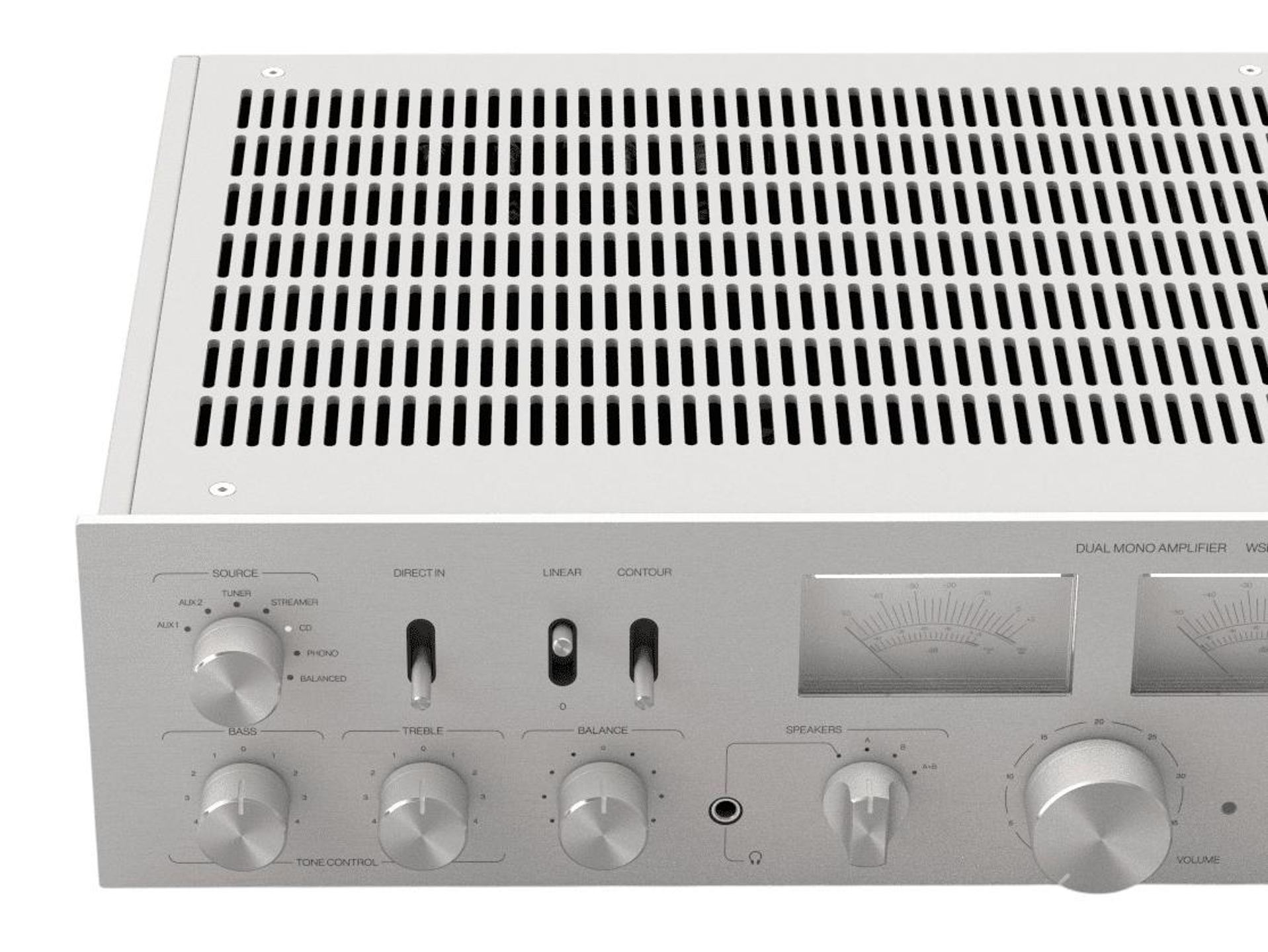
A monumental chassis housing an uncompromising design
The WSH-805 immediately impresses with its massive construction. Its metal chassis houses 1,586 carefully selected components, giving it a net weight of 18 kilograms. The generous dimensions of 440 × 385 × 143 mm reflect a design philosophy where every element has the space it needs to operate under optimal conditions.
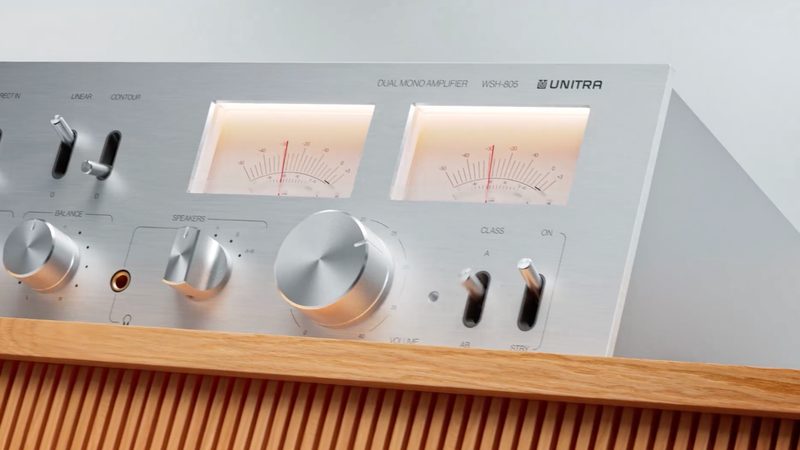
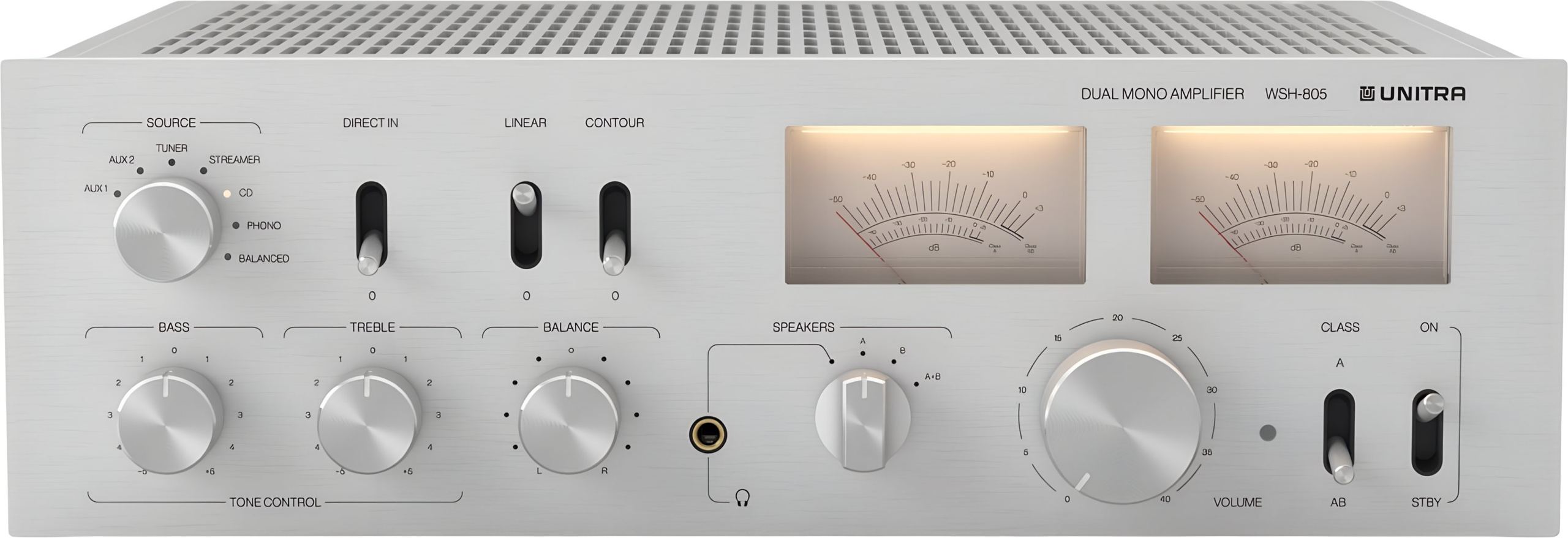
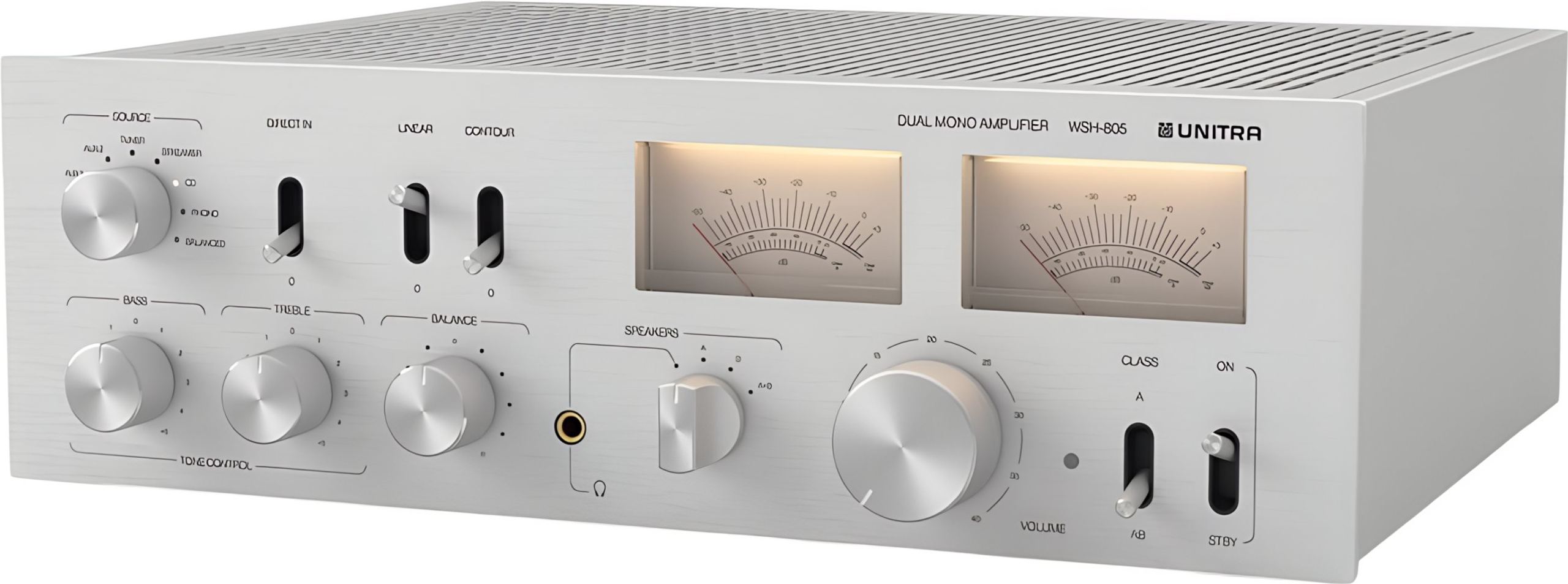
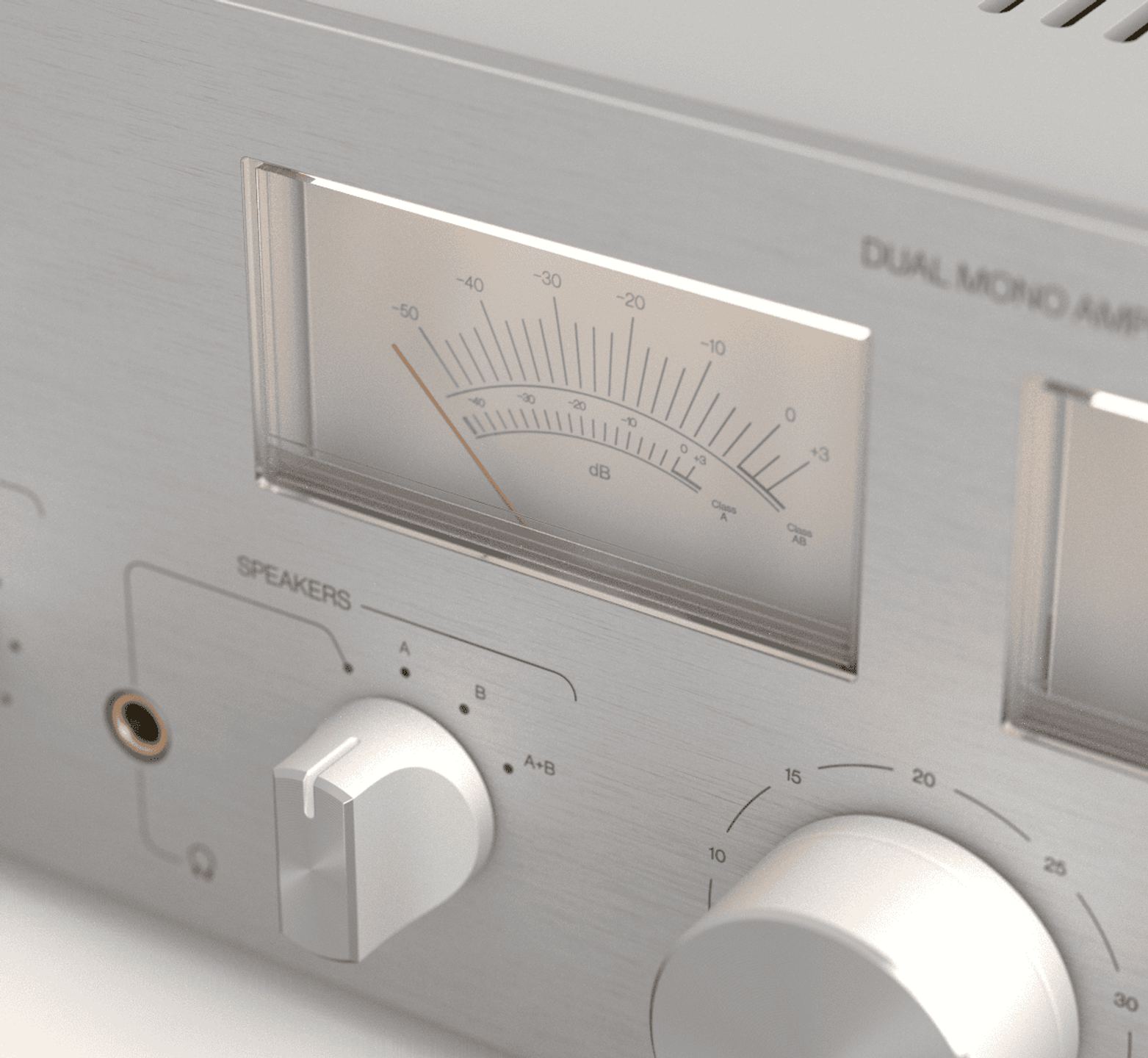
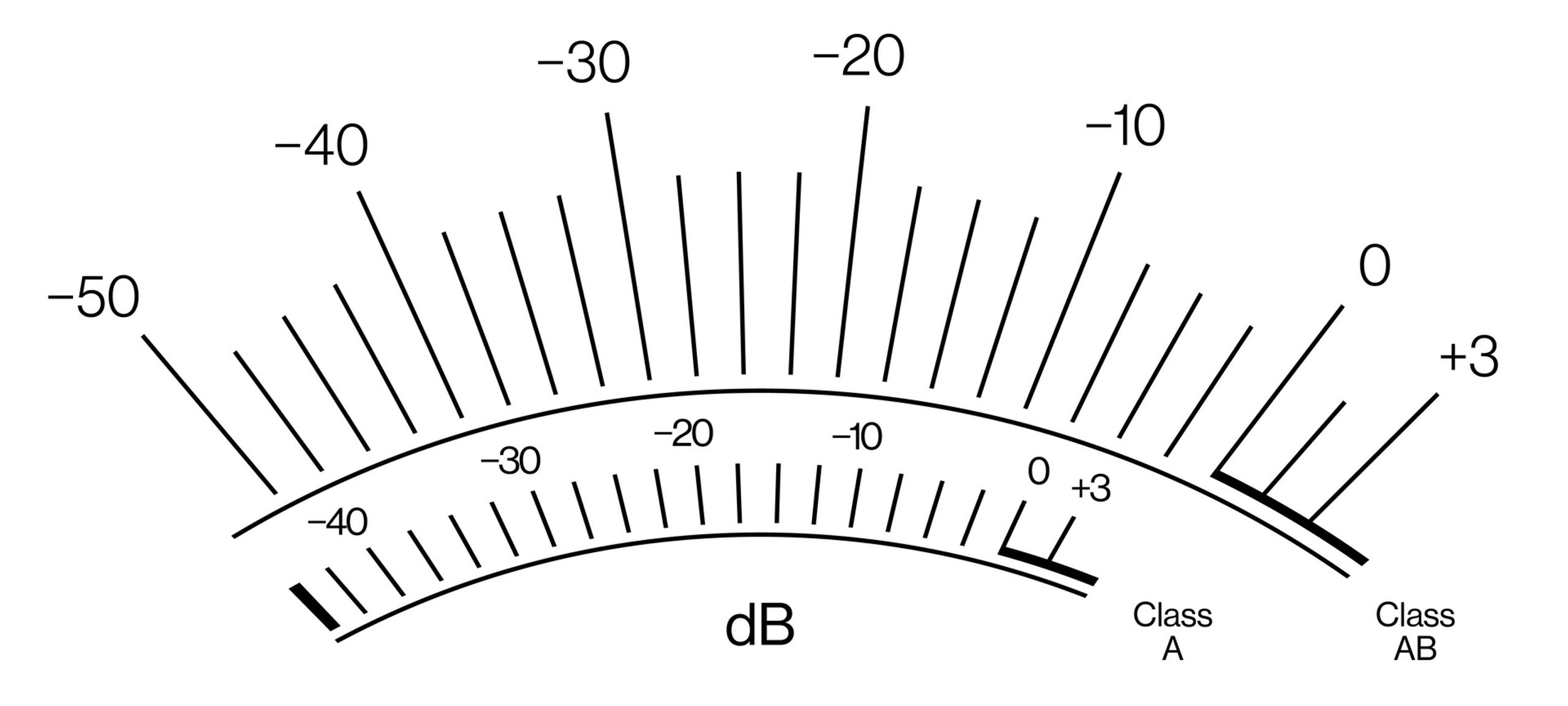
The front panel features swinging VU meters characteristic of the golden age of hi‑fi. These analog indicators do more than display signal level; they create a visual animation that accompanies the music. The interface relies on bistable switches, a technology patented by Unitra that combines timeless aesthetics with modern functionality. Every anodized aluminum control element offers calibrated resistance to movement, providing a precise tactile feel. Adjustable front lighting gently bathes the device, creating an atmosphere conducive to attentive listening.
The WSH-805 is available in several finishes: silver or black for the standard versions, as well as Classic variants with American walnut side panels and brass accents. These Classic versions strictly retain the same electronics and audio performance; only the aesthetics differ.
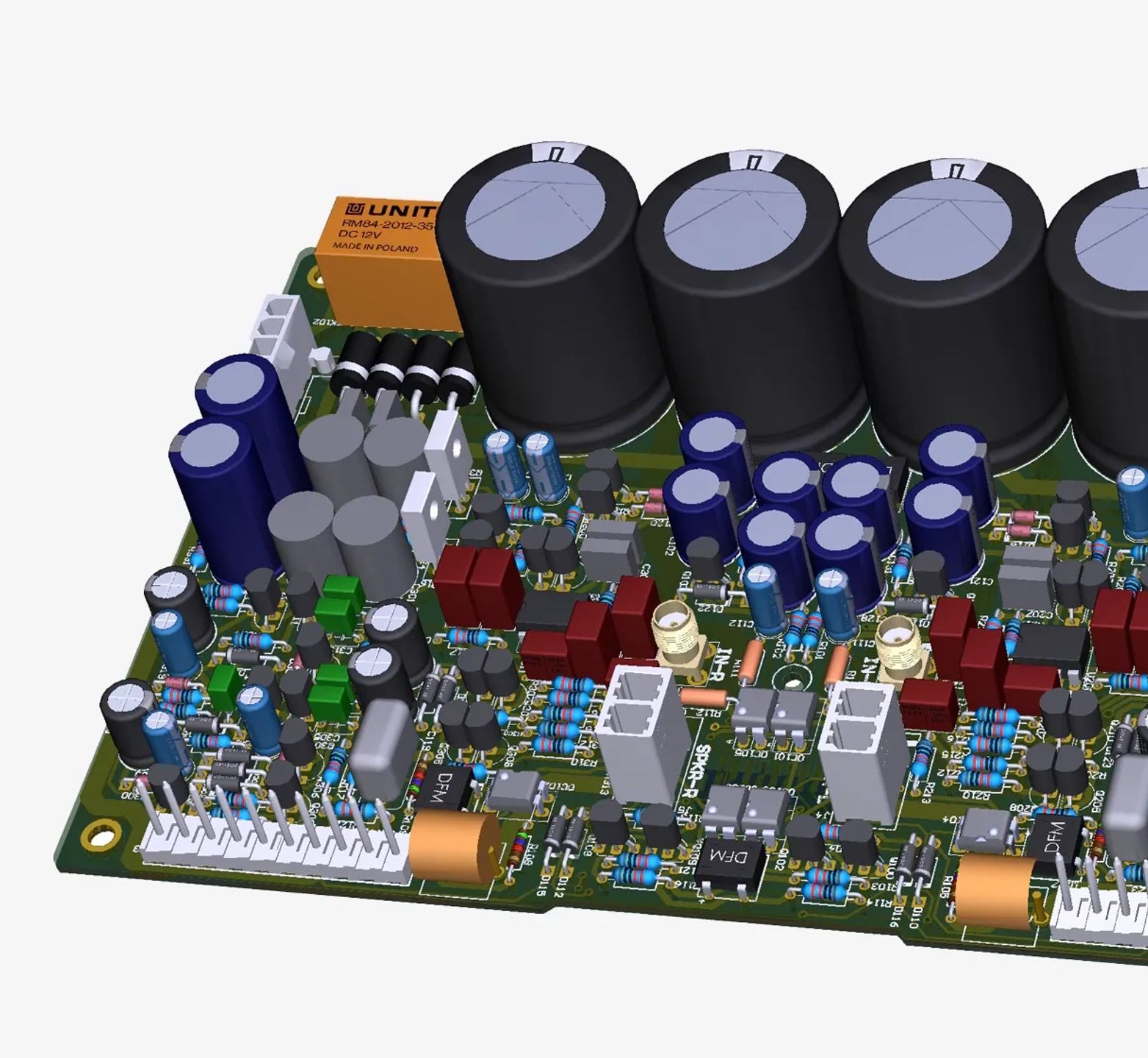
Current Feedback topology in service of channel separation
The WSH-805 adopts a Current Feedback topology, a technical choice that sets this amplifier apart from conventional voltage-feedback designs. In a classic amplifier, the inverting input reacts to voltage variations. With Current Feedback, current becomes the primary control parameter.
This approach offers several significant advantages. Bandwidth remains constant regardless of the selected gain, unlike traditional amplifiers where these two parameters are linked. Current Feedback circuits also enable considerably higher slew rates, as current-mode operation largely sidesteps the parasitic effects of node capacitances. This results in better transient reproduction and preserved dynamics across the entire frequency range.
Implementing this topology in the WSH-805 directly contributes to the exceptional channel separation, measured at over 100 dB at 1 kHz. This performance ensures a precise and stable stereo image, each channel maintaining its integrity without crosstalk contamination.
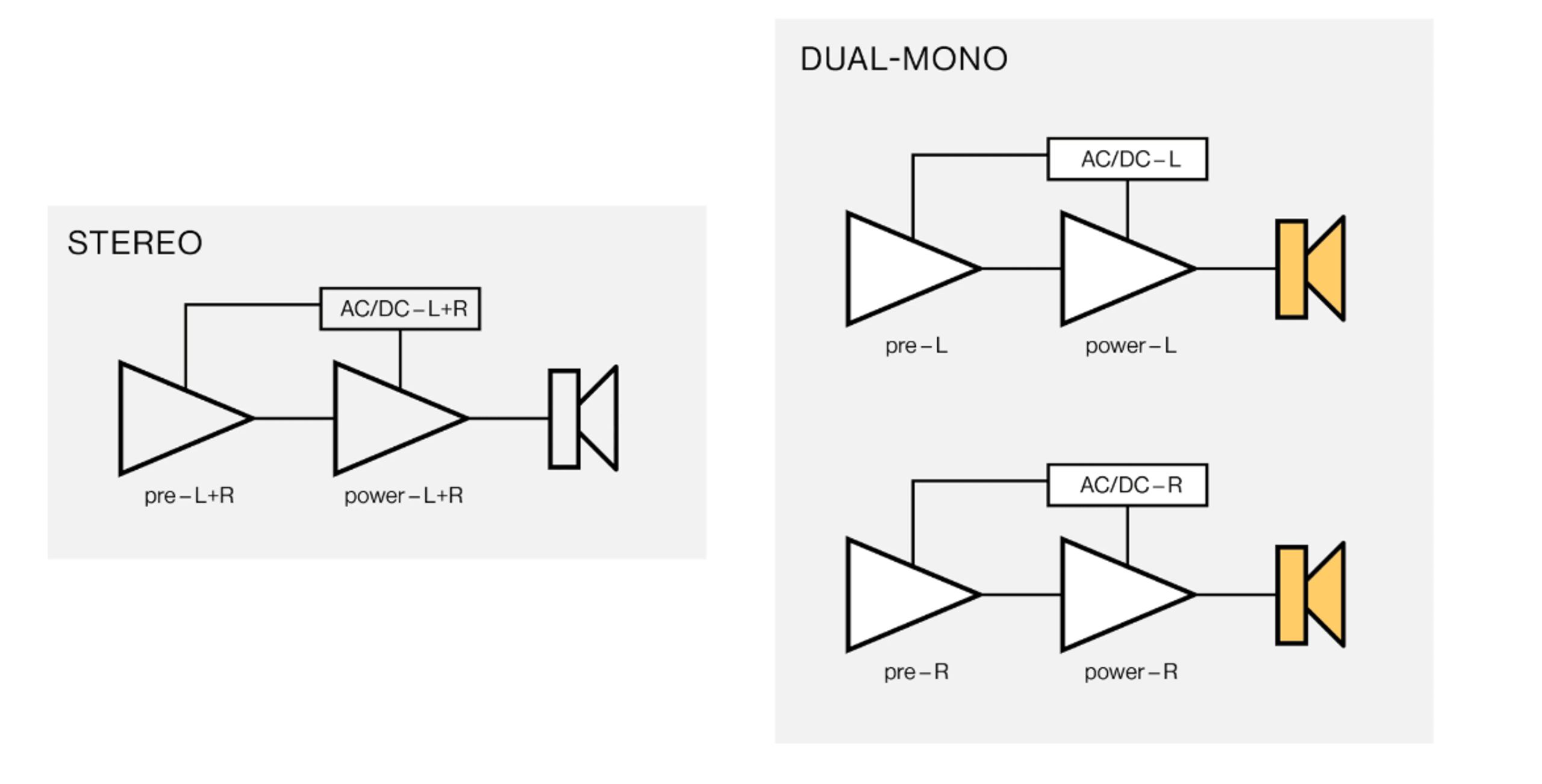
Dual-mono: complete channel independence
The dual-mono architecture takes separation logic to its limit. Each channel has its own preamplifier and power amplifier, operating completely independently. This configuration, more costly and complex to implement than a conventional stereo design, virtually eliminates any form of crosstalk between channels.
In practical terms, the left and right channel signals follow completely separate electrical paths from input to output terminals. This physical and electrical isolation manifests as remarkably low intermodulation distortion (less than 0.0015% at 19 + 20 kHz for 10 W) and contributes to the characteristic sonic clarity of the unit.
The dual-mono configuration does impose certain design constraints—doubling some circuits and more complex thermal management—but the performance benefits fully justify this approach for an amplifier in this category.
Class A / Class AB switching: two amplification philosophies
The WSH-805 includes a rare feature: the ability to switch between Class A and Class AB operation via a simple front switch. This flexibility allows the amplifier to adapt to listening conditions and personal preferences.
In Class AB mode, the amplifier delivers its rated power of 80 watts per channel into 8 ohms (125 W into 4 ohms). This mode is ideal for dynamic listening and speakers that demand power. Energy efficiency remains reasonable, limiting heat buildup during extended sessions.
Switching to Class A radically changes the amplifier’s behavior. Power drops to 8 watts into 8 ohms (16 W into 4 ohms), but linearity reaches its maximum. In this mode, the output transistors conduct continuously over the entire signal cycle, eliminating the crossover distortion inherent in Class AB operation. Music lovers who favor moderate listening levels with high-sensitivity speakers will particularly appreciate this option.
Connectivity designed for pure analog
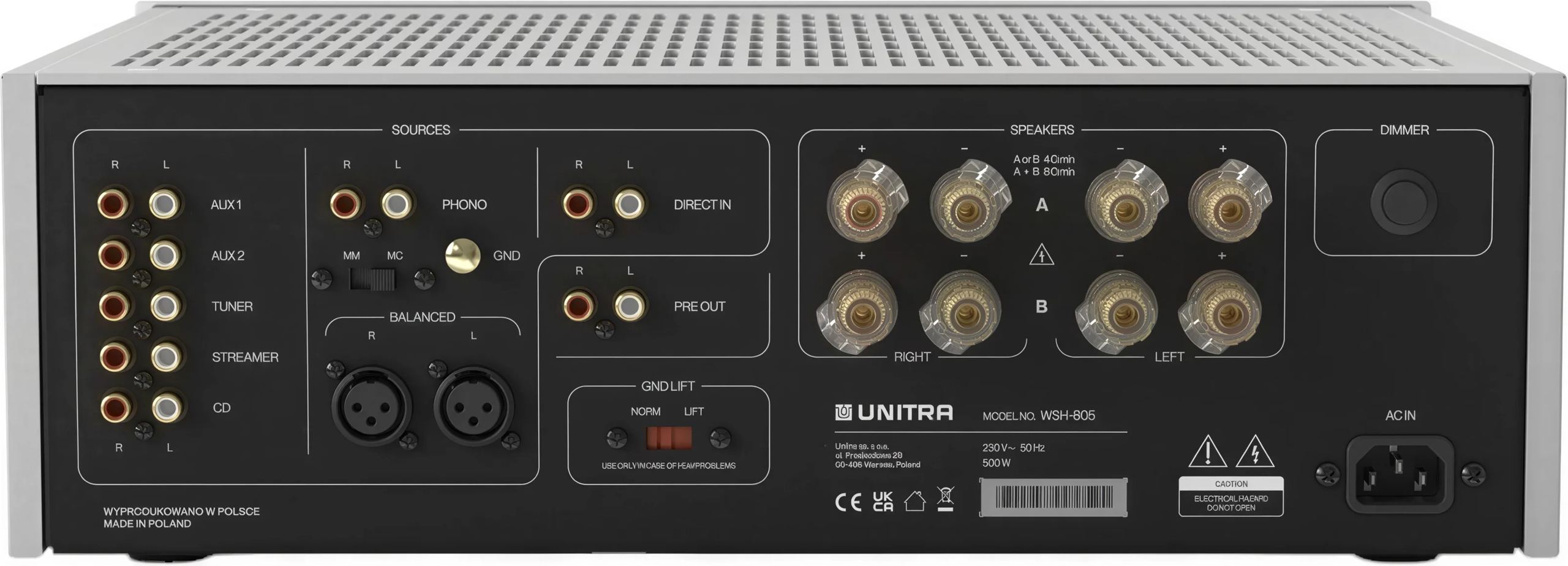
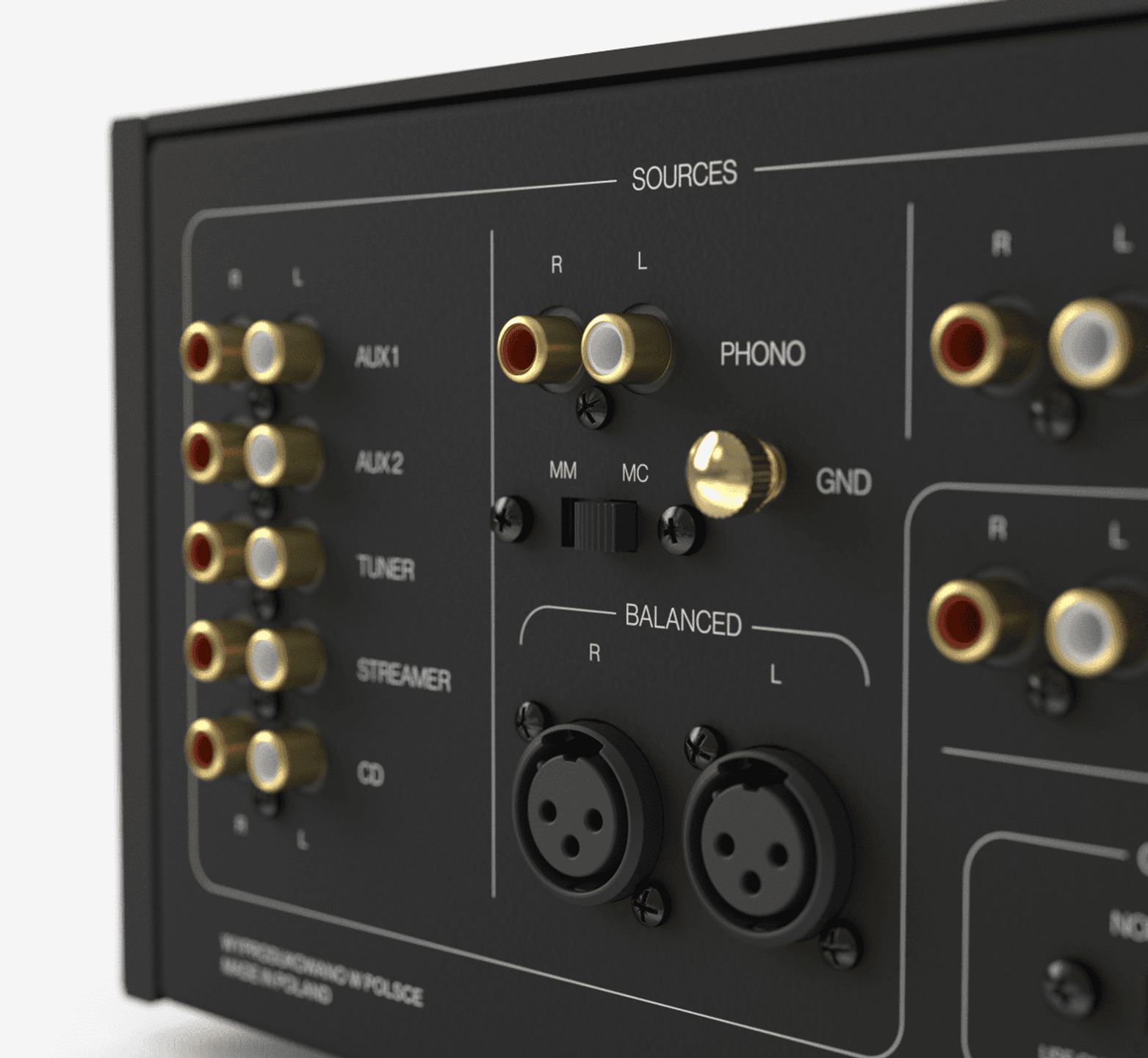
The WSH-805 fully embraces its analog positioning with connectivity free of any digital inputs. Five RCA inputs (Aux 1, Aux 2, Tuner, CD, Streamer) accommodate standard line sources. A switchable MM/MC phono input allows direct connection of a turntable without an external preamp. The Direct In input bypasses tone controls for purists seeking the shortest possible signal path.
The presence of a balanced XLR input reflects attention to professional connections. This input minimizes electromagnetic interference over long runs, particularly useful in complex setups.
The built-in phono preamp deserves special mention. MM/MC switching is handled on the front panel, automatically adapting gain and input impedance. While the MC section uses a fixed impedance optimized for most cartridges on the market, it still delivers commendable performance with a wide range of transducers.
Outputs include two pairs of speaker binding posts (A and B, usable separately or simultaneously), a headphone output on a 6.3 mm jack, and a preamplifier output on RCA. The dedicated headphone amplifier, designed for low impedances, efficiently drives the most demanding high-fidelity headphones.
Measurements that reflect rigorous engineering
The measured performance of the WSH-805 reflects the care devoted to its design. Total harmonic distortion, below 0.0008% at 1 kHz for 40 watts, places the amplifier among the most transparent in its class. The frequency response, extending from 6.3 Hz to 110 kHz at -3 dB, far exceeds the audible spectrum, ensuring faithful reproduction without phase alteration in the useful band.
The signal-to-noise ratio of 102 dB ensures an exemplary noise floor, even during the most delicate passages. The damping factor of 160 demonstrates excellent control of loudspeaker diaphragms, particularly beneficial in the low end.
These figures, while remarkable, tell only part of the story. The WSH-805’s fully analog philosophy prioritizes coherence and musicality over a spec sheet arms race. The total absence of digital signal processing preserves the integrity of the musical message from input to output.
What the press says
You'd have to have a heart of stone to not fall for the delightful retro look of UNITRA's WSH-805 amplifier, with its illuminated VU meters and large toggle switches.[...] The PCB construction is very neat — this is no amateur work, but rather Polish engineering at its finest.[...] The effortless reproduction of the WSH-805 comes across as fairly uncolored, certainly not very warm, which allows the many instruments contributing to the folk track to shine beautifully.[...] Built in Poland with a solid dose of technical knowhow and featuring a wonderful retro design, the WSH-805 excels with a balanced, resolution-rich performance that reveals a great deal in a relaxed manner.
Automatically translated — Show original (Dutch)
The Unitra WSH-805 integrated looks great on paper, but doesn’t have the sonic ability to back it up.[...] The presentation is pleasingly large-scale, and the amplifier has a firm sense of grip. It sounds taut, clean and crisp without exaggerating the leading edges of notes.[...] The Unitra’s presentation lacks finesse and natural warmth.[...] The built-in phono stage is surprisingly capable.
The build quality and heftiness of these control elements make the 18kg WSH-805 appear authentically luxurious, just as the overall fit and finish will give the likes of Yamaha's traditional A-series amplifiers a good run for their money. [...] Even in the tone controls' default 12 o'clock position there's some HF lift. [...] The denser and warmer approach of the WSH-805 made for an enjoyable complement. Nor is the WSH-805 too laidback. [...] People expecting two vastly different sonic palettes might be disappointed. [...] Whatever mode you choose, Unitra's WSH-805 serves up a stress-free, organic sound suited to hours of musical discovery.
Documentation
Technical Specifications
Power and Audio Performance
- RMS power: 80 W / 8 Ω (125 W / 4 Ω) in Class AB
- RMS power: 8 W / 8 Ω (16 W / 4 Ω) in Class A
- Total harmonic distortion: < 0.0008% @ 1 kHz / 40 W
- Intermodulation distortion: < 0.0015% @ 19 + 20 kHz / 10 W
- Frequency response: 6.3 Hz – 110 kHz (–3 dB)
- Signal-to-noise ratio: 102 dB
- Channel separation: > 100 dB @ 1 kHz
Connectivity and Inputs / Outputs
- Analog inputs:
- RCA (aux 1/2, tuner, CD, streamer, moving-magnet / moving-coil phono, direct input), balanced XLR
- Outputs: A/B/AB speaker binding posts, 6.3 mm headphone output, preamplifier output
- Built-in phono preamplifier with moving-magnet / moving-coil selection
- Built-in low-impedance headphone amplifier
Features and Controls
- Class A / Class AB switching to choose between maximum linearity or higher power
- Bass and treble control
- Intelligent adaptive contour
- Tone control bypass
- Stereo balance
- Swinging VU meters and classic interface with latching toggle switches
Dimensions and Weight
- Dimensions: 440 × 385 × 143 mm (W × D × H)
- Net weight: 18 kg
- Gross weight: 22 kg
Box Contents
- Power cord
- Remote control with battery
- User manual
- Warranty card
Frequently Asked Questions
What is the difference between the standard and Classic versions of the WSH-805?
The Classic versions differ only in their aesthetics, with solid American walnut side panels and brass details. The electronics, signal path, and performance remain strictly identical. The choice between the two is therefore purely about looks and budget, with the Classic versions being slightly more expensive.
How exactly does switching between Class A and Class AB work?
A front-panel switch changes the bias point of the output transistors. In Class A, they conduct continuously, dissipating constant power even at idle. In Class AB, they alternate conduction according to signal polarity. Switching from one mode to the other is instantaneous and does not require turning the unit off.
Can the built-in phono preamp replace a dedicated external preamp?
For most users, the integrated preamp offers entirely satisfactory performance. It handles MM cartridges and most common MCs properly. Vinyl enthusiasts with very specific MC cartridges or those seeking fine-tuning options (capacitance, variable load resistance) will, however, prefer a specialized external preamp.
Why does the amplifier weigh 22 kilograms?
This weight results from several factors: oversized power transformers for each channel (dual-mono architecture), massive heatsinks enabling Class A operation, a thick metal chassis to limit vibrations, and professional-grade components. This robust construction ensures thermal stability and longevity.
Is the absence of digital inputs a limitation in 2025?
The WSH-805 is aimed at music lovers who already have external digital sources (DAC, streamer) or who favor analog sources (vinyl, tuner). The absence of built-in digital-to-analog conversion preserves the purity of the analog path and lets each user choose their converter according to preferences and budget.
Which speakers pair best with the WSH-805?
In Class AB mode, the amplifier comfortably drives most speakers on the market, including models that are relatively demanding (4-ohm impedance, average sensitivity). In Class A, opt for high-sensitivity speakers (above 90 dB/W/m) to fully enjoy the sound quality without dynamic limitation.
- Eco-contribution included in the sale price.
- Manufacturer reference: WSH-805S
- GTIN / EAN: 5904541492650