Unitra WSH-605 black


Overview
The WSH-605 is a 70-watt stereo integrated amplifier into 8 ohms, developed by Unitra, a Polish manufacturer. It features patented gain error correction technology and an ESS Sabre digital-to-analog converter. Designed in Poland, it adopts a modular architecture allowing the integration of both analog and digital sources.
Metal construction and retro touch controls
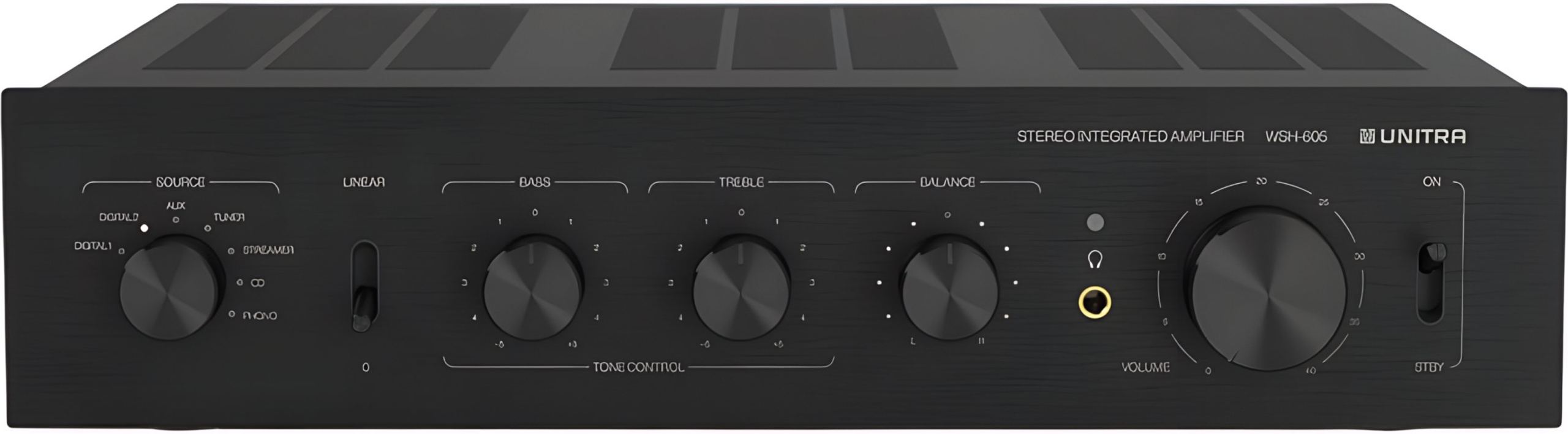
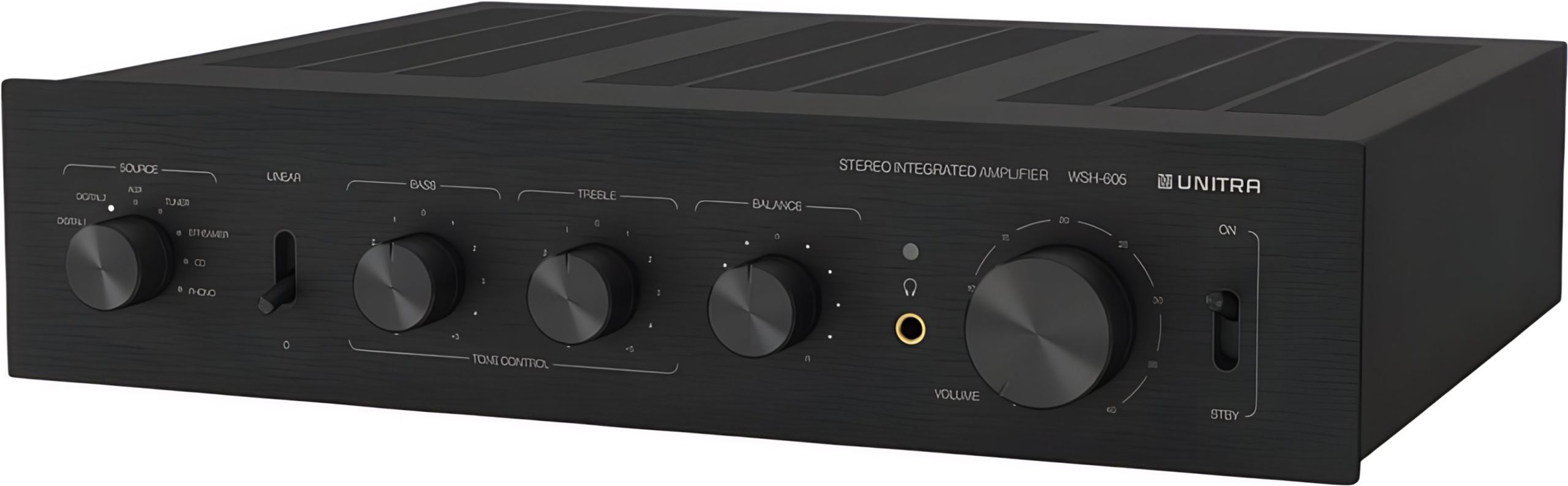
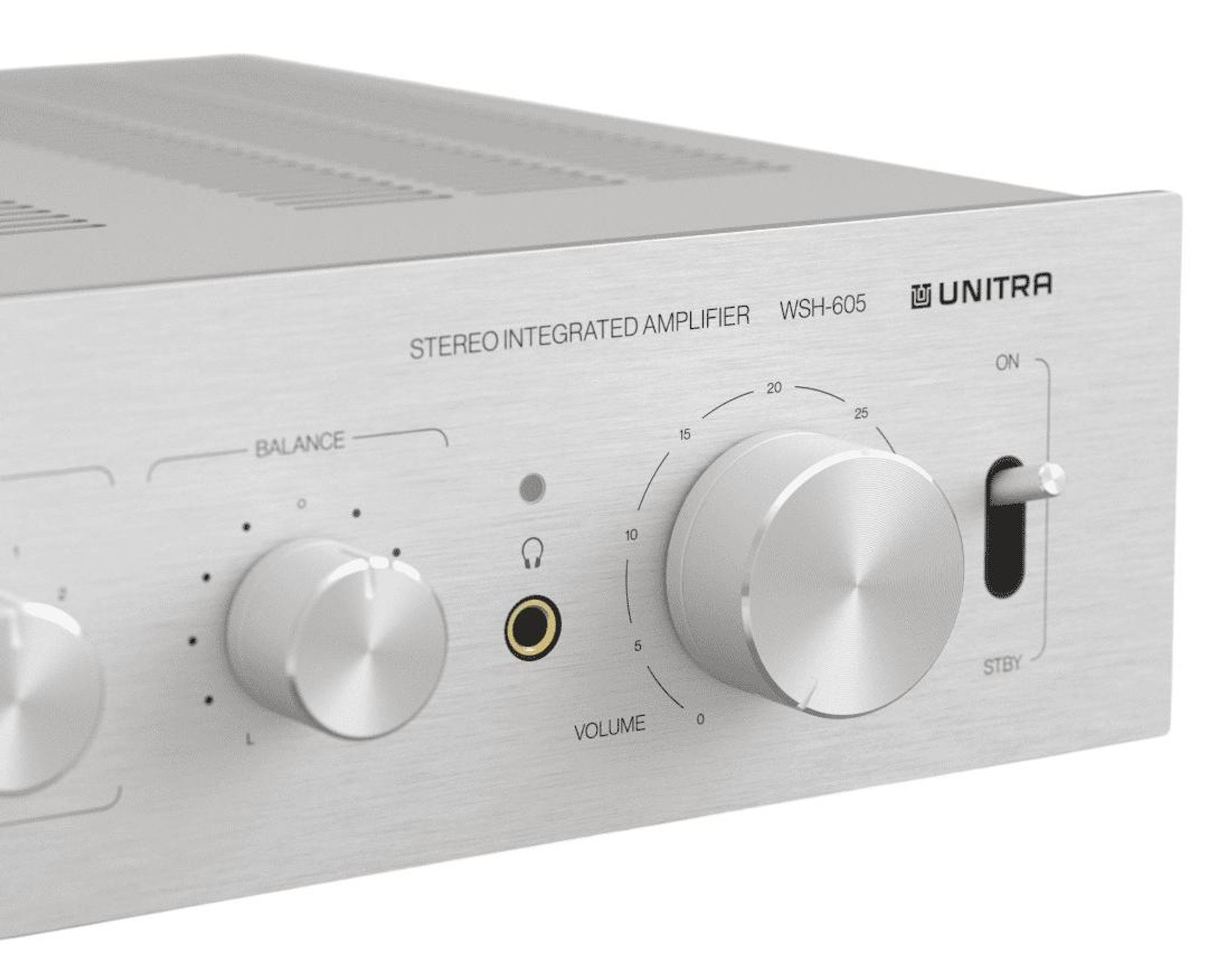
The WSH-605’s all-metal chassis reflects a robust build designed to last for decades. The brushed aluminum front panel, available in silver or black, gives the unit a discreet yet assertive presence. Its compact dimensions (440 mm wide, 372 mm deep, and 104 mm high) allow easy integration into any hi-fi rack, while the 11.8 kg weight ensures perfect stability even when operating the controls.
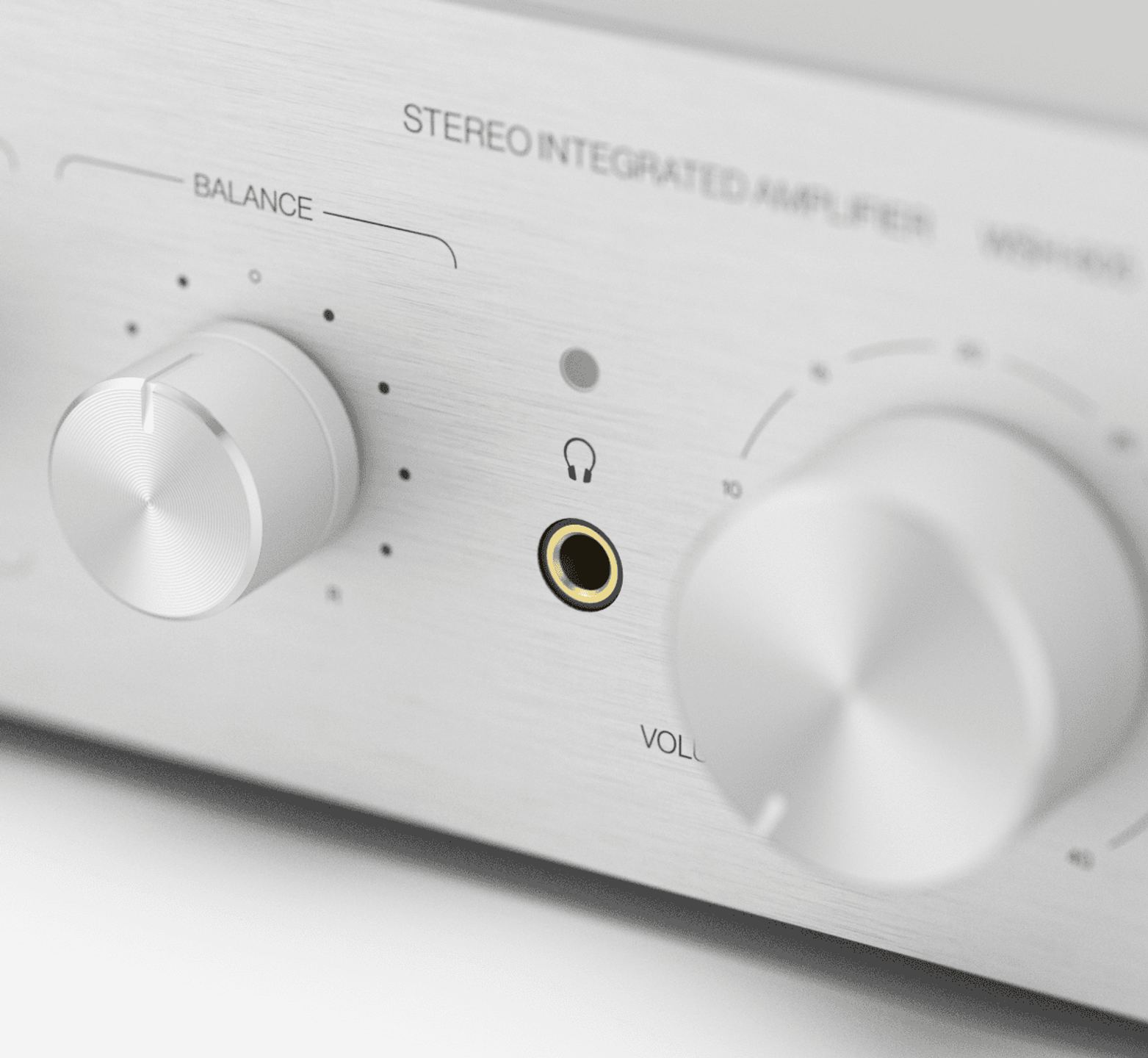
Four substantial rotary knobs adorn the front: volume, balance, bass, and treble. Their generous diameter and progressive travel allow fine adjustments, particularly appreciated for volume control thanks to a high-precision potentiometer. Two 1970s-style toggle switches complete the interface: one selects the sources, the other activates the “contour” function, which disables the tone controls for a direct signal path.
The front-mounted 6.3 mm headphone jack feeds a dedicated low-impedance amplifier, designed specifically for high-end headphones. This independent section delivers enough power to drive models that are particularly demanding in terms of impedance and sensitivity. Plugging in headphones automatically mutes the speaker outputs, avoiding any additional operation.
Gain error correction technology: an atypical approach
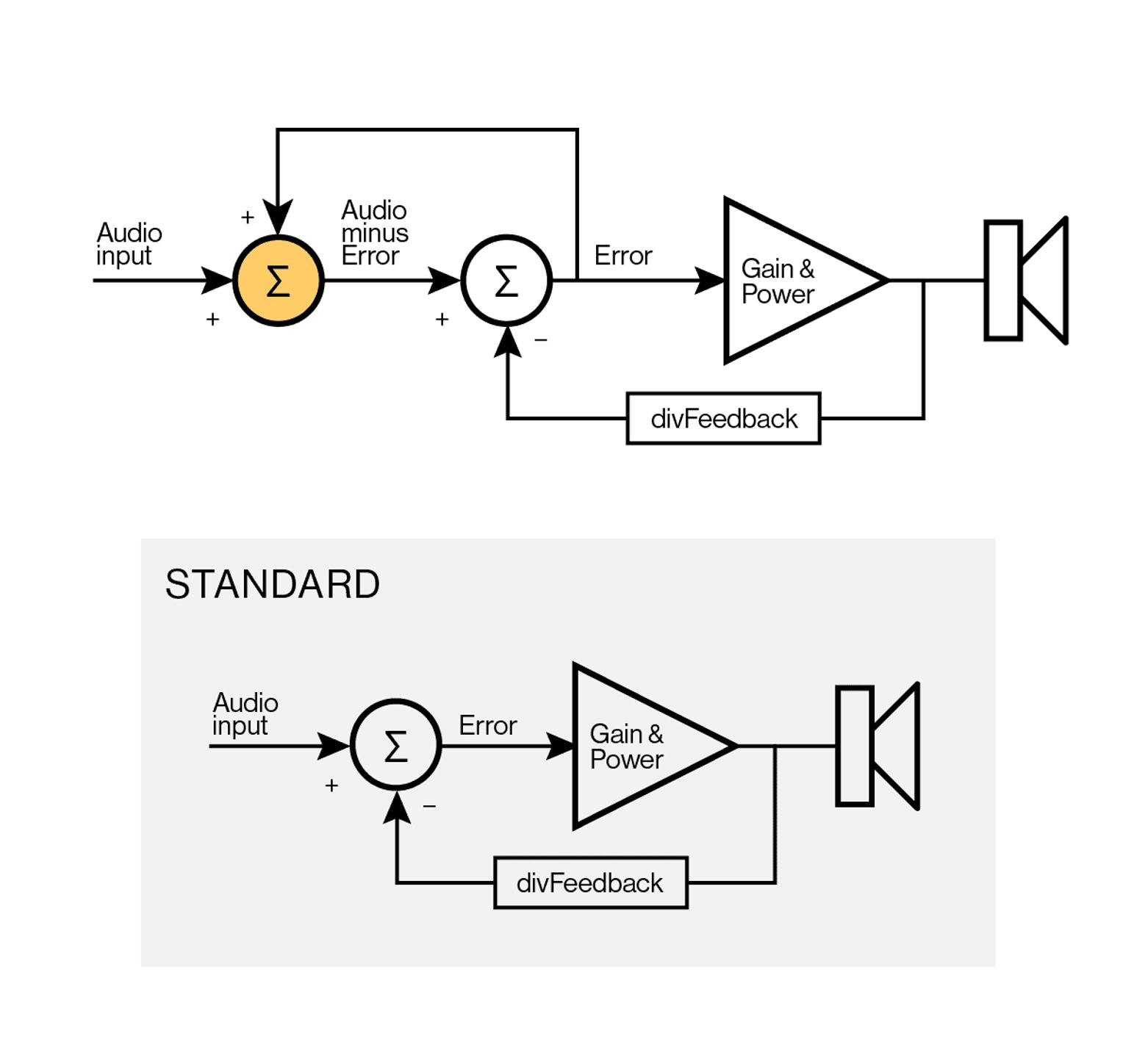
The WSH-605’s amplification section is based on a gain error correction technology implemented directly in the power stage—an approach rarely seen in commercial audio designs. Unlike traditional feedback circuits that attempt to correct distortions after the fact, this system compares in real time the signal after the output stage with the one at its input, then reinjects the calculated difference at the input.
This global correction precisely compensates for different types of distortion throughout the entire signal path. The result is a total harmonic distortion of only 0.0013% at 1 watt and 1 kHz, and intermodulation distortion below 0.0005% on the standard 19+20 kHz test. These exceptionally low values ensure crystal-clear sound reproduction, preserving micro-details and the harmonic texture of recordings.
Class AB amplification delivers 70 watts RMS into 8 ohms and 110 watts into 4 ohms, providing comfortable power reserves for the majority of speakers on the market. Frequency response extends from 7 Hz to 75 kHz, well beyond the audible spectrum, ensuring linear phase within the useful bandwidth. The 108.8 dB signal-to-noise ratio guarantees a remarkably quiet background, even at low listening levels.
ESS Sabre converter and digital source handling
The integrated ESS Sabre digital-to-analog converter is one of the WSH-605’s major assets. This chip, renowned in the industry for its outstanding performance, incorporates advanced jitter reduction technology that stabilizes the digital signal—even when it comes from consumer devices like TVs or set-top boxes that typically generate higher jitter levels.
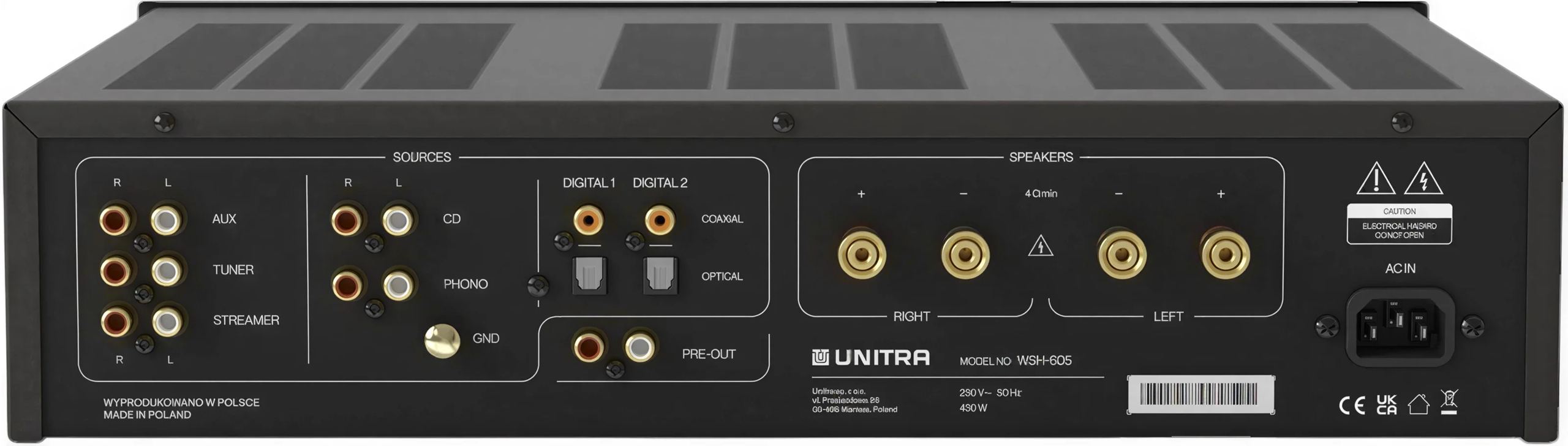
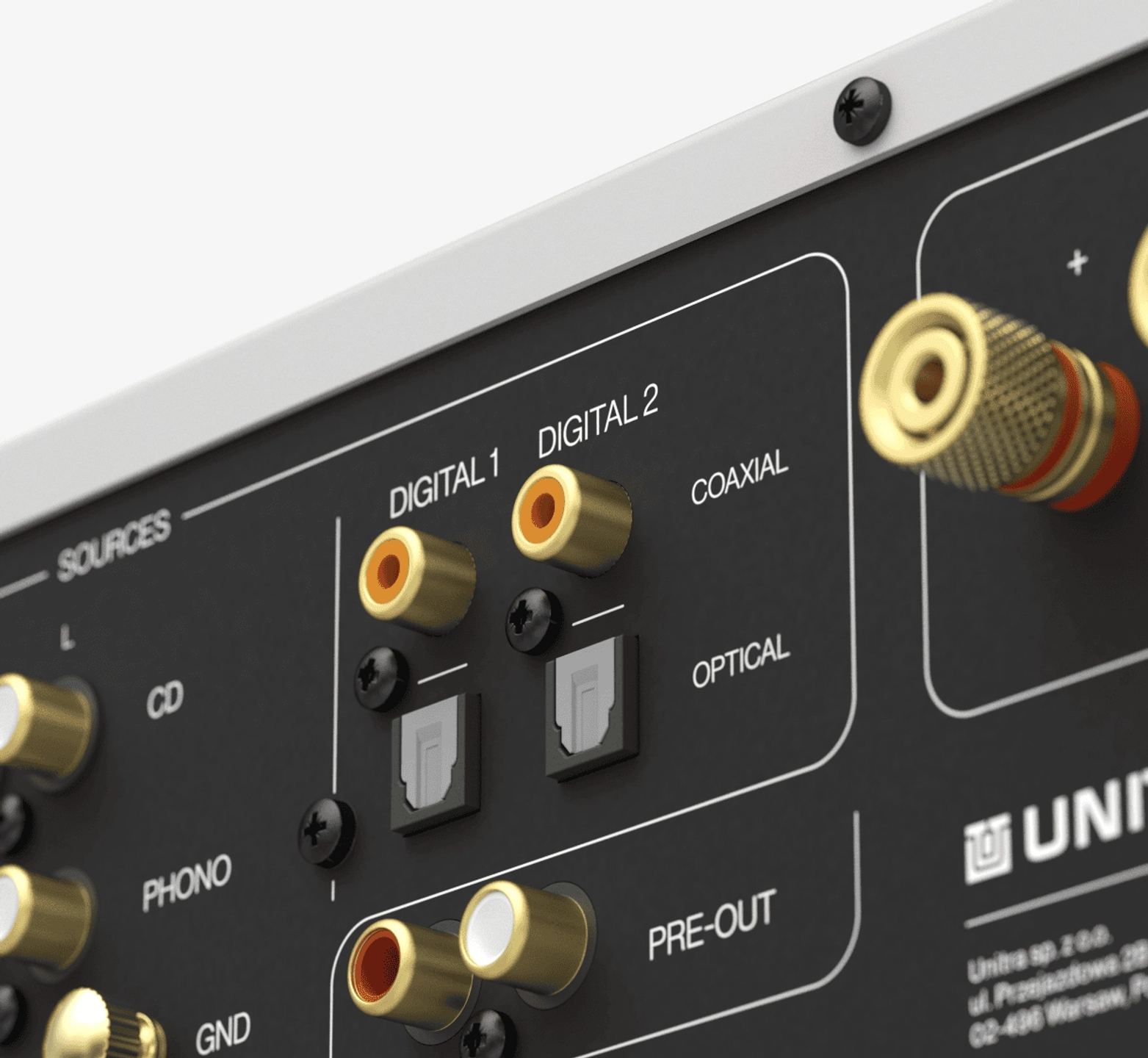
The DAC accepts PCM signals up to 192 kHz at 24-bit, thus covering all high-resolution formats available on streaming platforms and current physical media. Two coaxial and two optical inputs allow multiple digital sources to be connected simultaneously: CD player, TV, game console, network streamer, or computer. Switching between these sources is done via the front rotary selector, with automatic memory of the last source used.
ESS’s patented HyperStream technology pushes modulation noise out of the audio band, preserving the soundstage in all its purity and spatial coherence. This architecture also delivers a flat noise floor up to 200 kHz—a sought-after characteristic for natural reproduction of transients and upper harmonics.
Preamplification section and integrated phono stage
The WSH-605’s preamplification section includes a dedicated phono stage for moving magnet (MM) cartridges, allowing direct connection of a turntable without an external preamp. The ground post adjacent to the phono input provides an effective equipotential link with the turntable chassis, minimizing hum. The RIAA circuit applies the standard de-emphasis curve with precision, restoring the original tonal balance of the records.
Internal connections between the inputs on the rear panel and the front panel potentiometers use a symmetrical configuration. This differential architecture effectively rejects electromagnetic interference and common-mode noise that can couple onto internal links, particularly in urban environments saturated with radio waves and electrical disturbances.
Five line inputs accommodate traditional analog sources: tuner, network player, CD player, VCR, or any other line-level device. A variable preamplifier output allows the addition of an external power amplifier or an active subwoofer, with volume, tone, and balance functions remaining active on this output. This flexibility enables progressive system upgrades without replacing the main amplifier.
Remote control and user ergonomics
The supplied remote control offers essential functions from the listening position: volume adjustment, mute, source selection, and standby. A particularly well-thought-out “linear” button lets you enable or disable tone corrections remotely, making instant comparisons between the direct and equalized signals easy. This is valuable for assessing the impact of tone settings on different recordings.
Volume is adjusted in fine steps for precise level control. The mute function instantly cuts the signal to both speakers and headphones—handy during phone calls or to maintain neighborhood peace. Standby reduces power consumption while keeping control circuits powered for instant wake-up.
High-quality speaker terminals accept banana plugs, spades, or bare wire. Their generous spacing makes it easy to connect large-gauge cables, while progressive clamping ensures optimal electrical contact without risking damage to the conductors. The clear layout with color coding (red for positive, black for negative) prevents potentially harmful wiring errors.
Documentation
Technical Specifications
Power and audio performance
- Continuous power: 70 W / 8 Ω, 110 W / 4 Ω
- Frequency response: 7 Hz – 75 kHz
- Signal-to-noise ratio: 108.8 dB
- Channel separation: > 75 dB @ 1 kHz
- Total harmonic distortion: 0.0013% @ 1 W, 1 kHz
- Intermodulation distortion: < 0.0005% (19 + 20 kHz, 1:1)
- Dynamic, natural Class AB amplification
Digital conversion and signal processing
- Built-in ESS Sabre digital-to-analog converter
- Precise digital-to-analog conversion
- Advanced jitter reduction
- Compatible with TVs and set-top boxes
- Advanced error-correction technology
- Low harmonic distortion
- Minimal intermodulation
Connectivity and inputs/outputs
- Analog inputs: AUX, tuner, network player, CD, phono + ground (moving magnet)
- Digital inputs: 2 coaxial, 2 optical
- Outputs: speaker terminals, preamp output, 6.3 mm headphone
- Symmetrical signal paths between inputs and potentiometers to reduce interference
Controls and adjustments
- Precise volume, balance, and tone controls
- Audio adjustments: bass, treble, contour (tone control bypass), balance
- Built-in source selector
- Built-in moving-magnet phono stage
- Low output-impedance headphone amplifier for high-end headphones
Physical characteristics
- Dimensions (W × D × H): 440 × 372 × 104 mm
- Weight: 11.8 kg
- Metal chassis with brushed aluminum front panel
- Sturdy knobs and retro switches
Frequently Asked Questions
Can the WSH-605 drive hard-to-handle speakers?
With 110 watts into 4 ohms and a high damping factor, the WSH-605 effectively controls the majority of speakers on the market. Its class AB topology provides excellent stability with complex loads. However, for speakers that are particularly current-hungry or present very low impedances (below 2 ohms), adding an external power amplifier via the pre-out remains an option.
How does the error correction technology actually work?
The system continuously compares the amplified output signal with the original input signal. Detected differences—whether harmonic distortion, intermodulation, or other artifacts—are calculated and then reinjected in opposite phase at the amplifier input. This continuous correction loop compensates for the inherent non-linearities of electronic components, resulting in an output signal practically identical to the input signal, simply amplified.
Is the phono stage suitable for high-end cartridges?
The integrated phono stage delivers solid performance for MM cartridges up to around 200–300 euros. Beyond that, demanding vinyl enthusiasts can connect a higher-quality external phono preamp to one of the line inputs to fully exploit the potential of pricier MM or MC cartridges (with a step-up transformer).
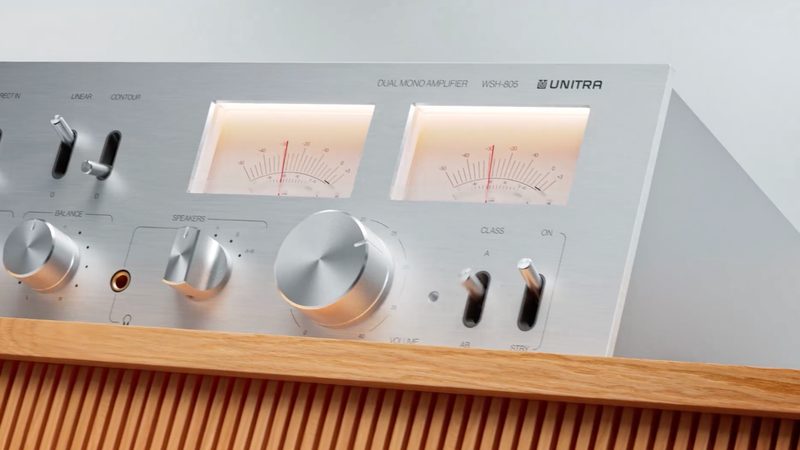
What’s the difference between the WSH-605 and the WSH-805?
The WSH-805, the higher-end model, adopts a fully dual-mono configuration with 80 watts per channel, backlit VU meters, and a switchable MM/MC phono stage. However, it does not include the digital-to-analog converter found in the WSH-605. The choice therefore depends on your priorities: multiple digital sources, or dual-mono architecture with visual level metering.
Do the digital inputs support DSD formats?
No, the WSH-605 handles PCM signals up to 192 kHz/24-bit via its coaxial and optical inputs only. For DSD file playback, use a player or streamer capable of converting DSD to PCM before transmission, or connect an external DSD-compatible DAC to one of the analog inputs.
How does the amplifier perform with high-impedance headphones?
The integrated low-impedance headphone amplifier was specifically designed for high-end models. Independent tests confirm its ability to properly drive demanding headphones like the HEDD Phone Two, known for its low sensitivity. The circuit provides sufficient voltage and current to realize the potential of most audiophile headphones on the market.
Can the tone controls be completely disabled?
Yes, the “contour” function accessible via one of the front-panel switches completely bypasses the bass/treble tone circuits. The signal then passes through the amplifier without any alteration to its frequency response—ideal for quality recordings and systems whose acoustics have been carefully optimized.
Does the amplifier run hot during prolonged use?
Class AB offers higher energy efficiency than pure class A, limiting heat dissipation. The metal chassis actively contributes to cooling via conduction and radiation. In normal home use, even after several hours of listening, temperature remains moderate. Natural convection is sufficient, without requiring significant clearance around the unit.
- Eco-contribution included in the sale price.
- Manufacturer reference: WSH-605B
- GTIN / EAN: 5906067291236