Hisense 55UR8S 2026
Specifications and features



Overview
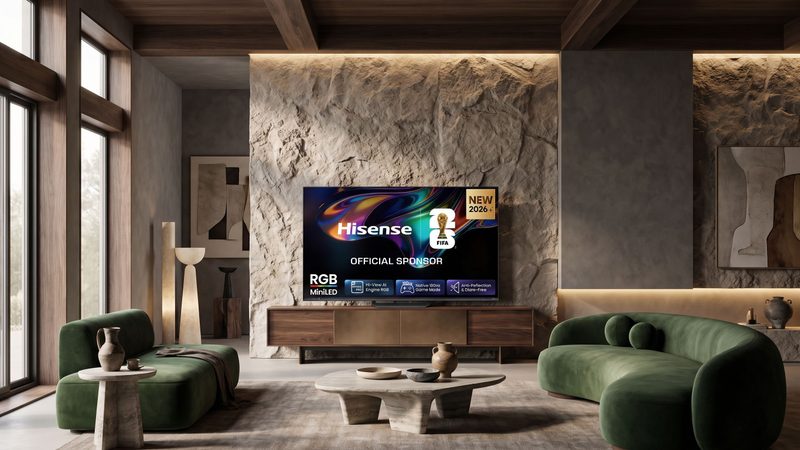
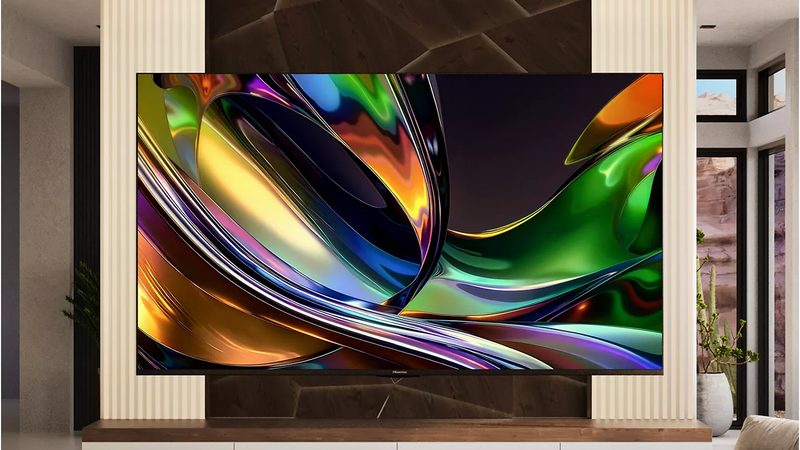
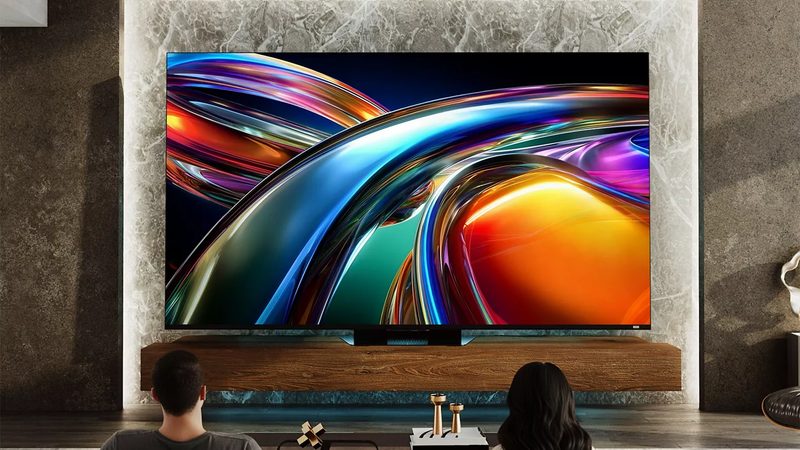
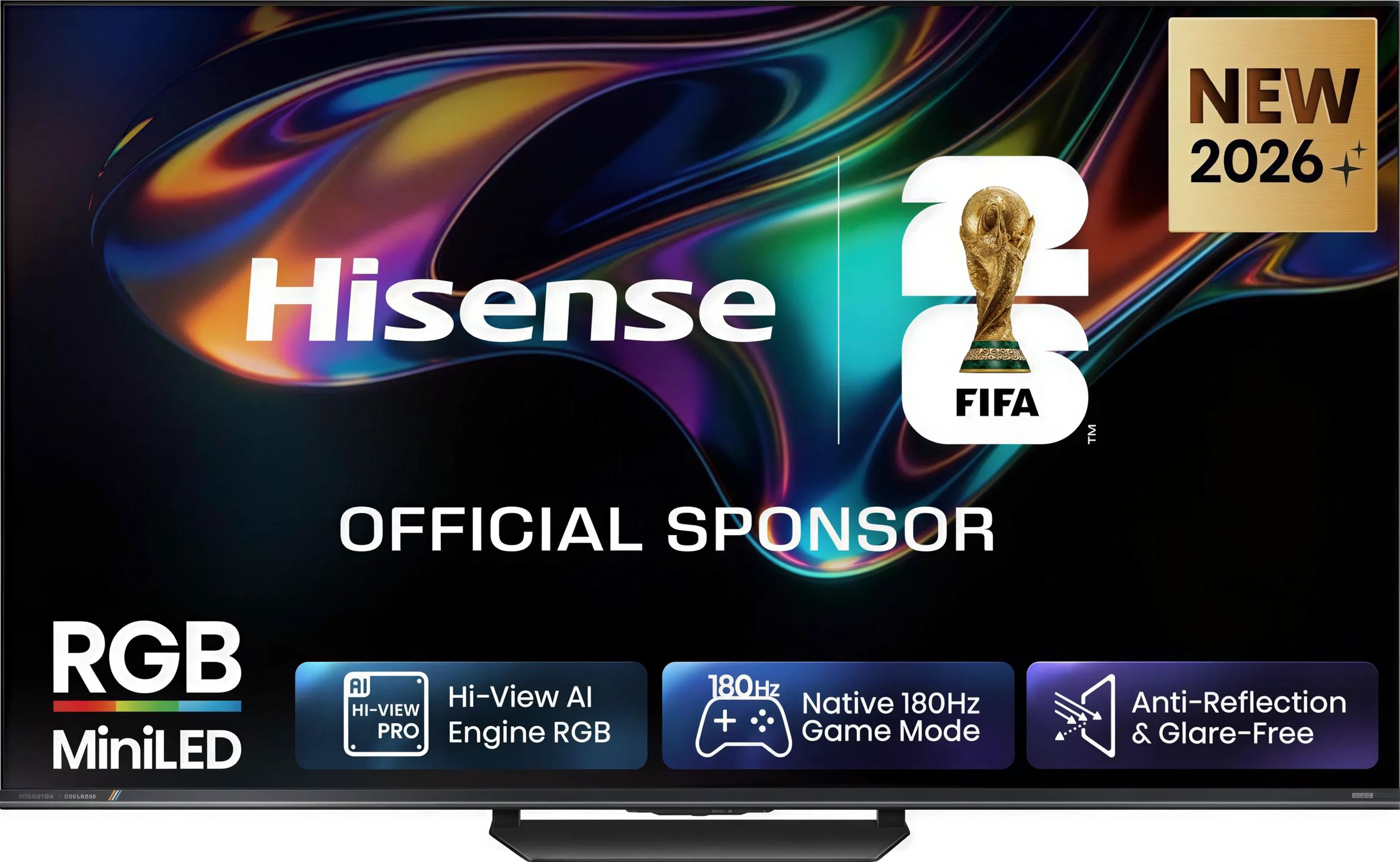
Producing red, green, and blue directly at the source rather than filtering white light: the principle behind RGB MiniLED backlighting changes the way an LCD screen creates its colors. In 2026, Hisense is introducing it on its UR8S series, whose 139 cm model opens the range with a 4K 180 Hz panel and an audio section tuned by Devialet. It remains to be seen what this technology actually brings to a living-room-sized screen.
Red, green, and blue at the source
Conventional MiniLED backlighting illuminates the panel with white or blue diodes, whose light then passes through colored filters. Each filter absorbs part of the light output and limits the purity of the resulting shades. On the 55UR8S, each backlight zone uses independent red, green, and blue diodes, which produce the color before any filtering. The backlighting remains DLED-type, spread across the entire surface of the panel rather than along its edges.
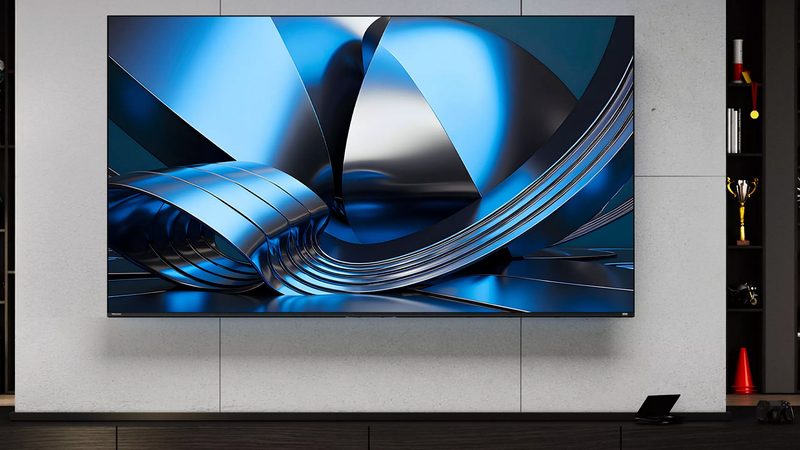
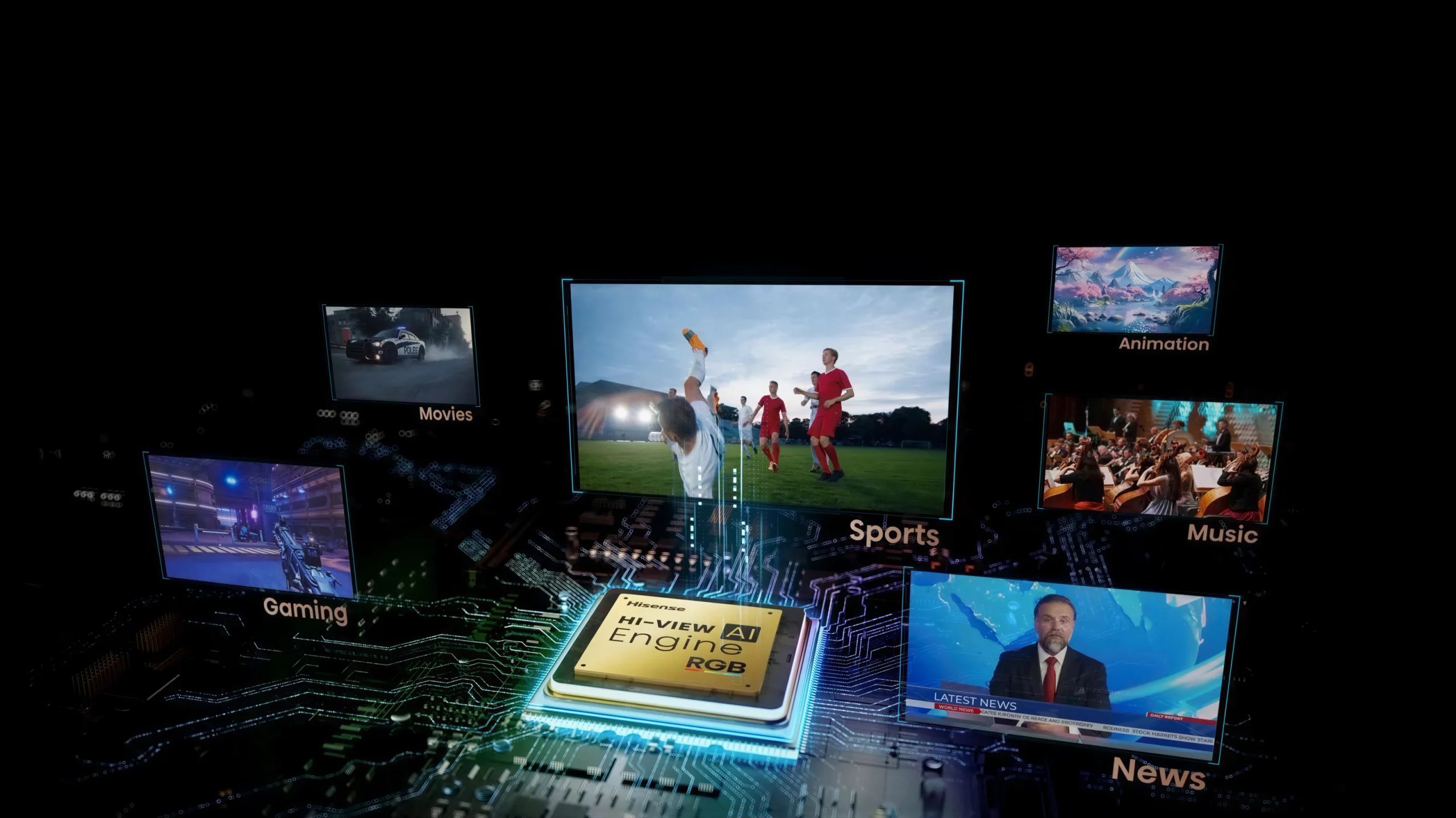
The gain is measured in color volume. Deep reds, saturated greens, and the blues of night scenes gain in accuracy rather than aggressiveness. Control is handled by the Hi-View Engine RGB processor, which adjusts in real time the light distribution between zones and the hue emitted by each of them.
This design does not eliminate the constraints of LCD. Blacks still depend on the precision of local dimming, and a very bright source against a dark background can still produce a slight halo. The number of zones and their colorimetric control reduce the effect without eliminating it.
A matte panel against living room reflections
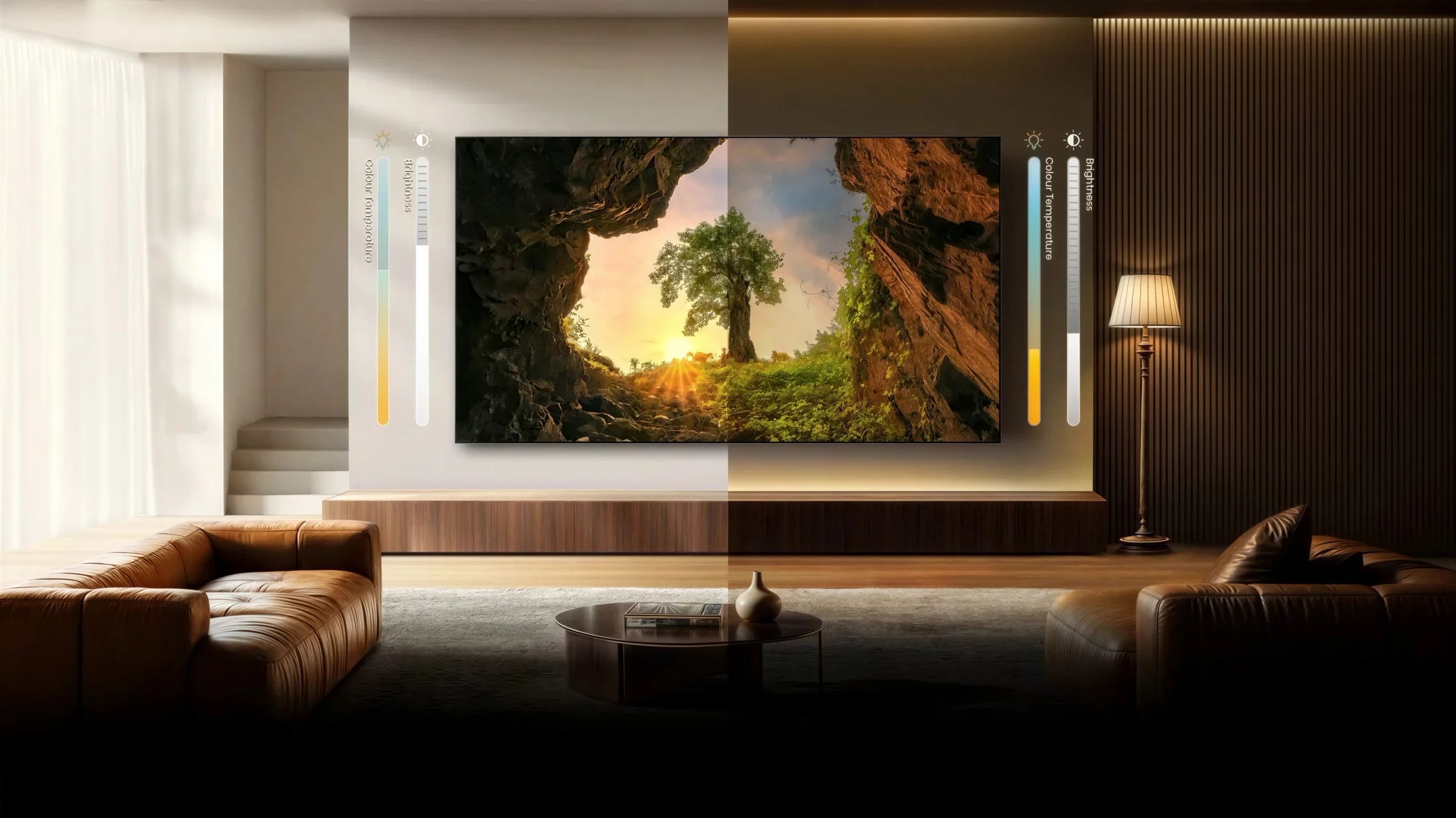
The anti-reflective finish used on this series diffuses stray light instead of reflecting it like a mirror. A side window or ceiling light no longer creates a sharp image on the screen. The trade-off is familiar: in a completely dark room, a matte panel appears slightly less deep than a glossy one, as residual ambient light is spread across the entire surface.
Hisense announces peak brightness of up to 4000 nits, a value measured on a reduced window as is standard practice. Combined with the anti-reflective treatment, this light reserve makes HDR content viewable in broad daylight, which remains the main limitation of self-emissive panels. Compatibility covers HDR10, HDR10+, HDR10+ Adaptive, HLG, and Dolby Vision 2, with Dolby Vision Gaming and HDR10+ Gaming variants. The AI RGB Light Sensor measures room lighting to adapt the rendering, a function that Filmmaker mode disables in favor of the original signal. IMAX Enhanced certification rounds out the package.
Native 180 Hz and four HDMI 2.1 inputs
All four HDMI ports are 2.1 standard, with ALLM and VRR up to 180 Hz on each of them. A console, a PC, an Ultra HD Blu-ray player, and a soundbar can coexist without compromise, with the latter using HDMI3, the only port equipped with eARC.
Hisense states input lag of less than or equal to 7 ms in 4K 120 Hz, with automatic switching to game mode thanks to ALLM. AMD FreeSync Premium Pro certification completes the synchronization package. Current consoles top out at 120 Hz in 4K: 180 Hz finds its use on a PC whose graphics card can deliver such a frame rate. Panel response time is rated at 6.5 ms, and MEMC motion compensation comes into play on low-frame-rate video content, with the smoothing effect that implies for cinema.
Devialet at the controls of a 2.1.2 system
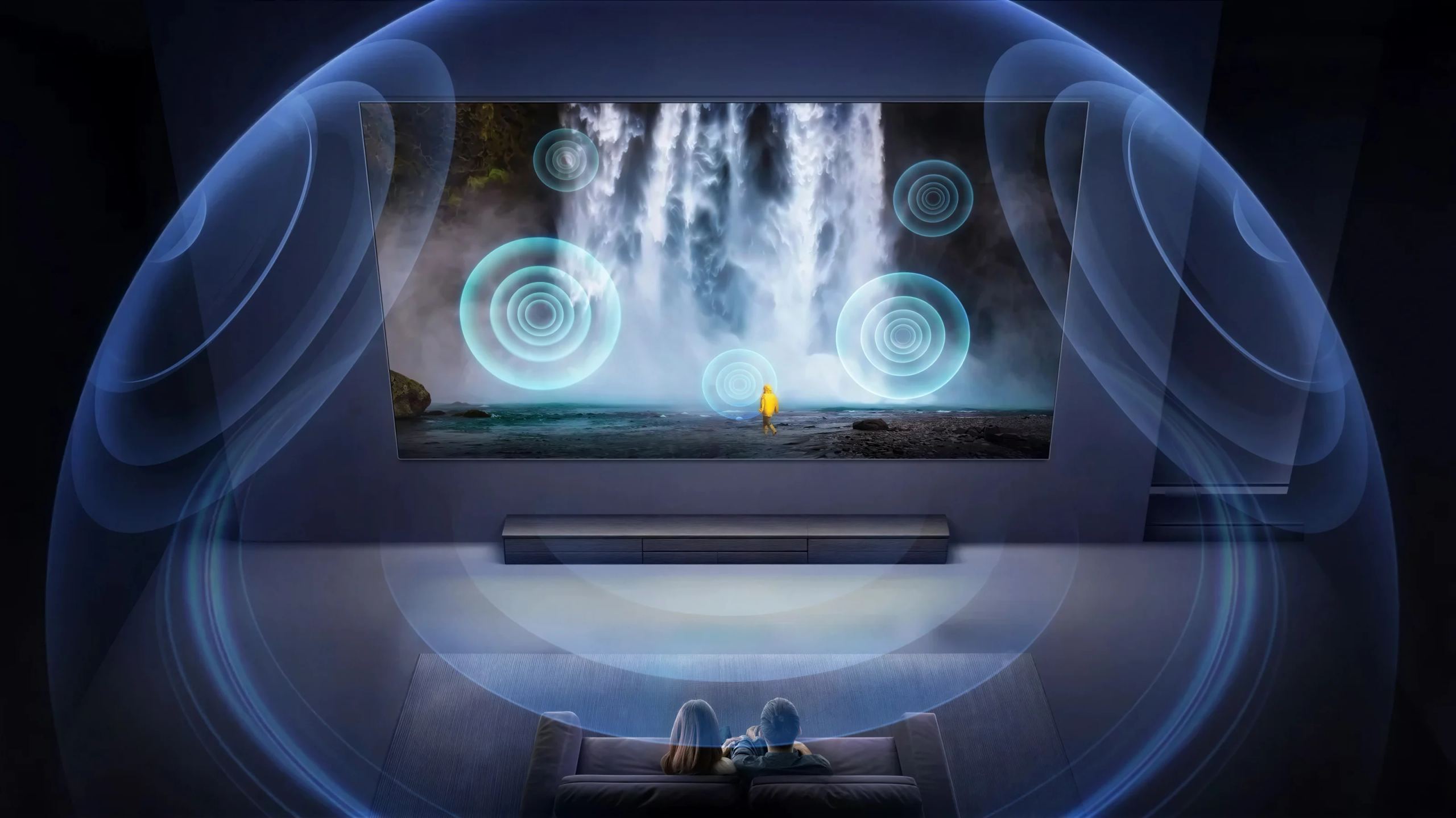
The audio configuration combines two 10 W main channels, an integrated 20 W subwoofer, and two 5 W upward-firing speakers handling height effects, for a total of 50 W. Devialet provides the tuning, as on the brand’s previous high-end series. Dolby Atmos decoding uses the two ceiling-facing channels to widen the soundstage.
You have to measure what 50 W can do in a 52 mm thick chassis: clarity in dialogue, solid enough presence in low-end layers, noticeable height in well-crafted scenes. Explosions and deep bass call for reinforcement. The Hi-Concerto function addresses this need by synchronizing the TV’s speakers with those of a compatible Hisense soundbar, rather than muting them. EzPlay, AI Sound, a TV mode, and a built-in equalizer complete the fine-tuning.
VIDAA rather than Google TV
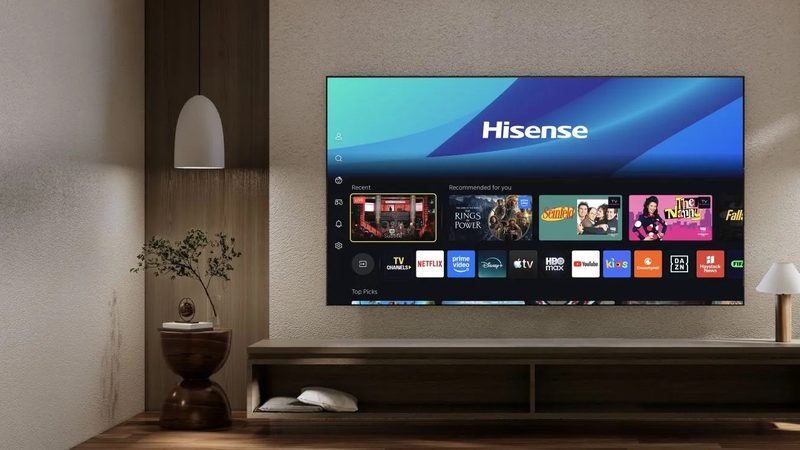
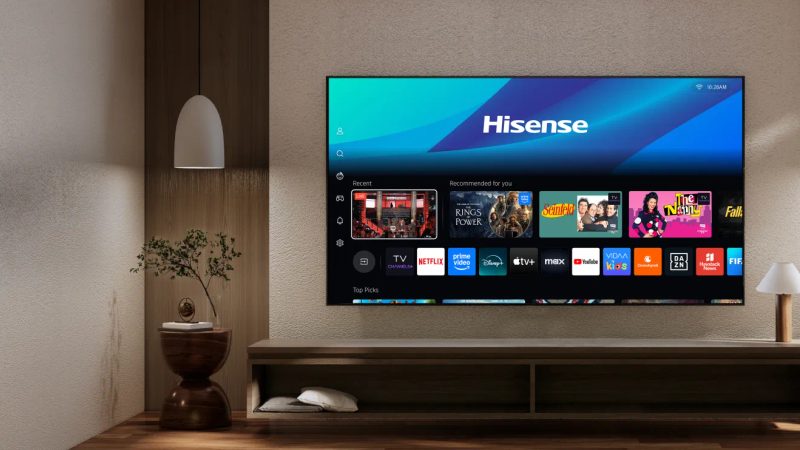
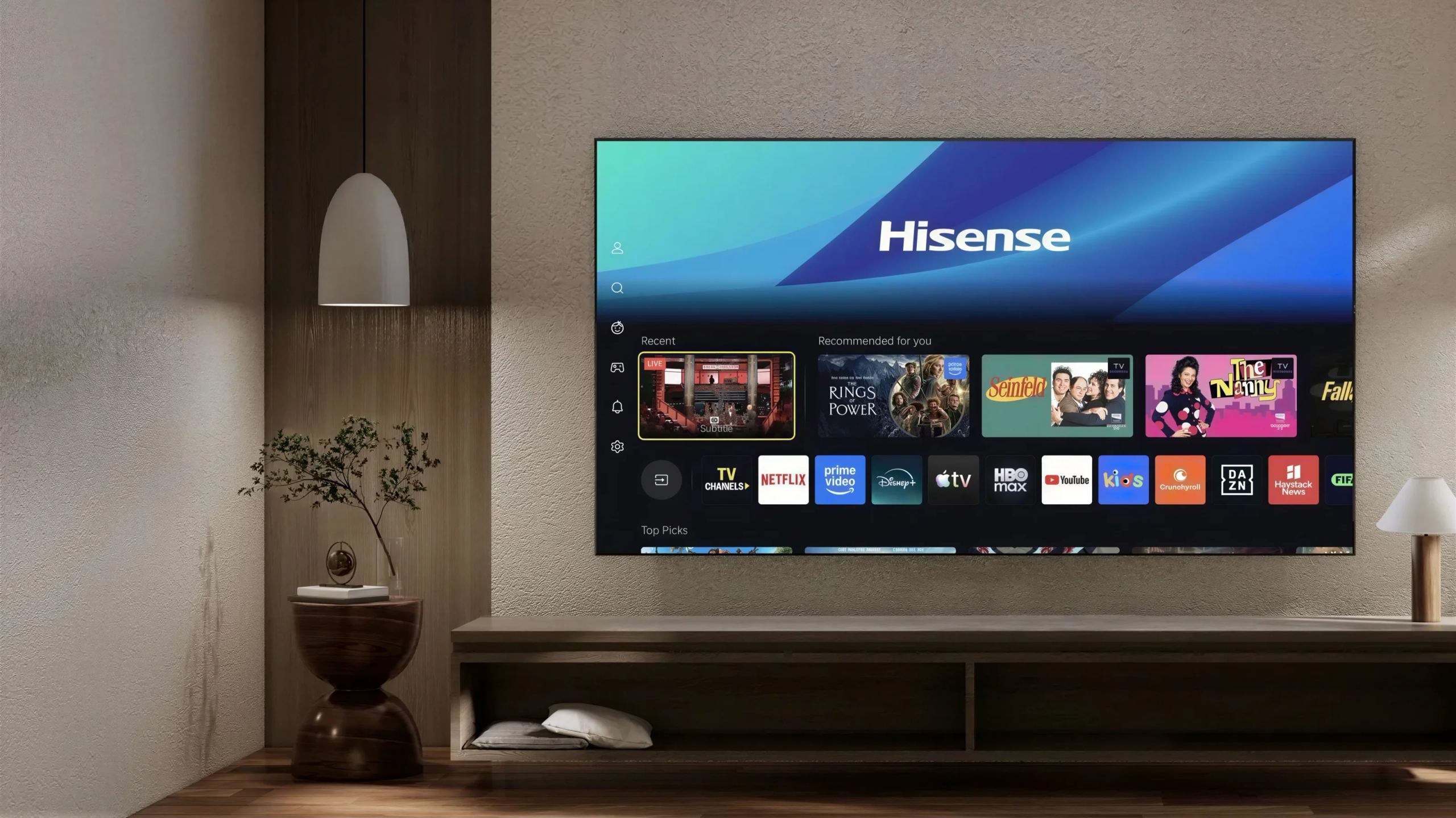
Hisense is keeping its in-house system. VIDAA Smart OS starts quickly, navigates without troublesome lag, and provides access to the major streaming platforms. AirPlay 2 is built in, sparing iPhone or Mac users from having to install anything to stream video or photos. Screen sharing and DMP/DMR protocols handle local sources.
The caveat concerns the app catalog. VIDAA remains less extensive than the most widespread platforms, and some local channel apps, regional catch-up services, or radio apps do not exist in this form. Checking for the presence of your app before buying helps avoid unpleasant surprises.
The dual tuner supports DVB-T2, DVB-C, and DVB-S2 standards, with a CI+ 2.0 slot for subscription cards. Wi-Fi covers the 2.4 and 5 GHz bands in 802.11ac, a generation behind the latest standards but sufficient for 4K streaming if the access point is properly positioned. The Ethernet port remains the most stable solution. One USB 3.0, one USB 2.0, an optical output, and Bluetooth round out the package.
A central stand and a solar remote
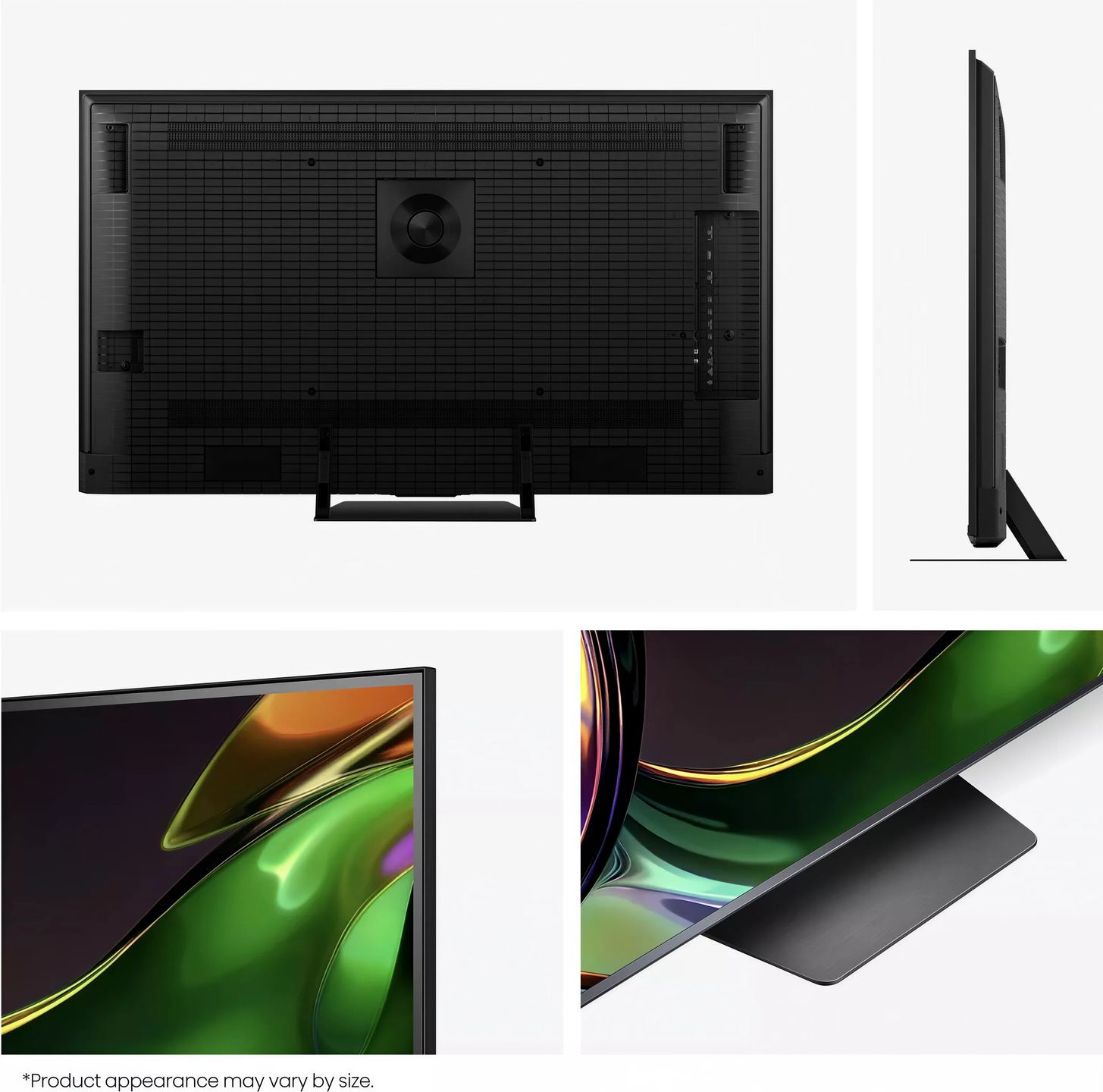
The chassis measures 52 mm at its thickest point and weighs 18.2 kg, which remains reasonable for wall mounting in VESA 400 × 400 mm format. The bezels are limited to 1 mm on three sides, with the bottom reaching 15.6 mm to house the electronics and sensor.
The stand is central rather than positioned at the ends. Its metal base measures 377 mm wide by 263 mm deep: a narrow piece of furniture will do, whereas two feet set far apart would require a width close to that of the TV. The stand is adjustable and includes cable management.
The remote recharges using ambient light, eliminating battery replacement. Maximum power consumption reaches 180 W, for energy class E in SDR and G in HDR, a logical difference given the brightness HDR requires on this type of backlighting. An automatic power-off timer completes the energy-saving settings.
Documentation
European product sheet
FrenchTechnical data sheet
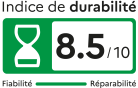
FrenchDurability index
French
Technical specifications
Display
- Screen type: RGB MiniLED with independent red, green, and blue LED backlighting
- Screen size: 55” (139 cm)
- Resolution: Ultra HD 4K (3840 × 2160)
- Aspect ratio: 16 / 9
- Native refresh rate: 180 Hz
- Viewing angle: 178°
- Response time: 6.5 ms
- Color gamut coverage: up to 100% BT.2020
- Peak brightness: up to 4000 nits
- Matte panel with anti-glare treatment
- HDR compatibility: HDR10, HDR10+, HDR10+ Adaptive, HLG, Dolby Vision, Dolby Vision Gaming, HDR10+ Gaming
- Hi-View Engine RGB video processor
- MEMC motion compensation
- Picture technologies: AI Picture, AI HDR Upscaler, AI 4K Upscaler, AI RGB Light Sensor, AI Sports Mode, AI Scenario
- Filmmaker Mode
- IMAX Enhanced certification
Gaming
- Native 180 Hz Game Mode
- HDMI 2.1 on all four inputs
- VRR (Variable Refresh Rate) up to 180 Hz
- ALLM (Auto Low Latency Mode)
- AMD FreeSync Premium Pro
- Input lag ≤ 7 ms (4K 120 Hz signal)
Audio
- Audio system: 2.1.2 channels
- Total power: 50 W (2 × 10 W + 20 W + 2 × 5 W)
- Dolby Atmos compatible
- AI Sound
- Tuned by Devialet
- Hi-Concerto
- EzPlay
- Built-in equalizer
Smart TV
- Operating system: VIDAA Smart OS
- Hands-free voice control
- AirPlay 2
- Screen sharing
- Smart Home Ready: Matter, Google Home, Apple Home
- Built-in media player
Connectivity
- 4 × HDMI 2.1 (including 1 eARC-compatible)
- 1 × USB 3.0
- 1 × USB 2.0
- 1 × optical S / PDIF output
- 1 × Ethernet RJ45
- Dual tuner: DVB-T2 / T / C / S2 / S
- CI+ 2.0
- Dual-band Wi-Fi (2.4 / 5 GHz)
- Bluetooth
Installation and accessories
- Compatible with VESA 400 × 400 mm wall mount
- Central metal stand with cable management
- Remote control rechargeable by solar energy and USB-C
Dimensions and weight
- Dimensions with stand (W × H × D): 1226 × 744 × 263 mm
- Dimensions without stand (W × H × D): 1226 × 714 × 52 mm
- Weight: 18.2 kg
Power consumption
- SDR energy class: E
- HDR energy class: G
- Maximum power consumption: 180 W
- Standby: 0.5 W
Frequently Asked Questions
What screen sizes are available in the UR8S series?
The series includes five sizes, from 55 inches to 100 inches. Video processing, connectivity, and audio configuration are shared across the different sizes, but peak brightness and the number of dimming zones increase with screen size.
What viewing distance should I choose for a 55-inch TV?
Between 1.80 m and 2.50 m depending on individual sensitivity. In 4K, the pixel structure becomes invisible from about 1.70 m on this screen size, allowing for a shorter viewing distance than in Full HD. Installation height matters just as much as distance: the center of the screen should be at eye level when seated.
Does the 55UR8S have a headphone jack?
No, no wired headphone output is built in. Individual listening is via Bluetooth, with the latency inherent to that connection, or via the optical output to a headphone amplifier.
Which HDMI cable is needed to enjoy 4K at 120 Hz?
An Ultra High Speed certified cable, capable of carrying 48 Gbit/s. Older High Speed or Premium High Speed cables are sufficient for 4K 60 Hz but cause signal dropouts, flickering, or no picture in 4K 120 Hz with HDR. The certification is indicated on the packaging and often on the connector itself.
Can this television be used as a PC monitor?
Yes, with reservations. The native 180 Hz and FreeSync Premium Pro are suitable for gaming, and low-latency mode activates automatically when the graphics card signals it. For text, a 55-inch panel viewed at close range requires adjusting the sharpness and picture mode, and noise reduction processing must be disabled. Chroma subsampling must be set to 4:4:4 in the HDMI input settings to obtain clean text.
Does the television allow recording programs to a USB drive?
PVR and Time Shift functions depend on the market: Hisense makes them subject to local regulations and configuration. On models distributed in France, their availability must be checked on the specific unit concerned, as the presence of USB ports does not guarantee them.
Which formats does the built-in media player support?
For video: AVI, MP4, MKV, TS, FLV, WMV, MOV, and WEBM containers, with AV1, HEVC/H.265, AVC/H.264, VP9, VP8, VC1, and MPEG family decoders. For audio: WMA, FLAC, MP3, and WAV. For images: JPEG, PNG, BMP, GIF, and JPG. A disk formatted in exFAT remains the safest choice for large files.
How does Hi-Concerto work with a soundbar?
The TV’s speakers remain active and synchronize with those of the compatible Hisense soundbar, instead of being muted as with a standard eARC connection. The TV’s height channels then complement those of the soundbar. The function requires a soundbar from the brand listed in the compatibility list, and up-to-date firmware on both devices.
- Eco-contribution included in the sale price.
- Spare parts available for 7 years
- GTIN / EAN: 6942351436500