Hisense 75UR8S 2026

Specifications and features



Overview
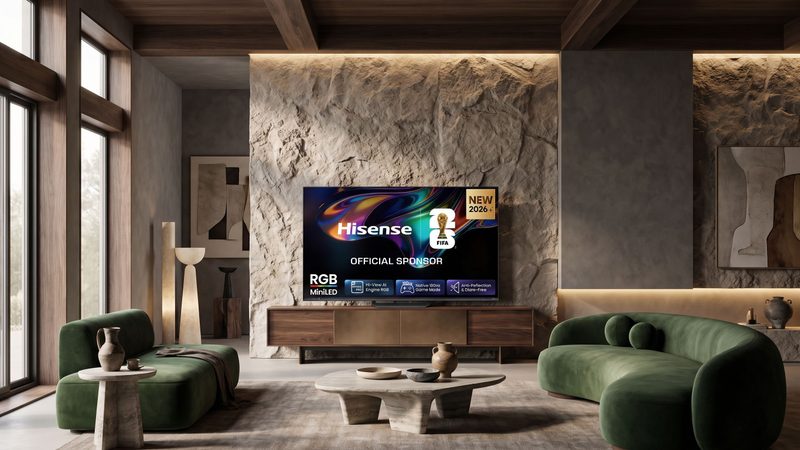
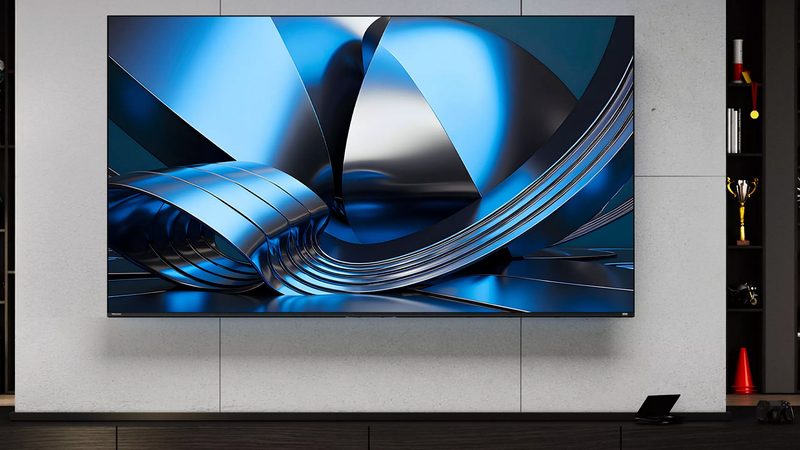
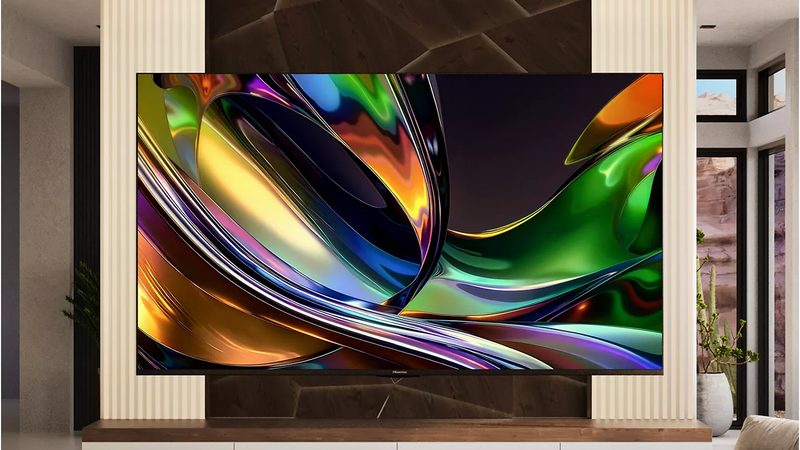
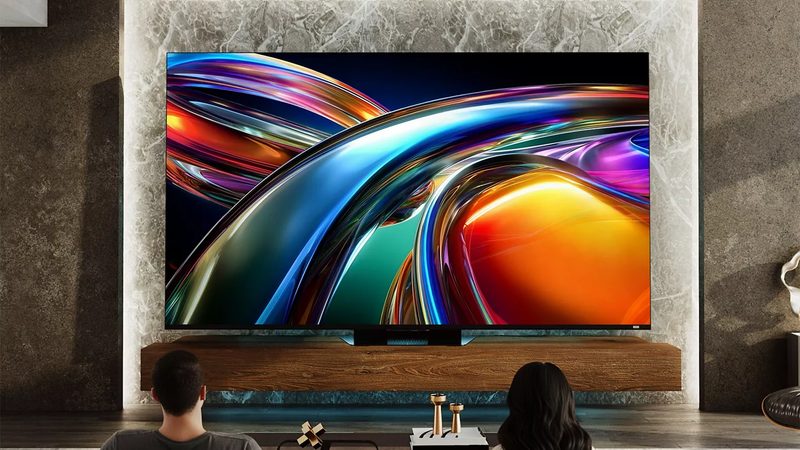
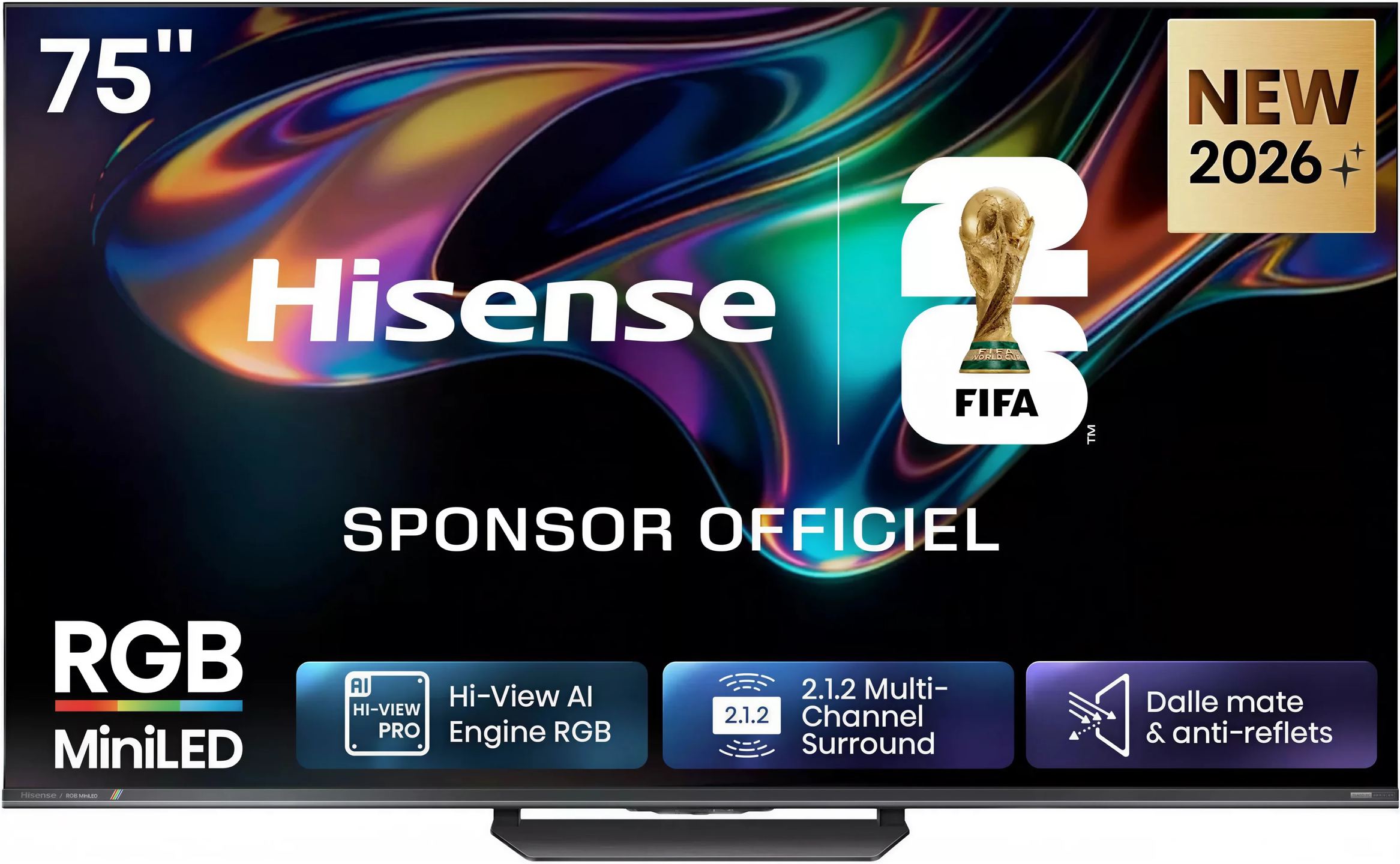
Producing color at the source rather than filtering it: that is the principle behind RGB MiniLED backlighting, arriving in 2026 on large screen sizes. Hisense is installing it on its UR8S series, positioned just below the UR9S, here with a 189 cm diagonal, a claimed peak brightness of 3500 nits, and a matte panel. The rest of the specs, 180 Hz native refresh rate and four HDMI 2.1 ports, clearly leans toward gaming.
Three diode colors instead of one
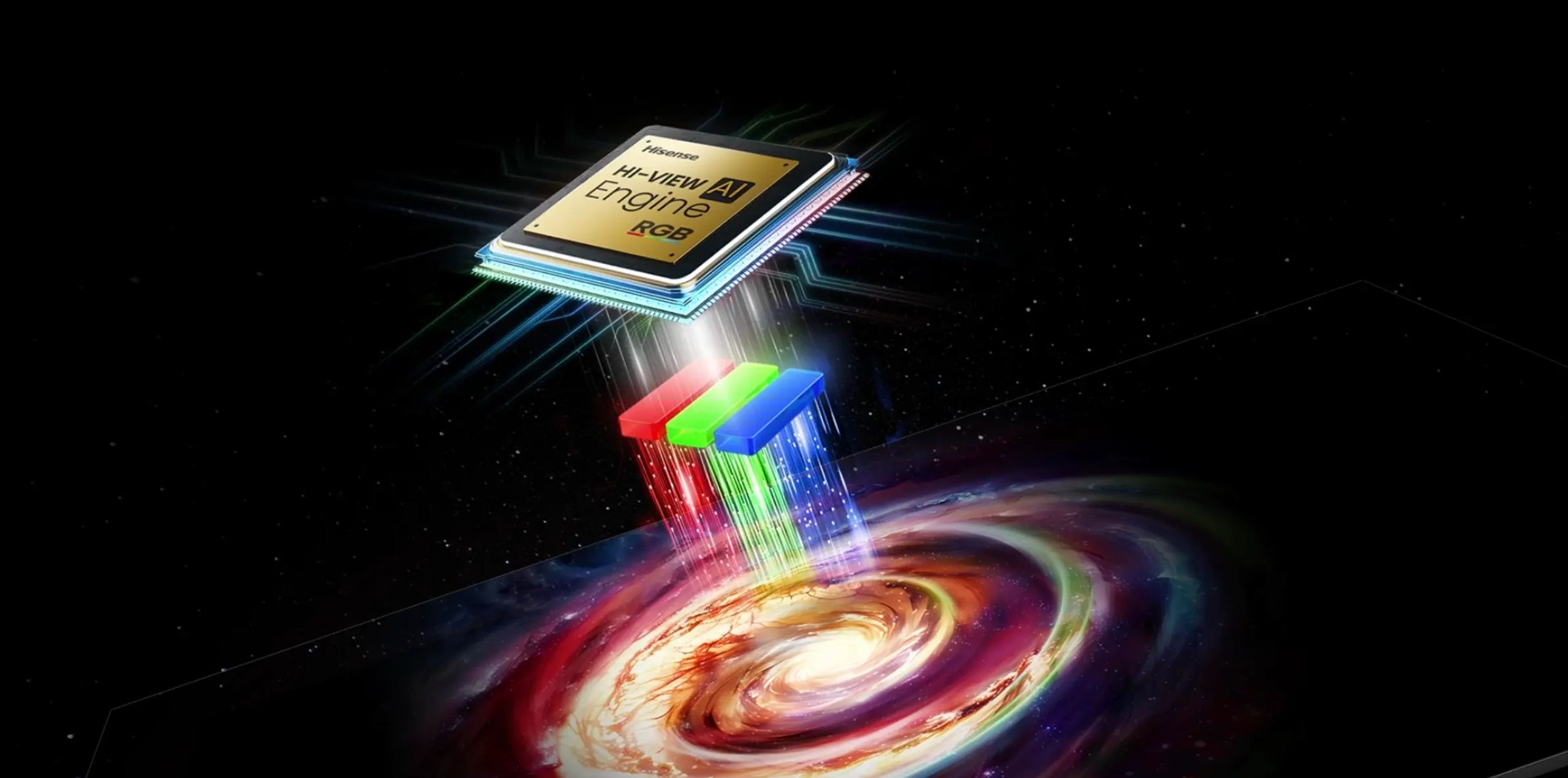
A conventional MiniLED backlight projects white light through a color filter, which costs saturation and precision in extreme shades. RGB MiniLED replaces those white diodes with red, green, and blue diodes driven separately. Color therefore comes from the backlight itself, rather than from filtering afterward. Measurable result: Hisense claims 100% coverage of the BT.2020 space, the broadest color reference in current video standards, still largely underused by the content available.
One point is worth knowing before purchase: the panel operates in 8 bits combined with FRC, a technique that simulates 10 bits by rapidly alternating neighboring shades. In practice, gradients remain clean on the vast majority of content, but a very broad twilight sky may reveal slight transitions in the finest grays.
3500 nits and a matte panel
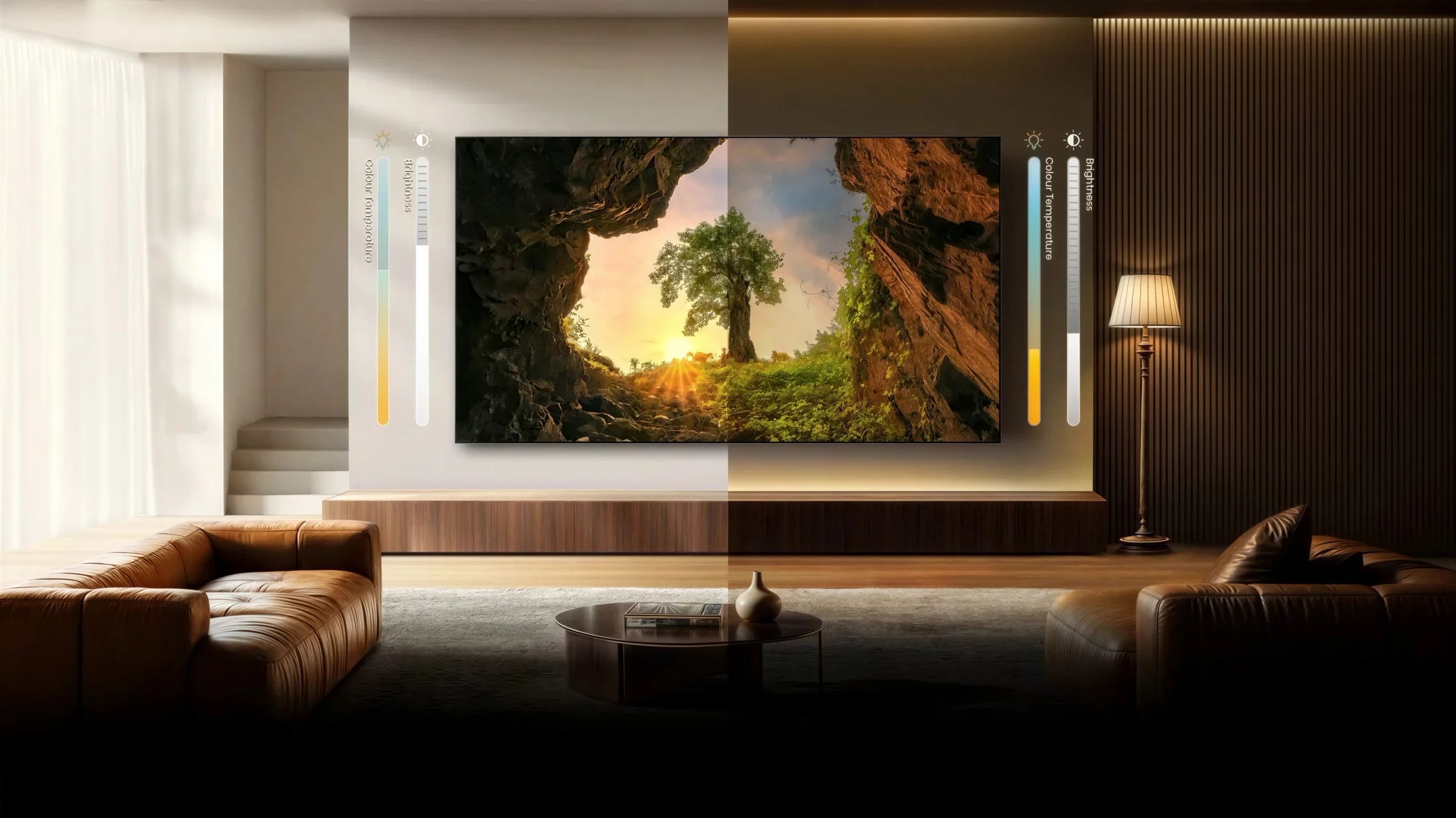
The claimed brightness peak, 3500 nits on this screen size, concerns small bright areas in an HDR image: a reflection on bodywork, a lamp in a dark shot. Full-screen brightness always remains much lower, on this television as on all others. This light reserve is mainly used to preserve depth in high-contrast scenes when the room is lit.
The anti-reflective treatment of the matte panel works in the same direction. It disperses stray light sources instead of reflecting them back as a sharp image, which makes a glass-filled living room clearly more livable. The trade-off is standard: in a room plunged into darkness, a matte coating diffuses part of the residual ambient light and black appears slightly less deep than with a glossy panel. Local Dimming, which switches off the backlight zone by zone, compensates for a good part of that difference.
On the HDR side, the list is complete: Dolby Vision and its IQ variant, which adapts rendering to room light via the built-in sensor, HDR10, HDR10+ and HDR10+ Adaptive, HLG for television broadcasts, plus IMAX Enhanced certification. The television is Calman Ready, allowing professional calibration with a probe and dedicated software.
The MT9655 processor in control
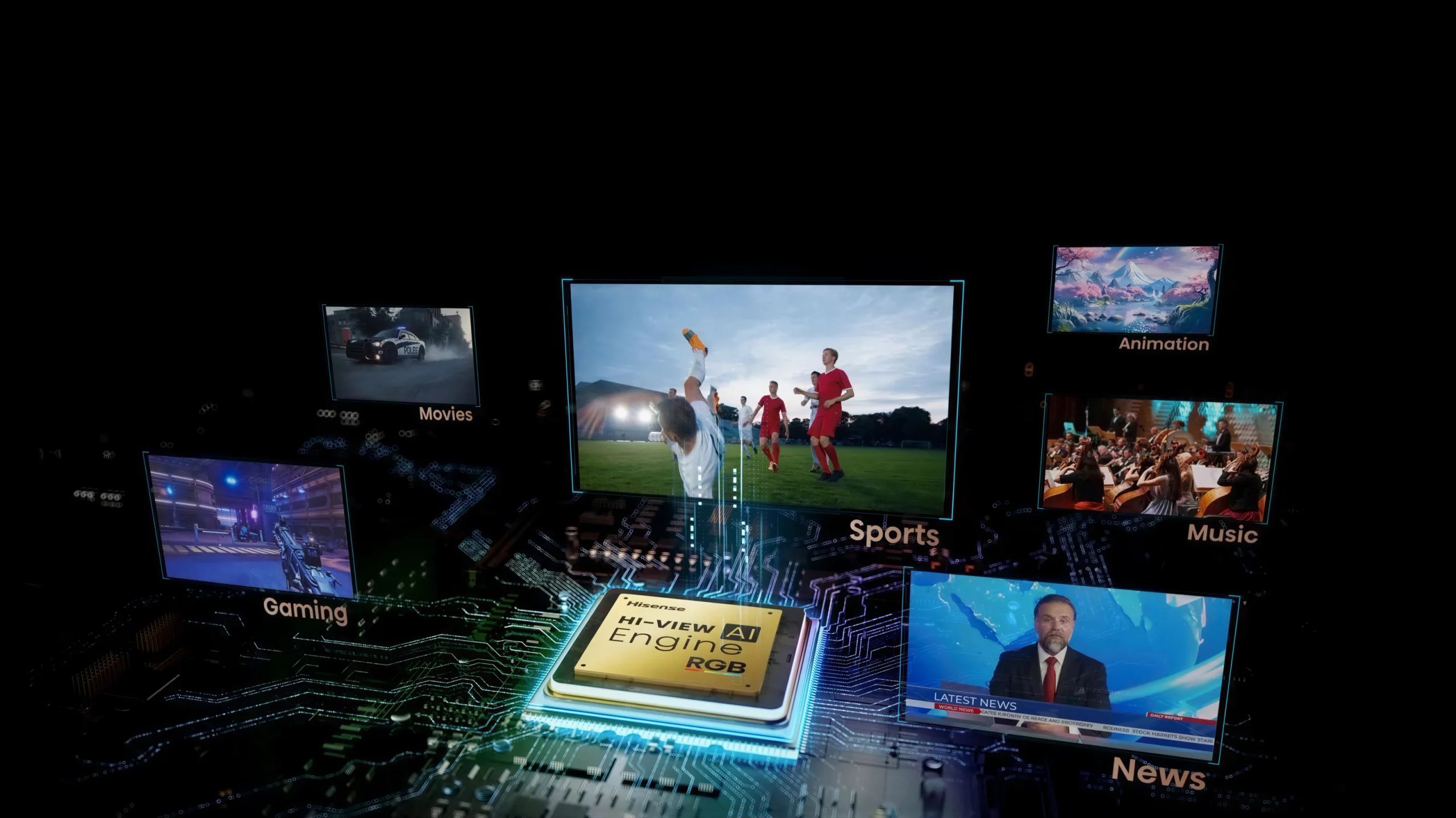
The MT9655 quad core, which Hisense markets under the name Hi-View AI Engine RGB, handles the upscaling of sources with resolution lower than 4K, MEMC motion compensation, and automatic image adjustment according to the detected content. On a 1080i terrestrial TV channel or an SD source, the benefit of upscaling is seen mainly on edges and video noise.
Motion compensation deserves a word of warning. It interpolates intermediate frames to smooth panning shots, which helps for sports but gives cinema that smooth video look that many people hate. Filmmaker mode disables these treatments and respects the original frame rate; Cinema mode remains gentler than Sport mode. The automatic artificial intelligence mode switches from one setting to another depending on the source, with the approximations that implies.
180 Hz native and 7 ms latency
The panel refreshes natively at 180 Hz, without interpolation. That is this model’s strong point compared with the 120 Hz still common in this range. An HSR mode pushes display up to 330 Hz. All four HDMI 2.1 ports accept 4K at 180 Hz with VRR, the adaptive synchronization that eliminates screen tearing when the console or graphics card struggles to keep up. AMD FreeSync Premium Pro is certified, ALLM automatically switches to Game mode when a console is detected, and input lag drops to 7 ms.
Not having to choose your HDMI port according to use is a real convenience: console, PC, and soundbar can be connected wherever you want, with eARC remaining reserved for HDMI 3. The rest of the connectivity includes an S/PDIF audio output for an amplifier without HDMI, an Ethernet port, one USB 3.0 and one USB 2.0. No headphone jack, no analog input, and no USB-C.
A 2.1.2 system tuned by Devialet
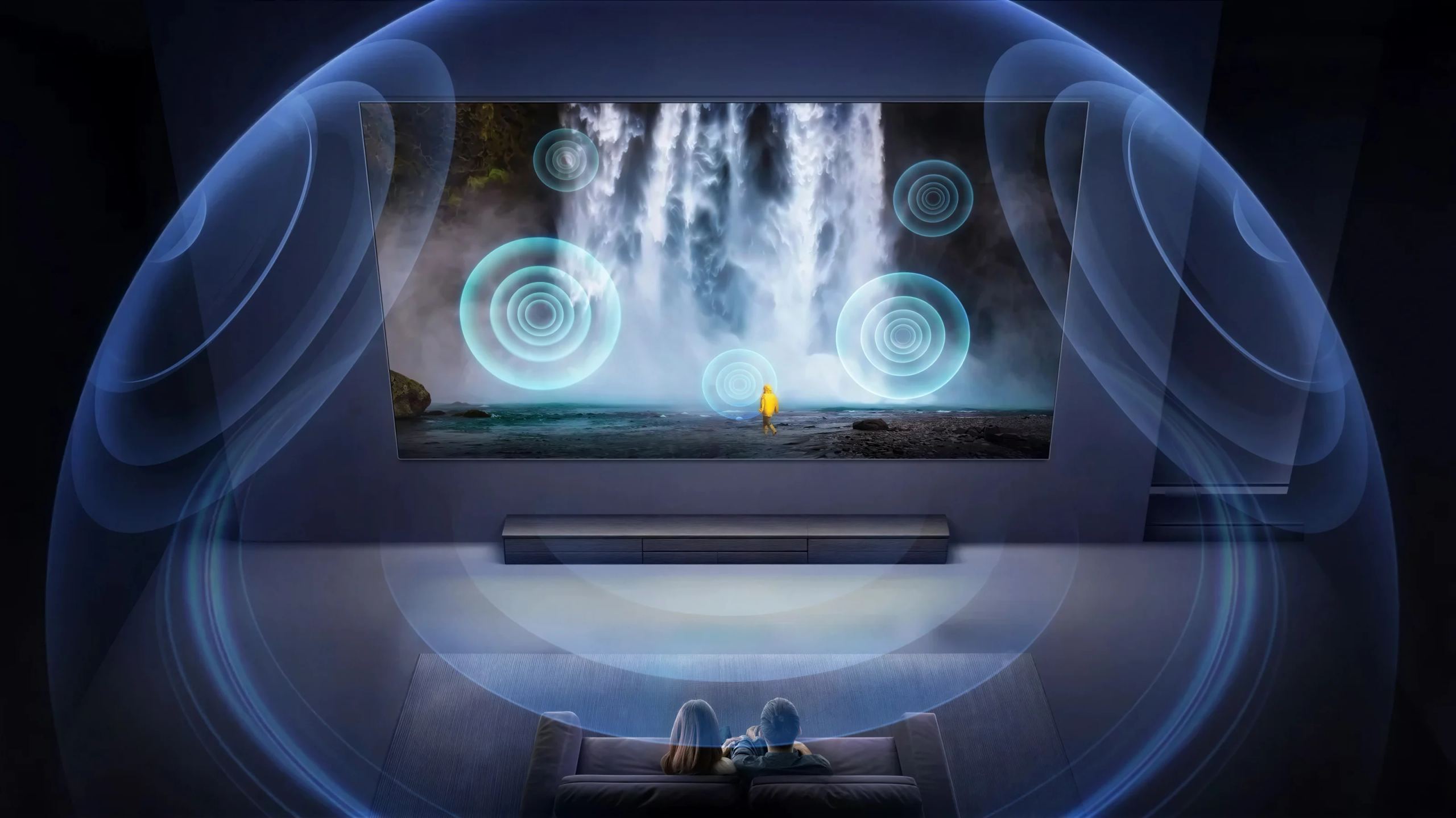
The audio section combines two main 10 W channels, a 20 W subwoofer, and two 5 W upward-firing speakers, for a total of 50 W in a 2.1.2 configuration. Dolby Atmos decoding uses these two vertical channels to place some effects above the plane of the screen. The French brand Devialet handles the tuning, and the Room Fitting Tuning function adjusts playback according to room dimensions.
An integrated 2.1.2 system in a 52 mm-thick chassis remains a constrained exercise: dialogue gains intelligibility, bass goes respectably low for a television, but the soundstage does not rival a dedicated setup. WiSA SoundSend compatibility opens the way to wireless speakers, and Hi-Concerto lets the television’s speakers work in addition to a compatible Hisense soundbar.
Everyday use under VIDAA U9.5
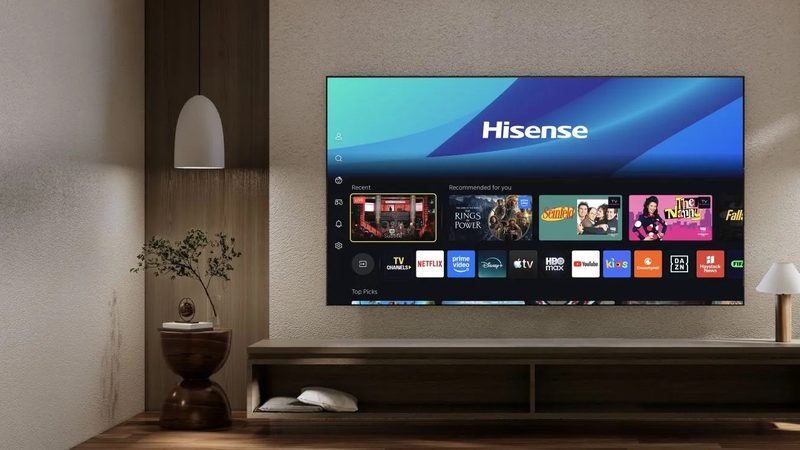
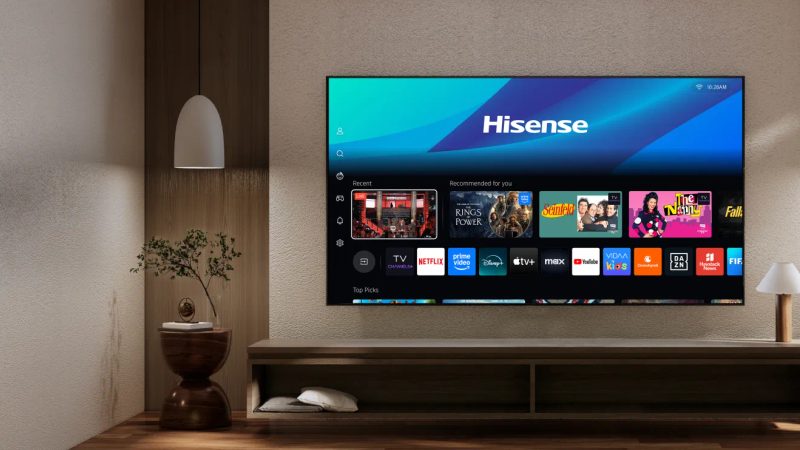
Hisense keeps its in-house system rather than a licensed platform. VIDAA U9.5 gains in fluidity, offers its app store with the main video-on-demand services, a browser, a media player, and VIDAA ART mode that displays artwork in standby. Alexa and VIDAA Voice respond to voice commands, with a microphone in the supplied remote control and direct-access buttons for apps.
Apple devices stream via AirPlay 2; PCs, tablets, and Android phones use screen sharing. Wireless connectivity relies on dual-band Wi-Fi 802.11ac, on 2.4 and 5 GHz, and on Bluetooth 5.4 for headphones or a controller. The reception side covers both satellite and terrestrial with a DVB-T2/T/C/S2/S tuner, Fransat certification, HbbTV 2.0.4, a CI+ slot, recording to USB drive, and live pause control.
Installing a 75-inch TV at home
Without its stand, the television measures 1668 mm wide by 963 mm high and 52 mm thick, and weighs 27.9 kg. With the stand, depth increases to 310 mm and the scale reads 32.1 kg. Wall mounting complies with the VESA 400 × 400 mm standard, a modest value for this screen size that requires a properly anchored mount. Plan on two people for handling, knowing that the packaged set reaches 42 kg. The ERF6P66H voice remote control and the power cable are included; the batteries are not.
Power consumption is read on two levels: 71 W in SDR for energy class C, but 200 W in HDR for class G. The gap directly reflects the electrical cost of a backlight capable of reaching 3500 nits. Standby remains under 0.5 W.
Documentation
FrenchTechnical data sheet
FrenchEuropean product sheet
FrenchEnergy label
Technical specifications
Image
- 75-inch (189 cm) RGB MiniLED LCD screen
- Ultra HD 4K resolution (3840 × 2160 pixels)
- Matte panel with anti-glare treatment
- Local Dimming backlight
- Peak brightness up to 3500 nits
- Native 180 Hz refresh rate
- HSR mode up to 330 Hz
Video processing
- Quad Core MT9655 processor
- 4K AI upscaling
- MEMC motion compensation
- Brightness sensor
- 100% BT.2020 color space
- 8-bit colors + FRC
- Calman Ready certification
- IMAX Enhanced compatible
- Picture modes: Filmmaker, Cinema, Sport
- Automatic picture mode powered by artificial intelligence
HDR compatibility
- Dolby Vision
- Dolby Vision IQ
- HDR10
- HDR10+
- HDR10+ Adaptive
- HLG
- 4K HDR Immersive
- IMAX Enhanced
Gaming
- 180 Hz Game Mode
- Input lag up to 7 ms
- AMD FreeSync Premium Pro
- HDMI 2.1
- ALLM
- VRR 4K 180 Hz
Smart TV
- VIDAA U9.5 system
- Voice assistants: Alexa, VIDAA Voice
- Voice control via the remote control
- Internet browser
- Media player
- VIDAA App Store
- AirPlay 2
- Screen sharing (PC, tablet, and Android smartphone)
- Dual-band Wi-Fi (2.4 and 5 GHz)
- Bluetooth 5.4
- VIDAA ART
Audio
- 2 × 10 W + 20 W + 2 × 5 W configuration
- Dolby Atmos
- Dolby Audio
- Surround effect
- Advanced equalizer
- Tuned by Devialet sound optimization
- Room Fitting Tuning
- WiSA SoundSend compatible
- Hi-Concerto
- TV Mode
- EzPlay
Connectivity
- 4 HDMI 2.1 inputs
- 4K 180 Hz
- VRR
- ALLM
- eARC (HDMI 3)
- 1 USB 3.0 port
- 1 USB 2.0 port
- S / PDIF optical audio output
- RJ45 Ethernet port
- Dual antenna input
Reception
- DVB-T2 / T / C / S2 / S tuner
- Fransat certification
- HbbTV 2.0.4
- CI+
- USB recording (PVR)
- Timeshift
- Parental control
- Hotel Mode
Supported formats
- Video: MP4, MOV, MKV, TS, AVI, WMV, WEBM
- Audio: MP3, WAV, WMA, FLAC
- Photos: JPEG, PNG, BMP, GIF, WEBP, TIFF
Power consumption
- SDR energy class: C
- HDR energy class: G
- SDR power consumption: 71 W
- HDR power consumption: 200 W
- Standby: ≤ 0.5 W
Dimensions and weight
- Dimensions with stand: 1668 × 310 × 1029 mm
- Dimensions without stand: 1668 × 52 × 963 mm
- Weight with stand: 32.1 kg
- Weight without stand: 27.9 kg
- VESA 400 × 400 mm mount compatible
Included accessories
- Voice remote control
- Power cable
Frequently Asked Questions
What is the difference between the UR8S series and the UR9S series?
Both series share RGB MiniLED technology and the MT9655 processor. The UR9S is Hisense’s high-end offering in 2026, while the UR8S adapts it to a broader positioning with five screen sizes, from 55 inches to 100 inches. On the 75UR8S, the announced peak brightness reaches 3500 nits.
Does 330 Hz HSR mode work with all sources?
No. This is a specific display mode offered above the panel’s native 180 Hz refresh rate. Current consoles and graphics cards do not transmit a 4K signal at 330 Hz via HDMI. In everyday use, it is the native 180 Hz that determines the actual smoothness.
Can programs be recorded directly on the television set?
Yes, via a USB storage device connected to one of the two ports, in USB 3.0 or USB 2.0. The PVR function records channels received by the integrated tuners, and Timeshift pauses live TV. Content from video-on-demand applications is not affected.
What does Calman Ready certification mean?
It indicates that the television supports automatic calibration via the Calman software and a colorimeter, with direct writing of corrections into the processor’s tables. This is a professional calibrator’s or well-equipped enthusiast’s approach, not a setting accessible from the menus.
Which codecs does the media player support?
For video, decoding covers MPEG-1/2, MPEG-4, H.264, H.265, VC1, WMV3, VP8, VP9, and AV1, in MP4, MOV, MKV, TS, AVI, WMV, or WEBM containers. AV1 support matters for streams from streaming platforms. For audio, lossless FLAC is included alongside MP3, WMA, AAC, Vorbis, and Opus.
Does WiSA SoundSend compatibility require an accessory?
Yes. WiSA transmits a wireless multichannel signal to compatible speakers, but requires a SoundSend transmitter sold separately, to be connected to a TV output. Without it, the function remains inactive.
Is Hotel Mode useful at home?
It locks certain settings, sets the maximum volume and the source displayed at startup, and blocks access to the menus. Designed for hospitality, it is also useful in a child’s room or a professional space where you want to keep the configuration fixed.
Do you need a reinforced wall mount?
The chassis weighs 27.9 kg without the stand and uses a VESA 400 × 400 mm mount, a reduced spacing relative to the 1668 mm width. The mount must be rated for the load and fixed into a load-bearing wall or with anchors suited to the wall type. An articulated mount, which shifts the weight outward, requires additional precautions.
- Eco-contribution of €12.65 included in the sale price.
- Spare parts available for 7 years
- GTIN / EAN: 6942351436760