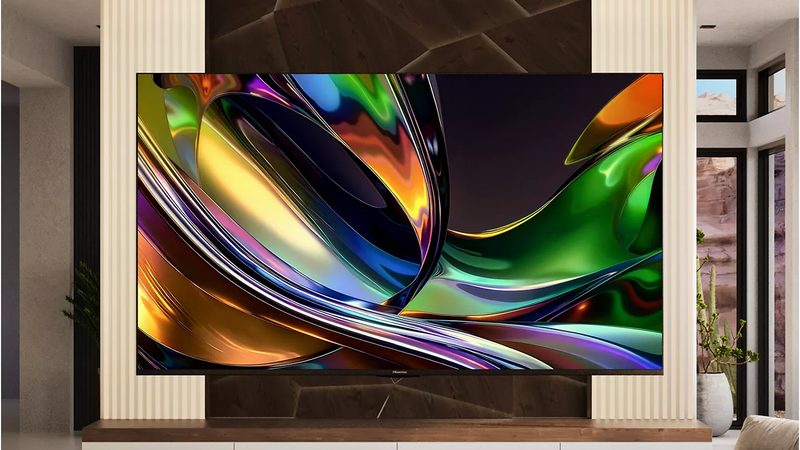
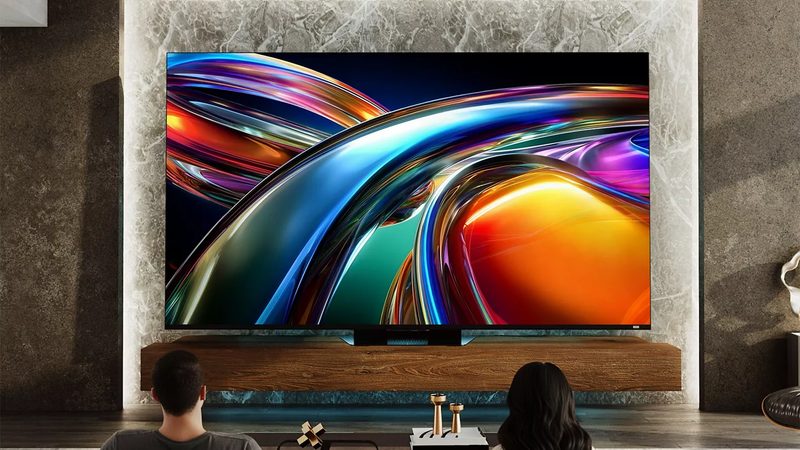
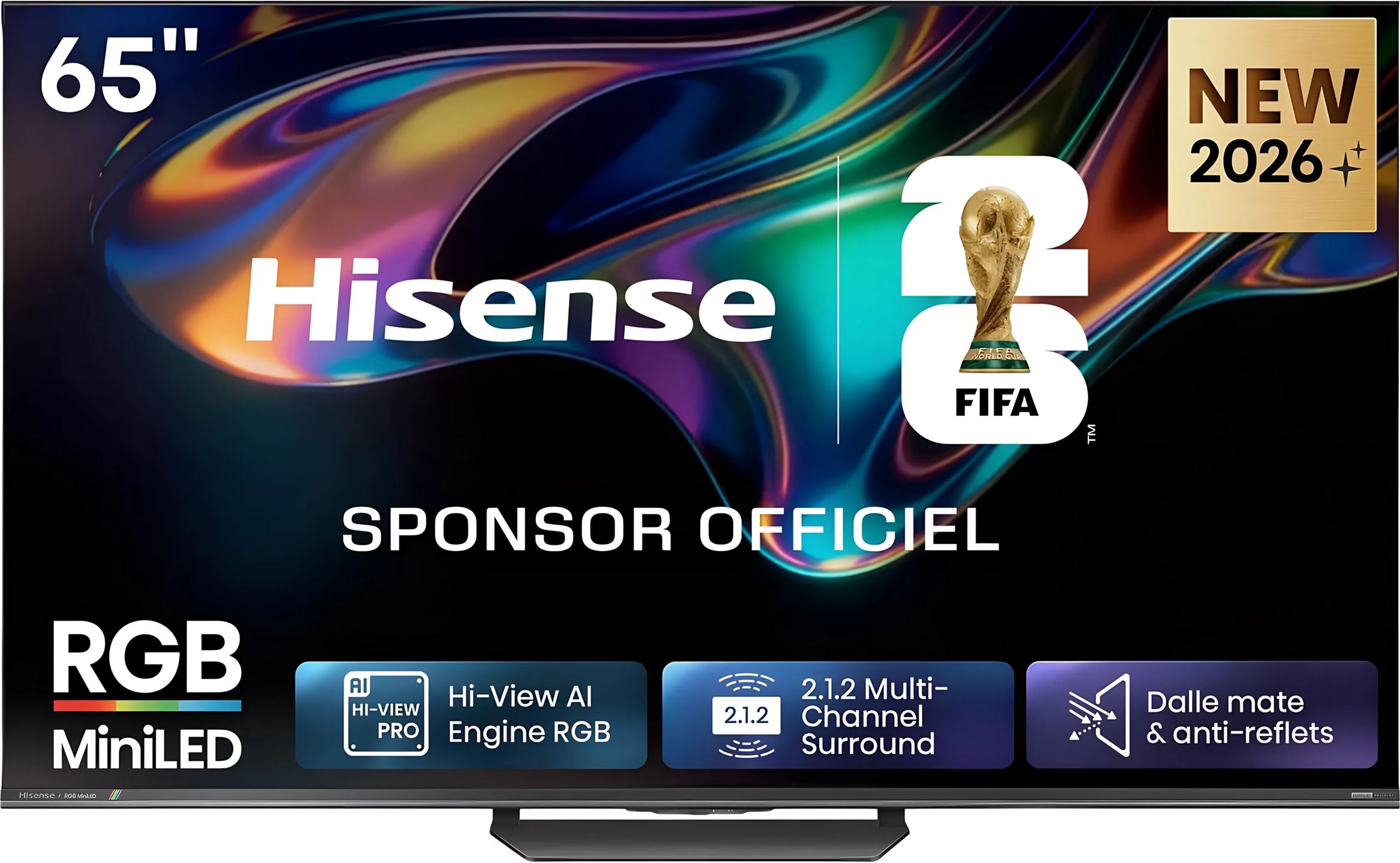
Hisense 65UR8S 2026
Specifications and features



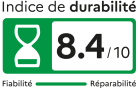
Overview
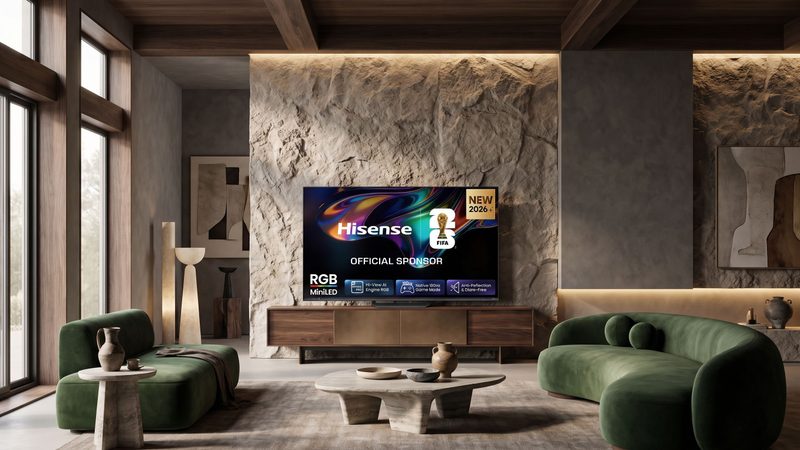
Long reserved for giant demonstration screens, RGB MiniLED backlighting is now arriving in living-room sizes. Here, Hisense pairs it with a 65-inch 4K panel running at 180 Hz, a claimed peak brightness of 3500 nits, and an audio section tuned by Devialet. The result aims broad: HDR movies, sports broadcasts, recent consoles, and rooms flooded with natural light. It remains to be seen what each of these arguments actually covers.
Red, green, and blue diodes
A conventional MiniLED backlight produces white light, which is then filtered to obtain the three primary colors. RGB MiniLED works differently: the mini diodes directly emit red, green, or blue, and their respective intensity is controlled zone by zone. The light passing through the panel is therefore already colored, which reduces losses and expands the reproducible palette. Hisense claims full coverage of the BT.2020 color space, the widest reference currently used for HDR content.
This color precision comes with a subtle trade-off: the panel operates in 8 bits combined with FRC, a temporal dithering technique that simulates the 10 bits expected by HDR content. The final rendering holds up on gradients, but this is not a native 10-bit panel. Hisense also does not disclose the number of local dimming zones, even though that figure has a direct impact on halo control around bright objects against a black background.
Brightness in bright rooms
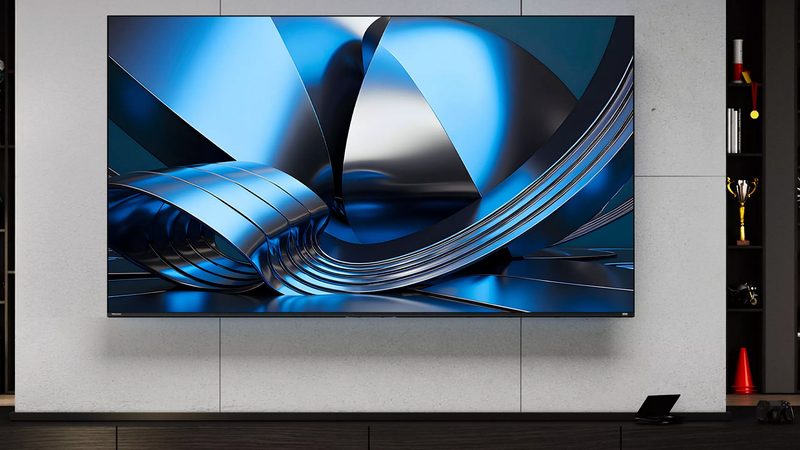
The claimed 3500-nit peak only applies to a fraction of the image, in very high-contrast scenes. In practical terms, a sun reflection on bodywork or a nighttime explosion retains its intensity instead of being clipped. The anti-reflective treatment of the matte panel works on another level: it diffuses stray light sources instead of reflecting them like a mirror. In return, this type of finish slightly raises the perceived black level when the room is very bright, a compromise accepted by most matte panels.
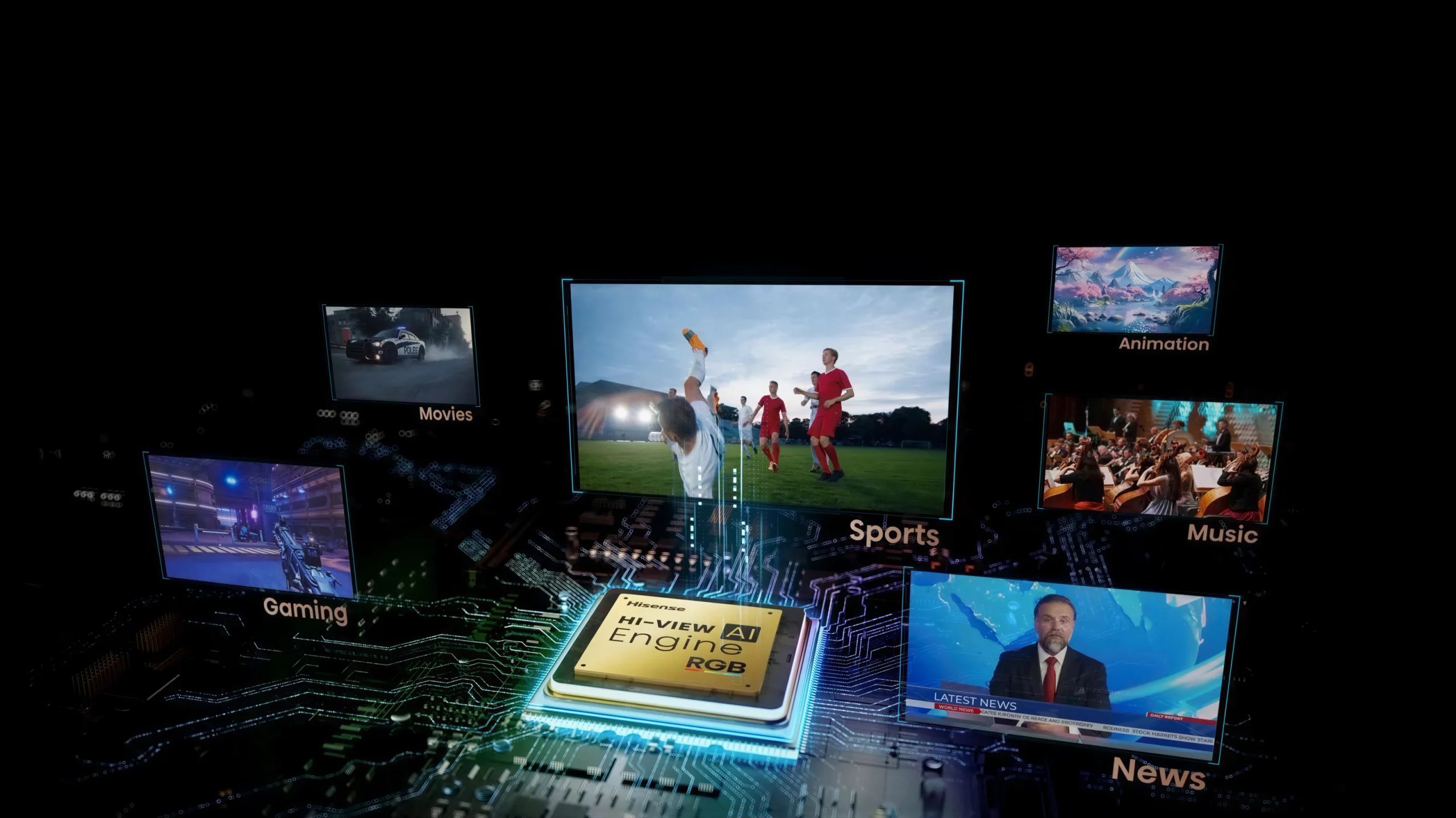
Control is handled by the Hi-View AI Engine RGB processor, a quad-core MT9655 tasked with adjusting contrast, brightness, and colors scene by scene. It also manages AI 4K Upscaling for lower-definition sources. An ambient light sensor completes the system. It feeds Dolby Vision IQ and HDR10+ Adaptive, which correct the tone curve according to the lighting in the room. The same sensor also powers the automatic picture mode, which switches settings based on the detected content.
All HDR formats, or almost
The 65UR8S supports Dolby Vision, HDR10, HDR10+, HLG, and their adaptive variants. This cross-compatibility avoids the usual headache: whatever the streaming platform or Ultra HD Blu-ray disc, dynamic metadata is used. IMAX Enhanced and Calman Ready certifications are also part of the package. The latter allows software calibration with a probe for those who want to push color accuracy to the limit.
Filmmaker Mode disables picture processing, including MEMC motion compensation, to preserve the original frame rate of films. Cinema and Sports modes occupy the opposite ground, with stronger interpolation on fast motion. Switching from one to the other radically changes the image texture. It is better to compare them before judging the TV by its out-of-the-box settings.
Native 180 Hz, 7 ms latency
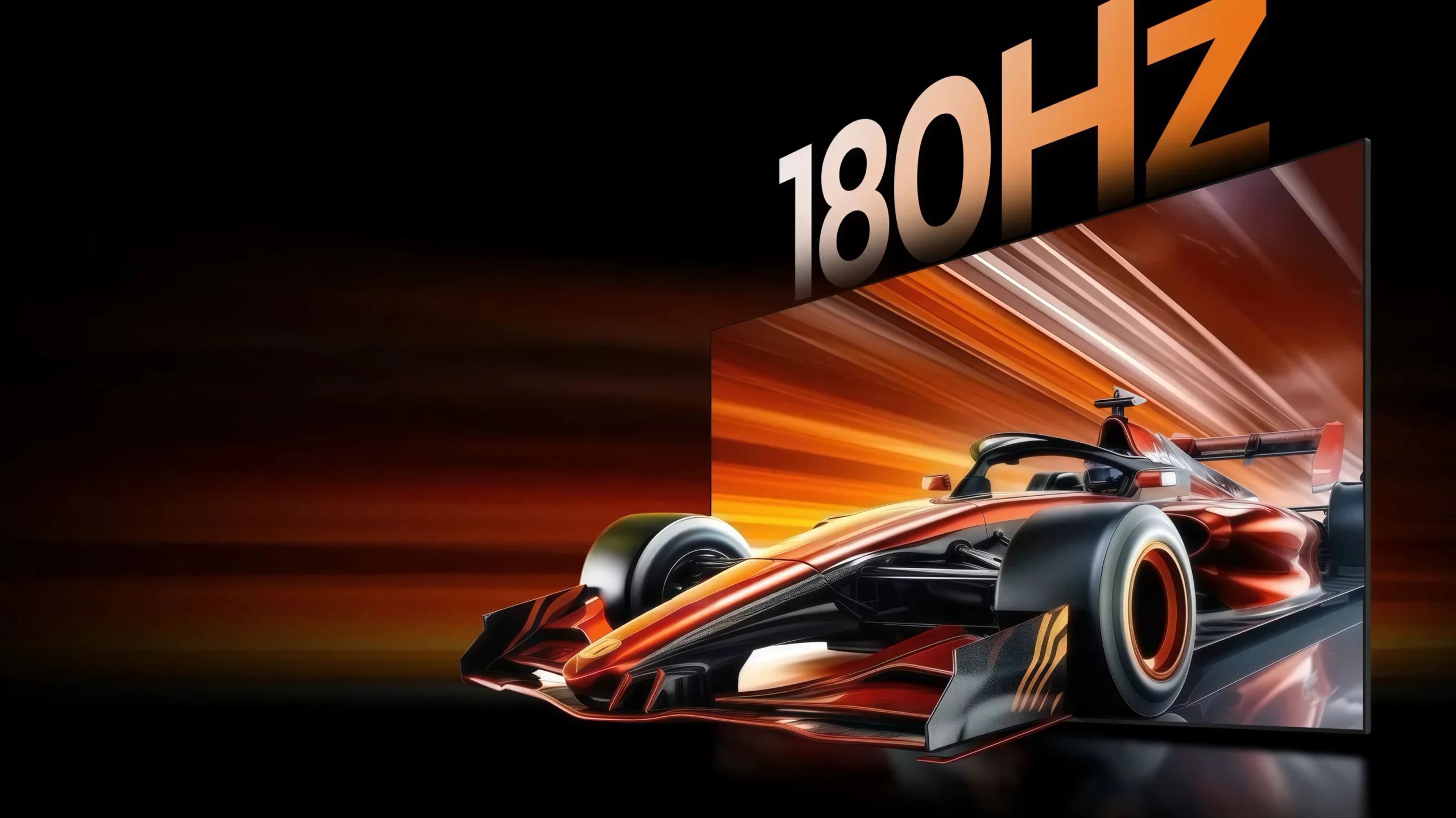
The panel refreshes natively at 180 Hz, a rate that the four HDMI 2.1 ports support in 4K with VRR. Latency drops to 7 ms in Game mode, and ALLM automatically switches to this mode as soon as a console is detected. AMD FreeSync Premium Pro synchronizes the display with the graphics card to eliminate screen tearing.
A useful nuance: current game consoles top out at 120 Hz in 4K. The 180 Hz, and even more so the 330 Hz of HSR mode, therefore concern a gaming PC, with HSR mode operating at reduced definition to sustain that rate. A console player will mainly benefit from the low latency and VRR; a PC player will take advantage of the whole package.
Devialet tunes the speakers
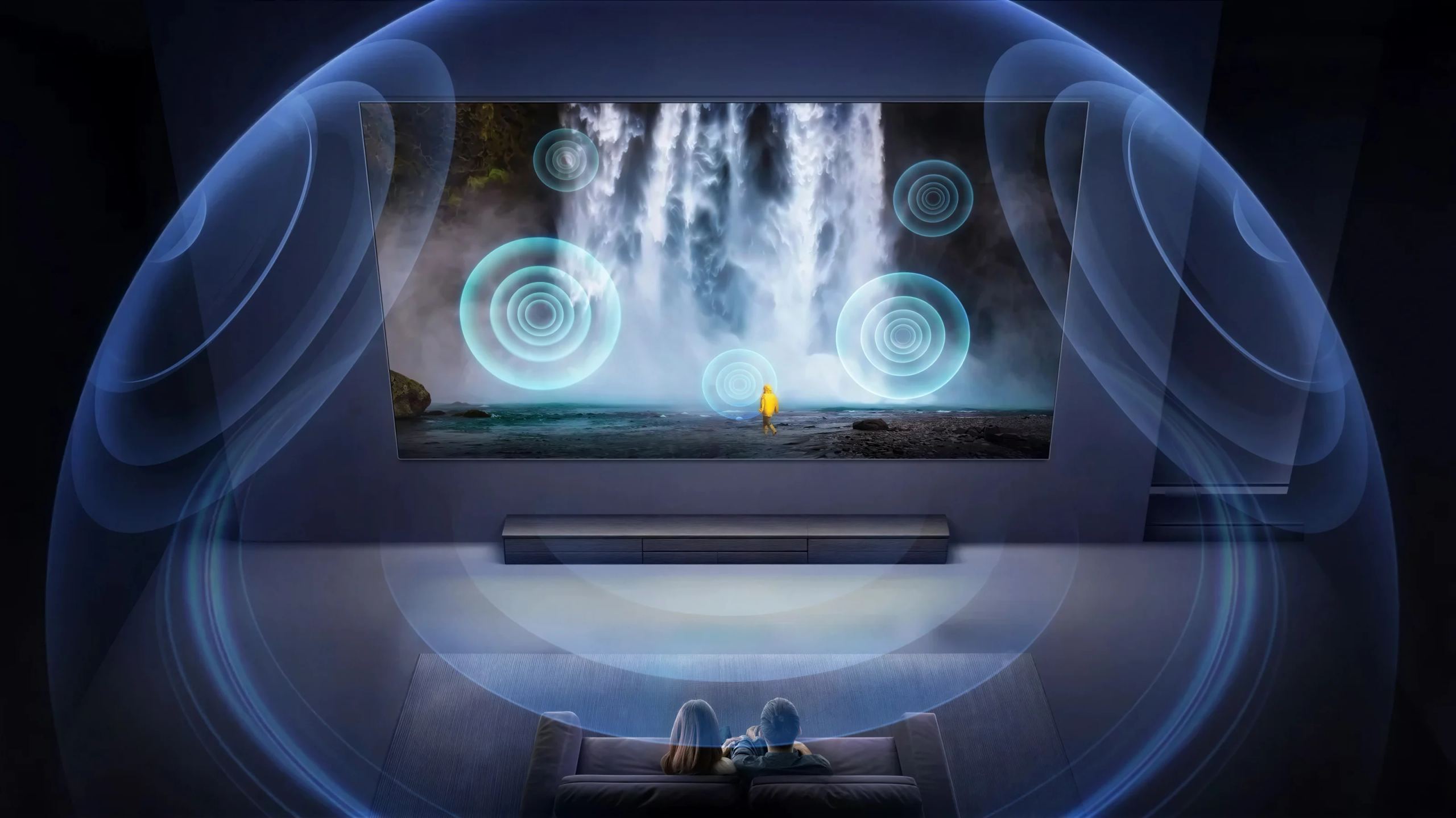
The 2.1.2 configuration combines two main 10 W channels, a 20 W subwoofer, and two 5 W transducers aimed at the ceiling for reproducing Dolby Atmos height channels. Fifty watts in total: enough to give dialogue some body and bass a bit of foundation, without claiming to replace a soundbar or a home theater system.
Devialet’s contribution lies in signal processing, with an optimization stage and a Room Fitting Tuning function that adjusts sound rendering according to the TV’s placement in the room. If the result is not sufficient, the eARC output on HDMI 3 can accommodate a soundbar or amplifier, while WiSA SoundSend compatibility opens the door to wireless speakers. The Hi-Concerto function, for its part, uses the TV’s speakers in addition to a compatible Hisense soundbar. No wired headphone output is provided. Bluetooth 5.4 and the optical S/PDIF output cover other connection needs.
VIDAA U9.5 day to day
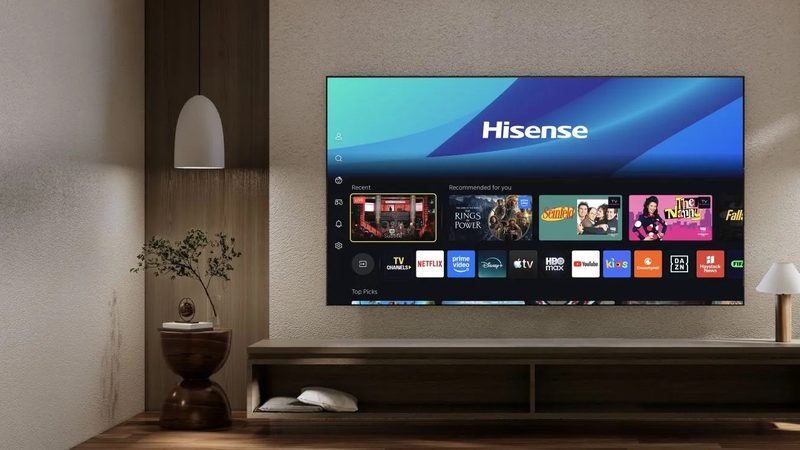
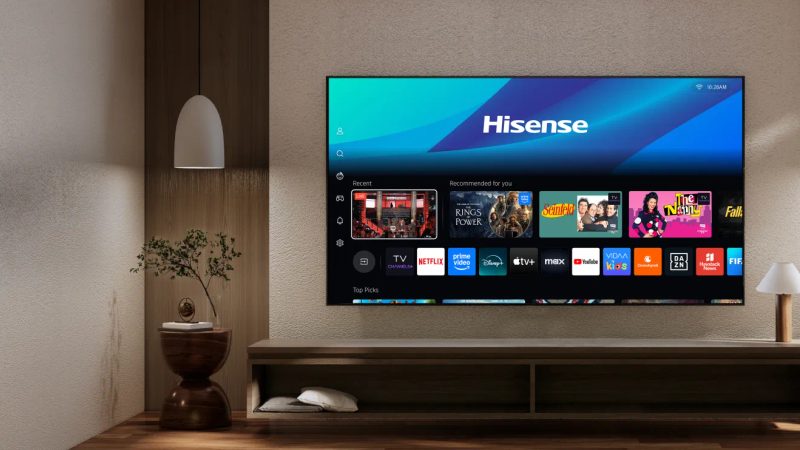
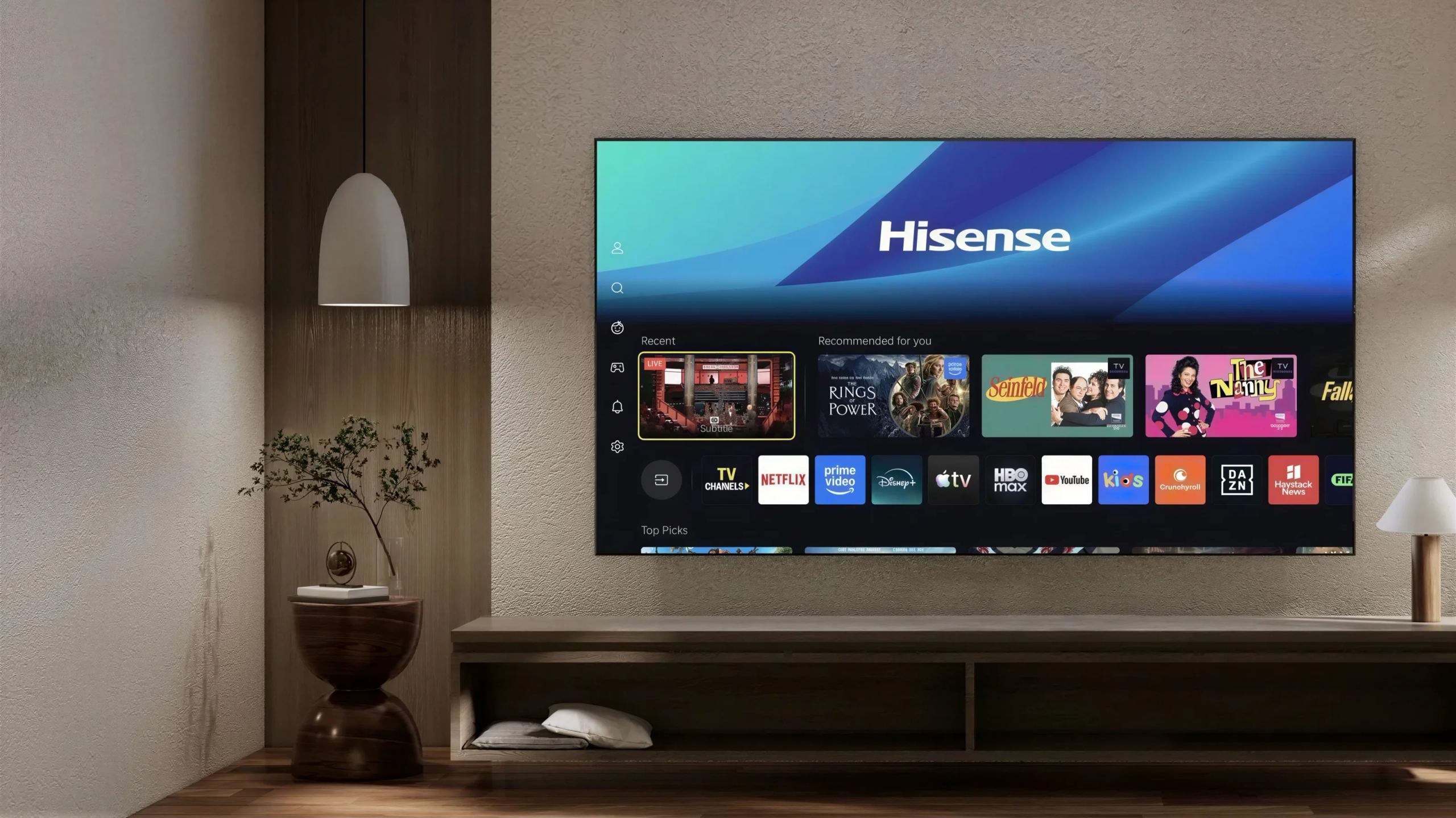
Hisense’s in-house system has become smoother over the course of versions. The major streaming platforms are present, Alexa is built in, and Vidaa Voice responds to voice commands from the remote control. AirPlay 2 handles streaming from an iPhone or Mac, and screen sharing works from a PC or Android mobile device. The VIDAA App Store catalog remains more limited than that of the most widespread systems, a point worth checking if you depend on a niche app.
On the reception side, the triple tuner covers terrestrial TV, cable, and satellite, with Fransat certification, HbbTV 2.0.4, and a CI+ slot for subscription cards. Recording to a USB drive and live pause are included.
Place it on furniture or mount it on the wall
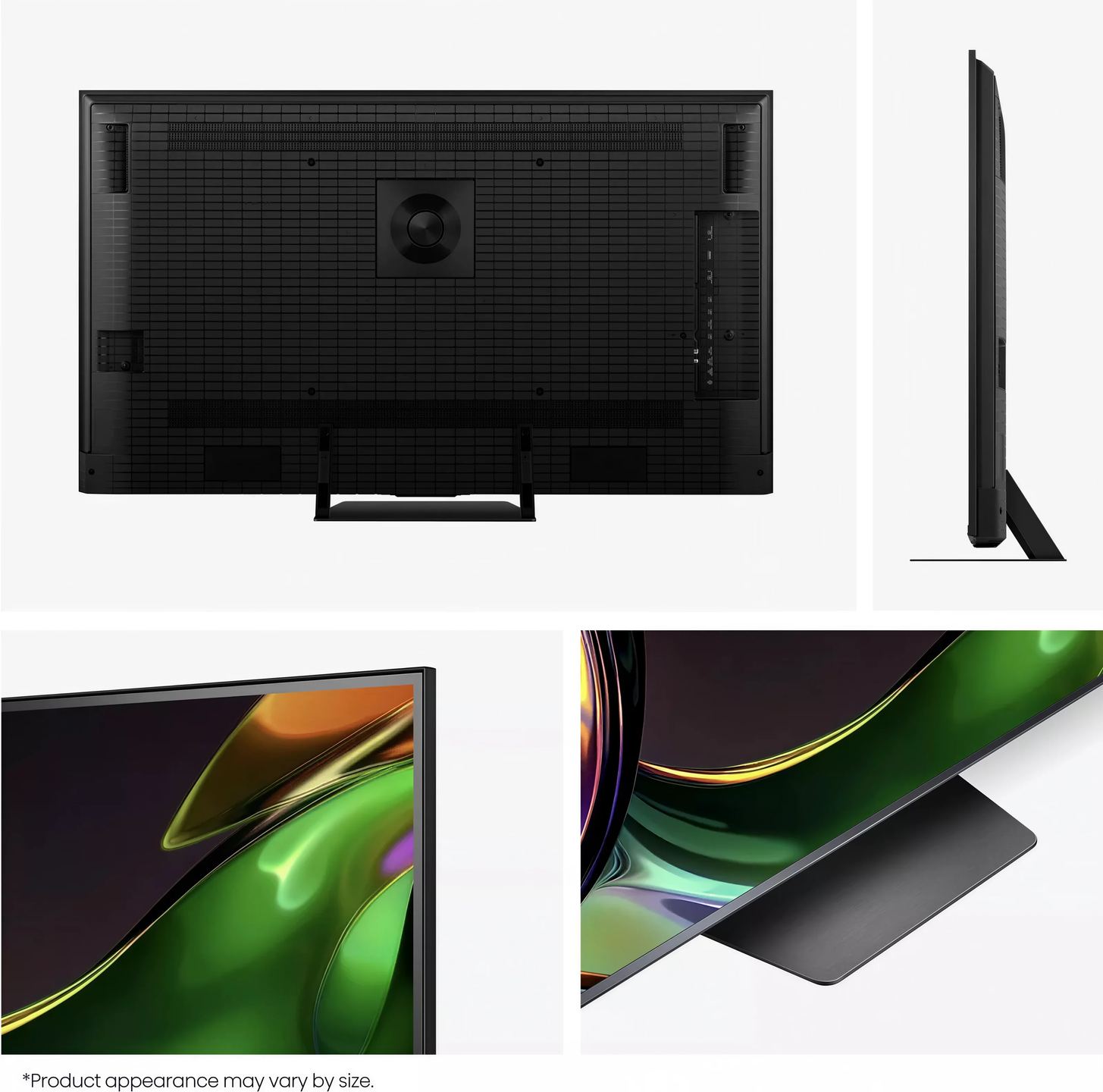
Without its stand, the TV measures 52 mm thick and weighs 19.6 kg, which remains reasonable for wall mounting on a VESA 400 × 300 bracket. With the stand, the total height comes to 897 or 867 mm depending on the chosen position, for 23.4 kg on the scale. The 1446 mm width remains the main constraint: the furniture has to match.
Power consumption stands at 80 W in SDR and rises to 140 W in HDR, with the energy class moving from E to G depending on the displayed content. The difference reflects the load on the backlight when the panel pushes its brightness peaks. In standby, power consumption remains below 0.5 W.
Technical specifications
Picture
- Display technology: RGB MiniLED
- Diagonal: 65 inches (164 cm)
- Resolution: Ultra HD 4K (3840 × 2160 pixels)
- Native refresh rate: 180 Hz
- HSR refresh rate: up to 330 Hz
- Local Dimming
- Peak brightness: 3500 nits
- Anti-glare matte panel
- Wide color gamut: 100% BT.2020
- Color depth: 8 bits + FRC
- AI 4K Upscaling
- MEMC motion compensation
- Brightness sensor
- Picture modes: Filmmaker, Cinema, Sport
- Automatic picture mode via artificial intelligence
- IMAX Enhanced certification
- Calman Ready
HDR
- Dolby Vision
- Dolby Vision IQ
- HDR10
- HDR10+
- HDR10+ Adaptive
- HLG
- 4K HDR Immersive
Gaming
- 180 Hz Game Mode
- Input lag: 7 ms
- AMD FreeSync Premium Pro
- ALLM (Auto Low Latency Mode)
- VRR up to 4K 180 Hz
Smart TV
- System: VIDAA U9.5
- Voice assistants: built-in Alexa, Vidaa Voice
- Voice control via remote
- Internet browser
- Media player
- VIDAA App Store
- AirPlay 2
- PC, smartphone, and tablet screen sharing
- Dual-band Wi-Fi (2.4 and 5 GHz)
- Bluetooth 5.4
- Vidaa ART
Audio
- Configuration: 2.1.2 channels
- Total power: 50 W (2 × 10 W + 20 W + 2 × 5 W)
- Dolby Atmos
- Dolby Audio
- Surround effect
- Advanced equalizer settings
- Tuned by Devialet sound optimization
- Room Fitting Tuning
- WiSA SoundSend compatible
- Hi-Concerto
- EzPlay
Connectivity
- 4 × HDMI 2.1
- HDMI 3 eARC compatible
- ALLM
- VRR 4K 180 Hz
- 1 × USB 3.0
- 1 × USB 2.0
- Optical audio output
- Ethernet RJ45
- Dual antenna input
TV reception
- Triple tuner DVB-T2 / C / S2 / S
- Fransat certification
- HbbTV 2.0.4
- CI+
- PVR (USB recording)
- Timeshift
- Hotel Mode
Supported formats
- Video: MP4, MKV, AVI, MOV, TS, WMV, WEBM
- Audio: MP3, WAV, FLAC, WMA
- Photo: JPEG, PNG, BMP, GIF, WEBP, TIFF
Power consumption
- SDR energy class: E
- HDR energy class: G
- SDR consumption: 80 W
- HDR consumption: 140 W
- Standby consumption: ≤ 0.5 W
Dimensions and weight
- With stand: 1446 × 290 × 897 mm
- Without stand: 1446 × 52 × 837 mm
- Weight with stand: 23.4 kg
- Weight without stand: 19.6 kg
- VESA mount: 400 × 300 mm
Included accessories
- Voice remote
- Power cord
Frequently Asked Questions
How many local dimming zones does the panel have?
Hisense does not publish this figure for the UR8S series. The backlighting is indeed MiniLED Local Dimming, but there is no official value that allows it to be determined precisely. The figures circulating here and there do not come from the manufacturer.
Is the panel really 10-bit?
No, in the strict sense. It operates in 8-bit with FRC, a process that very rapidly alternates between two neighboring shades to simulate a third. The result comes close to 10-bit rendering on subtle gradients, skies, and fades to black, without having its native finesse.
Can you achieve 330 Hz with a game console?
No. HSR mode works with a PC source equipped with a compatible graphics card, and it lowers the resolution to maintain that refresh rate. Current consoles are limited to 120 Hz in 4K, which the TV handles without any difficulty on its four HDMI 2.1 ports.
Does this television receive satellite channels?
Yes. The triple tuner supports the DVB-S and DVB-S2 standards, and the dual antenna input allows you to connect a satellite dish and a terrestrial antenna simultaneously. Fransat certification provides access to French channels broadcast by satellite with a compatible card.
Is it possible to record programs?
A PVR function allows recording to a hard drive or USB flash drive connected to one of the two ports. Live control allows a program currently being broadcast to be paused. The USB 3.0 port should be preferred for high-definition recordings.
What does Calman Ready certification mean?
It indicates that the TV supports calibration driven from Calman software, using a colorimeter. The corrections are written directly into the TV’s internal conversion tables, which provides greater accuracy than manual adjustment from the menus. This procedure remains reserved for installers or users equipped with measurement equipment.
Which wall mount should I choose?
The mounting pattern is VESA 400 × 300 mm. The chassis weighs 19.6 kg without its stand, a load that the vast majority of fixed or swivel wall mounts can handle without any problem. A tilting or swivel mount makes it easier to access the connectors, which are positioned on the side and rear of the television.
- Eco-contribution included in the sale price.
- Spare parts available for 7 years
- GTIN / EAN: 6942351436630