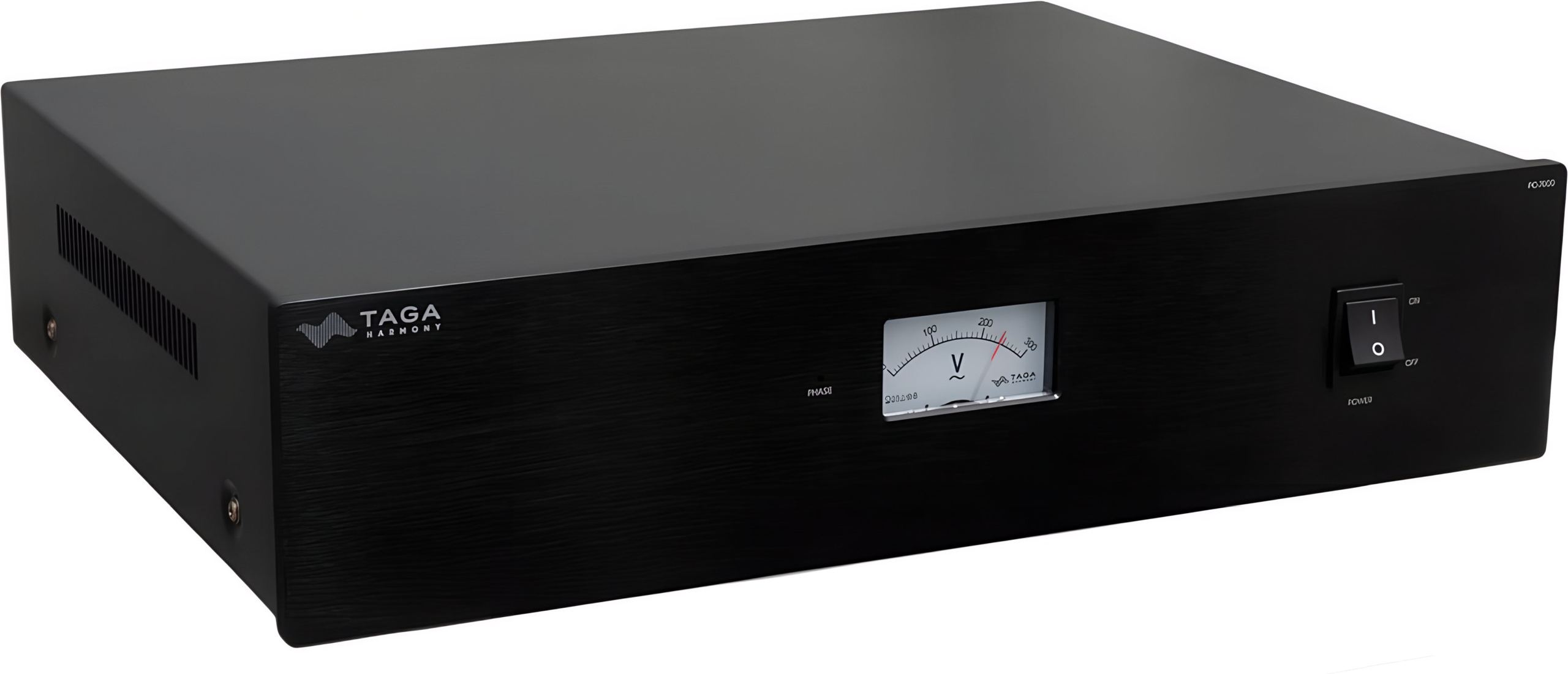
The PC-7000 from Taga Harmony is a power conditioner designed for audio and video setups. It features eight outlets with active filtering, isolation via a toroidal transformer, and distribution into specialized outlet groups. Its black metal enclosure integrates an analog voltmeter and a front-panel phase indicator, allowing visual monitoring of power quality.
A metal chassis that doubles as shielding
The PC-7000 uses a black metal case whose function goes beyond aesthetics. This conductive enclosure creates a Faraday cage that attenuates external electromagnetic interference likely to penetrate the internal circuits. The conditioner’s dimensions (11 cm high, 43 cm wide, 33 cm deep including feet) conform to a standard rack format, making it easy to integrate into a rack cabinet or place on an audio stand.
The front panel features an analog needle voltmeter for real-time monitoring of the supply voltage. This instrument displays fluctuations in the electrical grid between approximately 200 and 250 volts, making visible the micro-variations that electronic devices must absorb. A bi-color indicator complements this setup: blue when the phase is correctly oriented, red in case of inversion. This indication is particularly useful during initial hookup, as some wall outlets may have reversed polarity depending on their wiring.
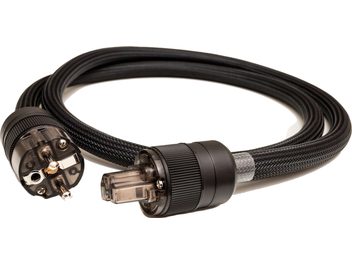
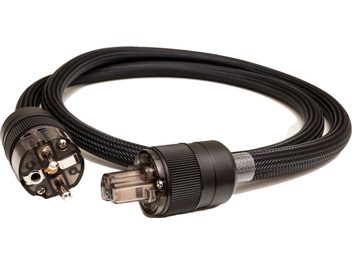
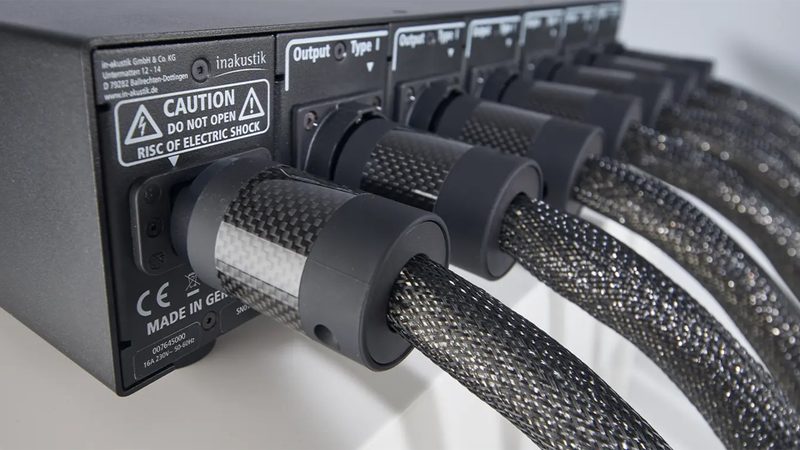
The rear panel hosts eight Schuko outlets distributed in four groups of two, each identified by its function and maximum amperage. A master switch simultaneously controls the four outlets in groups I and II, while groups III and IV remain permanently powered. The IEC C13 input connector accepts the supplied power cable, but can also accommodate higher-gauge audiophile cables if the user wishes to further optimize upstream power to the conditioner.
Four outlet groups with distinct roles
The PC-7000’s outlet layout follows a logic of separating equipment by nature and electrical needs. Group I, limited to 3 amps, targets digital accessories: DAC converters, network players, audio servers. These devices, often sensitive to high-frequency disturbances, benefit from dedicated filtering optimized for this range of parasitic signals.
Group II, restricted to 1 amp, is intended for low-consumption analog and digital audio sources: turntables, CD players, FM tuners. This deliberate current limitation matches the real needs of these devices and enables precise sizing of the associated filtering. Groups I and II are switched, i.e., controlled by the front-panel master switch.
Groups III and IV operate in unswitched mode, remaining powered even when the main switch is in the off position. Group III accepts up to 5 amps for preamplifiers and accessories requiring continuous power, such as external power supplies for turntables or certain digital audio processors. Group IV, also rated for 5 amps, is intended for power amplifiers.
This separation offers a technical advantage: it prevents large current draws from amplifiers from affecting sources and preamplifiers. The sudden consumption changes of a class AB amplifier during intense musical passages can generate disturbances on the local electrical network. By isolating different types of equipment, the PC-7000 limits the propagation of these interferences from one group to another.
A toroidal transformer at the heart of the filtering
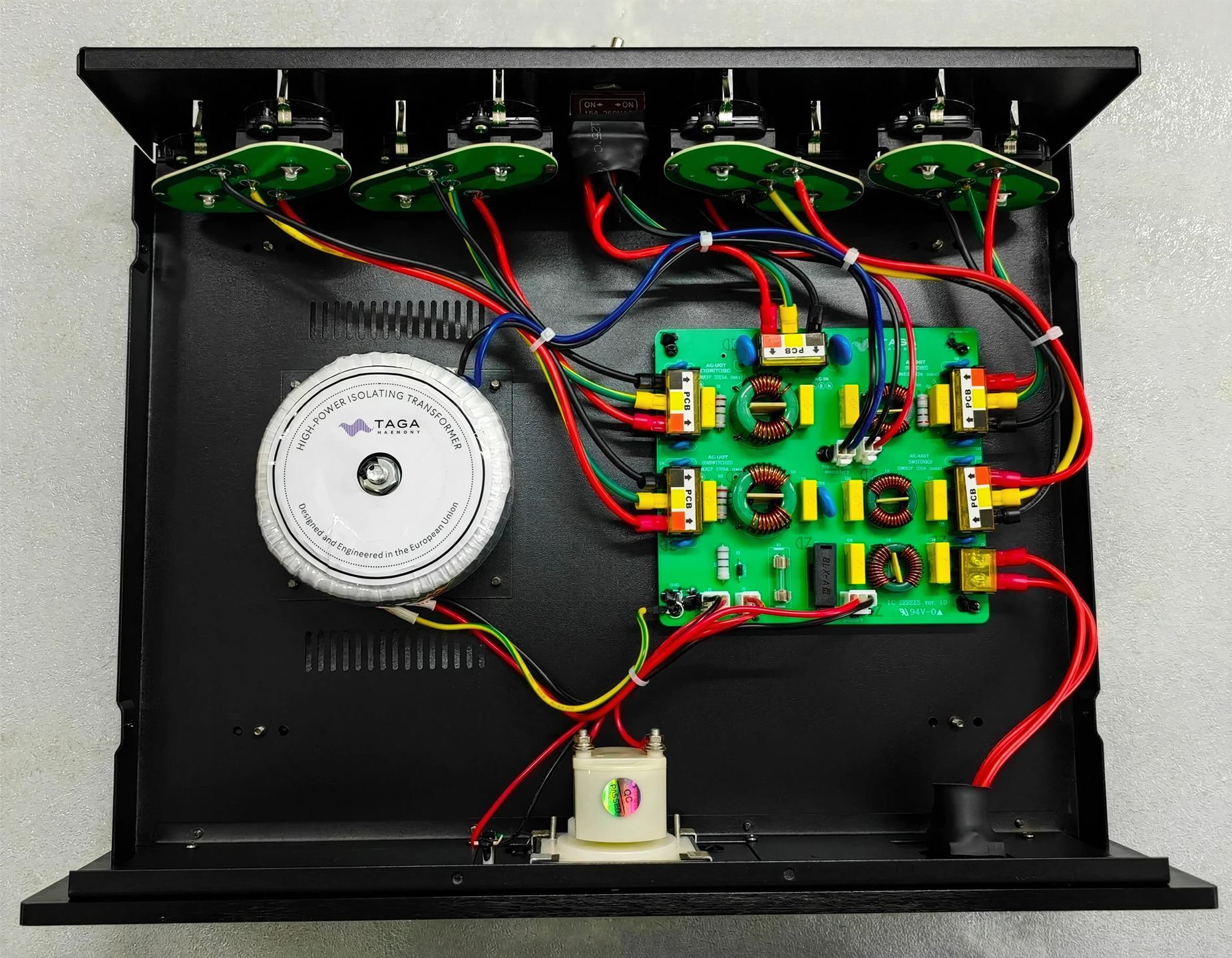
The PC-7000’s filtering system relies on several complementary technologies. At the center of the architecture is a toroidal transformer whose function differs from that of a simple traditional isolation transformer. This component creates a galvanic barrier between the mains supply and Groups I and II (audio sources and digital accessories), preventing the direct passage of common-mode disturbances present on the grid.
The toroidal shape of the magnetic core offers several advantages: minimal stray magnetic field thanks to the closed geometry, optimal energy efficiency, and reduced generation of mechanical vibrations. These characteristics explain why toroidal transformers traditionally equip quality audio amplifiers and, by extension, power conditioners aiming for sonic transparency.
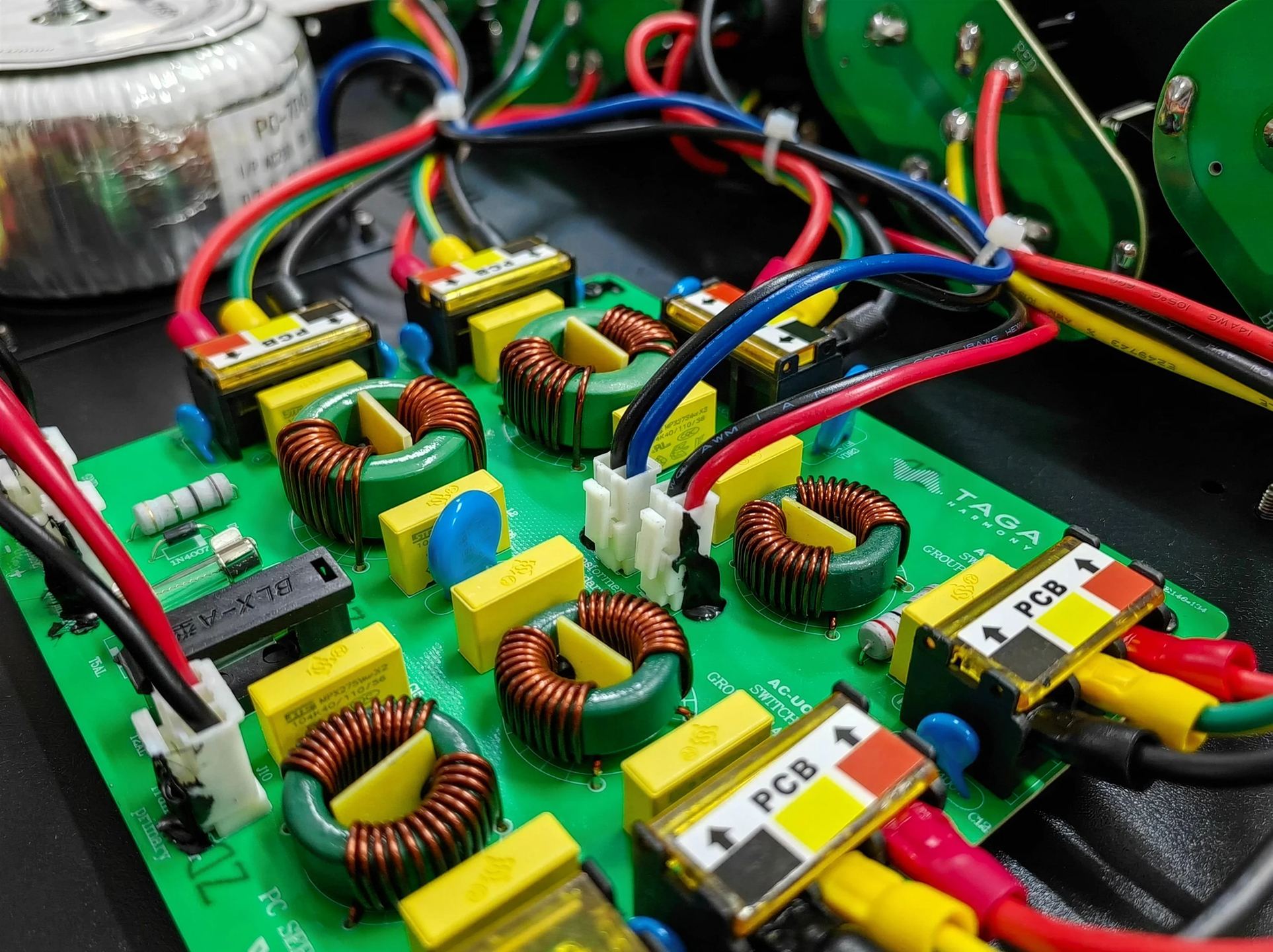
Filtering is also achieved through class X capacitors and inductors. These passive components form filtering cells that selectively attenuate parasitic frequencies between 2 and 100 MHz, a range corresponding to electromagnetic (EMI) and radio-frequency (RFI) interference typically encountered in domestic environments. The PC-7000 delivers variable attenuation of -10 dB to -55 dB depending on frequency, with the highest values corresponding to the most problematic harmonics for sensitive audio circuits.
Surge protection and stabilization
Beyond high-frequency noise filtering, the PC-7000 incorporates multiple layers of protection against transient events. Primary lightning protection intervenes in the event of an indirect surge caused by a lightning strike on the distribution network. The circuit can absorb a maximum surge current of 4500 amps on a standardized 8/20 µs pulse (8 microseconds rise time, 20 microseconds fall time).
The maximum peak voltage supported reaches 3000 volts at 10 milliamps, while the clamping voltage is 775 volts. These values characterize the conditioner’s ability to clip surges before they reach connected equipment. The maximum dissipatable energy is 140 joules, representing the amount of energy the protection components can absorb before saturation.
This protection is particularly relevant in areas prone to thunderstorms or unstable electrical grids. Modern audio and video equipment, whose switching power supplies and digital circuits contain numerous sensitive semiconductors, can suffer irreversible damage during even brief surges. The PC-7000 acts like an intelligent fuse that responds within microseconds, well before the internal protections of the devices are called upon.